Demetrius I Soter
king of the Hellenistic Seleucid Empire
Years: 185BCE - 150BCE
Demetrius I (born 185 BCE, reign 161–150 BCE), surnamed Soter (Greek: "Savior"), is a ruler of the Hellenistic Seleucid Empire.





Related Events
Filter results
Showing 10 events out of 25 total
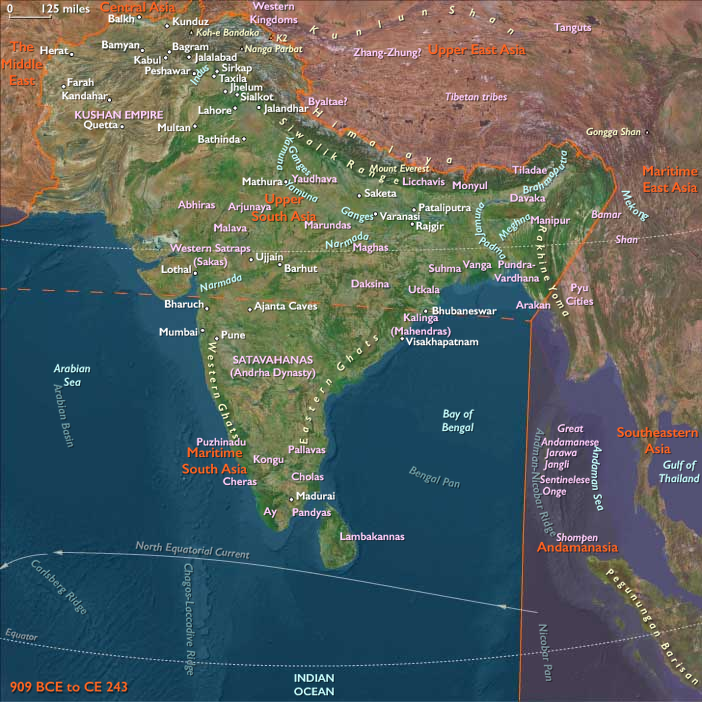
Taxila, or Takshashila, in the western Punjab (today represented by the remains in the present Bhir Mound) had become a great Buddhist center of learning during the reign of Ashoka, grandson of Chandragupta Maurya, founder of the Mauryan empire in eastern India.
Nonetheless, Taxila had briefly been the center of a minor local rebellion, subdued only a few years after its onset.
Two years after the assassination of the last Maurya emperor in 185, the Greco-Bactrian King Demetrius, who had succeeded his father Euthydemus around 200 BCE and conquered extensive areas in what now is eastern Iran and Afghanistan, led his troops across the Hindu Kush to conquer Gandhāra, the Punjab and the Indus valley, thus creating an Indo-Greek kingdom far from Hellenistic Greece.
It is generally considered that Demetrius ruled in Taxila (where many of his coins will be found in the archaeological site of Sirkap, on the opposite bank of the Tamranal River from Taxila.
The Indian records also describe Greek attacks on Saketa, Panchala, Mathura and Pataliputra.)
Demetrius I dies of unknown reasons, and the date 180 BCE is merely a suggestion aimed to allow suitable regnal periods for subsequent kings, of which there are to be several.
Even if some of them are co-regents, civil wars and temporary divisions of the empire are most likely.
The kings Pantaleon, Antimachus, Agathocles and possibly Euthydemus II rule after Demetrius I, and theories about their origin include all of them being relatives of Demetrius I, or only Antimachus.
Eventually, the kingdom of Bactria would fall to the able newcomer Eucratides, who in about 171 would uproot the Euthydemid dynasty of Greco-Bactrian kings and replace it with his own lineage.
Buddhism flourishes in the realms of the Bactrian kings.
The Sunga Empire's wars with the Indo-Greek Kingdom figure greatly in the history of this age, although the net result of these wars remains uncertain.
Financial difficulties, created in part by the heavy war indemnity exacted by Rome, have compelled Seleucus IV to pursue a policy devoid of expensive adventures.
His unambitious policy and care are also dictated by the fact that his son and heir, Demetrius, has been sent to Rome as a hostage for his father in exchange for Antiochus, the third son of Antiochus III, who has learned to admire Roman institutions and policies.
Seleucus, having heard that the temple treasury in Jerusalem is wealthy, wonders why some of the tribute is being withheld.
He sends one his chief ministers, Heliodorus, to investigate.
Heliodorus, having possibly found enough wealth to bribe elements in the Seleucid army, returns, assassinates Seleucus, and seizes the throne in 175.
As Seleucus' legitimate heir, Demetrius, is still a hostage in Rome, Antiochus, with the help of King Eumenes II of Pergamon, seizes the throne for himself, proclaiming himself co-regent for another son of Seleucus, an infant named Antiochus (whom he will murder a few years later).
He takes the throne as Antiochus IV Epiphanes (”God Manifest”).
Both economically and socially, Antiochus, a passionate philhellene who pays lip service to the political traditions of both Athens and Rome, makes efforts to strengthen his kingdom—inhabited in the main by Orientals (non-Greeks of Asia Minor and Persia)—by founding and fostering Greek cities.
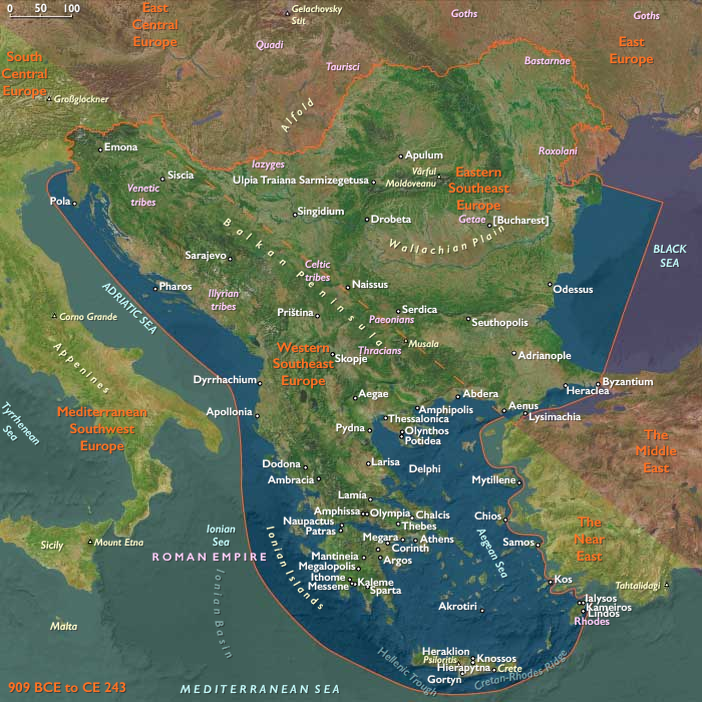
Even before he had begun his reign, he had contributed to the building of the temple of Zeus in Athens and to the adornment of the theater.
He enlarges Antioch on the Orontes by adding a section to the city (named Epiphania after him).
Here he builds an aqueduct, a council hall, a marketplace, and a temple to Jupiter Capitolinus.
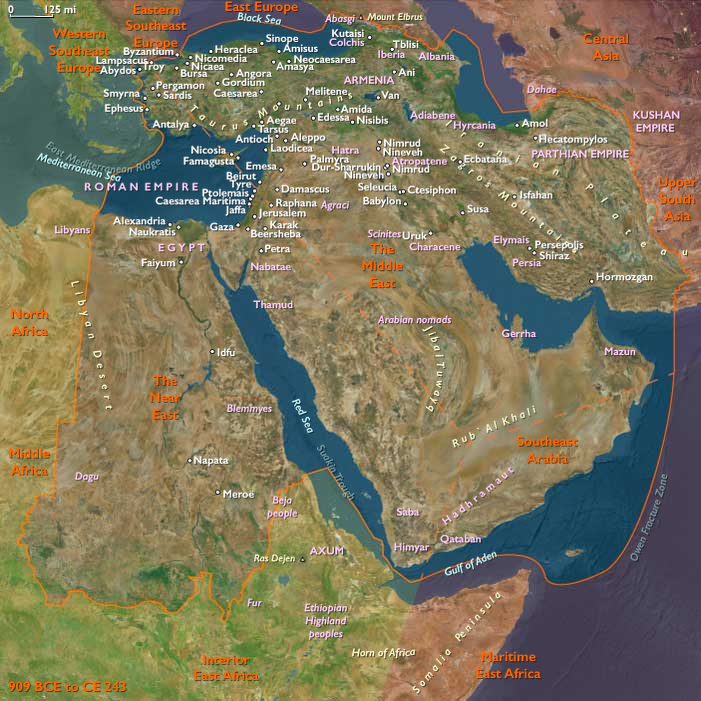
Mithridates I of Parthia, taking advantage of Antiochus' western problems, had attacked from the east and seized the city of Herat in 167 BCE, disrupting the direct trade route to India and effectively splitting the Greek world in two.
Antiochus, recognizing the potential danger in the east but unwilling to give up control of Judea, had sent a commander named Lysias to deal with the Maccabees, while the King himself is to lead the main Seleucid army against the Parthians.
Setting out in 164 BCE on an expedition to the Arabian coast, he funds the city of Antioch on the Persian Gulf, where its mint is to serve the trade along the sea route between India and the district at the mouth of the great Mesopotamian rivers.
Near the end of the year, the fifty-one-year-old monarch of an illness at Tabae (or Gabae, probably present Isfahan) in Persis.
(Many believers see his death as a punishment for his attempt to loot the shrine of Nanaia in Elam, but this story seems to be baseless.
The numbers of claimants to the Seleucid throne following the death of Antiochus make a continuous Seleucid policy toward Palestine impossible, because each claimant feels the need to seek support wherever it might be found.
The Roman Senate still keeps Demetrius, son of Seleucus IV and the rightful heir to the throne, as hostage, refusing to release him because they consider it better to have Syria nominally ruled by a boy and his regent than the twenty-two-year-old Demetrius.
The general Lysias, who had been left in charge of Syria by Epiphanes, had collected another army at Antioch, and after the recapture of Beth-zur had been besieging Jerusalem when he learned of the approach of Philip, to whom Antiochus, on his deathbed, had entrusted the guardianship of the first son of Laodice IV and Antiochus III.
This prince, a younger cousin of Demetrius, is only nine years old when he succeeds to the kingship as Antiochus V. Lysias, returning to Syria to claim the regency, defeats Philip in 163 BCE; he is supported at Rome.
Timarchus, a Greek satrap of the Seleucid province of Media, becomes the more or less independen, in opposition to the general Lysias, who acts as steward for the infant king Antiochus V.
Timarchus has distinguished himself by defending Media against the emergent Parthians.
On his coins, Timarchus introduces the epithet "Great King" (Basileus Megas) which is the traditional Achaemenid title and may reflect an effort to gather support from the natives in a time when the Seleucid empire has lost ground in Iran.
He is inspired by the Bactrian king Eucratides the Great, who had assumed the same title a few years earlier.
The Roman senate, on hearing that the Syrian kingdom is keeping more warships and elephants than allowed by the peace treaty of Apamea made in 188 BCE, send a Roman embassy to travel along the cities of Syria and attempt to cripple Seleucid military power by sinking the Syrians' warships and hamstringing their elephants.
Lysias dares do nothing to oppose the Romans, but his subservience has so enraged his Syrian subjects that the Roman envoy Gnaeus Octavius (consul of 165 BCE) is assassinated in Laodicea in 162 BCE).
Demetrius, having escaped from confinement in Rome with the help of the historian Polybius, is received in Syria as the true king.
Welcomed back on the Syrian throne in 161 BCE, he immediately kills Antiochus V and Lysias.
This may well have been the provocation that caused Timarchus to take the final step to independence and declare himself king.
The Romans continue to prevent any resurgence of Seleucid power, confining the Seleucids to Syria.
Demetrius’ victory over the Jews in 161 has brought him into conflict with Attalus II of Pergamon.
Judas attacks the harbor of Jamnia in his anger at the inhabitants' hostility.
There is evidence that the ruthlessness exhibited by the Hasmoneans toward the Greek cities of Palestine has political rather than cultural origins, and that, in fact, they are fighting for personal power no less than for the Torah.
In any case, some of those who fight on the side of the Maccabees are idol-worshipping Jews.
Hostage Seleucid prince Demetrius, aided by Polybius, escapes from Rome in 162 and in the following year receives recognition as king from the Roman Senate.