Constantine of Scotland
King of Alba
Years: 878 - 952
Constantine, son of Áed (known in most modern regnal lists as Constantine II; before 879 – 952) is an early King of Scotland, known at this time by the Gaelic name Alba.
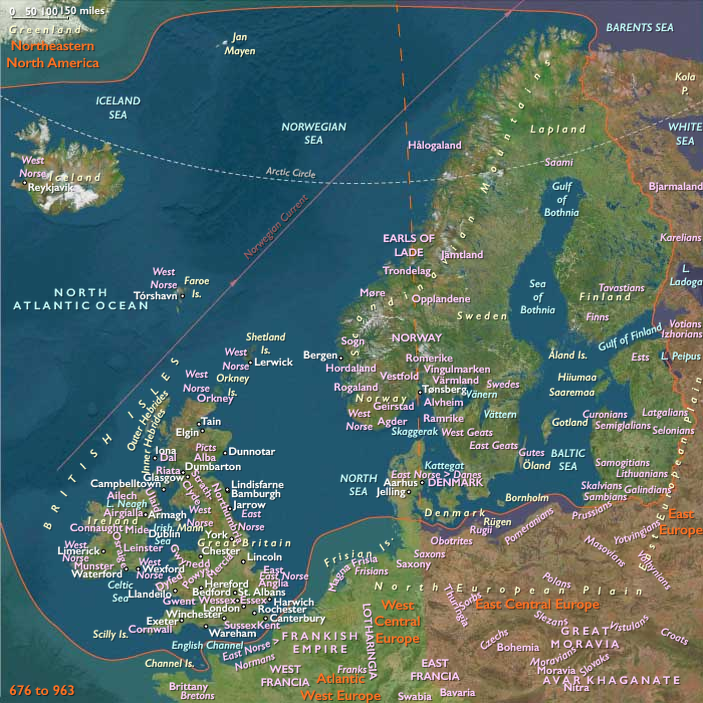
The Kingdom of Alba, a name which first appears in Constantine's lifetime, is in northern Great Britain.
The core of the kingdom is formed by the lands around the River Tay.
Its southern limit is the River Forth, northwards it extends towards the Moray Firth and perhaps to Caithness, while its western limits are uncertain.
Constantine's grandfather Kenneth I of Scotland (Cináed mac Ailpín, died 858) is the first of the family recorded as a king, but as king of the Picts.
This change of title, from king of the Picts to king of Alba, is part of a broader transformation of Pictland and the origins of the Kingdom of Alba are traced to Constantine's lifetime.
His reign, like those of his predecessors, is dominated by the actions of Viking rulers in the British Isles, particularly the Uí Ímair ("the grandsons of Ímar", or Ivar the Boneless).
During Constantine's reign the rulers of the southern kingdoms of Wessex and Mercia, later the Kingdom of England, extende their authority northwards into the disputed kingdoms of Northumbria.
At first allied with the southern rulers against the Vikings, Constantine in time comes into conflict with them.
King Æthelstan is successful in securing Constantine's submission in 927 and 934, but the two again fight when Constantine, allied with the Strathclyde Britons and the Viking king of Dublin, invades Æthelstan's kingdom in 937, only to be defeated at the great battle of Brunanburh.
In 943, Constantine abdicates the throne and retires to the Céli Dé (Culdee) monastery of St Andrews where he dies in 952.
He is succeeded by his predecessor's son Malcolm I (Máel Coluim mac Domnaill).
Constantine's reign of 43 years, exceeded in Scotland only by that of King William the Lion before the Union of the Crowns in 1603, is believed to have played a defining part in the gaelicization of Pictland, in which his patronage of the Irish Céli Dé monastic reformers is a significant factor.
During his reign the words "Scots" and "Scotland" (Old English: Scottas, Scotland) are first used to mean part of what is now Scotland.
The earliest evidence for the ecclesiastical and administrative institutions which will last until the Davidian Revolution also appears at this time.