Conrad II
Holy Roman Emperor
Years: 990 - 1039
Conrad II (c. 990 – 4 June 1039), also known as Conrad the Elder, is Emperor of the Holy Roman Empire from 1027 until his death.
The founder of the Salian dynasty of emperors, Conrad also serves as King of Germany from 1024, King of Italy from 1026, and King of Burgundy from 1033.
The son of a mid-level nobleman in Franconia, Count Henry of Speyer and Adelaide of Alsace, he inherits the titles of count of Speyer and of Worms as an infant when his father dies.
Conrad extends his power beyond his inherited lands, receiving the favor of the princes of the Kingdom of Germany.
When the Saxon-based Ottonian dynasty of emperors dies off with the childless Emperor Henry II, Conrad is elected to succeed him as King in 1024 at the age of 34.
Conrad founds his own dynasty of rulers, known as the Salian dynasty, which will rule the Holy Roman Empire for over a century.
Conrad continues the policies and achievements of the Ottonian Henry II regarding the Catholic Church and the affairs of Italy.
Conrad continues to build the Church as a center for imperial power, preferring to appoint church bishops over secular lords to important posts across the Empire.
Like Henry II before him, Conrad also continues a policy of benign neglect over Italy, especially for the city of Rome.
His reign marks a high point of the medieval imperial rule and a relatively peaceful period for the Empire.
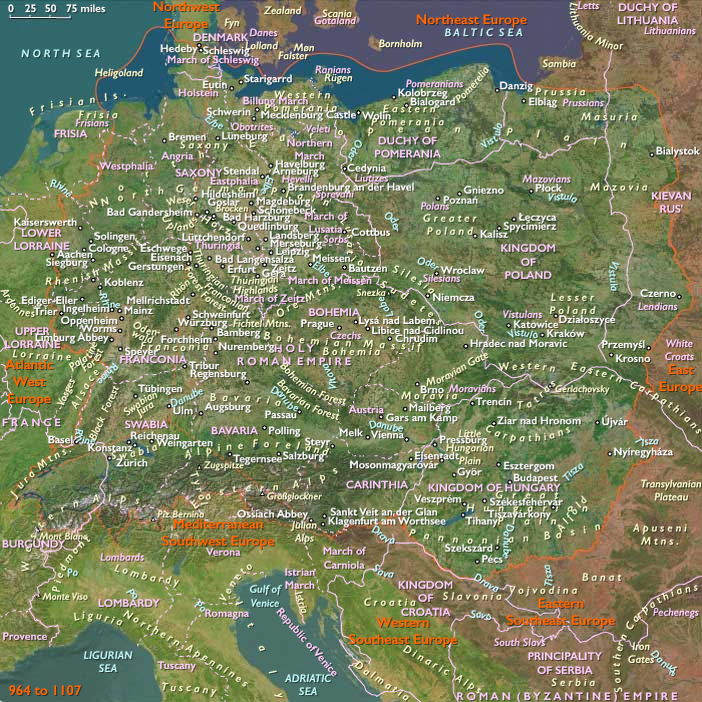
Following the death of the childish King Rudolph III of Burgundy in 1032, Conrad claims dominion over the Kingdom of Arles and incorporates it into the Empire.
The three kingdoms (Germany, Italy, and Burgundy) form the basis of the Empire as the "royal triad" (regna tria).