Northwest Europe (532–675 CE): Consolidation of Kingdoms and Spread of Christianity
Consolidation of Anglo-Saxon Kingdoms
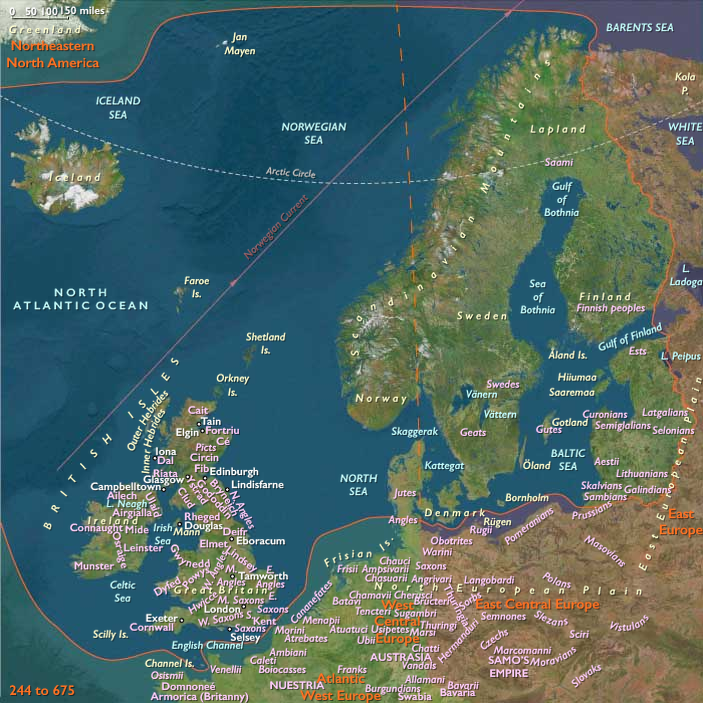
Between 532 and 675 CE, the Anglo-Saxon kingdoms of the Heptarchy—Northumbria, Mercia, East Anglia, Essex, Kent, Sussex, and Wessex—became more firmly established, expanding their territories and solidifying political control. Rivalries and alliances among these kingdoms characterized the period, setting the stage for later unification into the Kingdom of England. Notable historical turning points included the Battle of Deorham in 577, crucially establishing Anglo-Saxon dominance in southern Britain.
Expansion of Celtic Influence and Power
In the Celtic regions of Wales, Scotland, Cornwall, and Ireland, kingdoms such as Gwynedd, Dál Riata, Strathclyde, Rheged, Gododdin, and Dumnonia thrived culturally and politically. Gaelic language and culture spread extensively into western Scotland through the overkingdom of Dál Riata, which covered parts of modern-day Scotland and Northern Ireland. Continued maritime interactions between Celtic communities facilitated cultural and economic exchanges throughout the Irish Sea region.
Christianity’s Growth and Influence
The spread of Christianity accelerated dramatically across Northwest Europe, deeply influencing social and political structures. In 431 CE, the Chronicle of Ireland notes Bishop Palladius arrived to minister to the already-believing Irish, and Saint Patrick arrived shortly thereafter, marking a turning point in the decline of Druidism. Monastic foundations like Iona, founded by Saint Columba in 563 CE, and Lindisfarne, established in 635 CE, became vital centers of learning, missionary activity, and religious scholarship. Irish monks significantly influenced the conversion of Anglo-Saxon kingdoms, spreading Celtic Christianity throughout Britain and the Frankish Empire in continental Europe.
Latin and Greek Scholarship in Ireland
Ireland solidified its role as a hub for Christian scholarship, preserving and expanding knowledge of Latin and Greek literature, philosophy, and theology during a period when much of continental Europe experienced a decline in classical learning. Manuscript illumination, metalworking, and sculpture flourished, creating enduring treasures such as the Book of Kells, ornate jewelry, and numerous carved stone crosses.
Economic and Agricultural Adaptation
Economic life across Northwest Europe became increasingly regionalized, emphasizing local trade networks and self-sufficient agricultural practices. Agricultural techniques continued to evolve, tailored to regional conditions and improving productivity to sustain growing populations.
Celtic Resistance and Cultural Resilience
Despite Anglo-Saxon expansion, Celtic regions maintained considerable autonomy and resilience, preserving distinct languages, traditions, and political systems. Wales, Cornwall, and parts of northern Britain resisted Saxon advances, becoming concentrated in regions later identified as "Welsh" by Anglo-Saxons.
Anglo-Saxon Cultural and Linguistic Development
The Anglo-Saxons began using the Latin alphabet following the introduction of Christianity by Augustine of Canterbury, resulting in texts like King Æthelbert’s code of law, the oldest surviving document in Old English. The Germanic settlers—Angles, Saxons, Jutes, and possibly Frisians—initially referred to as Saxons, came to be collectively known as Anglo-Saxons, their language uniformly termed English.
Stability in the Orkney and Shetland Islands
The Orkney and Shetland Islands remained culturally and economically stable, largely unaffected by mainland political turbulence. These islands maintained autonomy, thriving through maritime trade and localized industries.
Persistent Isolation of Iceland and the Faroe Islands
Throughout this era, Iceland and the Faroe Islands continued to remain uninhabited due to harsh climates and geographic isolation. Iceland’s volcanic activity remained crucial for chronological research across Northwest Europe.
Legacy of the Age
By 675 CE, Northwest Europe had witnessed the consolidation of emerging medieval kingdoms, the profound spread and integration of Christianity, and sustained cultural diversity. The evolving interplay between Anglo-Saxon dominance, Celtic cultural resilience, and the flourishing monastic traditions set the foundation for the subsequent historical trajectory of the region.