Christian IV
King of Denmark and Norway
Years: 1577 - 1648
Christian IV (12 April 1577 – 28 February 1648) is the king of Denmark-Norway from 1588 until his death.
With a reign of more than 59 years, he is the longest-reigning monarch of Denmark.
He is sometimes referred to as Christian Firtal in Denmark and Christian Kvart or Quart in Norway.



Related Events
Filter results
Showing 10 events out of 85 total
European politics of the sixteenth century had revolved largely around the struggle between Catholic and Protestant forces, so it had seemed almost inevitable that Denmark, a strong, unified Lutheran kingdom, would get drawn into the larger war when it came.
The Thirty Years' War goes badly for the Protestant states in the early 1620s, and a call goes out to Denmark–Norway to "save the Protestant cause".
King Christian IV, who is also a duke of the Holy Roman Empire on the basis of his possessions in Holstein, decides to intervene in the conflict raging in northern Germany.
The campaign ends in defeat, and Jutland is occupied by the imperial army of Albrecht von Wallenstein.
In the Treaty of Lübeck, Christian makes peace and agrees to not intervene in Germany again.
The war in Germany has been very expensive and Christian IV sees no other recourse than to raise the Sound tolls.
Unfortunately, this act pushes the Netherlands away from Denmark and into the arms of Sweden.
The ensuing conflict becomes known as the Torstenson War.
The Netherlands, wishing to end the Danish stranglehold on the Baltic, join the Swedes in their war against Denmark–Norway.
In October 1644 a combined Dutch-Swedish fleet destroys eighty percent of the Danish fleet in the Battle of Femern.
The result of this defeat proves disastrous for Denmark–Norway: in the Second treaty of Brömsebro (1645), Denmark cedes to Sweden the Norwegian provinces Jemtland, Herjedalen and Älvdalen as well as the Danish islands of Gotland and Øsel.
Halland goes to Sweden for a period of thirty years and the Netherlands are exempted from paying the Sound Duty.
Nevertheless, Danes remember Christian IV as one of the great kings of Denmark.
He has a very long reign, from 1588 to 1648, and has become known as "the architect on the Danish throne" because of the large number of building projects he undertook.
Many of the great buildings of Denmark date from his reign.
After the death of Christian IV in 1648, his son Frederick succeeds him.
Northeast Europe (1588–1599 CE): Post-War Stabilization, Continued Rivalries, and Cultural Flourishing
Between 1588 and 1599 CE, Northeast Europe transitioned from prolonged warfare to relative stabilization following the conclusion of the Livonian War. This period saw cautious diplomatic realignments, internal political consolidations, continued economic resilience, and significant cultural and intellectual developments, even as regional rivalries persisted.
Aftermath and Stabilization Following the Livonian War
The Treaty of Plussa (1583) and the Truce of Yam-Zapolsky (1582) ended hostilities, allowing Northeast Europe a brief respite from decades of warfare. Territories previously ravaged by conflict, especially in Livonia, began recovery processes through reconstruction and economic revitalization, although geopolitical tensions remained high among former combatants.
Swedish Consolidation and Governance in Estonia and Livonia
Under John III (r. until 1592) and subsequently his son Sigismund III Vasa, Sweden solidified its control over northern Livonia and Estonia. Sweden improved administrative governance, reinforced defensive fortifications in key cities such as Reval (Tallinn) and Narva, and encouraged continued settlement by communities like the Forest Finns, enhancing Sweden’s territorial stability and economic strength.
Polish–Lithuanian Commonwealth’s Internal Strength and Regional Influence
The Polish–Lithuanian Commonwealth under Sigismund III Vasa (r. from 1587) sought internal stability and consolidation of its extensive Livonian territories. The Commonwealth maintained effective administrative control, promoted economic recovery, and strengthened diplomatic relationships, solidifying its role as a central power influencing Northeast Europe’s geopolitical landscape.
Denmark–Norway’s Maritime and Diplomatic Ambitions
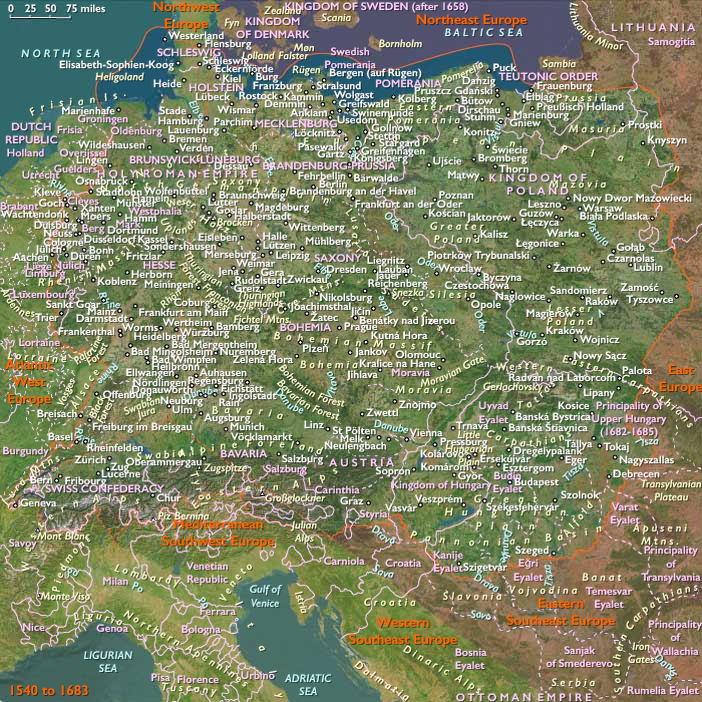
Under Christian IV (r. from 1588), Denmark–Norway actively strengthened its Baltic maritime interests. The kingdom invested in naval expansion, enhanced fortifications, and diplomatic initiatives aimed at balancing Swedish and Polish–Lithuanian influence, further complicating regional dynamics.
Muscovy’s Internal Challenges and Territorial Adjustments
Following the death of Ivan IV (the Terrible) in 1584 and the subsequent ascension of Feodor I, Muscovy grappled with significant internal governance challenges. Despite diplomatic truces, Muscovy continued strategic preparations aimed at future territorial revisions, maintaining regional tension.
Economic Stability and Growth in the Duchy of Prussia
Under Duke Albert Frederick, the secularized Duchy of Prussia sustained political neutrality, robust internal governance, and continued economic prosperity, particularly through thriving urban centers like Königsberg. Prussia’s strategic diplomatic neutrality and economic strength provided regional stability amidst surrounding geopolitical shifts.
Continued Economic Vitality of Urban Centers
Major urban centers such as Reval (Tallinn), Riga, Königsberg, and Visby on Gotland furthered their economic resilience. Stable maritime commerce, active merchant networks, and effective urban governance fostered regional prosperity and helped recover from the war’s disruptions.
Cultural, Educational, and Religious Flourishing
Protestantism, especially Lutheranism, deepened its influence, driving further educational reforms and cultural developments. Schools and universities flourished, promoting literacy, intellectual advancements, and cultural production across Northeast Europe. However, religious tensions, particularly between Protestant and Catholic communities, continued to influence internal and external politics significantly.
Intellectual and Scientific Contributions
The region continued to benefit from intellectual advancements, exemplified by the continuing impact of Danish astronomer Tycho Brahe, whose meticulous astronomical observations remained influential, setting the stage for future scientific developments and consolidating Northeast Europe as a significant center of scholarly activity.
Diplomatic Realignments and Strategic Maneuvering
Diplomatic interactions remained intricate as regional powers navigated post-war realities. Negotiations and alliances sought to balance territorial interests, mitigate ongoing rivalries, and secure lasting stability, reflecting continued geopolitical caution among major powers.
Legacy of the Era
The era from 1588 to 1599 CE significantly shaped Northeast Europe's trajectory through post-war stabilization, cultural advancements, and continued diplomatic complexity. These developments laid critical foundations for subsequent regional stability, territorial delineations, and cultural identities, guiding Northeast Europe into the seventeenth century.
Northwest Europe (1588–1599 CE): Defeating the Armada, Continued Strife, and Flourishing Culture
England: Triumph over the Spanish Armada
The defining event of this era was the defeat of the Spanish Armada in 1588, a pivotal naval engagement that affirmed England's growing maritime dominance. Commanded by leaders such as Charles Howard, 1st Earl of Nottingham (Lord Howard of Effingham) and Sir Francis Drake, the English fleet utilized strategic ingenuity, superior maneuverability, and adverse weather conditions (famously termed the "Protestant Wind") to thwart Spain’s invasion attempt. This victory boosted national pride, secured Protestantism in England, and marked the beginning of Spanish naval decline.
Queen Elizabeth I continued to face internal and external threats despite the Armada victory. Persistent Catholic plots remained a concern, and Elizabeth’s government responded with increased vigilance and repression. Nonetheless, Elizabeth maintained her delicate political balance, navigating religious and political divisions effectively.
Plague had remained present in England since the Black Death of the fourteenth century, occasionally transmitted from rodents to humans with disastrous consequences. The plague, erupting periodically throughout the sixteenth century, notably struck Newcastle in 1589, killing 1,727 residents by January 1590. From 1590 to 1592, Plymouth and Devon also suffered outbreaks, with significant fatalities in towns such as Totnes and Tiverton. The disease spread through the English countryside, eventually reaching London in the summer of 1592.
Scotland: Political Stability and Monarchical Authority
In Scotland, James VI consolidated his authority and began to actively govern, gradually reducing factional strife. His effective political maneuvering laid the foundations for greater stability, though tensions between the monarchy and the Kirk continued. James VI's writings, notably Basilikon Doron (1599), outlined his views on kingship, emphasizing the divine right of monarchs, and reflected his ambition to succeed Elizabeth I in England.
Ireland: Tyrone’s Rebellion
Ireland saw heightened resistance against English rule through Hugh O'Neill, Earl of Tyrone, who launched Tyrone’s Rebellion (also known as the Nine Years' War) beginning in 1594. Tyrone united various Gaelic lords in a widespread and formidable revolt, successfully employing guerrilla tactics that initially challenged English military strength. This conflict became a significant drain on English resources, compelling Elizabeth to dispatch substantial military forces.
Scandinavia: Economic Stability and Lutheran Orthodoxy
Denmark-Norway under King Christian IV from 1588 experienced ongoing stability, economic prosperity, and cultural patronage. Christian IV’s reign, though initially overseen by a regency until he came of age in 1596, eventually became noted for promoting trade, enhancing Copenhagen's infrastructure, and reinforcing Lutheran orthodoxy.
Cultural Expansion and Literary Achievements
Elizabethan England continued to enjoy remarkable cultural and literary vitality. This era witnessed the flowering of William Shakespeare’s dramatic career, producing early masterpieces such as Romeo and Juliet (1595), A Midsummer Night’s Dream (1595–1596), and The Merchant of Venice (1596–1598). Shakespeare’s plays, performed at the Globe Theatre (opened in 1599), highlighted the depth and diversity of English culture and drama.
Maritime Expansion and Imperial Ambitions
English maritime expansion intensified, with notable voyages including expeditions by explorers such as Sir Francis Drake and Sir Walter Raleigh. Although Raleigh’s initial Roanoke Colony had failed, efforts to establish English colonies continued, paving the way for future colonial enterprises.
Legacy of the Era
By 1599 CE, Northwest Europe had witnessed decisive victories, ongoing conflicts, and significant cultural advancements. England emerged from the Armada’s defeat with enhanced national pride and maritime prestige, while Scotland moved towards greater internal stability. Ireland’s ongoing rebellion posed severe challenges to English rule, highlighting enduring tensions. Culturally, the period marked the height of Elizabethan literary and dramatic achievements, establishing a rich legacy for subsequent generations.
Princess Anne of Denmark has enjoyed a close and happy family upbringing, thanks largely to Queen Sophie, who tends the children herself during their illnesses.
Suitors from all over Europe have sought the hands of Anne and her older sister in marriage, including James VI of Scotland, who favors Denmark as a kingdom reformed in religion and a profitable trading partner.
Scottish ambassadors had at first concentrated their suit on the oldest daughter, but after had Frederick had betrothed Elizabeth to Henry Julius, Duke of Brunswick, he promised the Scots instead that "for the second [daughter] Anna, if the King did like her, he should have her."
Sophie's constitutional position had become difficult after Frederick's death in 1588, when she found herself in a power struggle with the Rigsraad for control of King Christian IV, her eleven-year-old son.
As a matchmaker, however, Sophie proves more diligent than Frederick and, overcoming sticking points on the amount of the dowry and the status of Orkney, she seals the agreement by July 1589.
Anne herself seems to have been thrilled with the match.
The English spy Thomas Fowler reports on July 28, 1589, that Anne is "so far in love with the King's Majesty as it were death to her to have it broken off and hath made good proof divers ways of her affection which his Majestie is apt in no way to requite."
Fowler's insinuation that James prefers men to women, would have been hidden from the fourteen-year-old Princess, who devotedly embroiders shirts for her fiancé while three hundred tailors work on her wedding dress.
Tycho, known for his accurate and comprehensive astronomical and planetary observation, had been granted an estate on the island of Hven by Frederick II of Denmark and the funding to build the Uraniborg, an early research institute, where he has built large astronomical instruments and taken many careful measurements.
Tycho's influence has steadily declined since Frederick’s death and the succession of his son, Christian IV; he has lost most of his financial privileges.
However, he retains Hven as a fiefdom, despite criticism of his treatment of the peasants.
Tycho leaves Hven in the spring of 1597 after several unpleasant disagreements with the new king.
Tycho Brahe, a Danish aristocrat, takes up residence at Wandesburg Castle in autumn 1597 at the invitation of the wealthy German humanist writer and statesman Heinrich Rantzau, the governor of Holstein, a prolific astrologer and a celebrated book collector.
Here Tycho prints a small first edition of Astronomiæ instauratæ mechanica, which contains illustrations and descriptions of the most important of the instruments he has developed, as well as a brief survey of his theoretical results.
Along with his catalogue of over one thousand stars, the book is sent to a wide range of colleagues and princes.
Europe’s leading astronomer is searching for a new employer.
Sigismund assembles an army consisting of merely five thousand men in February 1598 after loses his patience when he finds out about what has happened in Finland.
Unable to accept Duke Charles’s disrespectful actions, the King decides to use force.
A larger army had been proposed, but had been dismissed since Sigismund expects Swedish forces to join him, and also does not want to come into conflict with them.
The advisers and the King expect military support from Finland and Estonia (homes of the Swedish gentry formerly commanded by baron Klaus Fleming).
They also want help from Denmark–Norway and pro-Sigismund parts of Sweden.
The diplomat Laski is dispatched, but Denmark shows no interest.
Northeast Europe (1600–1611 CE): Renewed Rivalries, Expansion Efforts, and Cultural Innovation
Between 1600 and 1611 CE, Northeast Europe experienced renewed geopolitical tensions, significant territorial ambitions, and cultural advancements following the brief stabilization after the Livonian War. This era witnessed intensified rivalry between Sweden, Denmark–Norway, the Polish–Lithuanian Commonwealth, and Muscovy, coupled with notable intellectual and economic growth.
Swedish Territorial Ambitions and Internal Consolidation
Under Charles IX (r. 1604–1611), Sweden aggressively pursued territorial expansion in the Baltic region, strengthening control in Livonia and Estonia. Sweden fortified key cities such as Reval (Tallinn), Narva, and Riga, improving military preparedness and administrative efficiency. Efforts continued to promote settlements by communities including the Forest Finns, aiding territorial security and economic development in frontier regions.
Danish–Norwegian Assertiveness under Christian IV
King Christian IV actively expanded Denmark–Norway’s maritime and commercial presence in the Baltic. He initiated significant urban developments, reinforced naval strength, and promoted trade, intensifying the kingdom’s competition with Sweden. His assertive foreign policy sought to balance Swedish territorial expansion and uphold Danish interests, heightening regional tensions.
Polish–Lithuanian Commonwealth’s Geopolitical Influence
Under Sigismund III Vasa, the Polish–Lithuanian Commonwealth continued consolidating its influence in Livonian territories, securing southern Livonia and strengthening regional administration. Sigismund’s dual claims to the Swedish crown heightened diplomatic and military tensions, complicating interactions between the Commonwealth and Sweden.
Muscovite Recovery and Strategic Reorientation
After the death of Feodor I in 1598, Muscovy entered the tumultuous "Time of Troubles" marked by dynastic crises, internal rebellions, and foreign interventions. Despite significant internal disruptions, Muscovy began reorienting strategically, preparing for future territorial assertions in Livonia and the broader Baltic region, maintaining regional uncertainty.
Duchy of Prussia’s Neutrality and Stability
Under Duke Albert Frederick, the secularized Duchy of Prussia maintained its careful diplomatic neutrality, administrative stability, and economic prosperity. Königsberg and other urban centers continued thriving economically, serving as stable hubs within the turbulent regional landscape.
Economic Prosperity in Major Urban Centers
Key cities including Reval (Tallinn), Riga, Königsberg, and Visby continued to experience significant economic prosperity. Enhanced maritime commerce, active merchant networks, and effective urban governance supported regional economic resilience and growth despite surrounding geopolitical pressures.
Cultural and Educational Advancements
Protestantism, particularly Lutheranism, drove continued educational and cultural innovations. Universities, schools, and scholarly institutions flourished, significantly enhancing literacy, intellectual activities, and cultural production. Lutheran ecclesiastical influence shaped societal structures and regional identities, though religious tensions between Catholic and Protestant communities persisted.
Scientific and Intellectual Progress
Northeast Europe continued benefiting from intellectual advancements, prominently through astronomical studies inspired by Tycho Brahe. His scientific legacy furthered scholarly activities across the region, consolidating its reputation as a center of intellectual and scientific innovation.
Diplomatic Complexities and Strategic Alliances
Diplomatic interactions intensified significantly during this period, with intricate alliances, territorial claims, and strategic negotiations among regional powers. The geopolitical complexity involving Sweden, Denmark–Norway, Poland–Lithuania, Muscovy, and Prussia necessitated careful diplomatic management, influencing lasting territorial and political alignments.
Legacy of the Era
The era from 1600 to 1611 CE significantly influenced Northeast Europe’s historical trajectory through intensified geopolitical rivalries, territorial expansions, and substantial cultural and intellectual developments. These events laid vital groundwork for future political stability, territorial boundaries, and cultural identities, shaping the region profoundly into the seventeenth century.
Northwest Europe (1600–1611 CE): Transitions, Unifications, and Continued Struggles
England: End of the Elizabethan Era
The opening years of the seventeenth century saw the culmination and conclusion of the Elizabethan age. Queen Elizabeth I died in 1603, bringing to an end her long and largely successful reign. She was succeeded by James VI of Scotland, who ascended the English throne as James I, marking the beginning of the Stuart dynasty. This union of the crowns under James initiated a new political landscape, uniting Scotland and England under a single monarch, though both countries retained separate parliaments and administrations.
James I faced immediate challenges, notably the Gunpowder Plot of 1605, a failed Catholic conspiracy led by Robert Catesby and famously involving Guy Fawkes, who sought to assassinate the king and destroy Parliament. The plot's failure heightened anti-Catholic sentiments and intensified religious tensions within the realm. James, concerned about Catholic threats and assassination attempts justified by European Catholic writings, responded by expelling Jesuits and other Catholic priests from England and reimposing fines for recusancy, further aggravating religious tensions.
Ireland: End of Tyrone’s Rebellion
The prolonged Nine Years' War in Ireland reached its conclusion during this period. Hugh O'Neill, Earl of Tyrone, initially successful in employing guerrilla tactics, ultimately suffered defeat at the Battle of Kinsale in 1601. This decisive English victory under Lord Mountjoy marked the collapse of Gaelic resistance and the reaffirmation of English authority. The Treaty of Mellifont (1603) formalized O'Neill's submission, bringing temporary peace but setting the stage for subsequent displacements and the Plantation of Ulster, which began in earnest during these years, profoundly reshaping Ireland’s demographic and cultural landscape.
Scotland: Consolidation under James VI
With his ascension to the English throne, James VI sought to unify his realms more closely, though political and religious differences persisted. James advocated strongly for his concept of the divine right of kings, detailed in his writings such as the Basilikon Doron. His efforts to harmonize Scottish and English policies, however, met resistance from both nations’ elites, complicating his vision for a unified Britain.
Scandinavia: Continued Prosperity under Christian IV
Christian IV of Denmark-Norway continued to strengthen his realms economically and culturally. His reign saw the expansion of trade and infrastructure, notably with significant improvements in Copenhagen. Christian actively promoted exploration, initiating expeditions to North America, and further reinforced Lutheran orthodoxy, asserting greater control over religious and social life.
Cultural Achievements: Flourishing Literature and Theater
English culture continued to thrive under James I, who actively patronized literary and theatrical arts. William Shakespeare produced some of his greatest tragedies during this era, including Hamlet (1601), Othello (1603–1604), and King Lear (1605–1606). The theatrical scene also featured the works of other notable playwrights such as Ben Jonson, whose satirical comedies like Volpone (1605–1606) achieved considerable acclaim. The issuance of the King James Bible in 1611 became a cornerstone for English literature and Protestant thought.
Maritime and Colonial Ambitions
Maritime exploration and imperial ambitions persisted. The English established their first permanent settlement in North America at Jamestown, Virginia in 1607, signaling the beginning of sustained English colonial presence. The Virginia Company of London financed this venture, hoping to profit from gold and other resources, though the colony initially struggled with harsh conditions and high mortality rates. The East India Company, established in 1600, began asserting England's global commercial presence, contending with Iberian rivals for domination of world trade.
Legacy of the Era
By 1611 CE, Northwest Europe had undergone significant transformations, marked by dynastic changes, the conclusion of major rebellions, and continued cultural flourishing. The peaceful transition from Elizabethan to Stuart rule in England, despite challenges such as the Gunpowder Plot, laid the foundation for ongoing debates over monarchy and governance. Ireland’s defeat at Kinsale fundamentally altered its societal structure, setting patterns of colonization and conflict. Scotland’s integration with England under James VI and I began reshaping both kingdoms politically. Meanwhile, cultural achievements, particularly in drama and literature, maintained their vibrancy, continuing to enrich European civilization profoundly.