Chrétien de Troyes
French poet and trouvère
Years: 1150 - 1210
Chrétien de Troyes (Christian) is a late 12th century French poet and trouvère known for his work on Arthurian subjects, and for originating the character Lancelot.
This work represents some of the best-regarded of medieval literature.
His use of structure, particular in Yvain, the Knight of the Lion, has been seen as a step towards the modern novel.
Chrétien may have named himself Christian of Troyes in contrast to the Jewish Rashi, also of Troyes.
Little is known of his life, but he seems to have been from Troyes, or at least intimately connected with it, and between 1160 and 1172 he served at the court of his patroness Marie of France, Countess of Champagne, daughter of Eleanor of Aquitaine, perhaps as herald-at-arms (as Gaston Paris speculated).
Related Events
Filter results
Showing 7 events out of 7 total
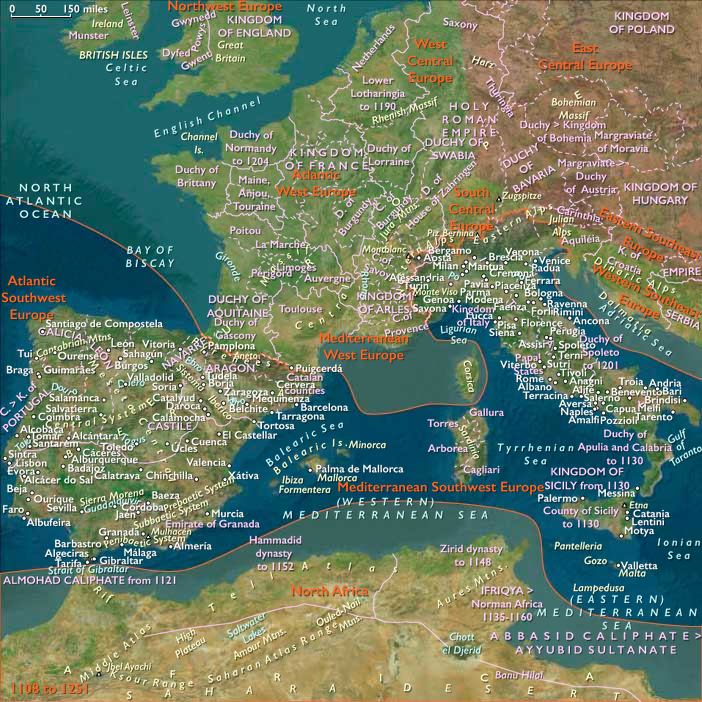
Atlantic West Europe (1180–1191): Capetian Revival, Angevin Strains, and Cultural Dynamism
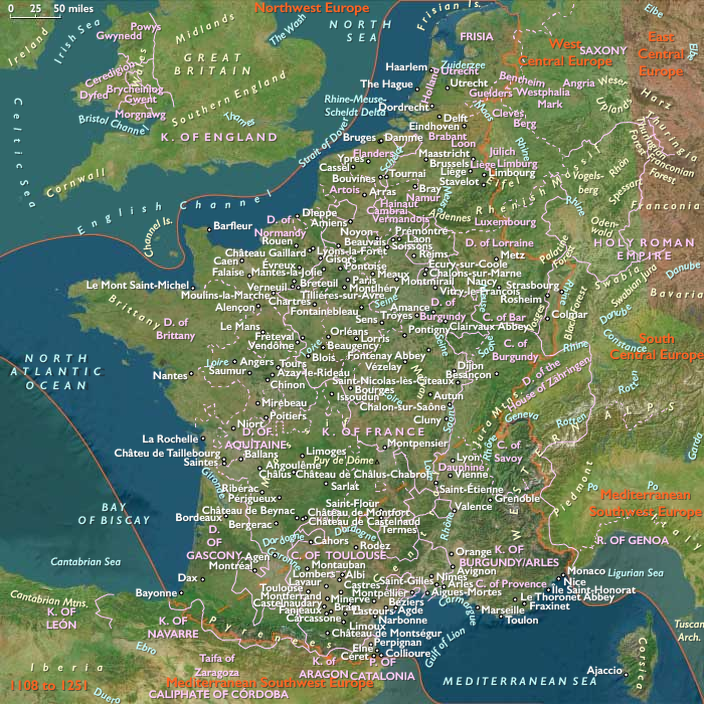
Between 1180 and 1191, Atlantic West Europe—including the Low Countries, Brittany, Normandy, Aquitaine, Burgundy, central France, Alsace, and Franche-Comté—experienced a significant shift in regional dynamics, marked by a Capetian revival under Philip II Augustus, growing strains within the Angevin Empire, vibrant cultural and economic activity, and intensified crusading zeal.
Political and Military Developments
-
Capetian Revival under Philip II Augustus
- Philip II Augustus (r. 1180–1223) ascended the French throne, inaugurating an era of renewed royal strength, asserting Capetian authority by actively challenging Angevin dominance.
- Philip skillfully exploited internal Angevin rivalries to reclaim territories, significantly strengthening royal authority and centralization in France.
-
Internal Strife within the Angevin Empire
- Henry II (r. 1154–1189) faced escalating internal revolts led by his sons, including Richard (the future Richard I "the Lionheart") and John, with support from Queen Eleanor and external backing from the Capetian crown.
- Persistent revolts weakened Angevin cohesion, culminating in the defeat and subsequent death of Henry II (1189), and the accession of Richard I (r. 1189–1199).
-
Brittany and Normandy Amid Shifting Alliances
- Brittany’s ducal authority was increasingly tied to the Angevin family through the marriage of Geoffrey Plantagenet and Duchess Constance (1181), integrating Brittany deeper into Angevin politics and struggles.
- Normandy remained an Angevin stronghold, though increasingly contested by Philip Augustus.
-
Burgundy and the Low Countries: Stability and Growth
- Hugh III of Burgundy (r. 1162–1192) successfully navigated regional rivalries, maintaining stability through diplomatic neutrality and economic prosperity.
- The Low Countries, particularly Flanders, thrived economically despite minor conflicts and remained politically stable.
Economic and Social Developments
-
Economic Prosperity and Urban Growth
- Rapid expansion of trade networks supported prosperity in Flanders (Bruges, Ghent, Ypres), Normandy (Rouen, Caen), and Champagne.
- Increased urbanization supported communal institutions and early civic self-government, particularly in towns of northern France and the Low Countries.
-
Rural Development and Agricultural Innovation
- Advances in agricultural methods facilitated population growth and supported the expansion of market-oriented farming, especially in the fertile regions of northern and central France.
Cultural and Intellectual Developments
-
Gothic Architecture and Artistic Patronage
- Gothic architecture flourished dramatically, notably through continued construction at Notre-Dame de Paris and the cathedrals of Chartres and Laon, marking a golden era for architectural innovation and artistic achievement.
-
Literary and Courtly Culture
- Troubadour poetry and courtly literature thrived, heavily influenced by Eleanor of Aquitaine’s patronage and the aristocratic courts of Aquitaine and Normandy.
- Chrétien de Troyes produced his most influential Arthurian romances during this period, profoundly impacting European literary culture.
-
Intellectual Expansion
- The University of Paris attracted leading scholars, solidifying its place as Europe's intellectual capital, advancing scholastic theology, philosophy, and canon law.
Religious Developments
-
Third Crusade (1189–1192) and Regional Impact
- The fall of Jerusalem (1187) to Saladin triggered widespread religious fervor, influencing significant crusading participation from the region, notably by Philip II Augustus and Richard I.
-
Monastic Influence and Spiritual Movements
- Cistercian monasteries continued their rapid expansion, promoting monastic reforms, educational development, and agricultural innovations across Atlantic West Europe.
Legacy and Significance
The period 1180 to 1191 was transformative, characterized by a Capetian resurgence under Philip Augustus, internal Angevin turmoil, and vibrant cultural activity. This era laid crucial foundations for the enduring rivalry between Capetian France and the Angevin territories, shaped regional political alignments, and saw significant cultural achievements—especially in Gothic architecture and literature—that defined Atlantic West Europe's trajectory into the thirteenth century.
The Holy Grail and Chrétien de Troyes' Perceval, ou le Conte du Graal (1180–1190 CE)
The Holy Grail, originally a symbolic talisman likely rooted in Celtic pagan tradition, evolved in the late 12th century into a Christian relic associated with the cup used at the Last Supper. According to later legend, Joseph of Arimathea used this cup to collect the blood of Christ at the Crucifixion.
The Grail became a central object of medieval quest literature, sought after by King Arthur's knights, most notably in Perceval, ou le Conte du Graal by Chrétien de Troyes, the first known literary work to feature the Holy Grail.
Chrétien de Troyes and Perceval (1180–1190)
- French poet Chrétien de Troyes wrote Perceval, ou le Conte du Graal (Perceval, or the Story of the Grail) around 1180.
- The romance tells the story of Perceval, a young knight who witnesses a mysterious procession featuring the Grail at the castle of the Fisher King.
- However, Perceval fails to ask the right questions about the Grail, missing his chance to heal the wounded king and restore the land.
Chrétien died before completing the romance, and other poets later attempted to finish it between 1180 and 1190, adding Christian mystical interpretations to the legend.
The Holy Grail’s Evolution in Medieval Literature
- In Chrétien’s original Arthurian context, the Grail is a mysterious object with unclear religious significance.
- Later versions, such as Robert de Boron’s Joseph d’Arimathie (late 12th century), explicitly link the Grail to Christ and the Last Supper, transforming it into a sacred Christian relic.
- The Grail quest becomes central to Arthurian legend, inspiring later romances, including:
- Wolfram von Eschenbach’s Parzival (early 13th century).
- The Vulgate Cycle (13th century), which introduced Galahad as the purest Grail knight.
- Thomas Malory’s Le Morte d'Arthur (15th century), cementing the Grail as a key element of Arthurian mythology.
Legacy of Perceval and the Grail Legend
- Chrétien’s Perceval marked the first recorded literary appearance of the Holy Grail, setting the foundation for centuries of Grail literature.
- The legend blended Celtic, Christian, and chivalric themes, shaping medieval spiritual and heroic ideals.
- The Grail’s transformation from a mystical object to a Christian relic reflected broader religious and cultural changes in medieval Europe.
Though unfinished at his death in 1180, Chrétien de Troyes' Perceval gave birth to one of the most enduring and influential legends of Western literature.
Atlantic West Europe (1192–1203): Shifting Alliances, Angevin Decline, and Cultural Flourishing
Between 1192 and 1203, Atlantic West Europe—including the Low Countries, Brittany, Normandy, Aquitaine, Burgundy, central France, Alsace, and Franche-Comté—experienced dramatic shifts marked by the decline of Angevin power, a significant expansion of Capetian authority under Philip II Augustus, intensified economic prosperity, and remarkable cultural and intellectual growth.
Political and Military Developments
-
Decline of the Angevin Empire and Rise of Capetian France
- Richard I ("the Lionheart," r. 1189–1199), frequently absent from his continental territories due to crusading and captivity, saw Angevin authority weaken significantly.
- Upon Richard’s death (1199), his brother John Lackland (r. 1199–1216) inherited an empire in turmoil, facing immediate challenges from Philip Augustus of France.
- Philip II Augustus skillfully exploited John's vulnerabilities, gradually undermining Angevin control, particularly in Normandy, Anjou, and parts of Aquitaine.
-
Loss of Normandy and Angevin Territories
- Philip II’s military campaigns culminated in the decisive Siege of Château Gaillard (1203), significantly weakening Angevin defenses in Normandy.
- By 1203, Angevin territories were on the brink of collapse, setting the stage for Normandy’s complete loss (1204).
-
Brittany’s Ambiguous Position
- Brittany, under Duchess Constance and later her young son Arthur of Brittany, became embroiled in the Angevin-Capetian conflict, exacerbating regional instability.
- Arthur’s capture (1202) by King John further destabilized the region, ultimately benefiting Capetian ambitions.
-
Burgundy and the Low Countries: Stability Amid Conflict
- Odo III of Burgundy (r. 1192–1218) maintained stable rule, skillfully navigating alliances between France and the Empire.
- The Low Countries, particularly Flanders, continued to prosper economically and maintained relative political autonomy despite external tensions.
Economic and Social Developments
-
Trade Expansion and Urban Prosperity
- Economic activity in Flanders flourished, particularly in Bruges, Ghent, and Ypres, becoming European centers of textile manufacturing and trade.
- Continued growth of the Champagne fairs integrated markets, strengthening Atlantic West Europe's centrality in European commerce.
-
Rural Productivity and Agricultural Innovation
- Increased agricultural productivity and population growth supported further urbanization, with widespread improvements in agricultural technology and crop rotation.
Cultural and Intellectual Developments
-
Gothic Architecture Reaches New Heights
- Gothic construction reached a high point in this era, particularly at Chartres Cathedral (rebuilt after 1194), which became an influential model across Europe.
-
Courtly Literature and Intellectual Activity
- Courtly literature flourished further, notably in the works of Chrétien de Troyes’ successors, who expanded Arthurian romance and courtly poetry.
- Universities, especially the University of Paris, became dominant intellectual hubs, attracting students and scholars from across Europe.
Religious Developments
-
Crusading Zeal and the Fourth Crusade
- Atlantic West Europe actively supported crusading efforts, culminating in regional participation in preparations for the ill-fated Fourth Crusade (1202–1204).
-
Monasticism and Religious Reform
- Continued expansion of Cistercian monasticism influenced regional religious practice, economy, and education, reinforcing their societal significance.
Legacy and Significance
The era 1192–1203 marked a critical turning point in Atlantic West Europe, characterized by the dramatic weakening of Angevin rule and corresponding rise of Capetian dominance under Philip II Augustus. Combined with robust economic growth, cultural achievements, and intense crusading fervor, this era fundamentally reshaped the political and cultural landscape, establishing a clear foundation for Capetian dominance, regional prosperity, and cultural vitality throughout the thirteenth century.
Atlantic West Europe (1192–1203): Shifting Alliances, Angevin Decline, and Cultural Flourishing
Between 1192 and 1203, Atlantic West Europe—including the Low Countries, Brittany, Normandy, Aquitaine, Burgundy, central France, Alsace, and Franche-Comté—experienced dramatic shifts marked by the decline of Angevin power, a significant expansion of Capetian authority under Philip II Augustus, intensified economic prosperity, and remarkable cultural and intellectual growth.
Political and Military Developments
-
Decline of the Angevin Empire and Rise of Capetian France
- Richard I ("the Lionheart," r. 1189–1199), frequently absent from his continental territories due to crusading and captivity, saw Angevin authority weaken significantly.
- Upon Richard’s death (1199), his brother John Lackland (r. 1199–1216) inherited an empire in turmoil, facing immediate challenges from Philip Augustus of France.
- Philip II Augustus skillfully exploited John's vulnerabilities, gradually undermining Angevin control, particularly in Normandy, Anjou, and parts of Aquitaine.
-
Loss of Normandy and Angevin Territories
- Philip II’s military campaigns culminated in the decisive Siege of Château Gaillard (1203), significantly weakening Angevin defenses in Normandy.
- By 1203, Angevin territories were on the brink of collapse, setting the stage for Normandy’s complete loss (1204).
-
Brittany’s Ambiguous Position
- Brittany, under Duchess Constance and later her young son Arthur of Brittany, became embroiled in the Angevin-Capetian conflict, exacerbating regional instability.
- Arthur’s capture (1202) by King John further destabilized the region, ultimately benefiting Capetian ambitions.
-
Burgundy and the Low Countries: Stability Amid Conflict
- Odo III of Burgundy (r. 1192–1218) maintained stable rule, skillfully navigating alliances between France and the Empire.
- The Low Countries, particularly Flanders, continued to prosper economically and maintained relative political autonomy despite external tensions.
Economic and Social Developments
-
Trade Expansion and Urban Prosperity
- Economic activity in Flanders flourished, particularly in Bruges, Ghent, and Ypres, becoming European centers of textile manufacturing and trade.
- Continued growth of the Champagne fairs integrated markets, strengthening Atlantic West Europe's centrality in European commerce.
-
Rural Productivity and Agricultural Innovation
- Increased agricultural productivity and population growth supported further urbanization, with widespread improvements in agricultural technology and crop rotation.
Cultural and Intellectual Developments
-
Gothic Architecture Reaches New Heights
- Gothic construction reached a high point in this era, particularly at Chartres Cathedral (rebuilt after 1194), which became an influential model across Europe.
-
Courtly Literature and Intellectual Activity
- Courtly literature flourished further, notably in the works of Chrétien de Troyes’ successors, who expanded Arthurian romance and courtly poetry.
- Universities, especially the University of Paris, became dominant intellectual hubs, attracting students and scholars from across Europe.
Religious Developments
-
Crusading Zeal and the Fourth Crusade
- Atlantic West Europe actively supported crusading efforts, culminating in regional participation in preparations for the ill-fated Fourth Crusade (1202–1204).
-
Monasticism and Religious Reform
- Continued expansion of Cistercian monasticism influenced regional religious practice, economy, and education, reinforcing their societal significance.
Legacy and Significance
The era 1192–1203 marked a critical turning point in Atlantic West Europe, characterized by the dramatic weakening of Angevin rule and corresponding rise of Capetian dominance under Philip II Augustus. Combined with robust economic growth, cultural achievements, and intense crusading fervor, this era fundamentally reshaped the political and cultural landscape, establishing a clear foundation for Capetian dominance, regional prosperity, and cultural vitality throughout the thirteenth century.
Atlantic West Europe (1216–1227): Consolidating Royal Power, Economic Vitality, and Intellectual Progress
Between 1216 and 1227, Atlantic West Europe—including the Low Countries, Brittany, Normandy, Aquitaine, Burgundy, central France, Alsace, and Franche-Comté—experienced a period of political stabilization following significant territorial realignments, alongside sustained economic growth, dynamic urban expansion, and substantial cultural and intellectual advancements.
Political and Military Developments
-
France: Strengthening Capetian Authority
- Under Philip II Augustus (r. 1180–1223) and subsequently Louis VIII (r. 1223–1226), the French crown consolidated power in territories newly acquired from the Angevin Empire, notably Normandy and Anjou.
- Louis VIII reinforced royal control through decisive campaigns in Poitou and further weakened Angevin influence in southwestern France.
-
England and Aquitaine: Shifting Loyalties
- With the decline of Angevin power after King John's death in 1216, Aquitaine became increasingly isolated, facing internal dissent and external pressure from the Capetian monarchy.
- Henry III's accession as a child (1216–1272) left English possessions on the continent vulnerable, weakening Angevin claims.
-
Brittany: Regional Autonomy under French Influence
- The Breton duchy remained nominally independent but increasingly fell under Capetian influence due to dynastic connections and strategic pressures from neighboring French territories.
-
Burgundy and the Low Countries: Political Stability
- Burgundy, under Duke Odo III (r. 1192–1218) and his successor Hugh IV (r. 1218–1272), maintained autonomy, adeptly navigating the complex political landscape dominated by the Capetian kings and Holy Roman Empire.
- In Flanders, Countess Joan (1205–1244) maintained economic prosperity while carefully balancing French and imperial interests.
Economic and Social Developments
-
Urbanization and Commercial Expansion
- Major urban centers, including Bruges, Ghent, Rouen, and Paris, continued to flourish as economic hubs, benefiting from robust trade networks and the continued importance of the Champagne fairs.
- Increased specialization in textiles, wool, and luxury goods supported urban economic vitality, boosting regional prosperity.
-
Agricultural Innovation and Population Growth
- Ongoing agricultural advancements, including crop rotation improvements and enhanced farming techniques, drove rural productivity and sustained population increases, further supporting urban development.
Cultural and Intellectual Developments
-
Gothic Architecture’s Ascendancy
- Gothic architectural styles became widespread, notably with continued construction at cathedrals like Chartres and Reims. These structures embodied both religious devotion and urban prestige.
-
Expansion of Scholasticism
- The University of Paris gained international prominence, attracting notable scholars like William of Auvergne and Robert Grosseteste, who contributed significantly to theology and early scientific inquiry.
-
Courtly Literature and Romance
- The popularity of Arthurian legends and chivalric literature continued to rise, particularly with the works of poets like Chrétien de Troyes, enhancing cultural connections between regions.
Religious Developments
-
Albigensian Crusade (1209–1229)
- The continuation of the Albigensian Crusade in southern France intensified religious fervor throughout the region, impacting political allegiances and reinforcing the authority of the Catholic Church in combating perceived heresy.
-
Monastic Growth and Reform
- Cistercian and other monastic orders continued to expand their spiritual and economic influence, founding monasteries that enhanced both regional productivity and cultural life.
Legacy and Significance
The period 1216–1227 was characterized by a marked consolidation of Capetian power, reshaping Atlantic West Europe's political landscape after the Angevin Empire’s decline. The sustained economic growth, coupled with dynamic cultural and intellectual developments, reinforced the region’s significance and set enduring foundations for its influence throughout the High Middle Ages.
Atlantic West Europe (1228–1239): Consolidation of Capetian Authority, Urban Expansion, and Cultural Flourishing
Between 1228 and 1239, Atlantic West Europe—including the Low Countries, Brittany, Normandy, Aquitaine, Burgundy, central France, Alsace, and Franche-Comté—experienced continued political stabilization, robust economic activity, expanding urbanization, and notable intellectual and cultural growth, amid ongoing religious transformation.
Political and Military Developments
-
France: Strengthening Royal Power
- Louis IX (Saint Louis, r. 1226–1270), though initially ruling under the regency of Blanche of Castile until 1234, significantly strengthened the centralized authority of the Capetian monarchy, suppressing noble revolts and furthering administrative reforms.
- The 1229 Treaty of Paris ended the Albigensian Crusade, effectively incorporating Languedoc into Capetian France, thus securing southern boundaries and enhancing royal prestige.
-
Brittany and Normandy: Integration and Autonomy
- Brittany retained nominal autonomy under Duke Peter Mauclerc (r. 1213–1237) but increasingly aligned with Capetian interests through marital and political alliances.
- Normandy, now firmly under French control, prospered economically while adjusting to centralizing royal governance.
-
Aquitaine: Continued Fragmentation
- Aquitaine remained a region of competing interests, with localized conflicts persisting as English Plantagenet authority weakened, enhancing French leverage.
-
Burgundy and the Low Countries: Stability and Economic Growth
- Burgundy under Hugh IV (r. 1218–1272) consolidated internal stability, skillfully balancing imperial and royal influences.
- In Flanders, Countess Joan (r. 1205–1244) sustained regional prosperity, balancing relations with France, England, and the Holy Roman Empire.
Economic and Social Developments
-
Urbanization and Trade Expansion
- Urban centers such as Paris, Bruges, Ghent, and Rouen continued rapid growth, supported by flourishing commerce in textiles, luxury goods, and agricultural produce.
- The Champagne fairs remained central, integrating trade networks across Europe, and fostering economic prosperity throughout the region.
-
Agricultural Innovation and Population Growth
- Continued agricultural advancements supported ongoing demographic growth, driving urban expansion and commercial activity, resulting in the region’s sustained prosperity.
Cultural and Intellectual Developments
-
Flourishing Gothic Architecture
- Gothic architecture reached new heights, exemplified by significant progress in constructing iconic cathedrals such as Amiens, Reims, and Beauvais, reflecting both civic pride and religious devotion.
-
Rise of Scholastic Philosophy
- The University of Paris solidified its reputation as Europe's preeminent intellectual center, hosting influential scholars such as Robert Grosseteste and William of Auvergne, fostering advancements in theology, philosophy, and science.
-
Courtly Literature and Cultural Patronage
- Courtly literature, particularly Arthurian romances and troubadour poetry, thrived, enriching cultural life in noble courts from Aquitaine to Champagne.
Religious Developments
-
Aftermath of the Albigensian Crusade
- The suppression of Catharism through the Albigensian Crusade solidified Catholic dominance, increasing the authority of the Church and supporting royal claims to legitimacy.
-
Monastic Influence and Expansion
- The Cistercian order and mendicant orders, especially the Franciscans and Dominicans, expanded significantly, enhancing religious education, preaching, and social influence across urban and rural communities.
Legacy and Significance
The period 1228–1239 marked an era of deepening Capetian consolidation, dynamic urban growth, and vibrant cultural expression. The integration of southern territories, flourishing economic networks, and continued intellectual leadership positioned Atlantic West Europe as a leading center of medieval European power, culture, and prosperity
Atlantic West Europe (1240–1251): Capetian Consolidation, Rising Urban Economies, and Intellectual Dynamism
From 1240 to 1251, Atlantic West Europe—including the Low Countries, Brittany, Normandy, Aquitaine, Burgundy, central France, Alsace, and Franche-Comté—experienced further consolidation of royal authority, continued economic vitality, deepening urban growth, and influential intellectual and cultural developments, laying the foundations for the transition from the High Middle Ages into the Late Medieval period.
Political and Military Developments
-
France: Strengthening Capetian Centralization
- Louis IX (Saint Louis, r. 1226–1270) continued consolidating royal authority, establishing a more effective justice system, enforcing peace among nobles, and initiating far-reaching administrative reforms.
- Louis IX participated in the Seventh Crusade (1248–1254), temporarily shifting royal attention overseas, though domestic administration remained stable due to robust governance systems established during his reign.
-
Brittany and Normandy: Stable Autonomy and Integration
- Brittany, under Duke John I (r. 1237–1286), maintained relative autonomy while strengthening its diplomatic ties with the French crown, reinforcing regional stability.
- Normandy continued its integration into royal France, enhancing economic prosperity and benefiting from centralized administration.
-
Aquitaine: Shifts in Angevin Influence
- Continued rivalry between the Capetian kings and English Plantagenet authority intensified regional instability. However, French influence steadily increased, laying groundwork for future conflicts.
-
Burgundy and the Low Countries: Political Stability and Economic Expansion
- Under Hugh IV of Burgundy (r. 1218–1272), the duchy experienced continued stability, managing complex relationships with France and the Empire.
- In Flanders, Countess Joan of Constantinople (r. 1205–1244) and subsequently her successors sustained economic prosperity through textiles, trade, and diplomacy.
Economic and Social Developments
-
Expansion of Trade and Commerce
- Cities such as Bruges, Ghent, Rouen, and Paris continued rapid economic expansion driven by textile manufacturing, luxury trades, and long-distance commerce, maintaining strong connections with Mediterranean and North Sea trade networks.
- The Champagne fairs remained significant, solidifying Atlantic West Europe's central role in international trade.
-
Urbanization and Guild Development
- Urban populations expanded considerably, leading to increased prominence of guilds that regulated production, trade practices, and worker welfare, shaping urban governance and social structures.
Cultural and Intellectual Developments
-
Advancement of Gothic Architecture
- Gothic architecture continued its vibrant evolution, with significant progress in monumental cathedrals such as Amiens and Chartres, showcasing innovative techniques in vaulting, sculpture, and stained glass.
-
Scholasticism and Intellectual Growth
- The University of Paris remained a foremost intellectual center, nurturing figures such as Thomas Aquinas, who studied and taught in Paris from 1245, significantly influencing medieval philosophy and theology.
-
Literary and Cultural Flourishing
- Continued patronage of courtly literature, poetry, and troubadour traditions enriched the region's cultural life, reflecting courtly ideals, religious devotion, and chivalric values.
Religious Developments
-
Influence of Crusading Ideals
- Louis IX's Seventh Crusade (1248–1254), despite limited military success, reinforced crusading ideals, shaping popular religious sentiment and royal legitimacy.
-
Expansion of Mendicant Orders
- Franciscans and Dominicans expanded significantly, playing crucial roles in education, preaching, and combating heresy, enhancing their social and spiritual influence.
Legacy and Significance
The years 1240–1251 marked a period of increased political consolidation under Capetian leadership, vibrant economic growth, dynamic urbanization, and significant intellectual and cultural advancement. This era solidified Atlantic West Europe’s position as a critical hub in medieval Europe, preparing the region for the transitions and challenges of the Late Middle Ages.