Charles V, Holy Roman Emperor
Holy Roman Emperor; King of the Romans; King of Italy
Years: 1500 - 1558
Charles V (Spanish: Carlos I, Carlos V or "Carlos I de España y V de Alemania", German: Karl V., Dutch: Karel V, French: Charles Quint, February 24, 1500 – September 21, 1558) is ruler of the Holy Roman Empire from 1519 and, as Carlos I of Spain, of the Spanish Empire from 1516 until his abdication in 1556.
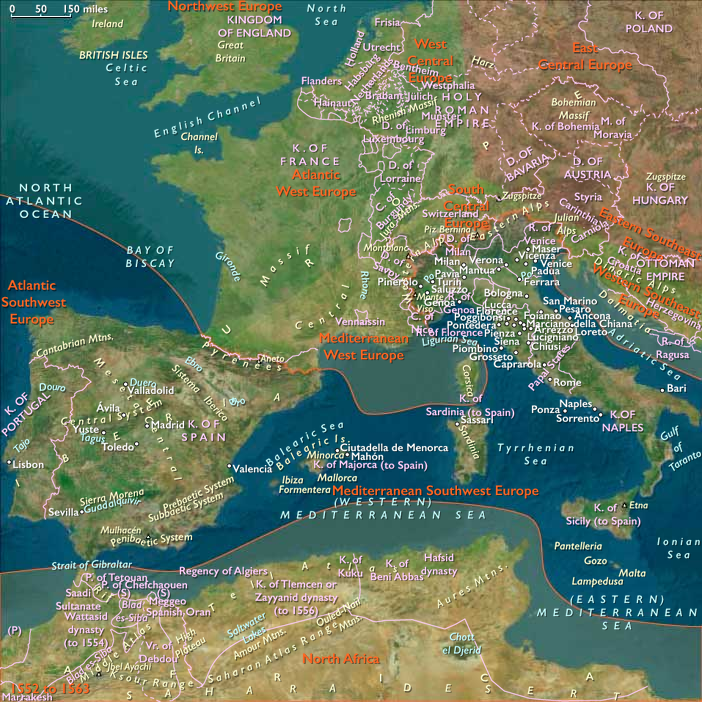
As the heir of three of Europe's leading dynasties — the House of Habsburg of the Habsburg Monarchy; the House of Valois-Burgundy of the Duchy of Burgundy; and the House of Trastámara of Crown of Castile-León & Aragon — he rules over extensive domains in Central, Western, and Southern Europe; and the Spanish colonies in North, Central, and South America, the Caribbean, Asia, and the Philippines.
Maximilian I, Holy Roman Emperor, married his son Philip the Handsome to Queen Joanna of Castile-León (who also later became heiress to the Kingdom of Aragon), thus initiating the Habsburg dynasty in Spain.
In addition to this, Maximilian was married to Duchess Mary of Burgundy, allowing Philip to also inherit the Duchy of Burgundy (which included the Low Countries) when Mary died in 1482.
Charles is the eldest son of Philip and Joanna.
When Philip dies in 1506, Charles inherits Burgundy and Castile-León, and then inherits Aragon jure matris upon the death of his maternal grandfather Ferdinand II in 1516.
As Charles was the first person to rule Castile-León and Aragon simultaneously in his own right, he becomes the first de jure King of Spain (Charles co-reigns with his mother Joanna, which is however a technicality given her mental instability).
Maximilian outlives Philip, and thus passes the entire Habsburg Monarchy and the imperial throne to Charles when he dies in 1519.
At this time, his realm, which has been described as "the empire on which the sun never sets", spans nearly four million square kilometers across Europe, the Far East, and the Americas.
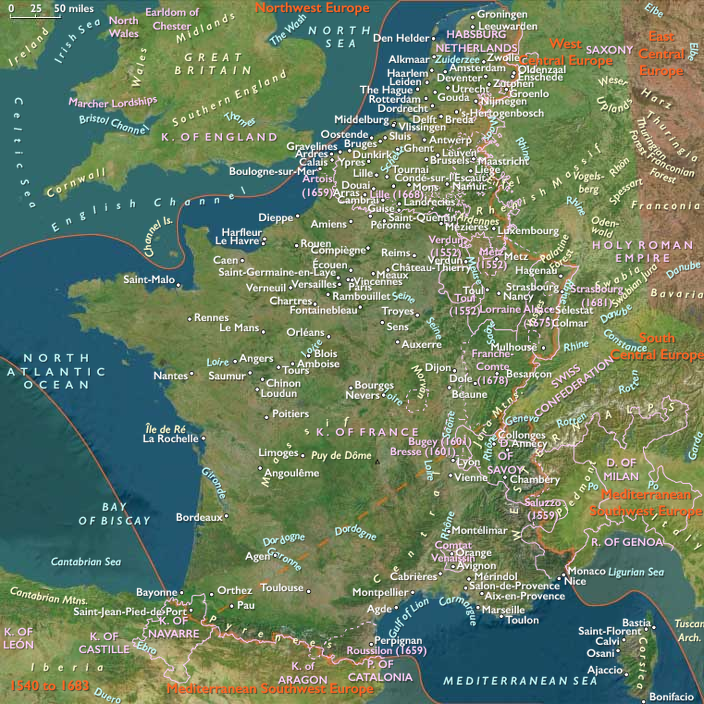
Much of Charles' reign is devoted to the Italian Wars against the French kings Francis I and Henry II, which although enormously expensive, are militarily successful due to the undefeated Spanish tercio and the efforts of his prime ministers Mercurino Gattinara and Francisco de los Cobos y Molina.
Charles' forces recapture both Milan and Franche-Comté from France after the decisive Habsburg victory at the Battle of Pavia in 1525, which pushes Francis to form the Franco-Ottoman alliance.
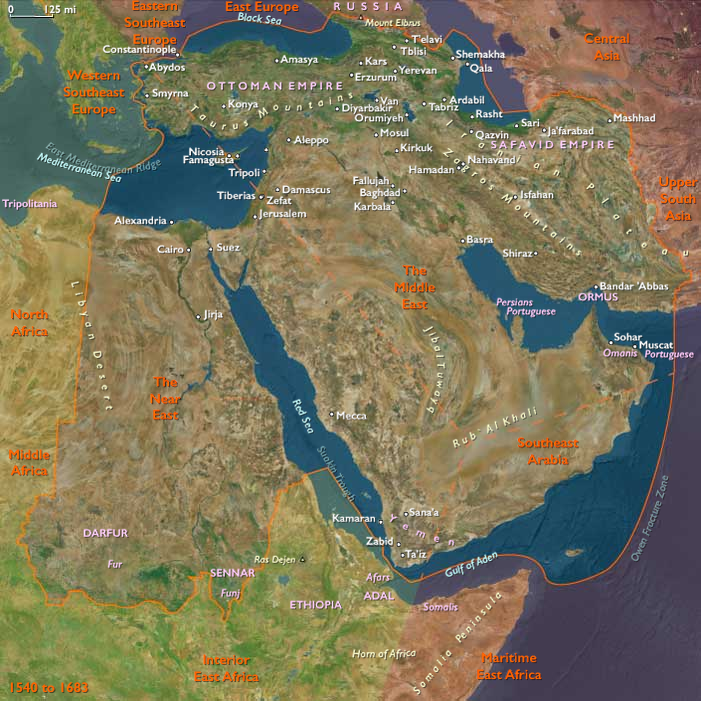
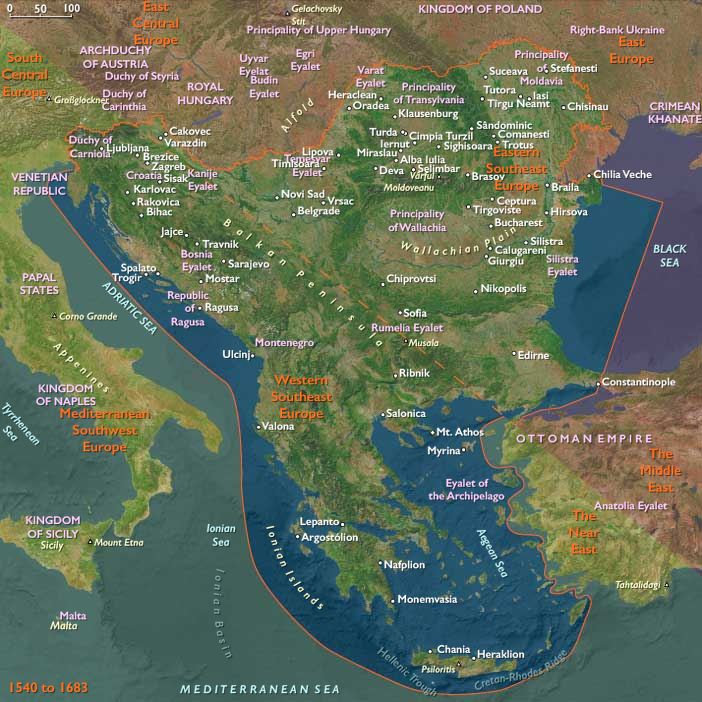
Charles' rival Suleiman the Magnificent conquers Hungary in 1526 after defeating the Christians at the Battle of Mohács.
However, the Ottoman advance is halted after they fail to capture Vienna in 1529.
Aside from this, Charles is best known for his role in opposing the Protestant Reformation.
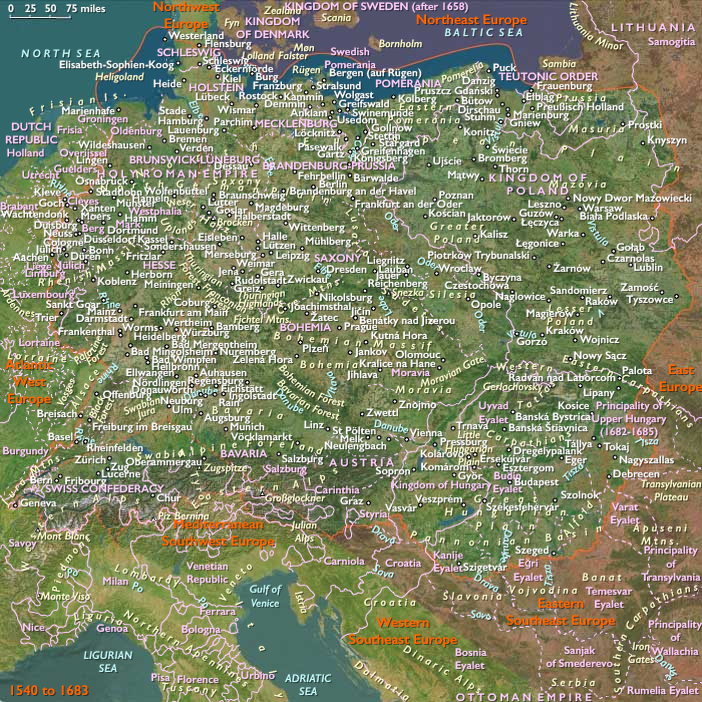
In addition to the Peasants' War against the Empire, several German princes abandon the Catholic Church and form the Schmalkaldic League in order to challenge Charles' authority with military force.
Unwilling to allow the same religious wars to come to his other domains, Charles pushes for the convocation of the Council of Trent, which begins the Counter-Reformation.
The Society of Jesus is established by St. Ignacio de Loyola during Charles' reign in order to peacefully and intellectually combat Protestantism, and continental Spain is spared from religious conflict largely by Charles' nonviolent measures.
In Germany, although the Protestants are personally defeated by Charles at the Battle of Mühlberg in 1547, he legalizes Lutheranism within the Holy Roman Empire with the Peace of Augsburg.
Charles also maintains his alliance with Henry VIII of England, despite the latter splitting the Church of England from Rome and violently persecuting Catholics.
In the New World, Charles oversees the Spanish colonization of the Americas, including the conquest of both the Aztec Empire and the Inca Empire.
The rapid Christianization of New Spain is attributed to the miracle of Our Lady of Guadalupe.
Uncomfortable with how his viceroys are governing the Americas vis-à-vis the Native Americans, Charles consults figures such as Francisco de Vitoria and Bartolomé de las Casas on the morality of colonization.
He also provides five ships to Ferdinand Magellan and his navigator Juan Sebastian Elcano, after the Portuguese captain was repeatedly turned down by Manuel I of Portugal.
The commercial success of the Magellan's voyage (the first circumnavigation of the Earth) temporarily enriches Charles by the sale of its cargo of cloves and lays the foundation for the Pacific oceanic empire of Spain, and through Ruy López de Villalobos, begins Spanish colonization of the Philippines.
Though always at war, Charles is essentially a lover of peace, and all his wars are virtually defensive.
"Not greedy of territory," wrote Marcantonio Contarini in 1536, "but most greedy of peace and quiet."
Charles retires in 1556.
The Habsburg Monarchy passes to Charles' younger brother Ferdinand, whereas the Spanish Empire is inherited by his son Philip II.
The two empires will remain allies until the 18th century.