
Charles Lindbergh
American aviator, military officer, and author
1902 CE to 1974 CE
Charles Augustus Lindbergh (February 4, 1902 – August 26, 1974) was an American aviator, military officer, and author. On May 20–21, 1927, he made the first nonstop flight from New York to Paris, a distance of 3,600 miles (5,800 km). His aircraft, the Spirit of St. Louis, was built to compete for the $25,000 Orteig Prize for the first flight between the two cities. Although not the first transatlantic flight, it was the longest at the time by nearly 2,000 miles (3,200 km), the first solo transatlantic flight, and set a new flight distance world record. The achievement garnered Lindbergh worldwide fame and stands as one of the most consequential flights in history, signalling a new era of air transportation between parts of the globe.
Raised in both Little Falls, Minnesota and Washington, D.C., Lindbergh was the son of U.S. Congressman Charles August Lindbergh. He became a U.S. Army Air Service cadet in 1924. The next year, Lindbergh was hired as a U.S. Air Mail pilot in the Greater St. Louis area, where he began to prepare for crossing the Atlantic. For his 1927 flight, President Calvin Coolidge presented Lindbergh both the Distinguished Flying Cross and Medal of Honor, the highest U.S. military award. He was promoted to colonel in the U.S. Army Air Corps Reserve and also earned the highest French order of merit, the Legion of Honor. Lindbergh's achievement spurred significant global interest in flight training, commercial aviation and air mail, which revolutionized the aviation industry worldwide (a phenomenon dubbed the "Lindbergh Boom"), and he spent much time promoting these industries. Time magazine named Lindbergh its first Man of the Year for 1927, President Herbert Hoover appointed him to the National Advisory Committee for Aeronautics in 1929, and Lindbergh received the Congressional Gold Medal in 1930. In 1931, he and French surgeon Alexis Carrel began work on inventing the first perfusion pump, a device credited with making future heart surgeries and organ transplantation possible.
On March 1, 1932, Lindbergh's first-born infant child, Charles Jr., was kidnapped and murdered in what the American media called the "crime of the century". The case prompted the U.S. to establish kidnapping as a federal crime if a kidnapper crosses state lines with a victim. By late 1935, public hysteria from the case drove the Lindbergh family abroad to Europe, from where they returned in 1939. In the months before the United States entered World War II, Lindbergh's non-interventionist stance and statements about Jews and race led many to believe he was a Nazi sympathizer. Lindbergh never publicly stated support for the Nazis and condemned them several times in both his public speeches and personal diary, but associated with them on numerous occasions in the 1930s. Lindbergh also supported the isolationist America First Committee and resigned from the U.S. Army Air Corps in April 1941 after President Franklin Roosevelt publicly rebuked him. In September 1941, Lindbergh gave a significant address, titled "Speech on Neutrality", outlining his position and arguments against greater American involvement in the war.
Following the Japanese attack on Pearl Harbor and German declaration of war against the U.S., Lindbergh avidly supported the American war effort but was rejected for active duty, as Roosevelt refused to restore his colonel's commission. Instead, Lindbergh flew 50 combat missions in the Pacific Theater as a civilian consultant and was unofficially credited with shooting down an enemy aircraft. In 1954, President Dwight Eisenhower restored his commission and promoted him to brigadier general in the U.S. Air Force Reserve. In his later years, Lindbergh became a Pulitzer Prize-winning author, international explorer and environmentalist, helping to establish national parks in the U.S. and protect certain endangered species and tribal people in both the Philippines and east Africa. After retiring in Maui, he died of cancer in 1974.
World
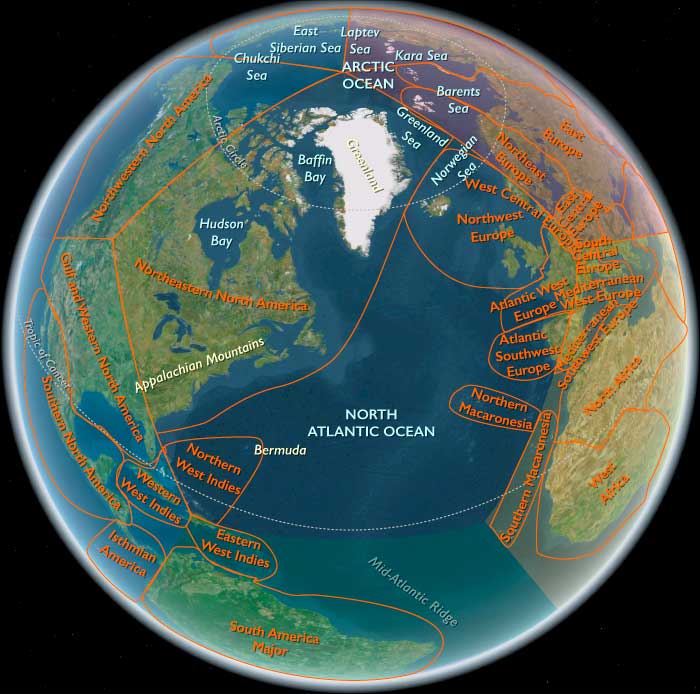
The Atlantic Lands
View →Related Events
Showing 1 events out of 1 total
Northeastern North America (1828–1971 CE)
Industrial Heartlands, Atlantic Gateways, and Cold War Crossroads
Geography & Environmental Context
Northeastern North America includes all territory east of 110°W, except the lands belonging to Gulf and Western North America. This encompasses the Great Lakes basin, the St. Lawrence River corridor, Hudson Bay and Labrador, Newfoundland, Greenland, the Arctic, the Maritime provinces, and the Atlantic seaboard from New England through Virginia, the Carolinas, and most of Georgia. It also contains the Mississippi Valley north of Illinois’ Little Egypt and the Upper Missouri above the Iowa–Nebraska crossing, as well as northeast Alabama, central and eastern Tennessee, and nearly all of Kentucky.
Anchors included the Great Lakes–St. Lawrence corridor, the Appalachian piedmont, Hudson Bay, the Greenland ice sheet, and the Atlantic coastal plain. This was a region of forests and prairies, industrializing river valleys, and Arctic margins increasingly integrated into continental and global networks.
Climate & Environmental Shifts
The 19th century saw the close of the Little Ice Age, with harsh winters persisting into the mid-century before gradual warming by the 20th. The Great Lakes and St. Lawrence valleys endured blizzards and drought cycles. Greenland’s sea ice remained extensive until the early 20th century, then retreated. Atlantic storms reshaped seaboards, while the Dust Bowl’s fringes touched the upper Mississippi Valley. By the mid-20th century, industrial pollution, damming, and deforestation altered rivers and lakes. Warmer conditions opened some Arctic navigation and enabled agricultural expansion on the prairies.
Subsistence & Settlement
-
United States:
-
The eastern seaboard and interior transformed into an industrial core. Wheat, corn, and cotton farming underpinned rural life, while cities like New York, Boston, Philadelphia, Cleveland, Detroit, and Chicago grew as manufacturing giants.
-
Immigration from Europe swelled urban populations; African Americans migrated north in the Great Migration, reshaping cities.
-
-
Canada:
-
Confederation (1867) bound Ontario, Quebec, and the Maritimes; later provinces joined as prairie farming expanded through the Great Lakes–St. Lawrence corridor.
-
Industrial centers like Montreal, Toronto, and Halifax grew rapidly.
-
-
Greenland:
-
Inuit sustained hunting and fishing lifeways; Danish colonial administrators introduced trade posts, missions, and modernization projects.
-
Sealing and cod fisheries dominated, while U.S. bases after WWII tied Greenland into Cold War strategy.
-
-
Indigenous nations: Though often displaced or confined, Native communities persisted through fur trade, wage labor, and mixed economies, maintaining ceremonies and oral traditions despite assimilationist pressures.
Technology & Material Culture
-
Industrialization: Steamships, canals (Erie, Welland), and railroads structured 19th-century movement. Iron, coal, and later oil fueled factories; by the 20th century, automobiles, telephones, and electricity reshaped life.
-
Great Lakes: Shipyards, steel mills, and automotive industries (Detroit) symbolized industrial power.
-
Urban landscapes: Skyscrapers rose in New York and Chicago; monumental civic buildings reflected republican ideals.
-
Inuit technology: umiaks, sledges, and skin clothing persisted, gradually blending with rifles, aluminum boats, and modern textiles.
Movement & Interaction Corridors
-
St. Lawrence–Great Lakes corridor: Lifeline for grain, timber, coal, and manufactured goods; the St. Lawrence Seaway (1959) opened direct passage to the Atlantic.
-
Atlantic ports: New York, Boston, Halifax, and Norfolk became hubs for immigration, finance, and shipping.
-
Hudson Bay Company posts: Continued fur trading into the 19th century, later giving way to mining and forestry.
-
Greenland: Danish trade routes and, later, U.S. airbases connected Inuit settlements to North Atlantic geopolitics.
-
Railroads and highways: Linked Atlantic and Great Lakes cities to prairies; by mid-20th century, interstate highways and air travel reinforced northeastern dominance.
Cultural & Symbolic Expressions
-
Indigenous resilience: Powwows, art, and oral tradition preserved identity despite reservation and assimilation policies.
-
United States: Republican ideals, frontier and industrial myths, and later consumer democracy shaped identity; jazz, blues, and rock emerged from northeastern cities.
-
Canada: Bilingual (French-English) traditions, maritime folklore, and Indigenous storytelling marked cultural life.
-
Greenland Inuit: Shamanic traditions blended with Lutheranism; drum dances, carvings, and hunting songs remained central.
-
Symbols of modernity: factories, bridges, skyscrapers, and lighthouses expressed progress and connection to the Atlantic.
Environmental Adaptation & Resilience
-
Farmers expanded into prairies with mechanization and fertilizers, though soil depletion and dust crises highlighted limits.
-
Industrial growth degraded landscapes with smoke and effluent; the Great Lakes suffered heavy pollution by mid-20th century.
-
Fisheries collapsed in parts of the Atlantic; conservation movements responded with national parks and wildlife protections.
-
Inuit adapted to retreating sea ice by diversifying hunting practices and incorporating modern tools.
Political & Military Shocks
-
United States: Civil War (1861–65) ended slavery and reshaped the Union; World Wars I & II propelled it to superpower status.
-
Canada: Confederation (1867) and expansion west built a new nation within the British Empire; by 1931 (Statute of Westminster), Canada achieved near-full sovereignty.
-
Greenland: Remained a Danish colony until 1953, when it became an autonomous province; Cold War airbases underscored its strategic value.
-
Indigenous dispossession: Treaties, removals, and boarding schools stripped communities of land and autonomy, though resistance and renewal persisted.
Transition
By 1971 CE, Northeastern North America had become an industrial heartland and Atlantic hub. The United States emerged as a global superpower anchored in its eastern cities; Canada consolidated as a bilingual, industrial nation; and Greenland shifted into Cold War geopolitics under Danish and U.S. oversight. Indigenous nations endured profound losses but maintained cultural resilience. This subregion had become both the engine of the Atlantic world and a critical stage for modern geopolitics, carrying deep ecological and cultural legacies into the late 20th century.