Charles IV of Alençon
Duke of Alençon
Years: 1489 - 1525
Charles IV of Alençon (1489, Alençon –1525, Lyon) is the son of René of Alençon and the Blessed Margaret of Vaudémont.
Related Events
Filter results
Showing 3 events out of 3 total
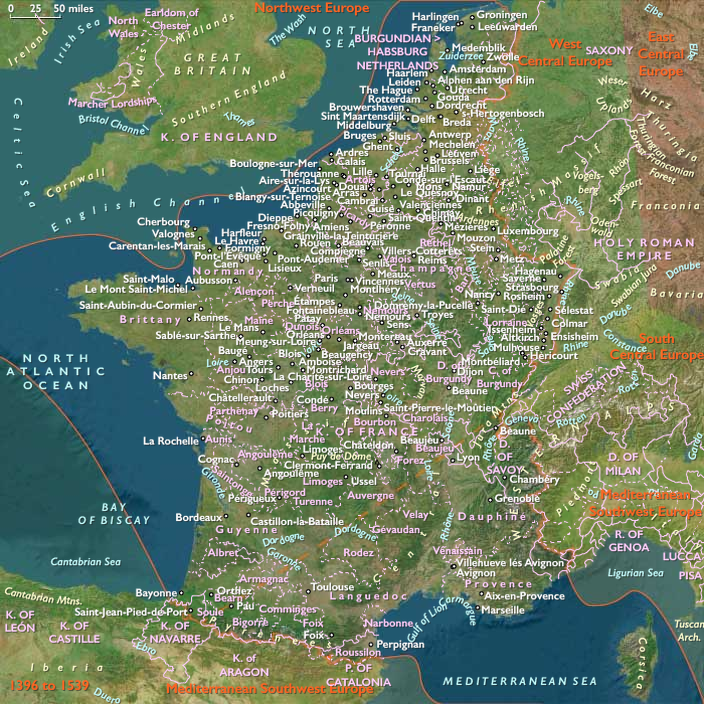
The Siege of Thérouanne and French Attempts to Relieve the Town (August 1513)
In August 1513, as the English siege of Thérouanne tightened under King Henry VIII, French commanders made vigorous and creative attempts to resupply the beleaguered fortress town. Facing increasingly desperate circumstances, French commanders undertook bold missions to break through English lines, highlighting both the strategic value of the town and the determined resilience of its defenders.
The Successful Resupply by Fonterailles (July–August 1513)
Earlier, in late July 1513, a daring French relief expedition led by Fonterailles successfully penetrated English lines, delivering crucial supplies—gunpowder and food provisions, notably bacon—to Thérouanne. Aided by artillery cover from the town's defenses, Fonterailles reinforced the garrison with about eighty fresh soldiers, boosting the morale and confidence of the defenders. Reports sent back to Venice described significant English casualties, approximately three hundred men, emphasizing the effectiveness of the operation.
Fonterailles confidently declared afterward that the town could endure until further aid arrived on a larger scale. These events provided temporary encouragement to French resistance, but also alerted English commanders to their vulnerability to swift French countermeasures.
The Subsequent French Relief Attempt: Stradiotes and Cavalry (August 16, 1513)
Encouraged by Fonterailles' partial success, the French attempted another ambitious resupply in mid-August. A larger relief force was assembled at Blangy, composed of mixed companies of heavy cavalry (gendarmes), pikemen, and specialized stradiotes—light cavalry of Balkan origin noted for their distinctive equipment: short stirrups, small spears, curved Turkish swords, and distinctively shaped hats. According to chronicler Edward Hall, each stradiot carried a side of bacon and a sack of gunpowder for delivery to the besieged town.
To distract and divide English attention, French commanders—La Palice, Louis, Duke of Longueville, and Charles IV, Duke of Alençon—split their forces. The heavy cavalry units, separated into two groups, attempted coordinated maneuvers intended to occupy the English and enable the swift, lightly armed stradiotes to slip through the siege lines.
English Defensive Measures and Strategic Response
In anticipation, English forces under King Henry VIII and George Talbot, Earl of Shrewsbury, had already repositioned and reinforced their lines. Henry had personally overseen securing the strategically important position at the Tower of Guinegate, expelling French spear-armed cavalry stationed there. English artillery and troops maintained tight vigilance, prepared to counter any further French attempts at breakthrough.
To improve tactical flexibility and response times, English engineers had improved defenses around the siege perimeter. Reports dispatched to Venice noted significant English casualties from earlier skirmishes, reflecting the real costs and stakes involved in the siege operations. Nevertheless, the English remained resolute in their determination to maintain the siege.
Consequences and Legacy
Despite determined French relief attempts, ultimately these efforts failed to break the siege decisively, with the English and their allies soon gaining the upper hand. Yet, the episodes illustrate vividly the complexity, intensity, and ingenuity of military engagements during the early 16th century. The encounters around Thérouanne particularly underscore the rapidly evolving tactics of combined arms warfare, the increasing importance of mobile units such as the stradiotes, and the logistical challenges faced by European commanders.
The siege of Thérouanne, culminating in English victory and the town’s eventual destruction, became emblematic of Henry VIII’s aggressive early foreign policy, vividly capturing the blend of chivalric symbolism, strategic maneuvering, and ruthless practical tactics characteristic of warfare in Atlantic West Europe in the early sixteenth century.

The Treaty of Rouen and the Renewal of the Franco-Scottish "Auld Alliance" (August 26, 1517)
Between 1517 and 1520, John Stewart, Duke of Albany, Scotland's regent, resided predominantly in France, managing Scotland’s affairs remotely through trusted lieutenants, most notably Antoine d'Arces, sieur de la Bastie. This arrangement was a strategic consequence of Albany's strong personal and political ties to France, and it shaped Scotland’s political trajectory during the regency period.
Context and Key Figures
John Stewart, Duke of Albany, had assumed the Scottish regency during the minority of King James V, following the death of James IV at Flodden in 1513. Albany, a cousin to the young king, had close familial and political connections to France, reflecting the long-standing alliance between the two kingdoms, popularly known as the "Auld Alliance."His frequent absences from Scotland and residence in France underscored the enduring political and diplomatic influence France wielded over Scottish affairs.
In Albany’s absence, governance on the ground was conducted through a network of deputies, prominently led by the French-born Antoine d'Arces, Sieur de la Bastie, whose role underlined the heavy French influence in Scotland’s internal politics at the time.
The Treaty of Rouen (August 1517)
On August 26, 1517, Albany formalized these Franco-Scottish ties through the Treaty of Rouen, signed with Charles IV, Duke of Alençon, a senior figure in the French royal family. This treaty effectively renewed the traditional alliance between France and Scotland, which had been a cornerstone of both nations’ foreign policies for centuries, primarily directed against England’s geopolitical influence.
A significant clause within the treaty was France’s promise of a royal bride for the young James V, further strengthening dynastic connections between the kingdoms and securing ongoing French influence in Scotland.
The Scottish poet and diplomat, Gavin Douglas, Bishop of Dunkeld, played a critical role in negotiating the treaty, underscoring Scotland’s recognition of the importance of literary and cultural diplomacy alongside military and political alliances.
Political and Diplomatic Implications
The Treaty of Rouen reiterated the strategic alignment of Scotland with France, bolstering Scottish security against potential English aggression while simultaneously serving French interests in maintaining a strong diplomatic foothold on England’s northern border. However, Albany’s frequent absences and reliance on deputies such as la Bastie eventually exposed vulnerabilities within the Scottish regency government, complicating internal stability.
Long-Term Consequences and Legacy
Albany’s sojourn in France and the subsequent Treaty of Rouen had substantial long-term implications. The enduring strength of the Auld Alliance kept Scotland closely tied to French political, cultural, and military spheres, shaping the kingdom’s international relationships through much of the sixteenth century. At the same time, it highlighted the challenges faced by a regency government conducted from afar, eventually contributing to tensions within Scottish nobility and influencing domestic politics.
Ultimately, the treaty demonstrated the complexity of Scotland’s geopolitical position in early modern Europe, balancing internal governance with external alliances, a delicate equilibrium significantly impacted by Albany’s decisions during this period.
Charles III, Duke of Bourbon: Betrayal and Shifting Allegiances (1522)
In 1522, Charles III, Duke of Bourbon, Constable of France, becomes increasingly alienated from King Francis I, setting in motion one of the most dramatic betrayals of the early modern era. The proud duke, already renowned as a military commander—especially for his role commanding the vanguard at the victorious Battle of Marignano (1515)—had initially been rewarded by Francis with both the office of Constable and the prestigious Governorship of Milan. Yet Bourbon's increasing power, wealth, and independence soon made Francis uneasy, resulting in Charles’s recall from Milan, Francis’s refusal to repay his debts, and the king's decision to place the command of the vanguard in subsequent campaigns (notably the recent war in the Netherlands) in the hands of Charles IV of Alençon, the king's brother-in-law, a clear slight against Bourbon’s honor.
The breaking point occurs in 1521 with the death of Bourbon’s wife, Suzanne, Duchess of Bourbon, whose vast estates form the backbone of his wealth and status. Suzanne, who had no surviving children, had designated Charles as her sole heir. However, Louise of Savoy, mother of Francis and sister of Suzanne, quickly lays claim to these estates, citing her closer blood relation. Louise seeks to resolve this inheritance dispute by marrying Charles herself, but the duke rejects her offer, citing their significant age difference—Louise is fourteen years his senior—and his personal disdain for the proposal.
Angered by Charles's rejection and motivated by financial necessity for his ongoing campaigns in the Italian Wars, Francis supports his mother’s legal claims and aggressively moves to seize the disputed lands. Even before a formal ruling in the lawsuit, the crown confiscates part of Bourbon’s property, further enraging the duke and driving him towards treasonous actions.
Feeling betrayed, isolated, and humiliated at the French court, Bourbon secretly begins negotiations with Emperor Charles V, plotting to shift his considerable military talents and influence to the Imperial cause against his own sovereign.
Long-term Consequences and Significance
Bourbon’s alienation and subsequent defection radically alter the balance of power in the ongoing conflicts between France and the Habsburg Empire. By turning one of France’s leading military commanders into an Imperial ally, Charles V gains an invaluable strategic advantage. Bourbon’s defection deepens the crisis facing Francis I and exposes critical vulnerabilities in the French monarchy’s management of powerful nobles, setting the stage for a series of military and political disasters, including the catastrophic French defeat at Pavia (1525) and the resulting capture of Francis himself. This rupture between Francis and Bourbon exemplifies the volatile interplay between personal rivalries, dynastic politics, and international warfare in early sixteenth-century Europe.