Charles William of Baden-Durlach had decided to build himself a new palace in the Hardtwald forest in the plains west of Durlach.
The reasons for his choice of venue are shrouded in legend.
Apart from his quarrels with citizens of Durlach, he may have wanted to escape from the confines of the city and from the company of his unloved wife.
The foundation stone for the new Karlsruhe Palace is laid on June 17, 1715.
The central building of the palace and, subsequently, the whole city, is the so-called Lead Tower.
From this central tower, thirty-two avenues radiate in all directions, marking a uniform distance in all directions.
This outline shapes the map of the "fan city" of Karlsruhe to this day.
To promote the influx of citizens, Charles William had granted them legal, religious, and financial privileges in a decree dated September 24, 1715.
The construction of the castle and town had been sped up and already on July 5, 1717, he had held his first audience in the new palace.
The Court had moved in by 1718, and Charles William in 1719 orders all court officials to move to Karlsruhe, to the regret and anger of the citizens of Durlach.
The rapid implementation and the lack of money means that the building—except for the lead roof of the tower—has to be made of wood.
The wooden houses are painted red, and this causes Karlsruhe to be called the "Red City".
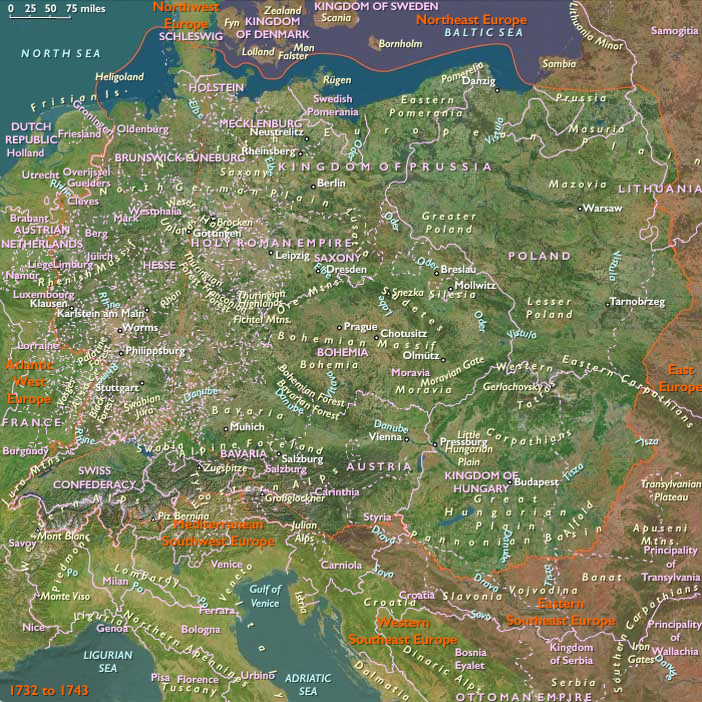
The capital of the northern part of the Margraviate of Baden (held by the Ernestine line) was initially Pforzheim after the margraviate was split in 1535.
Margrave Charles II had moved the capital to Durlach in 1565 for reasons unknown; his territory was then called Baden-Durlach.
He expanded the medieval Karlsburg Castle into a palace.
This palace was burned down by French troops in 1689 during the Nine Years' War, and the plundering was repeated in 1691.
Friedrich VII Magnus had begun to rebuild the palace in 1698 on his return from exile in Basel.
The economy of Baden-Durlach had suffered from the war, however, and had been unable to sustain his grand plan.
Construction had been suspended in 1703 after the completion of the first two palace wings.