Charles III of Spain
King of Spain
Years: 1716 - 1788
Charles III (Spanish: Carlos III; Italian: Carlo III; 20 January 1716 – 14 December 1788) is the King of Spain and the Spanish Indies from 1759 to 1788.
He is the eldest son of Philip V of Spain and his second wife, the Princess Elisabeth Farnese.
In 1731, the fifteen-year-old Charles becomes the Duke of Parma and Piacenza, as Charles I, at the death of his childless great uncle Antonio Farnese, Duke of Parma.
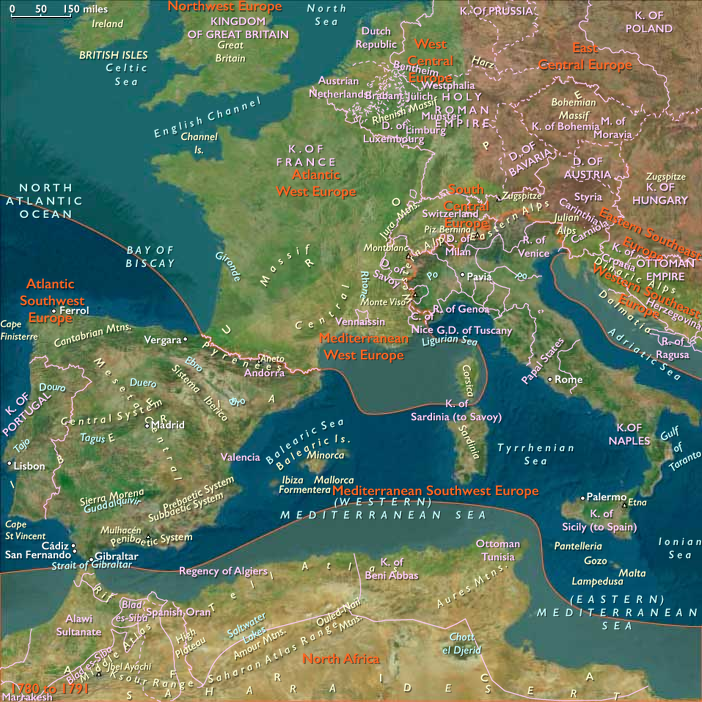
In 1734, as the Duke of Parma, he conquers the kingdoms of Naples and of Sicily, and is crowned as the King of Naples and Sicily on 3 July 1735, reigning as Charles VII of Naples and Charles V of Sicily.
In 1738 he marries the Princess Maria Amalia of Saxony, an educated, cultured woman who gives birth to thirteen children, eight of whom reach adulthood.
Charles and Maria Amalia reside in Naples for nineteen years; she dies in 1760.
Upon succeeding to the Spanish throne on 10 August 1759, Charles, a proponent of enlightened absolutism, on 6 October 1759 abdicates the Neapolitan and Sicilian thrones in favor of Ferdinand, his third surviving son, who becomes Ferdinand I of the Two Sicilies, or Ferdinand IV of Naples and III of Sicily.
Charles III's descendants rule the Kingdom of the Two Sicilies until 1861.
As king of Spain, Charles III tries to rescue his empire from decay through such far-reaching reforms as weakening the Church and its monasteries, promoting science and university research, facilitating trade and commerce, modernizing agriculture and avoiding wars.
He never achieves satisfactory control over finances, and is obliged to borrow to meet expenses.
His reforms prove short-lived and Spain relapses after his death