Charles II, King of Navarre
King of Navarre
Years: 1332 - 1387
Charles II (October 10, 1332 – January 1, 1387), called "Charles the Bad", is King of Navarre 1349–1387 and Count of Évreux 1343–1387.
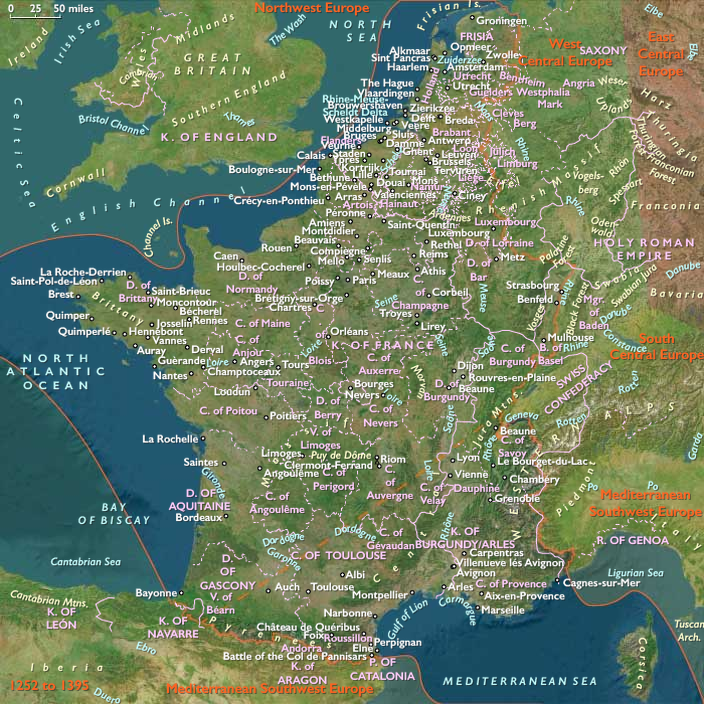
Besides the Pyrenean Kingdom of Navarre, he has extensive lands in Normandy, inherited from his father, Count Philip of Évreux, and his mother, Queen Joan II of Navarre, who had received them as compensation for resigning her claims to France, Champagne, and Brie in 1328.
Thus, in Northern France, Charles possesses Évreux, Mortain, parts of Vexin, and a portion of Cotentin.
He is a major player at a critical juncture in the Hundred Years' War between France and England, repeatedly switching sides in order to further his own agenda.
His horrific death by burning is widely considered God's justice upon him.

Related Events
Filter results
Showing 10 events out of 24 total
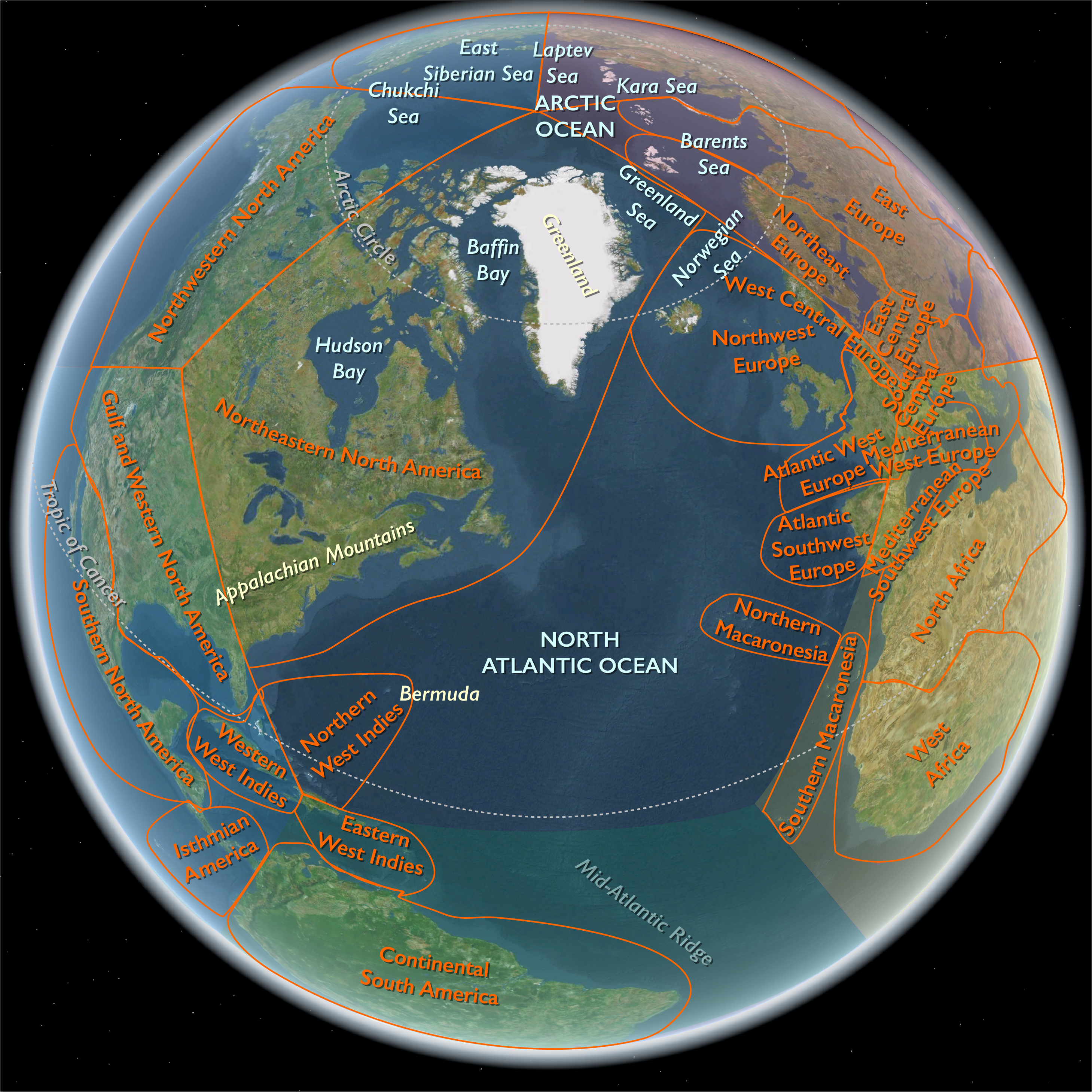
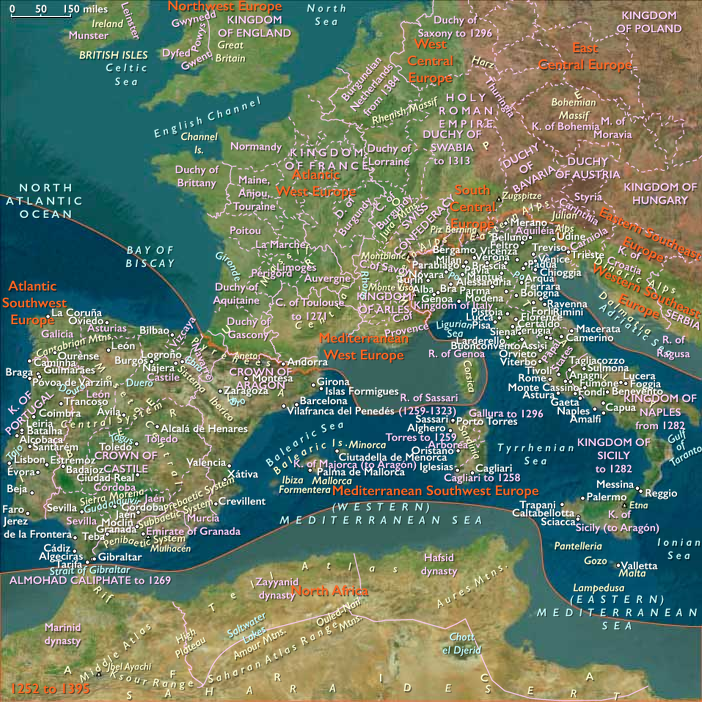
Atlantic Southwest Europe (1252 – 1395 CE): Wool, Iron, Wine, and the Atlantic Turn
Geographic and Environmental Context
Atlantic Southwest Europe includes Portugal’s Lisbon, Beira, Minho, Trás-os-Montes, and Spain’s Galicia, Asturias, Cantabria, Basque Country, Castile and León, northern Rioja, and northern Navarra.
-
Anchors: the Cantabrian coast (A Coruña–Gijón–Santander–Bilbao–San Sebastián), the Douro/Minho estuaries, and the Meseta–Cantabrian passes binding the plateau to Atlantic ports.
Climate and Environmental Shifts
-
Little Ice Age onset (~1300) brought cooler, wetter weather; stormier Bay of Biscay; good fisheries persisted.
-
Black Death (1348–1352) hit towns hard; ports recovered quickest via maritime trade.
Societies and Political Developments
-
Castile and León unified under Alfonso X (r. 1252–1284), then fractured and reconsolidated amid the Trastámara coup (Pedro I vs Enrique II, 1366–1369).
-
Portugal strengthened under Afonso III and Dinis (reforestation of Leiria for ship timber; University of Coimbra 1290), then defended independence in the Crisis of 1383–1385; João I and Aljubarrota (1385) sealed the Anglo-Portuguese alliance (Treaty of Windsor, 1386).
-
Navarre navigated between France and Castile; Basque towns (Bilbao, charter 1300; San Sebastián) grew as maritime communes.
Economy and Trade
-
Wool complex: Castilian wool—organized by the Mesta (founded 1273)—flowed through Burgos, León, and Cantabrian ports to Flanders and England.
-
Basque iron & shipbuilding: forges supplied anchors, nails, artillery shot; yards built cogs and naos for Atlantic service and whaling.
-
Wine & salt fish: Douro/Minho wines, Galician/Portuguese salt fish (cod, sardine) and tuna moved north; Lisbon/Porto emerged as major entrepôts.
-
Finance & law: municipal fueros, urban consulates, and English–Portuguese treaties stabilized credit, convoys, and tariffs.
Subsistence and Technology
-
Mixed Atlantic polyculture (rye/wheat, vines, chestnuts, cattle); stern-rudder hulls, improved rigging, magnetic compass and portolan practice diffused into Iberian waters.
Movement and Interaction Corridors
-
Sea: Lisbon ⇄ London/Bristol; Cantabria ⇄ Flanders; Galicia ⇄ Brittany; pilgrim sailings to Santiago.
-
Land: Meseta passes fed Burgos, León, Salamanca; Douro road/river linked Castile to Porto.
Belief and Symbolism
-
Cathedrals and monasteries in Santiago, León, Burgos, Salamanca; confraternities of sailors and merchants venerating St. James and St. Nicholas kept social cohesion in plague decades.
Adaptation and Resilience
-
Route redundancy (many ports, multiple passes), portfolio exports (wool–iron–wine–fish–salt), and crown–town compacts hedged risk from war, weather, and plague.
Long-Term Significance
By 1395, the Atlantic façade from Lisbon to San Sebastián had become a maritime-industrial platform: wool, iron, wine, and shipbuilding—backed by Portugal’s English alliance—set the stage for the 15th-century Atlantic turn and overseas exploration.
Atlantic Southwest Europe (1348–1359 CE): The Black Death, Castilian Governance Challenges, Portuguese Stability, and Navarrese Diplomatic Prudence
Between 1348 and 1359 CE, Atlantic Southwest Europe—including Galicia, northern and central Portugal, Asturias, Cantabria, and northern Spain south of the Franco-Spanish border (43.05548° N, 1.22924° W)—faced unprecedented challenges from the devastating impact of the Black Death, alongside complex political transitions. The region witnessed severe demographic decline, economic disruptions, and social changes. Portugal under King Afonso IV (1325–1357 CE) and subsequently his successor King Pedro I (1357–1367 CE) managed to maintain relative stability. Castile, following the death of King Alfonso XI (1350 CE) from plague, endured political turmoil during the minority of King Pedro I "the Cruel" (1350–1369 CE). Navarre, under Queen Joan II (1328–1349 CE) and her son Charles II "the Bad" (1349–1387 CE), carefully preserved diplomatic neutrality and regional autonomy despite internal and external pressures.
Political and Military Developments
Portuguese Political Stability under Afonso IV and Pedro I
Portugal managed effective governance through the catastrophic impact of the Black Death. Under the late reign of Afonso IV and the early years of his son Pedro I, Portugal maintained political coherence, territorial integrity, and stable administration despite significant demographic challenges and economic disruptions. Both kings emphasized judicial reforms and governance continuity, decisively preserving Portuguese national stability through the crisis.
Castilian Turmoil Following Alfonso XI’s Death
The sudden death of King Alfonso XI from plague in 1350 triggered severe political instability during the early reign of his son Pedro I. Castile endured internal aristocratic rivalries, weakened governance, and social unrest, intensified by the plague’s devastating effects. Despite these challenges, frontier defenses remained intact, and regional governance structures eventually adapted, preserving long-term Castilian stability and identity.
Navarre’s Diplomatic Stability amid Succession Challenges
Navarre skillfully navigated the transition following the death of Queen Joan II in 1349, with her son Charles II "the Bad" decisively maintaining diplomatic neutrality and regional autonomy. Charles II pursued careful diplomatic strategies, balancing complicated relationships with Castile, Aragón, and France, significantly preserving Navarre’s territorial integrity and internal stability through a difficult era.
Economic Developments
Devastating Impact of the Black Death
The Black Death (1348–1351 CE) profoundly disrupted the region, causing severe demographic losses, agricultural labor shortages, and economic disruption. Agricultural productivity sharply declined, temporarily weakening local economies, trade networks, and artisanal industries. However, gradual recovery occurred, reshaping labor dynamics, agrarian structures, and economic practices.
Slow Recovery of Maritime Commerce and Trade Networks
Despite initial disruptions from the plague, Portuguese ports (Lisbon, Porto, Braga, Coimbra) and Galician trade centers like A Coruña gradually resumed maritime commerce. Commercial exchanges with northern Europe (England, Flanders, Normandy, Brittany) slowly recovered, reinforcing regional economic resilience and providing foundations for subsequent revival.
Pilgrimage and Economic Adaptation
Pilgrimage to Santiago de Compostela significantly declined during the immediate aftermath of the plague but eventually recovered, decisively contributing to regional economic restoration. The pilgrimage industry adapted to changing conditions, reinforcing Galicia’s economic resilience and cultural identity despite demographic setbacks.
Cultural and Religious Developments
Portuguese Cultural Resilience and Continuity
Portugal sustained cultural continuity and intellectual traditions despite severe demographic challenges. Monastic communities, educational institutions, and royal patronage remained vibrant, preserving Portuguese linguistic standardization, cultural identity, and scholarly traditions throughout the difficult period.
Galician Cultural Resilience and Ecclesiastical Patronage
Galicia maintained cultural vitality despite demographic disruption from the plague. Ecclesiastical institutions, particularly at Santiago de Compostela, continued supporting scholarly endeavors, manuscript preservation, architectural projects, and educational initiatives, significantly reinforcing Galician cultural identity.
Ecclesiastical and Monastic Influence Amid Crisis
Monastic communities decisively contributed to regional recovery efforts through scholarly activity, manuscript preservation, agricultural innovations, and educational reforms. Ecclesiastical authorities decisively influenced Iberian religious identity, social cohesion, and cultural resilience amid the demographic crisis.
Persistent Cultural Syncretism and Local Traditions
Orthodox Christianity continued integrating indigenous Iberian and Celtic traditions, particularly in rural Galicia and northern Portugal. Persistent cultural syncretism reinforced regional identities and social cohesion, providing resilience amid demographic upheaval.
Civic Identity and Governance
Portuguese Governance Stability Amid Crisis
Portugal, under Afonso IV and Pedro I, decisively preserved governance stability, territorial coherence, and civic identity despite severe demographic and economic disruptions caused by the plague. Effective administration and governance continuity significantly solidified Portuguese national identity and internal stability during a challenging era.
Castilian Governance Challenges and Regional Adaptation
Castile faced severe governance challenges during the early reign of Pedro I following Alfonso XI’s death. Internal rivalries temporarily weakened centralized administration, but resilient governance structures, frontier stability, and regional identity eventually facilitated recovery and adaptation.
Navarrese Regional Autonomy and Diplomatic Stability
Navarre decisively maintained regional autonomy, diplomatic neutrality, and governance stability under Charles II amid complex political circumstances. Navarre’s diplomatic prudence significantly preserved territorial integrity, internal governance stability, and northern Iberian geopolitical coherence through challenging times.
Notable Regional Groups and Settlements
-
Portuguese: Maintained governance stability, territorial coherence, and cultural continuity under Afonso IV and Pedro I, significantly preserving Portuguese national identity and medieval historical trajectory despite demographic disruptions.
-
Castilians: Experienced severe political turmoil yet preserved regional coherence, frontier stability, and resilient governance structures during the early reign of Pedro I, laying groundwork for subsequent stabilization.
-
Galicians: Demonstrated remarkable cultural resilience and gradual economic recovery, significantly supported by pilgrimage adaptations, maritime trade recovery, and ecclesiastical patronage.
-
Basques (Navarre): Skillfully preserved regional autonomy, diplomatic neutrality, and stable governance under Charles II, significantly maintaining northern Iberian geopolitical stability.
Long-Term Significance and Legacy
Between 1348 and 1359 CE, Atlantic Southwest Europe:
-
Confronted severe demographic and economic disruptions from the Black Death yet decisively preserved Portuguese governance stability, territorial integrity, and cultural continuity under Afonso IV and Pedro I.
-
Endured Castilian political instability during Pedro I’s early reign yet maintained regional identity, territorial coherence, and resilient governance structures, facilitating subsequent stabilization.
-
Maintained Navarrese regional autonomy, diplomatic neutrality, and governance stability under Charles II despite complex political circumstances, significantly influencing northern Iberian geopolitical coherence.
-
Demonstrated resilient economic recovery, cultural adaptability, and persistent local governance structures, profoundly shaping the region’s historical trajectory beyond the demographic crisis.
This pivotal era decisively influenced regional identities, governance stability, economic adaptation, and cultural resilience, profoundly shaping Atlantic Southwest Europe’s late medieval historical legacy.
Guillaume de Machaut: Poet, Composer, and Courtly Patronage
Guillaume de Machaut (c. 1300–1377), one of the most accomplished and versatile composers and poets of the 14th century, found patrons among the highest ranks of European nobility, including Charles of Navarre and King Charles V of France. His artistic output, shaped by his extensive travels and courtly experiences, reflects the richness and diversity of medieval literary and musical traditions.
A Fusion of Poetry and Music
Machaut’s expansive collections of poetry, often accompanied by musical compositions, display his mastery of courtly love themes, philosophical reflection, and personal lyricism. His works include:
- Narrative poems (dits), blending allegory and autobiography, such as Le Voir Dit (The True Tale).
- Lyric poetry, including ballades, rondeaux, and virelais, many of which he set to music.
- Sacred music, most notably the Messe de Nostre Dame, the first known complete polyphonic mass by a single composer.
Illuminated Manuscripts and Royal Patronage
Machaut oversaw the production of richly illuminated manuscripts of his works, ensuring their artistic refinement and textual integrity for his noble patrons. These lavish books, adorned with elegant miniatures and decorative script, were prepared for the French court and powerful aristocrats, securing his legacy as both a poet and composer.
His influence extended far beyond his lifetime, shaping the development of French poetry and polyphonic music, and positioning him as one of the most influential cultural figures of the late Middle Ages.
The Jacquerie (1358): A Peasant Revolt Born of Crisis
The Jacquerie of 1358, France’s archetypal peasant revolt, was fueled by economic hardship, much of it stemming from the devastation of the Black Death (1347–1351). The widespread population loss had already disrupted agriculture, reduced labor availability, and triggered rising wages, destabilizing feudal society. However, rather than improving the peasants’ position, the crisis was met with increased taxation, seigneurial repression, and military devastation, culminating in open rebellion.
Causes of the Revolt
Several interrelated crises contributed to the uprising:
- The Economic Shock of the Black Death – The plague had killed 25–50% of France’s population, leading to severe labor shortages. Although wages rose in response, lords sought to suppress these gains through repressive measures.
- War-Torn France – The Hundred Years’ War (1337–1453) brought devastation to the countryside, as bands of mercenaries and English raiders pillaged farms.
- The Capture of King John II (1356) – The French defeat at Poitiers left France in political and military turmoil, increasing pressure on the peasantry to finance the war effort through excessive taxation.
- Seigneurial Oppression – Feudal lords, eager to maintain their privileges amid economic decline, tightened their grip on the peasantry, reviving old obligations and demanding heavier dues.
The Revolt and Its Brutal Suppression
In May 1358, armed peasant bands in northern France launched attacks on manors, nobles, and clergy, destroying estates and castles in a frenzy of revenge and desperation. The revolt, however, was chaotic and poorly coordinated, lacking a clear leadership structure.
The nobility, led by Charles the Bad of Navarre, swiftly crushed the rebellion in June 1358. The retaliation was brutal, with thousands of peasants massacred in battle or executed afterward.
Legacy of the Jacquerie
Though short-lived, the Jacquerie became a defining symbol of peasant unrest in France. It illustrated the deep tensions between the aristocracy and the rural population, tensions that would persist and erupt again in later centuries, most notably during the French Revolution.
The revolt also revealed the fragility of feudal society in the face of economic turmoil and war, foreshadowing the slow but inevitable decline of medieval serfdom in France.
The English resume the offensive against the French with a damaging raid on the Languedoc.
The Great Raid of 1355 cripples southern France economically, and provokes resentment of the French throne among French peasantry.
The raid also 'cushions' the area for conquest, opens up alliances with neighbors in Aquitaine, the one with Charles II of Navarre being the most notable, and causes many regions to move towards autonomy from France, as France is not as united as England.
The Unstable Alliances Between John II of France and Charles II of Navarre (1354–1355)
During the Hundred Years' War, John II of France ("the Good") sought to neutralize the ambitions of his son-in-law and cousin, Charles II of Navarre, whose Norman holdings made him a key player in the conflict. Despite repeated attempts at diplomacy, Charles's shifting allegiances and ambitions undermined any lasting peace between them.
The Assassination of Charles de la Cerda and the Treaty of Mantes (1354)
- Charles II of Navarre, ruling a small Pyrenean kingdom, also controlled extensive lands in Normandy, making him a significant power in northern France.
- In 1354, he was implicated in the assassination of Charles de la Cerda, the Constable of France and a favorite of John II.
- Despite this, John II still sought an alliance with Charles II, hoping to secure his loyalty against English expansion in Gascony.
- On February 22, 1354, John signed the Treaty of Mantes, granting Charles new lands and privileges in Normandy in exchange for his loyalty to the French Crown.
- However, the truce between them was short-lived, as Charles continued negotiating with England.
The Treaty of Valognes (1355) and Renewed War
- By 1355, Charles II of Navarre had allied himself with Henry of Grosmont, 1st Duke of Lancaster, one of England’s most formidable commanders.
- To prevent Charles from fully joining the English, John II attempted another reconciliation, leading to the signing of the Treaty of Valognes in 1355.
- However, this peace proved as fragile as the previous one, as the Hundred Years' War escalated again that year.
- Charles II continued to maneuver between the English and the French, playing both sides to advance his own territorial ambitions.
Impact and Legacy
- The Treaties of Mantes (1354) and Valognes (1355) failed to bring lasting peace, as Charles II of Navarre remained untrustworthy and opportunistic.
- His Norman possessions made him a critical player in the conflict, ensuring that his actions deepened instability within France.
- His shifting alliances complicated John II’s war strategy, forcing the French king to contend with both English advances and internal betrayals.
The tensions between John II and Charles II of Navarre were emblematic of the fractured political landscape of France during the Hundred Years' War, where noble rivalries and personal ambitions often outweighed national loyalties.
The Aftermath of Poitiers and the Causes of the Jacquerie Revolt (1356–1358)
Following the Battle of Poitiers (September 1356) and the capture of King John II ("the Good"), France descended into chaos, plagued by political instability, economic collapse, and social unrest. The chronicler Jean de Venette, a Carmelite friar, vividly describes the period as one of lawlessness, corruption, and suffering, blaming both the French nobility and the roaming mercenary bands known as the "Companies" (routiers).
Jean de Venette’s Account: France in Ruins
Jean de Venette provides a firsthand account of the devastation, writing:
"...From that time on all went wrong with the Kingdom and the state was undone.
Thieves and robbers rose up everywhere in the land.
The nobles despised and hated all others and took no thought for the mutual usefulness and profit of lord and men.
They subjected and despoiled the peasants and the men of the villages.
In no wise did they defend their country from enemies.
Rather did they trample it underfoot, robbing and pillaging the peasants' goods."
- His criticism is directed not only at the nobility, who exploited and abandoned their subjects, but also at the routiers—mercenary bands left unchecked in the wake of the war.
- With the monarchy leaderless, local warlords and nobles took advantage, taxing the peasants heavily while failing to provide protection from external threats.
Political Instability and the Estates-General’s Failure
- With King John II in captivity, power fractured between:
- The Estates-General, which proved too divided to govern effectively.
- Charles II of Navarre, who sought his own advantage.
- The Dauphin, later Charles V, who struggled to assert control.
- This lack of leadership left France vulnerable, as nobles pursued their own interests rather than defending the country.
- The prestige of the nobility, already tarnished by defeats at Courtrai (1302) and Crécy (1346), reached a new low after they failed to protect France at Poitiers.
Economic Hardships and the Peasantry’s Growing Resentment
- To fund ransoms, military campaigns, and personal expenses, the privileged classes (nobles, clergy, and merchants) increased taxes on peasants.
- The taille (a direct land tax) was raised to unbearable levels, while the corvée (forced labor) forced peasants to rebuild war-damaged noble estates—without pay.
- A new law requiring peasants to defend châteaux (noble castles) became the final spark that ignited the Jacquerie rebellion.
- Many commoners already blamed the nobility for their failures at Poitiers and now questioned why they should continue working for a ruling class that could not even provide protection.
Mercenaries and the Breakdown of Order
- The countryside was overrun by routiers (unemployed mercenaries and brigands)—including English, Gascon, German, and Spanish troops, many of whom had fought for the English before being left without pay or leadership.
- These roving bands looted, raped, and burned villages, pillaging the land almost at will, while the Estates-General proved powerless to stop them.
- Many peasants faced a double threat:
- Noble exploitation through high taxes and forced labor.
- Uncontrolled mercenary violence that the nobility failed to suppress.
The Jacquerie Revolt (1358): A Violent Peasant Uprising
- In May 1358, these tensions erupted into the Jacquerie, a violent peasant rebellion in northern France.
- The revolt was short-lived but extremely bloody, with peasant mobs attacking nobles, burning estates, and killing aristocrats.
- Although the Jacquerie was brutally crushed by June 1358, it left a lasting impact, exposing deep class tensions that would continue to shape France’s social and political struggles.
Long-Term Consequences
- The failure of the nobility to defend France and its people in the 1350s permanently damaged the feudal system.
- The Jacquerie foreshadowed later peasant revolts, including:
- The English Peasants' Revolt (1381).
- The French Revolution (1789).
- France’s internal divisions further weakened the country’s ability to resist English advances in the Hundred Years’ War.
The years after Poitiers (1356–1358) were among the darkest in medieval France, as the absence of strong leadership, economic suffering, and unchecked mercenaries led to mass discontent and violent peasant uprisings.
The Jacquerie Uprising (May–June 1358): A Peasant Revolt Against the Nobility
The Jacquerie, a brutal peasant revolt that erupted in May 1358, was fueled by widespread suffering, economic hardship, and resentment toward the nobility following the devastation of the French countryside during the Hundred Years’ War. The rebellion was centered in northern France, with peasants taking violent revenge on knights, noble families, and their castles.
Origins of the Jacquerie: Discontent in the Countryside
- The uprising began in the village of St. Leu, near the Oise River, where a group of peasants gathered in a cemetery after vespers to discuss their grievances.
- The peasants, outraged by the nobility’s failure to defend France, believed that the lords had abandoned King John II at the Battle of Poitiers (1356), leaving the kingdom leaderless and vulnerable.
- France’s rural population had already suffered immensely:
- English soldiers plundered the countryside, demanding money and food on pain of death.
- French nobles imposed excessive taxes, claiming they needed money for ransoms and to recover losses from the Black Death.
- Peasants were forced to sleep in forests, caves, and marshes to avoid pillaging armies and roaming mercenaries (routiers).
- Even basic agricultural work was impossible without sentinels watching for attacks.
The Outbreak of Revolt: Guillaume Cale’s Leadership
- On May 21, 1358, the rebellion spread near Compiègne, northeast of Paris, under the leadership of Guillaume Cale (also called Carle).
- The revolt was known as the Jacquerie, named after the derogatory term "Jacques Bonhomme" used by nobles to refer to peasants.
- The rebels sought justice and vengeance, launching a wave of destruction against noble estates.
- Castles were stormed, burned, and looted, and the nobility were killed without mercy.
The Extreme Violence of the Jacquerie
Contemporary chroniclers describe atrocities committed by the peasants, often in gruesome detail.
-
Jean le Bel recounts one of the most infamous acts:
- Peasants captured a knight, roasted him alive on a spit, and forced his wife and children to watch.
- After raping the lady, they attempted to force her and her children to eat the roasted flesh of her husband before killing them all.
-
Even Jean de Venette, who was generally sympathetic to the peasants, recorded horrific scenes of slaughter and destruction.
-
Jean Froissart, an aristocrat who despised the peasants, portrayed them as savages, recounting numerous acts of mass murder, rape, and looting.
-
The only chronicler openly sympathetic to the peasants was the anonymous monk who continued the chronicle of Guillaume de Nangis, recognizing the deep suffering that had fueled the uprising.
Impact of the Revolt
- The Jacquerie’s brutal violence horrified the nobility, leading to harsh reprisals against the surviving rebels.
- Though the revolt was eventually crushed within weeks, it revealed the depth of peasant resentment toward the feudal system and noble exploitation.
- The uprising, though short-lived, left a lasting impression on France, foreshadowing future peasant rebellions and further destabilizing the already fragile French monarchy.
The Jacquerie of 1358 was not just a violent peasant uprising—it was an explosive reaction to years of suffering, injustice, and noble indifference, marking a turning point in medieval social unrest.
The Jacquerie of 1358: A Spontaneous and Disorganized Revolt Amidst French Chaos
The Jacquerie of 1358 was a spontaneous, unstructured peasant uprising, fueled by anger toward the nobility, economic hardship, and the general collapse of law and order in France following the capture of King John II at Poitiers (1356). Lacking central leadership or coordination, the revolt spread from village to village, igniting a wave of destruction across northern France.
Origins and Spread of the Revolt
- Jean le Bel speculated that governors and tax collectors may have deliberately spread word of rebellion to inspire peasant uprisings against the nobility.
- Many peasants joined simply because they saw others doing so, suggesting that the movement was more spontaneous than ideologically driven.
- However, some rebels expressed the radical belief that it was possible to rid the world of nobles entirely, reflecting deep resentment toward the feudal system.