Charles Alexandre de Calonne
French statesman
Years: 1734 - 1802
Charles Alexandre de Calonne (January 20, 1734 – October 30, 1802), titled Count of Hannonville in 1759, is a French statesman, best known for his involvement in the French Revolution.
Realizing that the Parlement of Paris will never agree to reform, Calonne handpicks an Assembly of Notables in 1787 to approve new taxes.
When they refuses, Calonne's reputation plummets and he is forced to leave the country.

Related Events
Filter results
Showing 10 events out of 15 total
Atlantic West Europe (1780–1791): Revolutionary Tensions, Economic Strains, and the Prelude to Upheaval
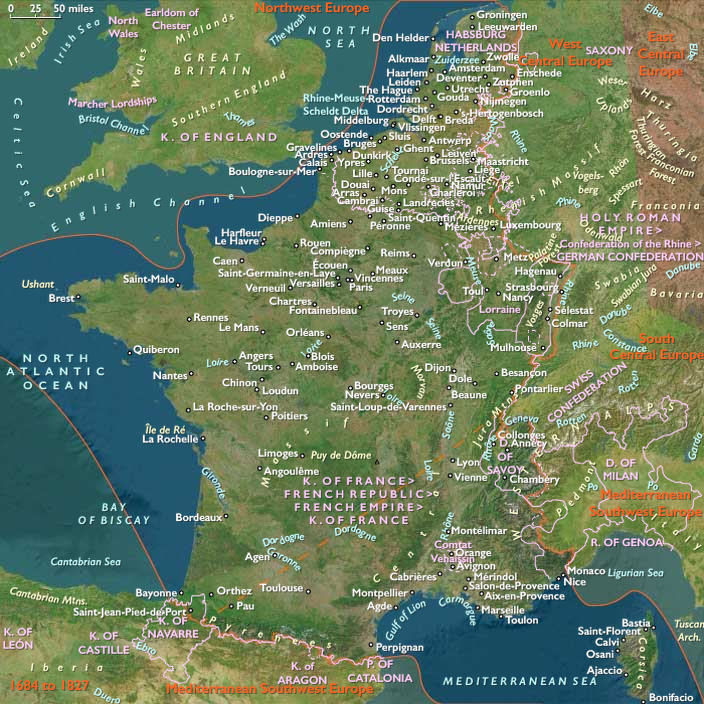
Between 1780 and 1791, Atlantic West Europe—comprising northern France, the Low Countries (modern Belgium, Netherlands, Luxembourg), and the Atlantic-facing and English Channel coastal regions—stood at a historic turning point. Marked by intensified revolutionary fervor, deepening economic pressures, Enlightenment-inspired critiques of established authority, and escalating social tensions, this era directly precipitated monumental political transformations, most notably the French Revolution of 1789.
Political and Administrative Developments
Rising Tensions and Prelude to Revolution in France
-
Under Louis XVI (r.1774–1792), France grappled with mounting fiscal crises, notably due to debts accumulated from aiding the American Revolution (1775–1783). Ministers, including Jacques Necker and Charles Alexandre de Calonne, attempted fiscal reforms but faced vehement resistance from aristocratic and clerical elites.
-
The convening of the Estates-General (1789)—France’s legislative body, dormant since 1614—was a response to the fiscal impasse but quickly evolved into a political catalyst, igniting revolutionary demands for constitutional governance, equal representation, and the dismantling of feudal privileges.
Revolt and Reform in the Austrian Netherlands
-
Under Emperor Joseph II (r.1780–1790), extensive Enlightenment-inspired reforms sought centralization, religious tolerance, and reduced ecclesiastical influence, sparking widespread unrest in the Austrian Netherlands (Belgium).
-
The Brabant Revolution (1789–1790) emerged as a regional revolt against Austrian centralization, establishing a short-lived United States of Belgium (1790), which briefly asserted local autonomy before Habsburg control was re-established under Leopold II (r.1790–1792).
Dutch Republic: Patriotic Movement and Foreign Intervention
-
In the Dutch Republic, the Patriotic Revolution (1780–1787)—driven by progressive political societies demanding republican reforms and reduced monarchical influence—challenged traditional Orangist dominance.
-
The revolution ended with Prussian military intervention (1787), reinstating Orangist authority, yet profoundly altering Dutch political culture and laying foundations for future republican reforms.
Economic Developments: Prosperity, Crisis, and Transition
Maritime Trade Prosperity and Vulnerability
-
Atlantic trade remained prosperous, notably benefiting ports such as Bordeaux, Nantes, and Amsterdam through vibrant commerce in wine, textiles, sugar, and colonial commodities. However, increasing competition from Britain, financial volatility, and trade disruptions from ongoing conflicts gradually eroded economic stability.
-
Dutch maritime trade and finance faced growing pressure from British naval power, while Antwerp and Brussels, despite regional unrest, experienced continued economic resilience through sustained commercial activities.
Agricultural Crisis and Food Scarcity
-
Severe agricultural disruptions, particularly the devastating harvest failures of 1787–1789, led to widespread food scarcity, rising bread prices, and intensified rural hardship across northern France and Belgium. These conditions inflamed social unrest, fueling popular grievances against feudal structures and aristocratic privileges.
-
Economic desperation among rural populations accelerated rural-urban migration, exacerbating urban poverty and intensifying political radicalization in Paris, Brussels, Lille, and other cities.
Intellectual and Cultural Developments
Enlightenment Radicalism and Revolutionary Ideals
-
Enlightenment thought reached its revolutionary peak. Radical ideas about equality, liberty, secular governance, and human rights—advanced by figures like Voltaire, Rousseau, Condorcet, and radical journalist Camille Desmoulins—inspired widespread calls for political and social reform.
-
Revolutionary ideals proliferated rapidly through pamphlets, journals, and political clubs in urban centers, deeply influencing popular consciousness and intensifying demands for change.
Scientific and Educational Advancements
-
Significant advances continued in science and education, exemplified by the vibrant intellectual life at institutions such as the University of Leiden and Paris’s scientific academies, contributing to Enlightenment rationalism and empirical inquiry.
-
New public education initiatives, promoted by revolutionary ideals, fostered expanded literacy and political awareness among urban middle classes, artisans, and broader populations.
Religious and Social Developments
Secularization and the Decline of Ecclesiastical Authority
-
Enlightenment critiques continued undermining traditional religious authority, promoting secularism and anticlerical attitudes, particularly among urban populations in Paris, Amsterdam, and Brussels.
-
Joseph II’s reforms in Belgium further attempted to curtail clerical privileges, inciting strong resistance but also advancing the principle of state sovereignty over church authority.
Social Crisis and Revolutionary Mobilization
-
Deepening economic disparities and increasing taxation inflamed social tensions among peasants, urban artisans, and middle-class intellectuals across northern France and the Low Countries, fueling revolutionary mobilization.
-
Revolutionary clubs, salons, and public assemblies proliferated, especially in Paris, Brussels, and Amsterdam, creating potent environments for political radicalization and activism.
Cultural and Artistic Flourishing
Neoclassical Dominance and Revolutionary Art
-
Neoclassicism thrived, reflecting Enlightenment ideals of rationality, republican virtue, and civic morality. Artists such as Jacques-Louis David, whose politically charged works (Oath of the Horatii, 1784) symbolized revolutionary ideals, profoundly influenced public sentiment.
-
Architectural and urban planning developments, exemplified in Paris and Brussels, emphasized rational planning, classical aesthetics, and civic utility, reflecting broader Enlightenment ideals.
Literary Innovation and Revolutionary Expression
-
Literary output surged, characterized by revolutionary fervor. Writings of political thinkers and journalists proliferated, significantly shaping revolutionary discourse and spreading revolutionary consciousness among literate and semi-literate populations.
-
In theater, plays critical of aristocratic privilege and advocating republican values captivated urban audiences, reinforcing revolutionary ideology.
Urban and Social Transformations
Urban Expansion and Revolutionary Epicenters
-
Urban centers like Paris, Brussels, and Amsterdam became crucibles of revolutionary ideas and actions. Rising urban poverty and dissatisfaction over social inequalities intensified revolutionary activism, public demonstrations, and political organization.
-
Paris notably emerged as the epicenter of revolutionary mobilization, culminating in major political events such as the storming of the Bastille (July 14, 1789), which symbolically ended feudal absolutism and initiated revolutionary governance.
Social Mobility and Revolutionary Agitation
-
Increasingly influential urban middle classes, merchants, and intellectuals, combined with disenfranchised artisans and urban poor, constituted crucial revolutionary constituencies. Their mobilization significantly undermined traditional social hierarchies, fostering new social dynamics and revolutionary ideals of meritocracy, equality, and political representation.
Legacy and Historical Significance
The period 1780–1791 decisively shaped the historical trajectory of Atlantic West Europe:
-
Politically, the era witnessed revolutionary tensions erupting into open revolt, profoundly altering traditional governance structures and heralding republican ideals.
-
Economically, crises, vulnerabilities, and agricultural disruptions intensified social tensions, directly fueling revolutionary fervor.
-
Intellectually, revolutionary Enlightenment ideas reached their zenith, fundamentally reshaping political ideologies, social attitudes, and cultural expressions.
-
Socially and culturally, the mobilization of urban populations, strengthened by Enlightenment ideals and revolutionary rhetoric, established potent models of civic activism, political organization, and public participation.
Ultimately, these decisive years set the stage for transformative revolutionary upheavals, dramatically reshaping Atlantic West Europe’s political, social, and cultural landscapes, and profoundly influencing subsequent European history.
Charles Alexandre de Calonne, born in Douai of an upper-class family, hed entered the legal profession and become a lawyer to the general council of Artois, procureur to the parlement of Douai, maître des requêtes, intendant of Metz (1768) and of Lille (1774).
He seems to be a man with notable business abilities and an entrepreneurial spirit, while generally unscrupulous in his political actions.
In the terrible crisis preceding the French Revolution, when successive ministers have tried in vain to replenish the exhausted royal treasury, Calonne had been summoned as Controller-General of Finances, an office he had assumed on November 3, 1783.
He owes the position to the Comte de Vergennes, who for the past three years has continued to support him.
According to the Habsburg ambassador, his public image is extremely poor.
Calonne had immediately set about remedying the fiscal crisis, and he has found in Louis XVI enough support to create a vast and ambitious plan of revenue-raising and administrative centralization.
Calonne has ocused on maintaining public confidence through building projects and spending, which is mainly designed to maintain the Crown's capacity to borrow funds.
He presents the king with his plan on August 20, 1786.
At its heart is a new land value tax, which will replace the old vingtieme taxes and finally sweep away the fiscal exemptions of the privileged orders.
The new tax will be administered by a system of provincial assemblies elected by the local property owners at parish, district and provincial level.
This central proposal is accompanied by a further package of rationalizing reform, including free trade in grain and abolition of France's myriad internal customs barriers.
It is in effect one of, if not the most, comprehensive attempts at enlightened reform during the reign of Louis XVI.
Calonne, in taking office, had found debts of one hundred and ten million livres, debts caused by France's involvement in the American Revolution among other reasons, and no means of paying them.
At first he had attempted to obtain credit, and to support the government by means of loans so as to maintain public confidence in its solvency.
In October 1785 he had reissued the gold coinage, and developed the caisse d'escompte (dealing in cash discounts).
Knowing the Parlement of Paris would veto a single land tax payable by all landowners, Calonne has persuaded Lous XVI to call an assembly of notables to vote on his referendum.
Calonne's eventual reform package, which will be introduced to the Assembly of Notables, consists of five major points:
1) Cut Government Spending
2) Create a revival of free trade methods
3) Authorize the sale of Church property
4) Equalization of salt and tobacco taxes
5) Establish a universal land value tax
All these measures will fail because of the powerlessness of the crown to impose them.
As a last resort, he proposes to the king the suppression of internal customs duties, and argues in favor of the taxation of the property of nobles and clergy.
Anne Robert Jacques Turgot and Jacques Necker had attempted these reforms, and Calonne attributes their failure to the opposition of the parlements.
Therefore, he calls an Assemblée des notables in February 1787, to which he presents the deficit in the treasury, and proposes the establishment of a subvention territoriale, which will be levied on all property without distinction.
Calonne's spendthrift and authoritarian reputation is well-known to the parlements, earning him their enmity.
Knowing this, he had intentionally submitted his reform program directly to the king and the hand-picked assembly of notables, not to the sovereign courts or parlements, first.
Composed of the old regime's social and political elite, however, the assembly of notables had balked at the deficit presented to them when they met at Versailles in February 1787, despite Calonne's plan for reform and his backing from the king.
If Calonne thought he would find more cooperation by changing the assembly, he was mistaken.
He had proposed a "land tax," Subvention Territoriale, to be imposed on all land-holders, rich or poor.
A storm of protest had arisen. Charges of mismanagement had been made.
Calonne, angered, had printed his reports and so alienated the court.
Louis XVI dismisses him on April 8, 1787, and exiles him to Lorraine.
The joy is general in Paris, where Calonne, accused of wishing to raise taxes, is known as Monsieur Déficit.
Calonne will soon afterward leave for Great Britain, and during his residence there will kept up a polemical correspondence with Necker.
After being dismissed, Calonne states, "The King, who assured me a hundred times that he would support me with unshakable firmness, abandoned me, and I succumbed”.
It had not met since 1626.
The usual business of registering the King's edicts as law is performed by the Parlement of Paris.
In this year it is refusing to cooperate with Calonne's program of badly needed financial reform, due to the special interests of its noble members.
As a last measure, Calonne had hoped to bypass them by reviving an archaic institution.
The initial roster of Notables includes one hundred and thirty-seven nobles, among them many future revolutionaries, such as the Comte de Mirabeau, and the Marquis de Lafayette, hero of the American Revolution, a major general in George Washington's Continental Army when the French army and navy helped it to victory in the Battle of Yorktown.
Calonne's replacement is Étienne Charles de Loménie de Brienne, President of the Assembly of Notables.
He is offered the post of Prime Minister, which is to include being Controller.
The Notables nevertheless remain recalcitrant.
They make a number of proposals but they will not grant the King money.
Lafayette suggests that the problem requires a national assembly.
Brienne asks him if he means the Estates General.
On receiving an affirmative answer, Brienne records it as a proposal.
Frustrated by his inability to obtain money, the King stages a day-long harangue, and on May 25 dissolves the Notables.
Their proposals revert to the Parlement.
Grenoble is the scene of popular unrest due to financial hardship from the economic crises.
The causes of the French Revolution affect all of France, but matters come to a head first in Grenoble.
Unrest in the town is sparked by the attempts of Cardinal Étienne Charles de Loménie de Brienne, the Archbishop of Toulouse and Controller-General of Louis XVI, to abolish the Parlements in order to enact a new tax to deal with France's unmanageable public debt.
Tensions in urban populations have been rising already due to poor harvests and the high cost of bread in France.
These tensions are exacerbated by the refusal of the privileged classes, the Church and the aristocracy, to relinquish any of their fiscal privileges.
They insist on retaining the right to collect feudal and seignorial royalties from their peasants and landholders.
This acts to block reforms attempted by the king's minister Charles Alexandre de Calonne and the Assembly of Notables that he had convoked in January 1787.
Added to this, Brienne, appointed the king's Controller-General of Finance on April 8, 1787, is widely regarded as being a manager without experience or imagination.
Shortly prior to the 7th of June in 1788, in a large meeting at Grenoble, those who attend the meeting decided to call together the old Estates of the province of Dauphiné.
The government responds by sending troops to the area to put down the movement.
They rush to the city gates to prevent the departure of judges who had taken part in the Grenoble meeting.
Some rioters attempt to cross the Isère but face a picket of fifty soldiers at the St. Lawrence bridge, while others head to the Rue Neuve.
The cathedral’s bells are seized by French peasants at noon.
The crowd swiftly grows, as the bells provoke the influx of neighboring peasants to creep in the city, climbing the walls, using boats on the Isere and for some, pushing open the city gates.
Other insurgents board the ramparts and rush to the hotel (L'hôtel de la Première présidence) the Duke of Clermont-Tonnerre is staying in at this time.
The Duke has two elite regiments in Grenoble, the Regiment of the Royal Navy (Régiment Royal-La-Marine) whose colonel is Marquis d'Ambert, and the regiment of Australasia (Régiment d'Austrasie) which is commanded by Colonel Count Chabord.
The Royal Navy is the first to respond to the growing crowds, and are given the order to quell the rioting without the use of arms.
However, as the mob storms the hotel entrance, the situation escalates.
Soldiers sent to quell the disturbances force the townspeople off the streets.
Some sources say that the soldiers were sent to disperse parliamentarians who were attempting to assemble a parlement.
During an attack, Royal Navy soldiers injure a seventy-five year old man with a bayonet.
At the sight of blood, the people become angry and start to tear up the streets.
Townspeople climb onto the roofs of buildings around the Jesuit College to hurl down a rain of roof-tiles on the soldiers in the streets below, hence the episode's name.
Many soldiers take refuge in a building to shoot through the windows, while the crowd continues to rush inside and ravage everything.
A non-commissioned officer of the Royal Navy, commanding a patrol of four soldiers, gives the order to open fire into the mob.
One civilian is killed and a boy of twelve wounded.
To the east of the city, the Royal Navy soldiers are forced to open fire in order to protect the city's arsenal, fearing that the rioters will seize the weapons and ammunition.
Meanwhile, Colonel Count Chabord begins deploying the regiment of Australasia to aid and relieve the Royal Navy soldiers.
Three of the four city councilors gather at the City Hall and attempt to reason with the crowd.
However, their words are silenced amid the clamor of the mob.
Through great difficulty, the councilors make their way through the crowds and eventually take refuge with the officers of the local garrison.
Later this evening, the Duke of Clermont-Tonnerre withdraws his troops from the streets and hotel to prevent further violence from escalating the situation.
The Duke manages to narrowly escape the hotel before the crowd completely loots the inside.
With control of the hotel lost, the Royal Navy troops are ordered to return to their quarters.
At six, a crowd estimated at ten thousand people shouting "Long live the parliament" forces the judges to return to the Palace of the Parliament of Dauphiné (Palais du Parlement du Dauphiné) by flooding them with flowers.
Throughout the night, carillons sound triumphantly and a large bonfire crackles on Saint-André square surrounded by a crowd that dances and sings "Long live forever our parliament! May God preserve the King and the devil take Brienne and Lamoignon."
The commander of the troops finds the situation so alarming that he agrees to allow the meeting of the Estates to proceed, but not in the capital.
A meeting is therefore arranged for the July 21, 1788 at the nearby village of Vizille.
This meeting will become known as the Assembly of Vizille.
In all, six outbreaks of rioting have been identified in the city during the 7th of June.