Cetshwayo kaMpande
King of the Zulu Kingdom
Years: 1826 - 1884
Cetshwayo kaMpande (1826– 8 February 1884) is the King of the Zulu Kingdom from 1872 to 1879 and their leader during the Anglo-Zulu War (1879).
His name has been transliterated as Cetawayo, Cetewayo, Cetywajo and Ketchwayo.
He famously leads the Zulu nation to victory against the British in the Battle of Isandlwana.
Related Events
Filter results
Showing 9 events out of 9 total
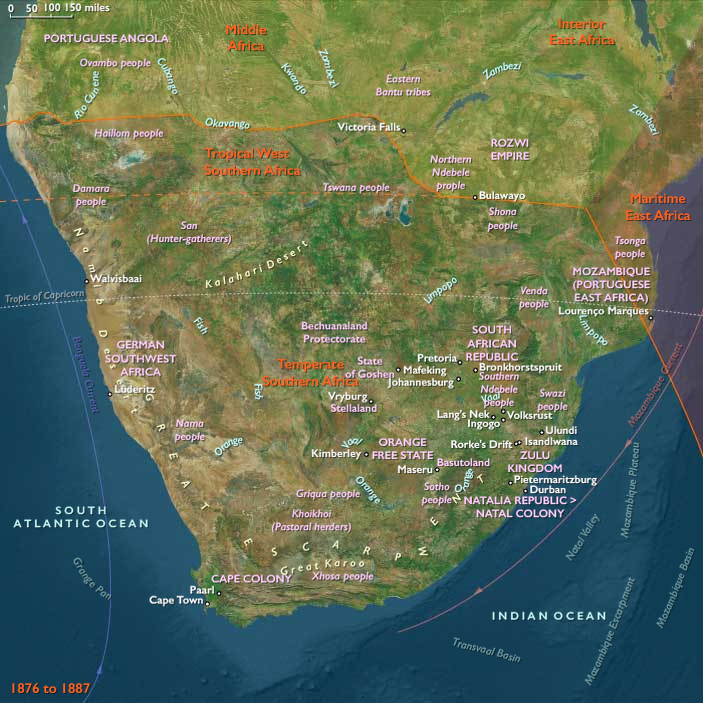
The two Boer republics, the Orange Free State and the Transvaal, are squeezed between the British-ruled Cape Colony to the south and west, Zululand to the east and Matabeleland and Bechuanaland to the north.
There had been a series of skirmishes within the Transvaal between the Boers and indigenous local tribes during the 1870s.
In particular, intensifying struggles between Boers and the Pedi, a Northern Sotho group led by Sekhukune I, over land and labor results in the war of 1876, in which the attacking Boers are defeated, in part because of the firepower bought with proceeds of early Pedi labor migration to the Kimberley diamond fields.
There are also serious tensions between the Transvaal Republic and the Zulus led by King Cetshwayo.
The Zulus occupy a kingdom located to the southeast, bordered on the one side by the Transvaal Republic and on the other by British Natal.
Cetshwayo, a son of Zulu king Mpande and Queen Ngqumbazi, half-nephew of the famous Zulu king Shaka and grandson of Senzangakhona kaJama, had in 1856 defeated and killed in battle his younger brother Mbuyazi, Mpande's favorite, and become the effective ruler of the Zulu people.
He did not ascend to the throne, however, as his father was still alive.
Stories from that time regarding his huge size vary, saying he stood at least between six feet six inches tall (one hundred and ninety-eight) and six feet eight inches tall (two hundred and three centimeters) and weighed close to twenty-five stone (one hundred and fifty-eight kilograms).
His other brother, Umtonga, was still a potential rival.
In 1861, Umtonga had fled to the Boers' side of the border and Cetshwayo had had to make deals with the Boers to get him back.
In 1865, Umtonga did the same thing, apparently making Cetshwayo believe that Umtonga would organize help from the Boers against him, the same way his father had overthrown his predecessor, Dingaan.
Mpande died in 1873 and Cetshwayo had become king on September 1.
As was customary, he has created a new capital for the nation and called it Ulundi (the high place).
Cetshwayo had expanded his army and reintroduced many of the paramilitary practices of Shaka.
He had also started equipping his impis with firearms, although this is a gradual process and the majority have only shields, clubs (knobkerries) and spears (throwing spears and the famous assegais).
Over forty thousand strong, disciplined, motivated and confident Zulu warriors are a formidable force on their own home ground, their lack of modern weaponry notwithstanding.
King Cetshwayo has banished European missionaries from his land, and there are suggestions that he might also have become involved in inciting other native African peoples to rebel against the Boers in the Transvaal.
The Transvaal Boers become increasingly concerned, but King Cetshwayo's policy is to maintain good relations with the British in Natal in an effort to counter the Boer threat.
Paul Kruger meets in Pietermaritzburg with the British representatives, Sir Henry Bartle Frere and Lieutenant General Frederic Thesiger (shortly to inherit the title of Lord Chelmsford) in September 1878, on his return from the second visit to London, n order to update them on the progress of the talks.
Sir Theophilus Shepstone, in his capacity as British governor of Natal, has his own concerns about the expansion of the Zulu army under King Cetshwayo and the potential threat to Natal especially given the adoption by the Zulus of muskets and other modern weapons.
Shepstone had been present at Cetshwayo's coronation, but has turned on the Zulus as he feels he is undermined by Cetshwayo's skillful negotiating for land area compromised by encroaching Boers.
In his new role of Administrator of the Transvaal, he is now responsible for protecting the Transvaal and has direct involvement in the Zulu border dispute from the side of the Transvaal.
Persistent Boer representations and Kruger's diplomatic maneuverings add to the pressure.
There are incidents involving Zulu paramilitary actions on either side of the Transvaal/Natal border, and Sir Shepstone increasingly begins to regard King Cetshwayo (who now finds no defender in Natal save Bishop Colenso) as having permitted such "outrages," and to be in a "defiant mood."
Disraeli's Tory administration in London does not want a war with the Zulus.
"The fact is," writes Sir Michael Hicks Beach, the colonial secretary in November 1878, "that matters in Eastern Europe and India... were so serious an aspect that we cannot have a Zulu war in addition to other greater and too possible troubles."
Sir Henry Bartle Frere, however, had been sent to the Cape Colony as governor and high commissioner in 1877 with the brief of creating a Confederation of South Africa from the various British colonies, Boer Republics and native states.
He concludes that the powerful Zulu kingdom stands in the way of this, and so is receptive to Sir Shepstone's arguments that King Cetshwayo and his Zulu army pose a challenge to the colonial powers’ peaceful occupation of the region.
Bartle Frere had begun to demand from the Zulus reparations for border infractions, mainly angering Cetshwayo, who keeps his calm until December 11, 1878, when Frere, notwithstanding the reluctance of the British government to start yet another colonial war, presents Cetshwayo with an ultimatum that the Zulu army be effectively be disbanded and the Zulus accept a British resident.
This is unacceptable to the Zulus as it effectively means that Cetshwayo, had he agreed, would lose his throne.
Cetshwayo asks for more time but Frere refuses.
Bartle Frere sends the British No. 3 Column under Lord Chelmsford to invade Zululand on January 11, with about seven thousand regular troops, a similar number of black African "levees" and a thousand white volunteers.
This results in the Battle of Isandlwana on January 22, 1879, which though a disaster for the British, does not end the war.
With the decisive defeat of Chelmsford's central column, the entire invasion of Zululand collapses and will have to be restaged.
Not only are there heavy manpower casualties to the Main Column, but most of the supplies, ammunition and draft animals have been lost.
As King Cetshwayo had feared, the embarrassment of the defeat will force the policy makers in London, who to this point had not supported the war, to rally to the support of the pro-war contingent in the Natal government and commit whatever resources are needed to defeat the Zulus.
Despite local numerical superiority, the Zulus do not have manpower, technological resources or logistical capacity to match the British in another, more extended, campaign.
The Zulus miss a tremendous opportunity to exploit their victory and possibly win the war this day on their own territory.
The reconnaissance force under Chelmsford, more vulnerable to being defeated by an attack than the camp is strung out and somewhat scattered, it had marched with limited rations and ammunition it cannot now replace, and it is panicky and demoralized by the defeat at Isandlwana.
Near the end of the battle, about four thousand Zulu warriors of the unengaged reserve Undi impi, after cutting off the retreat of the survivors to the Buffalo River southwest of Isandlwana, cross the river and attack the fortified mission station at Rorke's Drift.
The station is defended by only one hundred and thirty-nine British soldiers, who nonetheless inflict considerable casualties and repel the attack.
Elsewhere, the left and right flanks of the invading forces are now isolated and without support.
The No. 1 column under the command of Charles Pearson will be besieged for two months by a Zulu force at Eshowe, while the No. 4 column under Evelyn Wood halts its advance and will spend most of the next two months skirmishing in the northwest around Tinta's Kraal.
The British and Colonials had fallen into complete panic over the possibility of a counter invasion of Natal by the Zulus following the battles of Isandlwana and Rorke's Drift.
All the towns of Natal have 'laagered' up and fortified and provisions and stores laid in.
Bartle Frere has stoked the fear of invasion despite the fact that, aside from Rorke's Drift, the Zulus have made no attempt to cross the border.
Immediately following the battle, Zulu Prince Ndanbuko had urged them to advance and take the war into the colony but they were restrained by a commander, kaNthati, reminding them of Cetshwayo's prohibiting the crossing the border.
Unknown to the inhabitants of Natal, Cetshwayo, still hoping to avoid a total war, had prohibited any crossing of the border in retaliation and was incensed over the violation of the border by the attack on Rorke's Drift.
The British government's reasoning for a new invasion is threefold.
The first is jingoistic to a degree and national honor demands that the enemy, victors in one battle, should lose the war.
The second concerns the domestic political implications at the next parliamentary elections. (However, despite the new invasion, the British Prime Minister Disraeli and his party will lose the 1880 election.)
Finally, there are considerations affecting the Empire: unless the British are seen to win a clear-cut victory against the Zulus, it will send a signal that the British Empire is vulnerable and that the defeat of a British field army could alter policy.
If the Zulu victory at Isandlwana encourages resistance elsewhere in the Empire, then committing the resources necessary to defeat the Zulus will, in the long term, prove cheaper than fighting wars that the Zulu success inspire against British Imperialism elsewhere.
After Isandlwana, the British field army is heavily reinforced and again invades Zululand.
Sir Garnet Wolseley is sent to take command and relieve Chelmsford, as well as Bartle Frere.
Chelmsford, however, avoids handing over command to Wolseley and manages to defeat the Zulus in a number of engagements, the last of which is the Battle of Ulundi, followed by capture of King Cetshwayo.
The British encourage the subkings of the Zulus to rule their subkingdoms without acknowledging a central Zulu power.
By the time King Cetshwayo is allowed to return home in 1883 there will no longer be an independent Zulu kingdom.
The measure of respect that the British had gained for their opponents as a result of Isandlwana can be seen in that in none of the other engagements of the Zulu War had the British attempted to fight again in their typical linear formation, known famously as the Thin Red Line in an open-field battle with the main Zulu impi.
In the battles that followed, the British, when facing the Zulu, had entrenched themselves or formed very close-order formations, such as the square.
Sir Garnet Wolseley now turns to the Pedi in the Transvaal, and they are finally defeated by British troops in 1879.
The British now consolidate their power over Natal, the Zulu kingdom and the Transvaal.