Cao Zhang
Chinese general
Years: 189 - 223
Cao Zhang (died 223) is the third son of the warlord Cao Cao during the late Han Dynasty and Three Kingdoms era of Chinese history.
Cao Zhang is said to have wrestled and killed wild animals with his bare hands.
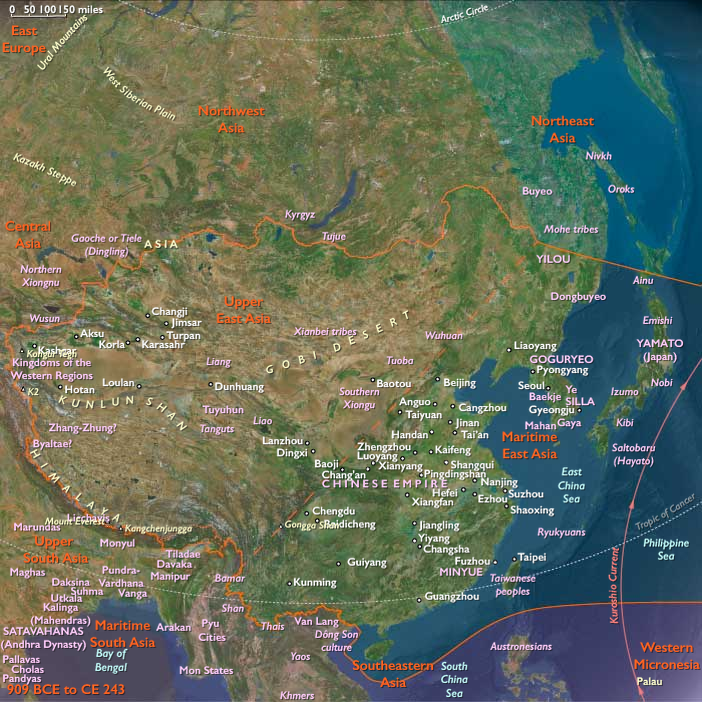
He is also a general under his father, having led his troops to significant victories against Wuhuan tribe incursions on the northern frontier.
Related Events
Filter results
Showing 6 events out of 6 total
…Liu Xun leads a force south to pillage Haihun (east of present-day Yongxiu County, Jiangxi).
Sun Ce is en route to attack Huang Zu, who was Sun Jian's killer, in Xiakou (present-day Hankou District, Wuhan, Hubei) when he receive the news.
He then turns back and captures the poorly defended Huancheng, taking over all of Yuan Shu's thirty thousand former troops.
Hearing that his base city had been taken, Liu Xun heads west and seeks help from Huang Zu, who sends a five thousand-strong naval force to assist him.
Sun Ce presses forward and defeats Liu Xun, who escapes north to Cao Cao.
Sun Ce annexes more than two thousand former troops and one thousand ships of his enemy and comes upon Huang Zu.
Despite reinforcements from Liu Biao, Huang Zu is utterly defeated.
During the battle, Sun Ce slays Liu Biao's officer, Han Xi, and completely routs Huang Zu's son, Huang She.
The victorious Sun Ce in 199 appears poised to take over the entirety of southern China.
As he is threatened by his rival Yuan Shao in the north and cannot divide his attention, Cao Cao attempts to further reinforce the alliance with Sun Ce by marrying the daughter of his relative Cao Ren to Sun Ce's youngest brother Sun Kuang.
Sun Ce in turn agrees to marry Sun Ben's daughter to Cao Cao's son Cao Zhang.
Cao Cao, chancellor of the Eastern Han Dynasty and Prince of Wei, as well as the warlords Liu Bei and Sun Quan, have continued over the past several years, to consolidate their power in their respective regions.
Through many wars, China has become divided into three powers—Wei, Shu and Wu, which have fought sporadic battles without the balance tipping significantly in anyone's favor.
Cao Cao is an accomplished poet, as are his sons Cao Pi and Cao Zhi, collectively known as the "Three Caos".
Cao Cao is also a a patron of poets such as Xu Gan.
Of Cao's works, only a remnant remain today.
His verses, unpretentious yet profound, help to reshape the poetic style of his time and beyond, eventually contributing to the poetry styles associated with Tang Dynasty poetry.
Together with certain other poets, the poetry of the “Three Caos” forms the backbone of what is known as the Jian'an style.
Jian'an is the era name for the period from 196 to 220, the final era of the Han Dynasty; however, poets such as those of the Cao family will continue to write and develop poetry in this style after the end of the Han and after the founding of the Cao Wei dynasty: these are the "Jian'an" poets.
Poetry has been affected by civil strife towards the end of the Eastern Han Dynasty, contributing to the Jian'an poems' often solemn yet heart-stirring tone, frequently lamenting the ephemeral nature of life.
From the early folk songs characteristic of Han poetry, the Jian'an poetry represents a transition towards a more scholarly poetry characteristic of Six Dynasties poetry.
Cao Cao and other Jian'an poets are specifically noted for developments to the characteristic Han fu (or yuefu).
While keeping some features, the uneven line lengths derived from the folksong or ballad tradition are eliminated, or changed into a regular five-character line-length style—very similar and inspirational to the regular five-character line shi poetry of the Tang Dynasty.
Cao Cao himself also is noted for his ballad style verse, which he apparently sets to music.
At this time, elaborate percussion orchestras of bells, cymbals, drums, gongs and triangles accompany the chants of Chinese Buddhism.
Cao Cao also writes verse in the older four-character per line style characteristic of the Shijing "Classic Odes".
One of Cao's most celebrated poems is in the old four-character line style: written during the Battle of White Wolf Mountain against the northern Wuhuan in 207, it is titled Though the Tortoise Lives Long.
Another of Cao Cao's most well known poems, written right before the Battle of Red Cliffs in the winter of 208, is Short Song Style.
Cao Zhi uses folk songs and simple language styles.

Cao dies at Luoyang in the spring of 220 at the age of sixty-five, having failed to unify China under his rule.
His will instructs that he be buried near Ximen Bao's tomb in Ye without gold and jade treasures, and that his subjects on duty at the frontier are to stay in their posts and not attend the funeral as, in his own words, "the country is still unstable".
Even though Cao Pi had been crown prince for several years, there is initially some confusion as to what will happen next.
The apprehension is particularly heightened when, after Cao Cao's death, the Qing Province (modern central and eastern Shandong) troops under the powerful general Zang Ba suddenly desert, leaving Luoyang and returning home.
Further, Cao Cao’ third son, the well-known general Cao Zhang, arrives in Luoyang in a hurry, creating the apprehension that he intends to seize power from his brother.
Upon hearing this news at Cao Cao's headquarters at Yecheng, Cao Pi hastily declares himself the new Prince of Wei and issues an edict in the name of his mother, Princess Bian, before receiving an official confirmation from Emperor Xian of Han, of whom he is still technically a subject.
After Cao Pi's self-declaration, neither Cao Zhang nor any other individual take action against him.
He then orders his brothers, including Cao Zhang and Cao Zhi, back to their fiefs.
With the help of Jiang Ji, the political situation soon stabilizes.
Cao Pi makes his move for the imperial throne in the winter of 220, strongly suggesting to Emperor Xian that he should yield the throne.
Emperor Xian does so, and Cao Pi formally declines three times (a model that will be followed by future usurpers in Chinese history), and then finally accepts, ending the Han Dynasty and starting a new Wei Dynasty.
The former Emperor Xian is created the Duke of Shanyang.
Cao Pi posthumously honors his grandfather Cao Song and father Cao Cao as emperors, and his mother Princess Dowager Bian as empress dowager.
He also moves the imperial capital from Xu (in modern Xuchang, Henan) to Luoyang.
The Cao Wei princes (unlike princes of the Han Dynasty), under regulations established by Cao Pi, are not only distanced from central politics, they also have minimal authority even in their own principalities and are restricted in many ways, particularly in the use of military.
Cao Pi, who still fears and resents Cao Zhi, soon has the latter's fief reduced in size and has a number of his associates executed.
Ding Yi, who is chief among Cao Zhi's strategists, has his whole clan wiped out as a result of assisting the latter in the past.
Cao Pi's younger brother, Cao Xiong, is also said to have committed suicide out of fears for his brother.
Legend also says Cao Pi assassinated his own brother, Cao Zhang.
The choice of empress had been an immediate issue after Cao Pi became emperor in 220.
Lady Zhen was his wife, but by this point had long lost favor due to a variety of reasons including the struggle she had with a favorite concubine of Cao's, Guo Nüwang.
Lady Guo used the unlikely possibility that Zhen's son Cao Rui might be biologically Yuan Xi's son to full advantage in creating conflicts between Cao Pi and Lady Zhen.
Cao therefore had refused to summon Lady Zhen to Luoyang after he ascended the throne but instead ordered her to remain at Yecheng, which caused Lady Zhen to be resentful.
When words of her resentment reached Cao, he became angry and forced her to commit suicide.
In 222, Cao had created Consort Guo empress.
Empress Guo, however, is without make issue.
Lady Zhen's son Cao Rui is the oldest of Cao Pi's sons, but because she had been put to death and because of Cao Pi's lingering doubt as to his paternity, has not been created crown prince.
but instead had been made only the Prince of Pingyuan following Cao Pi's ascension.
Cao Pi, however, does not appear to have seriously considered any other son as heir.
(It might have been because the other sons were all significantly younger, although their ages were not recorded in history.)
In the summer of 226, when Cao Pi is seriously ill, he finally creates Prince Rui crown prince.
On his deathbed, he entrusts his successor to the care of Cao Zhen, Chen Qun, and Sima Yi.
Following Cao Pi's death, Prince Rui ascends the throne at the young age of twenty-one.