Camille Desmoulins
French journalist and politician
Years: 1757 - 1794
Lucie Simplice Camille Benoît Desmoulins (March 2, 1760 – April 5, 1794) is a journalist and politician who plays an important role in the French Revolution.
He is a childhood friend of Maximilien Robespierre and a close friend and political ally of Georges Danton, who are influential figures in the French Revolution.
Danton is his ally and, in the end, the Committee of Public Safety sentences both of these men to death.

Related Events
Filter results
Showing 8 events out of 8 total
Atlantic West Europe (1780–1791): Revolutionary Tensions, Economic Strains, and the Prelude to Upheaval
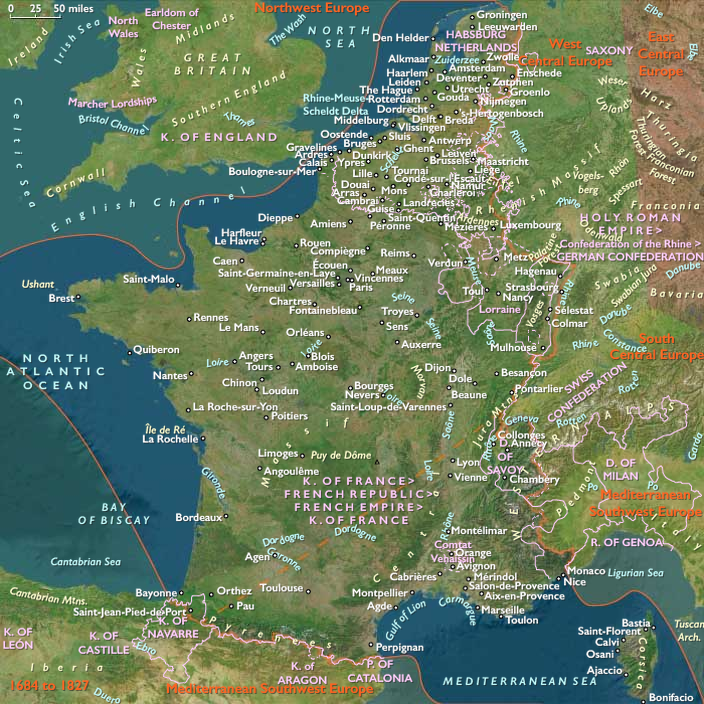
Between 1780 and 1791, Atlantic West Europe—comprising northern France, the Low Countries (modern Belgium, Netherlands, Luxembourg), and the Atlantic-facing and English Channel coastal regions—stood at a historic turning point. Marked by intensified revolutionary fervor, deepening economic pressures, Enlightenment-inspired critiques of established authority, and escalating social tensions, this era directly precipitated monumental political transformations, most notably the French Revolution of 1789.
Political and Administrative Developments
Rising Tensions and Prelude to Revolution in France
-
Under Louis XVI (r.1774–1792), France grappled with mounting fiscal crises, notably due to debts accumulated from aiding the American Revolution (1775–1783). Ministers, including Jacques Necker and Charles Alexandre de Calonne, attempted fiscal reforms but faced vehement resistance from aristocratic and clerical elites.
-
The convening of the Estates-General (1789)—France’s legislative body, dormant since 1614—was a response to the fiscal impasse but quickly evolved into a political catalyst, igniting revolutionary demands for constitutional governance, equal representation, and the dismantling of feudal privileges.
Revolt and Reform in the Austrian Netherlands
-
Under Emperor Joseph II (r.1780–1790), extensive Enlightenment-inspired reforms sought centralization, religious tolerance, and reduced ecclesiastical influence, sparking widespread unrest in the Austrian Netherlands (Belgium).
-
The Brabant Revolution (1789–1790) emerged as a regional revolt against Austrian centralization, establishing a short-lived United States of Belgium (1790), which briefly asserted local autonomy before Habsburg control was re-established under Leopold II (r.1790–1792).
Dutch Republic: Patriotic Movement and Foreign Intervention
-
In the Dutch Republic, the Patriotic Revolution (1780–1787)—driven by progressive political societies demanding republican reforms and reduced monarchical influence—challenged traditional Orangist dominance.
-
The revolution ended with Prussian military intervention (1787), reinstating Orangist authority, yet profoundly altering Dutch political culture and laying foundations for future republican reforms.
Economic Developments: Prosperity, Crisis, and Transition
Maritime Trade Prosperity and Vulnerability
-
Atlantic trade remained prosperous, notably benefiting ports such as Bordeaux, Nantes, and Amsterdam through vibrant commerce in wine, textiles, sugar, and colonial commodities. However, increasing competition from Britain, financial volatility, and trade disruptions from ongoing conflicts gradually eroded economic stability.
-
Dutch maritime trade and finance faced growing pressure from British naval power, while Antwerp and Brussels, despite regional unrest, experienced continued economic resilience through sustained commercial activities.
Agricultural Crisis and Food Scarcity
-
Severe agricultural disruptions, particularly the devastating harvest failures of 1787–1789, led to widespread food scarcity, rising bread prices, and intensified rural hardship across northern France and Belgium. These conditions inflamed social unrest, fueling popular grievances against feudal structures and aristocratic privileges.
-
Economic desperation among rural populations accelerated rural-urban migration, exacerbating urban poverty and intensifying political radicalization in Paris, Brussels, Lille, and other cities.
Intellectual and Cultural Developments
Enlightenment Radicalism and Revolutionary Ideals
-
Enlightenment thought reached its revolutionary peak. Radical ideas about equality, liberty, secular governance, and human rights—advanced by figures like Voltaire, Rousseau, Condorcet, and radical journalist Camille Desmoulins—inspired widespread calls for political and social reform.
-
Revolutionary ideals proliferated rapidly through pamphlets, journals, and political clubs in urban centers, deeply influencing popular consciousness and intensifying demands for change.
Scientific and Educational Advancements
-
Significant advances continued in science and education, exemplified by the vibrant intellectual life at institutions such as the University of Leiden and Paris’s scientific academies, contributing to Enlightenment rationalism and empirical inquiry.
-
New public education initiatives, promoted by revolutionary ideals, fostered expanded literacy and political awareness among urban middle classes, artisans, and broader populations.
Religious and Social Developments
Secularization and the Decline of Ecclesiastical Authority
-
Enlightenment critiques continued undermining traditional religious authority, promoting secularism and anticlerical attitudes, particularly among urban populations in Paris, Amsterdam, and Brussels.
-
Joseph II’s reforms in Belgium further attempted to curtail clerical privileges, inciting strong resistance but also advancing the principle of state sovereignty over church authority.
Social Crisis and Revolutionary Mobilization
-
Deepening economic disparities and increasing taxation inflamed social tensions among peasants, urban artisans, and middle-class intellectuals across northern France and the Low Countries, fueling revolutionary mobilization.
-
Revolutionary clubs, salons, and public assemblies proliferated, especially in Paris, Brussels, and Amsterdam, creating potent environments for political radicalization and activism.
Cultural and Artistic Flourishing
Neoclassical Dominance and Revolutionary Art
-
Neoclassicism thrived, reflecting Enlightenment ideals of rationality, republican virtue, and civic morality. Artists such as Jacques-Louis David, whose politically charged works (Oath of the Horatii, 1784) symbolized revolutionary ideals, profoundly influenced public sentiment.
-
Architectural and urban planning developments, exemplified in Paris and Brussels, emphasized rational planning, classical aesthetics, and civic utility, reflecting broader Enlightenment ideals.
Literary Innovation and Revolutionary Expression
-
Literary output surged, characterized by revolutionary fervor. Writings of political thinkers and journalists proliferated, significantly shaping revolutionary discourse and spreading revolutionary consciousness among literate and semi-literate populations.
-
In theater, plays critical of aristocratic privilege and advocating republican values captivated urban audiences, reinforcing revolutionary ideology.
Urban and Social Transformations
Urban Expansion and Revolutionary Epicenters
-
Urban centers like Paris, Brussels, and Amsterdam became crucibles of revolutionary ideas and actions. Rising urban poverty and dissatisfaction over social inequalities intensified revolutionary activism, public demonstrations, and political organization.
-
Paris notably emerged as the epicenter of revolutionary mobilization, culminating in major political events such as the storming of the Bastille (July 14, 1789), which symbolically ended feudal absolutism and initiated revolutionary governance.
Social Mobility and Revolutionary Agitation
-
Increasingly influential urban middle classes, merchants, and intellectuals, combined with disenfranchised artisans and urban poor, constituted crucial revolutionary constituencies. Their mobilization significantly undermined traditional social hierarchies, fostering new social dynamics and revolutionary ideals of meritocracy, equality, and political representation.
Legacy and Historical Significance
The period 1780–1791 decisively shaped the historical trajectory of Atlantic West Europe:
-
Politically, the era witnessed revolutionary tensions erupting into open revolt, profoundly altering traditional governance structures and heralding republican ideals.
-
Economically, crises, vulnerabilities, and agricultural disruptions intensified social tensions, directly fueling revolutionary fervor.
-
Intellectually, revolutionary Enlightenment ideas reached their zenith, fundamentally reshaping political ideologies, social attitudes, and cultural expressions.
-
Socially and culturally, the mobilization of urban populations, strengthened by Enlightenment ideals and revolutionary rhetoric, established potent models of civic activism, political organization, and public participation.
Ultimately, these decisive years set the stage for transformative revolutionary upheavals, dramatically reshaping Atlantic West Europe’s political, social, and cultural landscapes, and profoundly influencing subsequent European history.
The Parisians generally presume that the dismissal marks the start of a coup by conservative elements.
Liberal Parisians are further enraged by the fear that a concentration of Royal troops—brought in from frontier garrisons to Versailles, Sèvres, the Champ de Mars, and Saint-Denis—will attempt to shut down the National Constituent Assembly, which is meeting in Versailles.
Crowds gather throughout Paris, including more than ten thousand at the Palais-Royal.
The angry Parisian crowd, inflamed by a speech from journalist Camille Desmoulins, demonstrates against the King's decision to dismiss Minister Necker.
Desmoulins was born at Guise, Aisne, in Picardy.
His father, Jean Benoît Nicolas Desmoulins, is a rural lawyer and lieutenant-general of the bailliage of Guise.
Through the efforts of a friend, he had obtained a scholarship for the fourteen-year-old Camille to enter the Collège Louis-le-Grand in Paris.
Desmoulins had proved an exceptional student even among such notable contemporaries as Maximilien Robespierre and Louis-Marie Stanislas Fréron.
He had excelled in the study of Classical literature and politics, and gained a particular affinity for Cicero, Tacitus and Livy.
He had pursued law, and succeeded in gaining acceptance as an advocate of the parlement of Paris in 1785; however, his serious stammer and ferocious temper had proved severe obstacles to success in this arena.
Thus stymied, he had turned towards writing as an alternative outlet for his talents; his interest in public affairs had led him to a career as a political journalist.
In March 1789, Jean Benoît Nicolas Desmoulins had been nominated as deputy to the Estates-General from the bailliage of Guise; however, due to illness, he had failed to take his seat.
Camille Desmoulins, himself limited to the role of spectator at the procession of the Estates-General on May 5, 1789, had written a response to the event: Ode aux Etats Generaux.
The Comte de Mirabeau, a powerful political figure within the Estates-General who has positioned himself as a bridge between the aristocracy and the emerging reformist movement, had briefly enlisted Desmoulins to write for his newspaper at this time, strengthening Desmoulins' reputation as a journalist.
Owing to his difficulties in establishing a career as a lawyer, Desmoulins' position in Paris is a precarious one, and he often lives in poverty.
However, he had been greatly inspired and enthused by the current of political reform that surrounded the summoning of the Estates-General.
In letters to his father at the time, he had rhapsodized over the procession of deputies entering the Palace of Versailles, and criticized the events surrounding the closing of the Salle des Menus Plaisirs to the deputies who had declared themselves the National Assembly—events that led to the famous swearing of the Tennis Court Oath.
On July 12, spurred by the news of the politically unsettling dismissal of Necker, Desmoulins leaps onto a table outside the Cafe du Foy (one of many cafés in the garden of the Palais Royal frequented in large part by political dissidents) and delivers an impassioned call to arms.
Shedding his customary stammer in the excitement, he urges the volatile crowd to "take up arms and adopt cockades by which we may know each other", calling Necker's dismissal the tocsin of the St. Bartholomew of the patriots, a reference to the St. Batholomew's Day Massacre.
The stationing of a large number of troops in Paris, many foreign, has led Desmoulins and other political radicals to believe that a massacre of dissidents in the city is indeed imminent.
This is an idea that his audience also finds plausible and threatening, and they are quick to embrace Desmoulins and take up arms in riots that spread throughout Paris rapidly.
However, the color green is also associated with the Comte d'Artois, the reactionary and conservative brother of the King, and the cockades therefore are quickly replaced by others in the traditional colors of Paris: red and blue.
The forces semi-organized under this banner had attacked the Hôtel des Invalides to gain arms and, on 14 July, embark upon the Storming of the Bastille.
In short order, the entire body settles in only a few steps from the Tuileries at a former riding school, the Salle du Manège.
However, some fifty-six monarchien deputies have not come with them, believing the mob threat in the capital to be personally dangerous.
The October journées have thus effectively deprived the monarchist faction of significant representation in the Assembly as most of these deputies retreat from the political scene; many, like Mounier, flee the country altogether.
Conversely, Robespierre's impassioned defense of the march has raised his public profile considerably.
The episode has given him a lasting heroic status among the poissardes and burnished his reputation as a patron of the poor.
His later rise to become virtual dictator of the Revolution is greatly facilitated by his actions during the occupation of the Assembly.
Lafayette, though initially acclaimed, finds that he has tied himself too closely to the king.
As the Revolution progresses, he will be hounded into exile by the radical leadership.
Maillard has returned to Paris with his status as a local hero made permanent.
He will participate in several later journées, but in 1794 will become stricken with illness, dying at the age of thirty-one.
For the women of Paris, the march will become the source of apotheosis in revolutionary hagiography.
The "Mothers of the Nation" had been highly celebrated upon their return, and they will be praised and solicited by successive Parisian governments for years to come.
King Louis XVI is officially welcomed to Paris with a respectful ceremony held by mayor Jean Sylvain Bailly.
His return is touted as a momentous turning point in the Revolution, by some even as its end.
Optimistic observers such as Camille Desmoulins declare that France will now enter a new golden age, with its revived citizenry and popular constitutional monarchy.
Others are more wary, such as journalist Jean-Paul Marat, who writes:
It is a source of great rejoicing for the good people of Paris to have their king in their midst once again. His presence will very quickly do much to change the outward appearance of things, and the poor will no longer die of starvation. But this happiness would soon vanish like a dream if we did not ensure that the sojourn of the Royal Family in our midst lasted until the Constitution was ratified in every aspect. L'Ami du Peuple shares the jubilation of its dear fellow citizens, but it will remain ever vigilant.
— L'Ami du Peuple #7 (1789)
Many workers are already angered by the closing of various workshops, which has taken away jobs, leaving some unemployed.
Higher-skilled journeymen are also angered due to a lack of increase in wages since the beginning of the Revolution.
The attempted flight of the King had only increased the tensions between groups.
The massacre is the direct result of various factions reacting to the decree by the Constituent Assembly in different ways.
The Cordeliers Club, a populist group, had chosen to create a petition for a protest.
This had originally been backed by the Jacobins, though support was withdrawn at Robespierre's suggestion.
The Cordeliers had proceeded by creating a more radical petition calling for a republic and planning a protest that would help gain more signatures.
Based on records of the petition and of the dead bodies, the crowd was made up of individuals from the poorer sections of Paris, some of whom may not have been able to read.
The organizers seemed to desire representation of Paris as a whole, rather than any specific section.
A majority of the Committee had decided in the winter of 1793–94 that the Hébertist party would have to perish or its opposition within the Committee would overshadow the other factions due to its influence in the Commune of Paris.
Robespierre also has personal reasons for disliking the Hébertists for their "atheism" and "bloodthirstiness", which he associates with the old aristocracy.
In early 1794, he breaks with Danton, who has more moderate views on the Terror, and has Camille Desmoulins protest against it in the third issue of Le Vieux Cordelier.
Robespierre considers an end of the Terror as meaning the loss of political power he hopes to use to create the Republic of Virtue.
Subsequently, he joins in attacks on the Dantonists and the Hébertists, charging his opponents with complicity with foreign powers.
From February 13 to March 13, 1794, Robespierre had withdrawn from active business on the Committee due to illness.
On March 15, he reappears in the Convention.
Hébert and nineteen of his followers are arrested on March 19 and guillotined on March 24.
Maximilien Robespierre’s Revolutionary tribunal, equating dissidence with counterrevolutionary agitation, guillotines not only such extremist leaders as Hebert but also such moderate Montagnards as Georges Danton and Camille Desmoulins.
Towards the end of the Reign of Terror, Danton is accused of various financial misdeeds, as well as using his own position in the Revolution for personal gain.
Many contemporaries have commented on Danton's financial success during the Revolution, an acquisition of money that he cannot adequately explain.
Many of the specific accusations directed against him are based on insubstantial or ambiguous evidence.
During his tenure on the Committee of Public Safety, Danton had been behind a peace treaty agreement with Sweden.
Although the Swedish government had not ratified the treaty, on June 28, 1793, the convention had voted to give 4 million livres for diplomatic negotiations.
According to Bertrand Barère, a journalist and member of the Convention, Danton had taken a portion of this money that was shared with the Swedish Regent Although Barere’s accusation is the only evidence against him, this is not the first time that Danton had been implicated in profiting from political service.
Between 1791 and 1793, Danton has faced many allegations, including taking bribes during the insurrection of August 1792, helping his secretaries to line their pockets, and even forging assignats during his mission to Belgium.
Perhaps the most compelling evidence of financial corruption is a letter from Mirabeau to Danton in March 1791 that casually refers to 30,000 livres that Danton had received in payment.
The final serious accusation, which haunts him during his arrest and forms a chief ground for his execution, is his alleged involvement with a scheme to appropriate the wealth of the French East India Company.
During the reign of the Old Regime the original French East India Company had gone bankrupt, but was brought back in 1785, backed by royal patronage.
The Company had eventually fallen under the notice of the National Convention for profiteering during the war.
Soon the Company is to be liquidated and certain members of the Convention try to push through a decree that will cause the share prices to rise before the liquidation.
Discovery of the profits from this insider trading lead to the blackmailing of the directors of the Company to turn over half a million livres to known associates of Danton.
While there is no hard evidence that Danton is involved, he is vigorously denounced by François Chabot, and implicated by the fact that Fabre d’Eglantine, a member of the Dantonists, is implicated in the scandal.
On March 30, Danton, Desmoulins, and others of the indulgent party are suddenly arrested.
Georges Danton displays such vehemence before the revolutionary tribunal that his enemies fear he will gain the crowd's favor.
The Convention, in its cowardice, assents to a proposal made by Saint-Just that, if a prisoner shows want of respect for justice, the tribunal might pronounce sentence without further delay.
Danton, Desmoulins, and many other actual or accused Dantonist associates are tried from April 3 through 5 before the Revolutionary Tribunal.
The trial is less criminal in nature than political, and as such unfolds in an irregular fashion.
The accused are prevented from defending themselves by a decree of the National Convention.
This fact, together with confusing and often incidental denunciations (for instance, a report that Danton, while engaged in political work in Brussels, had appropriated a carriage filled with several hundred thousand livres of table linen) and threats made by prosecutor Antoine Quentin Fouquier-Tinville towards members of the jury, help to ensure a guilty verdict.
Additionally, the accused are denied the right to have witnesses appear on their behalf, though they have submitted requests for several -- including, in Desmoulins' case, Robespierre.
The verdict is passed in the absence of the accused, who had been removed from the courtroom to prevent unrest among the trial's observers.
Their execution is scheduled for the same day.
Danton is at once condemned, and led, in company with fourteen others, including Desmoulins, to the guillotine.
"I leave it all in a frightful welter," he said; "not a man of them has an idea of government.
Robespierre will follow me; he is dragged down by me.
Ah, better be a poor fisherman than meddle with the government of men!"
The phrase 'a poor fisherman' is almost certainly a reference to Saint Peter, Danton having reconciled to Catholicism.
In reference to his belief that Robespierre would meet a similar fate, his last words to the crowd are, "My only regret is that I am going before that rat Robespierre."
Danton's true last words are addressed to his executioner: "Don't forget to show my head to the people.
It's well worth seeing."