Boudica
queen of the British Iceni tribe
Years: 15 - 61
Boudica (alternative spelling: Boudicca), also known as Boadicea and known in Welsh as Buddug (d. CE 60 or 61) is queen of the British Iceni tribe who leads an uprising against the occupying forces of the Roman Empire.
Boudica's husband Prasutagus, ruler of the Iceni tribe who had ruled as a nominally independent ally of Rome, leaves his kingdom jointly to his daughters and the Roman Emperor in his will.
However, when he dies, his will is ignored — the kingdom is annexed as if conquered, Boudica is flogged, her daughters are raped, and Roman financiers call in their loans.
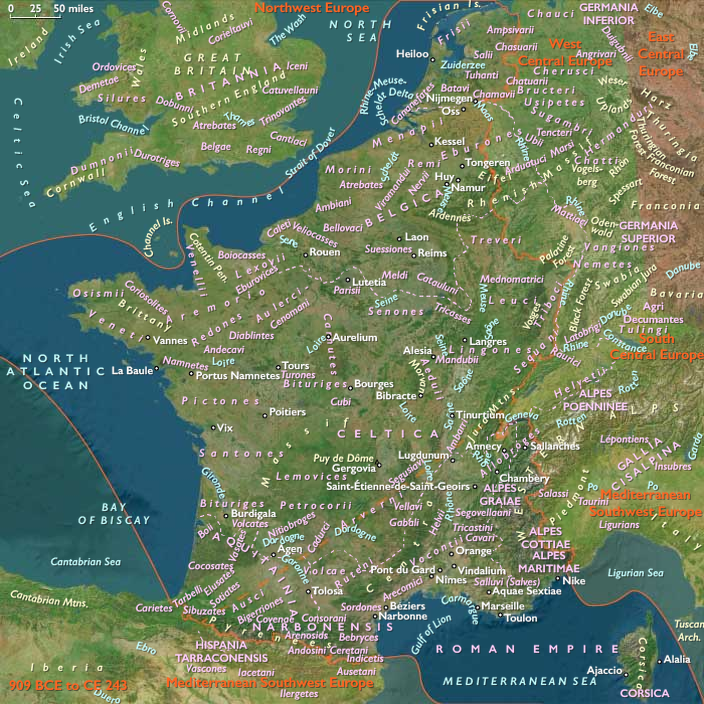
In CE 60 or 61, while the Roman governor, Gaius Suetonius Paulinus, is leading a campaign on the island of Anglesey in northern Wales, Boudica leads the Iceni people, along with the Trinovantes and others, in revolt.
They destroy Camulodunum (modern Colchester), formerly the capital of the Trinovantes, but now a colonia (a settlement for discharged Roman soldiers) and the site of a temple to the former emperor Claudius, which is built and maintained at local expense.
They also rout a Roman legion, the IX Hispana, sent to relieve the settlement.
On hearing the news of the revolt, Suetonius hurries to Londinium (London), the twenty-year-old commercial settlement that is the rebels' next target.
Concluding that he does not have the numbers to defend the settlement, Suetonius evacuates and abandons it — Londinium is burnt to the ground, as is Verulamium (St Albans).
An estimated 70,000–80,000 people are reported killed in the three cities (though the figures are suspect).
Suetonius, meanwhile, regroups his forces in the West Midlands and, despite being heavily outnumbered, defeats the Britons in the Battle of Watling Street.
The crisis causes the emperor Nero to consider withdrawing all Roman forces from Britain, but Suetonius' eventual victory over Boudica re-secures Roman control of the province.
Boudica then either kills herself so she would not be captured, or falls ill and dies— the extant sources, Tacitus and Cassius Dio, differ.
Interest in the history of these events was revived during the English Renaissance and led to a resurgence of Boudica's legendary fame during the Victorian era, when Queen Victoria was portrayed as her 'namesake'.
Boudica has since remained an important cultural symbol in the United Kingdom.
The absence of native British literature during the early part of the first millennium means that Britain owes its knowledge of Boudica's rebellion solely to the writings of the Romans.