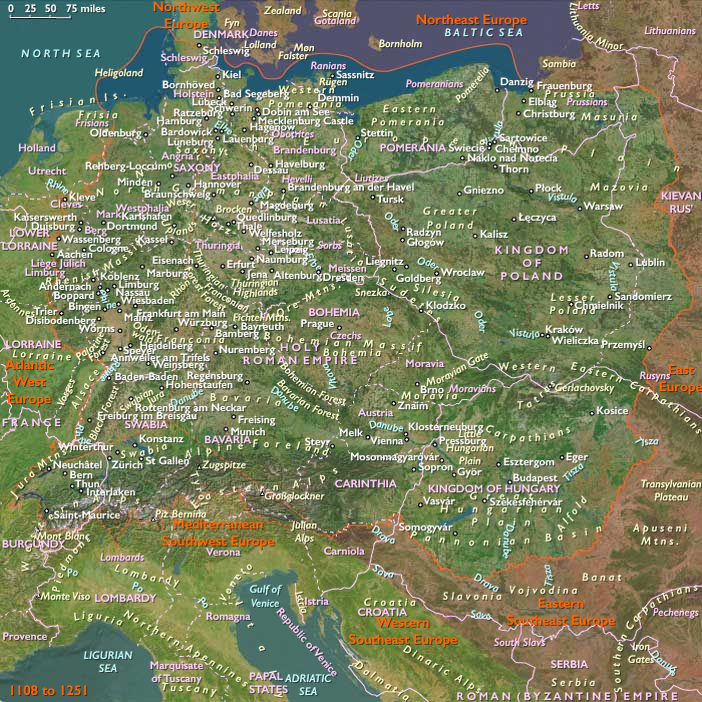
Wladyslaw II, the former High Duke of Poland, had administered the Kaiserpfalz at Altenburg and its dependencies in the Imperial Pleissnerland during the Second Crusade.
Without waiting for German aid, Wladyslaw and his wife Agnes had gone to the Roman Curia and asked Pope Eugene III for help in restoring Wladyslaw to the Polish throne but this attempt had been unsuccessful.
In 1152, King Conrad III of Germany had died and been succeeded by his nephew Frederick Barbarossa.
With this, the hopes of Wladyslaw II, called the Exile, of returning to Poland had been reborn.
Following the inducements of Wladyslaw and Frederick's aunt Agnes of Babenberg, the Holy Roman Emperor launches a new expedition to Greater Poland in 1157.
The campaign is a success, but unexpectedly Frederick Barbarossa does not restore Wladyslaw to the Polish throne, after Boleslaw IV, apprehended at Krzyszkowo, has to declare himself a vassal to the Emperor andis compelled to pay tribute to him.
In compensation, the Emperor forces Boleslaw IV to promise the restitution of Silesia to Wladylsaw's sons Boleslaw the Tall and Mieszko IV Tanglefoot.
At this time, it appears, Wladyslaw knew that his battle for supremacy in Poland was finally lost.
He remains in exile at Altenburg, where he will die two years later.
It will not be until 1163 that Boleslaw IV finally grants the Silesian province to Wladyslaw's sons.