Boleslaw III Wrymouth
Prince of Poland
Years: 1086 - 1138
Bolesław III Wrymouth (also known as Boleslaw III the Wry-mouthed, Polish: Bolesław III Krzywousty) (20 August 1086 – 28 October 1138) is Prince of Poland from 1107 until 1138.
He is the only child of Prince Władyslaw I Herman and his first wife Judith, daughter of Vratislaus II of Bohemia.
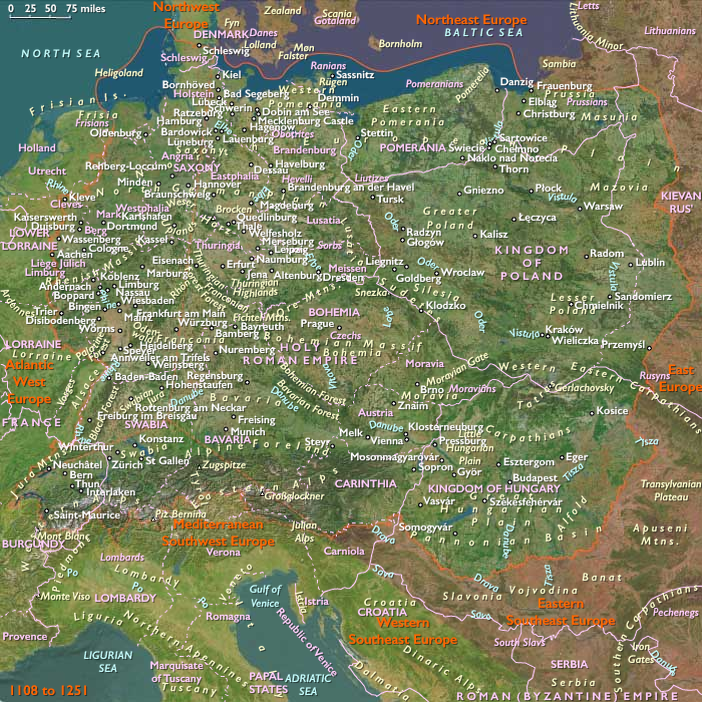
Boleslaw spends his early adulthood fighting his older half-brother Zbigniew for domination and most of his rule attending to the policy of unification of Polish lands and maintaining full sovereignty of the Polish state in the face of constant threat from the expansionist eastern policy of the Holy Roman Empire and her allies, most notably Bohemia.
Boleslaw III, like Boleslaw II the Bold, bases his foreign policy on maintaining good relations with neighboring Hungary and Kievan Rus, with whom he forges strong links through marriage and military cooperation.
Another foreign policy goal is the gain and conversion of Pomerania, which he initiates successfully by adding most of Pomerania to his domains by 1102–1122.
Bishop Otto of Bamberg from 1123 onward confirms the Christianization.
Bolesław III also upholds the independence of the Polish archbishopric of Gniezno.
He strengthes the international position of Poland by his victory over the Holy Roman Empire in the Holy Roman-Polish War of 1109.
He is also able to enlarge the country's territory.
Despite undoubted successes, Boleslaw III Wrymouth commits serious political errors, even against Zbigniew of Poland, his half-brother.
The crime against Zbigniew and his penance for it show Boleslaw’s great ambition as well as his ability to find political compromise.
His last, and perhaps the most momentous act, is his will and testament known as "The Succession Statute" in which he divides the country among his sons, leading to almost 200 years of feudal fragmentation of the Polish Kingdom.
Nevertheless, Bolesław becomes a symbol of Polish political aspirations until well into 19th century.