Haakon, born in 1340 (possibly in mid-August), most likely in Sweden, though the exact date and location of his birth remain unknown, is the younger son of Magnus Eriksson, king of Sweden and Norway, and Blanche of Namur.
His older brother Eric is a rival king of Sweden in opposition to his father between 1356 and 1359.
Haakon and his paternal family belong to the Swedish House of Bjelbo, which had succeeded the House of Eric in Sweden and the House of Sverre in Norway.
Haakon is a great-grandson of Haakon V of Norway through his only legitimate daughter, Ingeborg, and is considered an acceptable heir to the throne by the Norwegian nobility.
Another noteworthy ancestor of Haakon, through his paternal grandfather Eric Magnusson, Duke of Södermanland, is Magnus III of Sweden.
Haakon had been raised in Norway to prepare the young prince to later rule the kingdom in his own right.
During the early autumn of 1343, the most prominent members of the Norwegian Council of the Realm attended a meeting with Magnus at Varberg Castle.
Letters were issued throughout Norway and Sweden on August 15, 1343, stating that the King and the Council had decided to place Haakon on the throne of Norway.
Representatives of the cities and the general public had assembled barely a year later at Båhus Castle, where they hailed Haakon as their king and took the oath of perpetual fealty and servitude to him.
Though the meeting at Båhus Castle forged historic ties to the old elective monarchy in Norway, the acclamation documents created by the Council of the Realm stipulated that Haakon was to rule over only parts of Norway, and it was also carefully documented that the Norwegian Law of Succession would apply if he were to die leaving no legitimate son, thereby ensuring that the hereditary monarchy would be upheld.
The next in line to the Norwegian throne would then be his older brother Eric and his descendants, but the provision becomes moot when Eric dies in 1359.
The meetings at Varberg Castle in 1343 and at Båhus Castle in 1344 were later properly ratified in another meeting in the port city of Bergen as late as 1350.
Magnus had abdicated his Norwegian throne sometime between August 8 and 18 in 1355.
Haakon then ruled as the sole king in the kingdom, though his father continued to exercise control over Norway in the following years, albeit no longer in name.
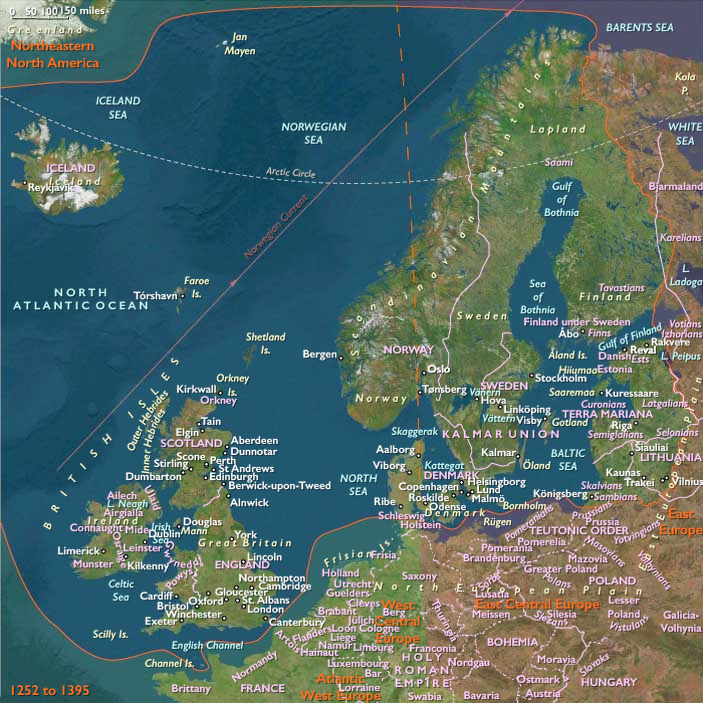
The first documented event in which Haakon acted as sole king and ruler over his kingdom was on January 22, 1358, when he sent a letter of approval for the privileges in the capital city of Oslo.Norway in 1355 had actually been partitioned between Haakon and Magnus: Magnus had specifically requested the territories of Hålogaland and the Norwegian islands in the North Sea at the ratification meeting in Bergen in 1350.
Magnus additionally holds the territories of Tønsberg and Skien, and he is also the real ruler over the territories of Borgar and most of Bohuslän, which are held as personal fiefs by Queen Blanche.
Because of this, the realm of Magnus is centered in the southeast, up against the important south-Swedish countryside and the Swedish-held Scania province.