Blackbeard
English pirate
Years: 1680 - 1718
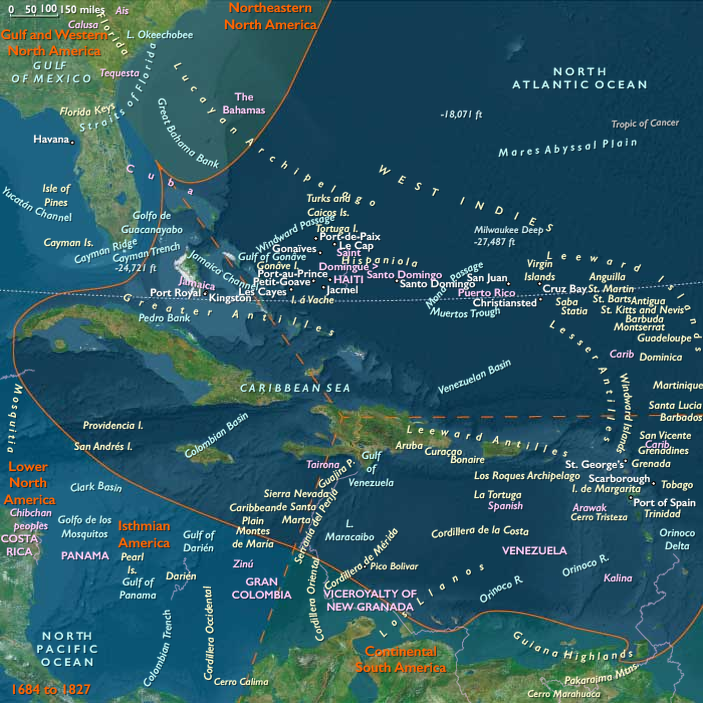
Edward Teach (c. 1680 – 22 November 1718), better known as Blackbeard, is a notorious English pirate who operates around the West Indies and the eastern coast of the American colonies.
Although little is known about his early life, he was probably born in Bristol, England.
He may have been a sailor on privateer ships during Queen Anne's War before settling on the Caribbean island of New Providence, a base for Captain Benjamin Hornigold, whose crew Teach joins sometime around 1716.
Hornigold places him in command of a sloop he had captured, and the two engage in numerous acts of piracy.
Their numbers are boosted by the addition to their fleet of two more ships, one of which is commanded by Stede Bonnet, but toward the end of 1717 Hornigold retires from piracy, taking two vessels with him.
Teach captures a French merchant vessel, renames her Queen Anne's Revenge, and equips her with 40 guns.
He becomes a renowned pirate, his cognomen derived from his thick black beard and fearsome appearance; he is reported to have tied lit fuses under his hat to frighten his enemies.
He forms an alliance of pirates and blockades the port of Charleston, South Carolina.
After successfully ransoming its inhabitants, he runs Queen Anne's Revenge aground on a sandbar near Beaufort, North Carolina.
He parts company with Bonnet, settling in Bath Town, where he accepts a royal pardon.
But he is soon back at sea and attracts the attention of Alexander Spotswood, the Governor of Virginia.
Spotswood arranges for a party of soldiers and sailors to try to capture the pirate, which they do on 22 November 1718.
During a ferocious battle, Teach and several of his crew are killed by a small force of sailors led by Lieutenant Robert Maynard.
A shrewd and calculating leader, Teach spurns the use of force, relying instead on his fearsome image to elicit the response he desires from those he robs.
Contrary to the modern-day picture of the traditional tyrannical pirate, he commands his vessels with the permission of their crews and there is no known account of his ever having harmed or murdered those he held captive.
He is romanticized after his death and becomes the inspiration for a number of pirate-themed works of fiction across a range of genres.