Bayezid I
Sultan of the Ottoman Empire
Years: 1360 - 1403
Bayezid I ("The Lightning"; 1360 – March 8, 1403) is the Sultan of the Ottoman Empire from 1389 to 1402.
He is the son of Murad I and Gülçiçek Hatun.
Related Events
Filter results
Showing 10 events out of 65 total
Eastern Southeast Europe (1384–1395 CE): Ottoman Dominance and Christian Fragmentation
Settlement and Migration Patterns
Ottoman Consolidation and Balkan Fragmentation
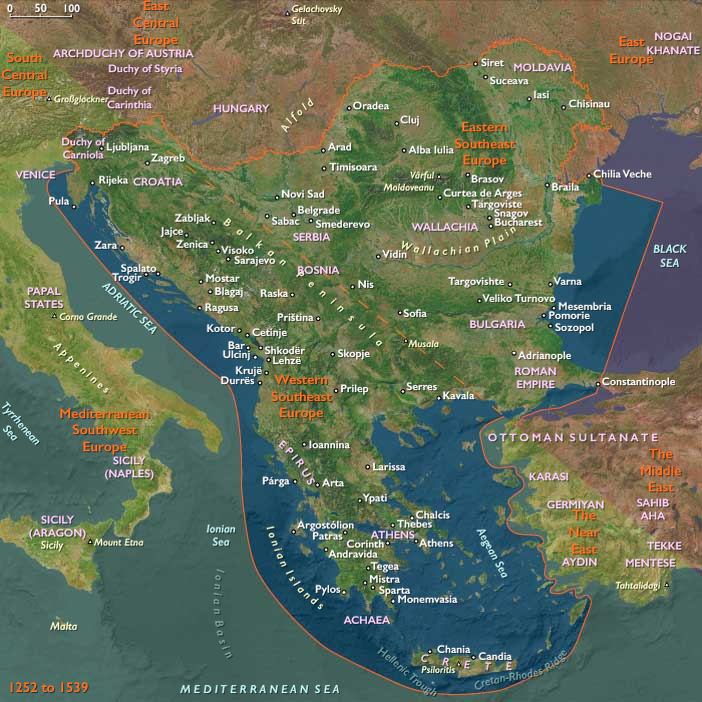
From 1384 to 1395, Ottoman dominance in the Balkans significantly accelerated. The Serbian state, already weakened, effectively disintegrated after the Battle of Kosovo Polje in 1389, in which the combined Serbian, Albanian, Hungarian, and Bosnian forces under Prince Lazar Hrebeljanović suffered a catastrophic defeat. This battle, although costly for the Ottomans—Sultan Murad I himself was assassinated—decisively ended organized Serbian resistance. The Serbian territories fragmented into smaller principalities ruled by local despots under Ottoman vassalage.
Economic and Technological Developments
Ottoman Military and Administrative Innovations
The Ottomans institutionalized key military and administrative practices, solidifying their governance and military capabilities. Under Murad I, critical Ottoman institutions emerged clearly, including the positions of kaziasker (military judge), beylerbeyi (commander-in-chief), and grand vizier (chief minister). The famed Janissary corps (Yeniçeri, meaning "New Force") and the devshirme system, which involved the conscription of Christian youths into Ottoman military service, became fully operational. The establishment of the Kapikulu corps ("Palace Guards") by Grand Vizier Chandarli Kara Halil further consolidated Ottoman military strength.
Cultural and Artistic Developments
Continued Byzantine Decline
Byzantine cultural influence and autonomy significantly declined during this era. Constantinople’s emperor, Manuel II Palaiologos, was forced into humiliating vassalage under Ottoman sultan Bayezid I after being compelled to reside at the Ottoman court. Upon learning of his father's death in 1391, Manuel escaped to Constantinople to inherit a severely diminished and impoverished empire. Ottoman blockades further isolated the Byzantine capital, weakening its economy and cultural vitality.
Social and Religious Developments
Fragmentation of Christian Alliances
Christian unity in the Balkans deteriorated significantly. Albania was divided between Venetian and Ottoman control, while the Bulgarian tsar Ivan Shishman abandoned alliances with fellow Christian Slavic states, submitting instead to Ottoman suzerainty. Bulgarian resistance collapsed, leading to partial Ottoman annexation. Bosnia, Venetian-held Albania, parts of Greece, and the Serbian fortress city of Belgrade became isolated holdouts against full Ottoman control.
Emergence of Independent Montenegro
Montenegro asserted independence from Serbia during this period, maintaining relative autonomy as a small but enduring regional entity amidst widespread Balkan fragmentation and Ottoman expansion.
Political Dynamics and Regional Rivalries
Hungary's Strategic Resistance
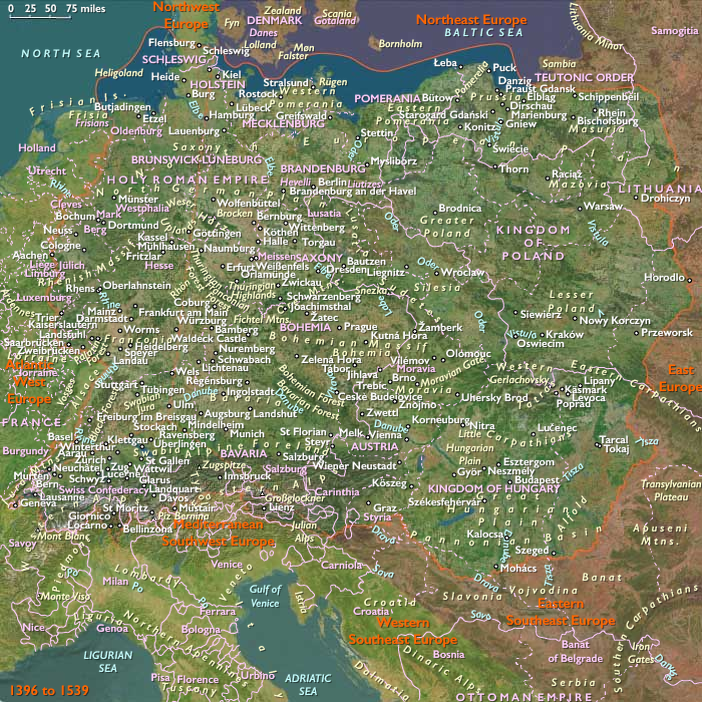
With the fall of most Balkan states, Hungary emerged as the primary Christian power capable of resisting Ottoman advances. Hungarian influence expanded in Wallachia and parts of Danubian Bulgaria, creating strategic counterbalances to Ottoman power. However, these efforts were insufficient to prevent Ottoman encroachment entirely.
Wallachian Vassalage and Moldavian Shifts
South of the Danube, Wallachia submitted to Ottoman vassalage. To the northeast, Moldavia fell under increasing Polish influence, adding complexity to regional geopolitics as local rulers sought external support to counterbalance Ottoman pressure.
Long-Term Consequences and Historical Significance
The years 1384–1395 were decisive in solidifying Ottoman ascendancy across Eastern Southeast Europe. The collapse of Serbia, fragmentation of Bulgaria, Byzantine subjugation, and Christian disunity dramatically reshaped regional dynamics. These developments established the groundwork for comprehensive Ottoman domination, significantly influencing the cultural, political, and social landscapes of the Balkans for centuries.
Andronikos IV predeceases his father, and his own son seizes Constantinople and the throne, as John VII, but the Turks again help Manuel and John regain it.
Manuel has been forced to live at the court of Bayezid as a submissive vassal, remaining there until his escape to Constantinople after learning of his father's death on February 16, 1391.
The forty-one-year-old Manuel has inherited an impoverished empire greatly reduced in size and strength, a Turkish overlord, and a frightened populace.
Ottoman forces have conducted campaigns that have succeeded in controlling vast Balkan territories, but Venetian advances in Greece, Albania, and imperial lands, together with the extension of Hungarian influence in Wallachia and Danubian Bulgaria, compel Bayezid to blockade Constantinople from 1391.
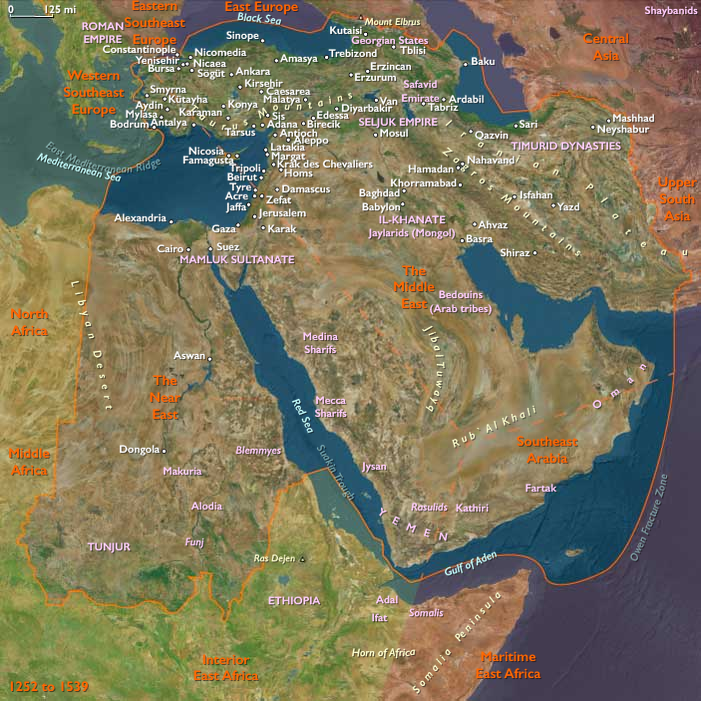
The Middle East: 1384–1395 CE
Timur's Conquests and Ottoman Expansion
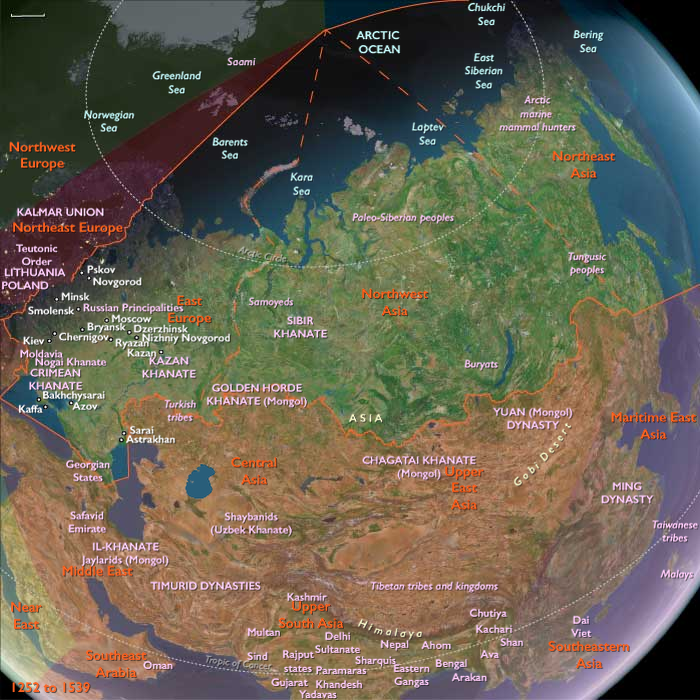
Between 1384 and 1395 CE, the Middle East witnesses intense military and political upheaval, primarily driven by the relentless campaigns of the Central Asian conqueror Timur (Tamerlane). Timur's invasions profoundly affect the Christian kingdom of Georgia, initiating a series of devastating attacks beginning in 1386. These invasions are intricately connected to his ongoing conflict with Tokhtamysh, the khan of the Golden Horde, as Timur seeks to secure and extend his influence across the Caucasus and Anatolia.
Ottoman Consolidation and Balkan Revolts
Meanwhile, the Ottoman Sultan Bayezid I, known for his aggressive expansionist policies, consolidates Ottoman control in Anatolia and the Balkans. In 1391, Bayezid decisively defeats the principality of Karaman and annexes several Turkmen states in eastern Anatolia, significantly expanding Ottoman territories and power.
However, Bayezid's eastern ambitions are temporarily halted by events in Europe, where several Balkan vassal states, emboldened and supported by Hungary and the declining Byzantine Empire, stage a revolt. Forced to redirect his focus westward, Bayezid suppresses these uprisings and reasserts Ottoman dominance in the region, setting the stage for future confrontations with both European powers and Timur himself.
Cultural and Intellectual Continuity
Despite ongoing conflicts, cultural and intellectual activities persist throughout the Middle East. Major urban centers such as Baghdad, Damascus, and Cairo continue to serve as key hubs of learning and scholarly exchange, fostering developments in literature, philosophy, and the sciences.
Fragmentation in Persia
The Jalayrid Sultanate, although maintaining nominal authority in western Persia and Iraq, continues to face significant internal dissension and external pressures. The fragmented political landscape allows regional rulers and rival tribal groups to challenge the Jalayrid's waning authority, contributing to sustained instability and ongoing power struggles across the region.
Legacy of Epidemics
Recurrent outbreaks of the Black Death persistently impact populations and economies, further exacerbating regional instability. These epidemics highlight vulnerabilities within the social and economic structures, influencing the broader political dynamics of the Middle East throughout the era.
In summary, the period 1384–1395 CE is marked by Timur's sweeping conquests, Ottoman territorial consolidation amidst Balkan revolts, continued cultural vitality despite fragmentation, and enduring challenges posed by recurring epidemics. These developments shape the historical trajectory of the Middle East, laying crucial groundwork for subsequent geopolitical shifts.
Bayezid attacks and defeats Karaman in 1391, annexes several Turkmen states in eastern Anatolia, and is preparing to complete his conquest in the area when he is forced to turn back to Europe to deal with a revolt of some of his Balkan vassals, encouraged and assisted by Hungary and Constantinople.
Murad's son Bayezid at Yenisehir in 1386 takes as his fifth wife a daughter of Emperor Manuel Palaeilogos.
Bayezid's first major role is as governor of Kütahya, city that has been conquered from the Germiyanids.
He is an impetuous soldier, earning the nickname of Lightning in a battle against the Karamanids.
Tradition holds that Wallachia's Prince Mircea had sent his forces to Kosovo to fight beside the Serbs; soon after the battle, Bayezid marches on Wallachia, a Hungarian vassal state, and imprisons Mircea until he pledges to pay tribute.
Wallachia thus becomes an Ottoman vassal for the first time.
A combined army of Serbs, Albanians, and Hungarians, led by the Serb knez, or prince, Lazar Hrebeljanovic, and including a large Bosnian contingent sent by Tvrtko, meets Murad's forces in battle on St. Vitus' Day (Vidovdan), June 28 (June 15, Old Style), 1389, on the Kosovo Polje ("Field of Blackbirds") near Pristina.
Victory appears at first to be on the side of the Serbs when Murad is killed by a Serbian noble, Miloš Obilić (or Kobilic), who had made his way into the Turkish camp on the pretext of being a deserter and forced his way into Murad's tent and stabbed him with a poisoned dagger.
Murad's twenty-nine-year-old son Bayezid quickly quells the confusion, and succeeds in surrounding the Serbs and inflicting a crushing defeat on their army.
Lazar is taken prisoner and executed; the Serbs are forced to pay tribute to the Turks and promise to do military service in the Ottoman army.
The defeat of the Serbs at the Battle of Kosovo seals the fate of the entire Balkan Peninsula, but will become hallowed in several great heroic ballads.
The vision of Lazar on the eve of the battle, the alleged betrayal by the Bosnian Vuk Brankovic, the killing of Murad by Serbian knight Miloš Obilić, the succor brought to the wounded on the battlefield by the Maid of Kosovo—these and other stories will be immortalized in Serbian folk literature.
Bayezid, immediately after obtaining the Ottoman throne, had had his younger brother strangled to avoid a plot.
He has recognized Stefan Lazarević, the son of Lazar, as the new Serbian leader (later despot), with considerable autonomy.
Bayezid arranges additional marriage alliances, having in 1389 taken as his sixth wife a daughter of John V Palaiologos by his wife, Helena Kantakouzenos.
In 1390, he takes as his seventh wife Hafisa Khanum, daughter of Amir Fakhr ud-din 'Isa Bey, Amir of Aydin; as his eighth wife Karamanoglu Khanum; as his ninth wife Sultan Khanum, daughter of Amir Sulaiman Shah Suli Bey, Amir of Dulkadir; and as his tenth wife (at Krushevatch Jami) Princess Despina Maria Olivera Khanum (b.
1372), daughter of the slain Prince Lazar Hrebeljanovic of Serbia, by his wife, Queen Militza, née Bulco.
Each of these marriages to Balkan princesses brings Christian followers and advisers into the Ottoman court, and it is under their influence that Bayezid will abandon the simple nomadic courts and practices of his predecessors and isolate himself behind elaborate court hierarchies and ceremonies borrowed primarily from the Greeks, setting a pattern that will be continued by his successors.
However, Bayezid is unable to take advantage of his father's victory to achieve further European conquest; in fact, he is compelled to restore the defeated vassals and return to Anatolia.
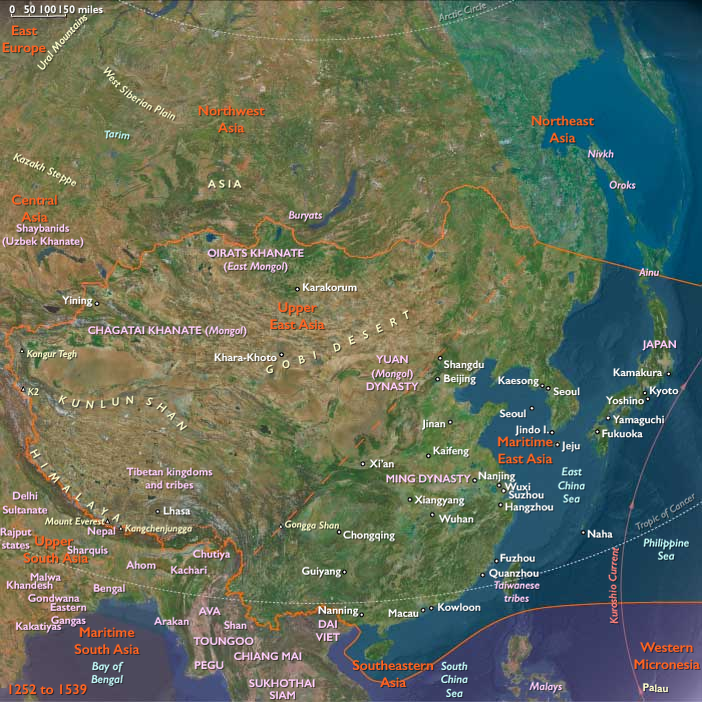
This return is precipitated by the rising threat of the Turkmen principality of Karaman, created on the ruins of the Seljuq empire of Anatolia which had its capital at Konya.
Bayezid's predecessors had avoided forceful annexation of Turkmen territory in order to concentrate on Europe.
They had, however, expanded peacefully through marriage alliances and the purchase of territories.
The acquisition of territory in central Anatolia from the emirates of Hamid and Germiyan had brought the Ottomans into direct contact with Karaman for the first time.
Murad had been compelled to take some military action to prevent it from occupying his newly acquired Anatolian territories but then had turned back to Europe, leaving the unsolved problem to his successor son.
Karaman had willingly cooperated with Serbia in inciting opposition to Ottoman rule among Murad's vassals in both Europe and Anatolia.
This opposition strengthens the Balkan Union that had been routed by the Ottomans at Kosovo and stimulates a general revolt in Anatolia that Bayezid is forced to meet by an open attack as soon as he is able.
Circassians from the North Caucasus region had become the majority in the Mamluk ranks by the late fourteenth century.
A revolt had broken out in 1377 in Syria and spread to Egypt, and the government had been taken over by the Circassians Barakah and Barquq; the last Bahri Sultan Al-Salih Hajji had been dethroned in 1382, thus ending the Bahri dynasty, and Barquq had been proclaimed sultan.
Barquq had been expelled in 1389 but in 1390 recaptures Cairo.
Permanently in power, he founds what came to be called the Burji dynasty.
Europe is meanwhile terrorized and Ottoman rule south of the Danube is assured; Bayezid's prestige in the Islamic world is so enhanced that he is given the title of sultan by the shadow 'Abbasid caliph of Cairo, despite the opposition of the caliph's Mamluk masters, who want to retain the title only for themselves.