Basarab IV cel Tânăr
Voivode of Wallachia
Years: 1445 - 1510
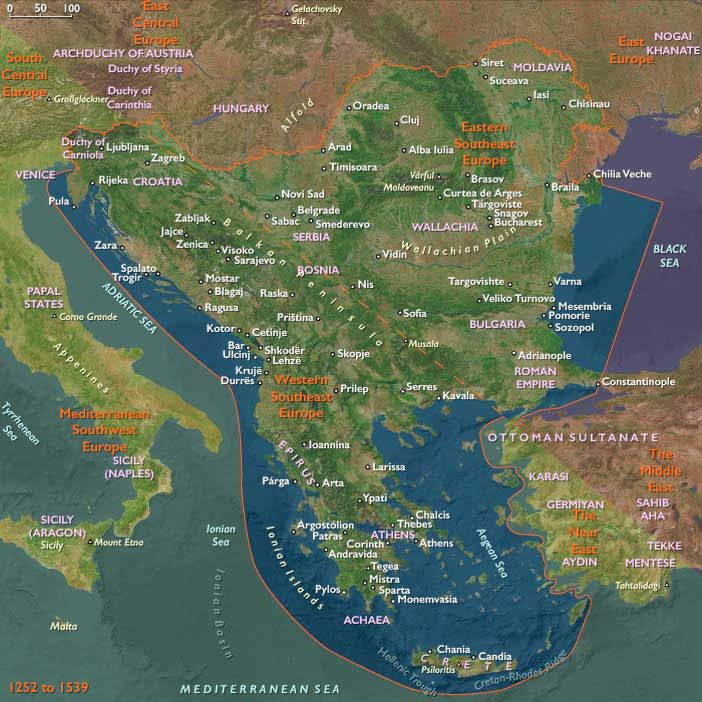
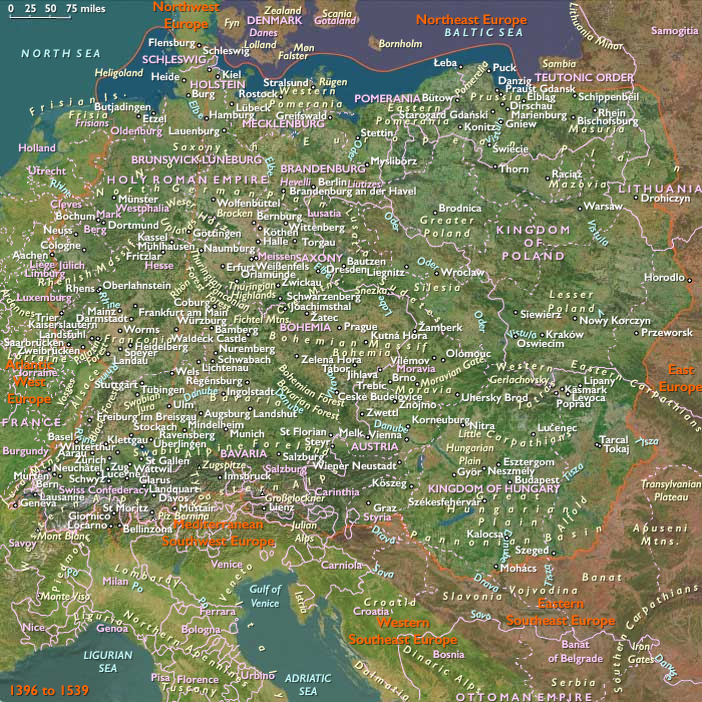
Basarab IV cel Tânăr ("the Young"), also known as Țepeluș ("the little Impaler"), son of Basarab II, is voivode of the principality of Wallachia, between the years 1477–1481, and again from 1481 to 1482.
Curiously, and symbolic of the unstable political climate of medieval Wallachia, despite the fact that he is removed from his position in 1481, and replaced the same year, two other men are granted the title Prince of Wallachia between his two reigns.
Related Events
Filter results
Showing 10 events out of 16 total
The invasion of the Ottoman Empire from the east by Uzun Hasan of Ak Koyunlu had caused a great crisis in the empire, and although he is defeated the following year, this unexpected event encourages Venice and Hungary to renew their war on the Ottomans, and Moldavia to free herself from any Ottoman influence.
In 1473, Stephen stops paying the annual tribute to the Porte and as a reaction to this, an Italian letter, dated from 1473 to Bartolomeo Scala, secretary of the Republic of Florence, reveals that Mehmed had left Constantinople on April 13 and is planning to invade Moldavia from land and sea.
Stephen still hopes to make peace with Radu and asks the Polish king to work as mediator.
The peace attempts fail and the conflict intensifies with three leaders challenging each other for the Wallachian throne: Radu, who is supported by Mehmed; the seemingly loyal Basarab Laiotă, who at first is supported by Stephen; and Basarab Ţepeluş cel Tânăr—who will gain the support of Stephen after Laiotă's betrayal.
A series of clashes follow, starting with another confrontation between Stephen and Radu on November 18–20, at Râmnicu Sărat, where the latter suffers his second defeat at the hands of the Moldavian warrior prince.
A few days later, on November 28, the Ottomans intervene with an army consisting of twelve thousand Ottomans and six thousand Wallachians, but are defeated and retreat across the Danube.
Stephen puts Laiotă on the throne after capturing the castle of Bucharest, but a new Ottoman army of seventeen thousand sets camp around the river Bârlad on December 31, laying waste to the countryside, and intimidating the new prince into abandoning his Wallachian throne and fleeing to Moldavia.
Ali Bey Mihaloğlu, Bey of Smederevo, pillages eastern parts of Hungary, destroys Várad, and takes sixteen thousand prisoners with him in January 1474.
Laiotă takes the Wallachian throne in the spring of 1474 for the second time; in June, he decides to betray his mentor by submitting to Mehmed.
Stephen now invests his support in a new candidate, named Ţepeluş (little spear), but his reign is even shorter, as it only lasts a few weeks after being defeated by Laiotă in battle on October 5.
Two weeks later, Stephen returns to Wallachia and forces Laiotă to flee.
Mehmed, tired of what transpires in Wallachia, gives Stephen an ultimatum to forfeit Chilia to the Porte, to abolish his aggressive policy in Wallachia, and to come to Constantinople with his delayed homage.
The prince refuses and in November 1474 writes to the Pope to warn him of further Ottoman expansion, and to ask him for support.
Mehmed had ordered his general, Suleiman Pasha, to end the siege of Venetian-controlled Shkodër, to assemble his troops in Sofia, and from there to advance with additional troops towards Moldavia.
For these already exhausted Ottoman troops, who had besieged the city from May 17 to August 15, the transit from Shkodër to Moldavia is a month's journey through bad weather and difficult terrain.
According to to the Polish chronicler Jan Długosz, Suleiman was also ordered that after inflicting defeat on Stephen, he was to advance towards Poland, set camp for the winter, then invade Hungary in spring, and unite his forces with the army of the Sultan.
The Ottoman army consists ofjanissaries and heavy infantry, which are supported by the heavy cavalry sipahis and by the light cavalry (akinci), who would scout ahead.
There are also Tatar cavalry and other troops (such as the Timariots) from vassal states.
Twenty thousand Bulgarian peasants are also included in the army; their main tasks are to clear the way for the rest of the army by building bridges over waters and removing snow from the roads, and to drive supply wagons.
In total, the Ottoman cavalry numbered thirty thousand.
In September 1474, the Ottoman army gathers in Sofia, and from here, …
…Suleiman marches towards Moldavia by crossing the frozen Danube on foot.
His first stop is Wallachia, which he enters via Vidin and Nicopolis.
His army rests in Wallachia for two weeks, and is later met by a Wallachian contingent of seventeen thousand under Basarab Laiotă, who has changed sides to join the Ottomans.
Ottoman scouts report to Suleiman that there are untouched villages near Vaslui, and the Ottomans head for that region.
The winter makes it difficult to set camp, which forced the Ottomans to move quickly and head for the Moldavian capital, Suceava.
In order to reach Vaslui, where the Moldavian army had its main camp, they need to cross Podul Înalt over the Bârlad River.
The bridge is made of wood and not suitable for heavy transportation of troops.
Stephen chooses this area for the battle—the same location where his father, Bogdan II, had defeated the Poles in 1450; and where he, at seventeen, had fought side-by-side with Vlad 'the Impaler'.
The area is ideal for the defenders: the valley is a semi-oval surrounded on all sides by hills covered by forest.
Inside the valley, the terrain is marshy, which restricts troop movement.
Suleiman has full confidence in his troops and makes few efforts to scout the area.
The battle begins on the rainy morning of January 10.
The weather is frigid, and a dense fog limits vision.
The Ottoman troops are exhausted.
Stephen fortifies the bridge, while setting and aiming his cannons at the structure.
Peasants and archers are hidden in the forest, together with their Prince and his boyar cavalry.
The Moldavians make the first move by sending musicians to the middle of the valley.
The sound of drums and bugles makes Suleiman think that the entire Moldavian army awaits him there.
Instead, the center of the valley holds the Székely forces and the Moldavian professional army, which have been instructed to make a slow retreat when they encountered the enemy.
Suleiman orders his troops to advance and, when they make enough progress, the Moldavian artillery startd to fire, followed by archers and handgunners firing from three different directions.
The archers cannot see the enemy for the fog, and, instead, have to follow the noise of their footsteps.
The Moldavian light cavalry then helps to lure the Ottoman troops into the valley by making hit-and-run attacks.
Ottoman cavalry try to cross the wooden bridge, causing it to collapse Those Ottoman soldiers who have managed to survive the attacks from the artillery and the archers, and who have not become caught in the marshes, have to confront the Moldavian army, together with the Székely soldiers further up the valley.
The five thousand Székely soldiers are successful in repelling the seven thousand Ottoman infantrymen.
They then make a slow retreat, as instructed by Stephen, but are later routed by the Ottoman sipahi, while the remaining Ottoman infantry attacks the Moldavian flanks.
Suleiman tries to reinforce his offensive, not knowing what had happened in the valley, but then Stephen, with the full support of his boyars, orders a major assault.
All his troops, together with peasants and heavy cavalry, attack from all sides.
Simultaneously, Moldavian buglers concealed behind Ottoman lines start to sound their bugles, and in great confusion some Ottoman units change direction to face the sound.
When the Moldavian army hits, Suleiman loses control of his forces.
He desperately tries to regain control, but is later forced to signal a retreat.
The battle lasts for four days; with the last three days seeing the fleeing Ottoman army being pursued by the Moldavian light cavalry and the two thousand-strong Polish cavalry until they reach the town of Obluciţa (now Isaccea, Romania), in Dobruja.
The Ottoman casualties are counted as forty-five thousand including four Pashas killed and a hundred standards taken.
Jan Długosz writes that "all but the most eminent of the Turkish prisoners are impaled", and their corpses burned.
Only one is spared—the only son of the Ottoman general Isaac Bey, of the Gazi Evrenos family, whose father had fought with Mircea the Old.
Another Polish chronicler reported that on the spot of the battle huge piles of bones rested upon each other, next to three immured crosses.

The Wallachians had fled the field without joining battle and Laiotă now turns his sword against the Turks, who had hoped for a safe passage in Wallachia; on January 20, he exits his castle and confronts some of the Turks that are lurking on his land.
He takes one of their flags and sends it to a Hungarian friend as proof of his bravery.
After the battle, Stephen sends four of the captured Turkish commanders, together with thirty-six of their standards and abundant booty, to King Casimir, and implores him to provide troops and money to support the Moldavians in the struggle against the Ottomans.
He also sends letters and a few prisoners and Turkish standards to the Pope and Hungarian King Matthias Corvinus, asking for support.
The Pope's reply to Stephen denies him help, but awards him with the "Athleta Christi", while King Casimir pleads poverty and does nothing; his own men then accuse him of sloth, and advise him to change his shameful behavior or hand over his rule to someone else.