Baldwin, making a bold strategic move as a result of his military victory at Mont Gisard, decides to march to Jacob’s Ford, one of the safest crossings of the Jordan River, and build a defensive fortress on its territory.
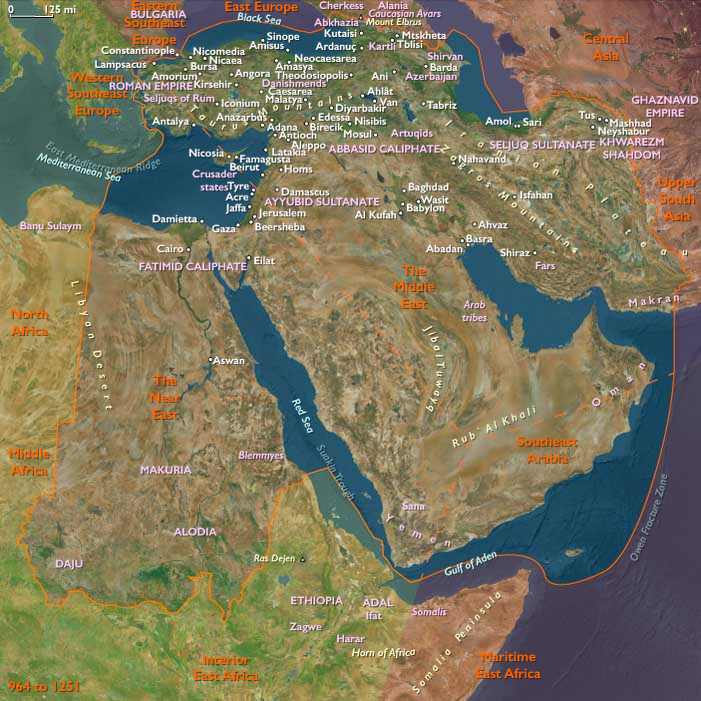
Christian Palestine and Muslim Syria utlize this key river crossing, approximately one hundred miles north of Jerusalem on one of the main roads between Acre, Israel and Damascus, as a major intersection between the two civilizations.
The king and his Crusaders theorize that such a fortification could protect Jerusalem from a northern invasion and put pressure on Saladin’s stronghold at Damascus.
Between October 1178 and April 1179, Baldwin had begun the first stages of constructing his new line of defense, a fortification called Chastellet, at Jacob’s Ford.
Saladin is unable to stop the erection of Chastellet by military force because a large portion of his troops is stationed in northern Syria, suppressing Muslim rebellions.
Consequently, the sultan offers Baldwin sixty thousand dinars to halt construction.
Baldwin declines, and Saladin increases the offer to one hundred thousand dinars.
The Christian king again refuses and continues to build Chastellet.
By the summer of 1179, Baldwin’s forces have constructed a stone wall of massive proportions.
Saladin, fully aware that any further bargaining or negotiations would only be in vain and that the more time he wastes, the more time Baldwin will have to complete his massive fortification, summons a large Muslim army to march southeast towards Jacob’s Ford.
On August 23, 1179, Saladin arrives at Jacob’s Ford and initiates a siege of the castle.
While his archers distract the men inside the fortification, miners dig a tunnel to breach the stone and iron walls at the northeast corner of Chastellet.
Once the tunnel is dug, Saladin’s forces place large pieces of wood into the tunnel and set them alight.
This process, called sapping, is a method by which the tunnel's supports are burnt away forcing the walls to eventually collapse under their own weight.
Sapping initially fails for Saladin and his troops, and, the troops are forced to put out the fire with buckets of water, being paid one gold piece per bucket to do so.
After the fire is extinguished, the miners are instructed to relight the fire.
At the same time, Baldwin, having learned of this attack, calls for reinforcements from Jerusalem.
However, communications between Baldwin, who is in Tiberias, and Chastellet are slow and, by this time, the siege has been underway for several days.
Baldwin’s forces inside the castle begin to reinforce the main gates around the castle.
Shortly after, the Muslims again light a fire in the tunnel under the castle, and the walls collapse.
Approximately six days after the siege began, Saladin and his troops enter Chastellet.
By August 30, the Muslim invaders have pillaged the castle and killed most of its residents.
On the same day, less than one week after reinforcements had been called, Baldwin and his supporting army set out from Tiberias, only to discover smoke permeating the horizon directly above Chastellet.
They are too late to save the seven hundred knights, architects, and construction workers who have been killed and the other eight hundred who have been taken captive.
Baldwin and his reinforcements turn back towards Tiberias and Saladin orders the remains of the fortification to be torn down.