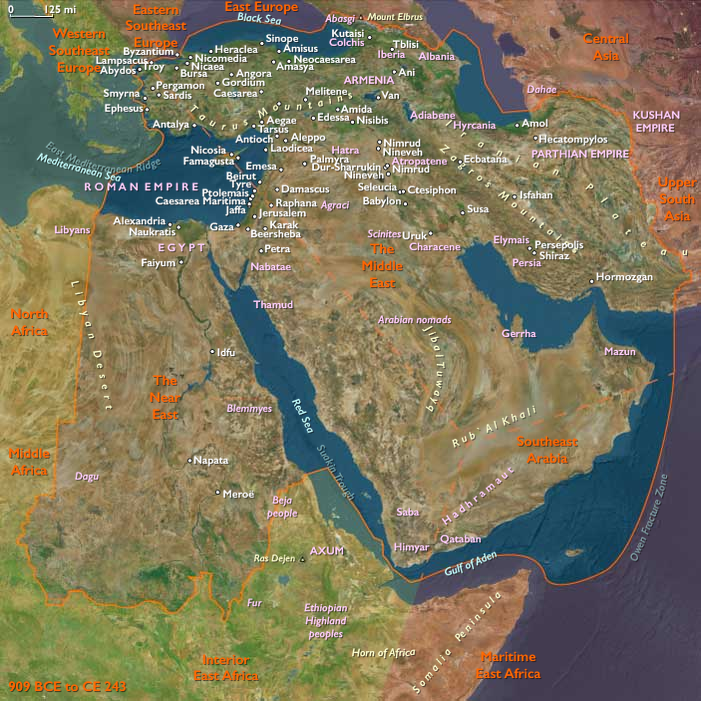
The Middle East: 681–670 BCE
Esarhaddon's Ascension and Consolidation
In 681 BCE, Assyrian king Sennacherib is assassinated by two of his sons following his conquest of Babylon. Esarhaddon, his loyal son, rapidly marches to Nineveh, defeating his rival brothers in a brief civil war. Formally declared king, Esarhaddon immediately takes measures to stabilize and expand his recently enlarged empire, especially guarding against invasions by the Cimmerians and Scythians, who threaten Assyrian possessions in Anatolia and Media.
Esarhaddon actively pursues religious and political policies designed to consolidate his rule. He initiates major construction projects in both Assyria and Babylonia, notably rebuilding the famed Esagila temple in Babylon and the Ekur temple at Nippur, sites traditionally identified with the Tower of Babel. Simultaneously, he reconstructs the sanctuary of Esharra in Ashur, underscoring his impartial stance toward both major Assyrian and Babylonian religious centers.
Sidonian Revolt and Its Suppression
In 680 BCE, Abdi-Milkutti, king of Sidon, leads a rebellion against Assyrian dominance, forming an alliance with Sanduarri of Kundu (western Cilicia) and Sizzu, a Lebanese prince. After a prolonged three-year siege, Esarhaddon defeats and executes Abdi-Milkutti in 677 BCE, utterly destroying Sidon and deporting its inhabitants. He rebuilds Sidon as Kar-Ashur-aha-iddina ("Harbor of Esarhaddon"). Sanduarri is also executed, with the severed heads of both kings publicly displayed in Nineveh. Loyal Assyrian vassals, including Baal I of Tyre, receive shares of the extensive plunder taken from Sidon.
Regional Diplomacy and Military Engagements
Esarhaddon undertakes extensive military campaigns to strengthen Assyrian influence. In 674 BCE, he campaigns in Bazu, identified with present-day Qatar near Dilmun (Bahrain), facing harsh desert conditions. Around 678 BCE, Esarhaddon campaigns against the rising power of the Medes, fortifying Assyrian control of critical trade routes and strategic regions along the Zagros Mountains.
In Anatolia, the Assyrians contend with significant challenges. In 679 BCE, the Cimmerians, led by Teushpa, invade Cilicia and the Neo-Hittite kingdom of Tabal. Esarhaddon confronts these threats and also besieges Melid in 675 BCE, though without immediate success. Diplomatic marriages, such as the union of Esarhaddon's daughter with the Scythian prince Bartatua, aim to stabilize relations with nomadic groups that posed recurring threats to Assyrian dominance.
Conflict with Elam and Urartu
Esarhaddon faces intermittent hostilities with Elam and Urartu. In 675 BCE, Humban-Haltash II of Elam launches an unsuccessful attack against Sippar but dies shortly thereafter. His successor, Urtaki, restores peaceful relations with Assyria. In 673 BCE, Esarhaddon wages war against Rusas II of Urartu, responding to Urartu's resurgence after earlier devastations by Sargon II and the Cimmerians.
Succession and Internal Politics
Internally, Esarhaddon carefully prepares the succession for his sons. Initially designating his eldest son, Sin-iddina-apla, as crown prince of Assyria and his second son, Shamash-shum-ukin, as ruler of Babylon, he is forced to adjust his plans after the death of the eldest son in 672 BCE. The younger Ashurbanipal, though initially unpopular with court elites, is elevated as crown prince. To secure his position, Esarhaddon negotiates loyalty agreements with Assyrian nobles, foreign rulers, and influential court members, setting the stage for Ashurbanipal's future reign.
Thus, from 681 to 670 BCE, Esarhaddon's dynamic leadership significantly reshapes the geopolitical landscape, reinforcing Assyria’s dominance, managing rebellions and invasions, and securing internal stability through strategic diplomacy and meticulous planning for succession.