Axel Oxenstierna
Swedish politician; Lord High Chancellor of Sweden
Years: 1583 - 1654
Axel Gustafsson Oxenstierna af Södermöre (June 16, 1583 – August 28, 1654), Count of Södermöre, is a Swedish politician.
He becomes a member of the Privy Council in 1609 and serves as Lord High Chancellor of Sweden from 1612 until his death.
He is a confidant of both Gustavus Adolphus and later Queen Christina.
Oxenstierna, widely considered one of the most influential people in Swedish history, plays an important role during the Thirty Years' War and is appointed Governor-General of occupied Prussia; he also lays the foundations of Swedish central government administration.
Related Events
Filter results
Showing 10 events out of 38 total
Sweden’s seventeen-year-old King Gustavus Adolphus has inherited from his father the throne and the war with Denmark as well as an ongoing succession of occasionally belligerent dynastic disputes with his Polish cousin Sigismund III of Poland.
The controlling, organizing hand of Axel Oxenstierna, who in January 1612 becomes Lord High Chancellor of Sweden, soon becomes apparent in every branch of the administration.
Gustavus Adolphus sues for peace, but Denmark’s Christian IV sees an opportunity for larger victories, and strengthens his armies in southern Sweden.
England and the Dutch Republic are also invested in the Baltic Sea trade, and pressured to curtail Denmark's power by ending the Kalmar War before a decisive victory could be attained.
The Danes, while well-equipped and strong, have relied heavily on mercenary forces and Christian IV, low on funds, is finally amenable to persuasion in 1613.
With the intercession of England’s James I, the Treaty of Knäred is signed on January 20, 1613.
Denmark has reached its goal, restoring Norwegian control of Sweden's land route through Lapland by incorporating Lapland into Norway (and thus under Danish rule).
Further, Sweden has to pay a high ransom for two fortresses, one of them Alsborg, captured by Denmark (this will take six years to accomplish).
Sweden, however, achieves a major concession—the right of free trade through the Sound Strait, becoming exempt of the Sound toll (a right shared by Britain and Holland).
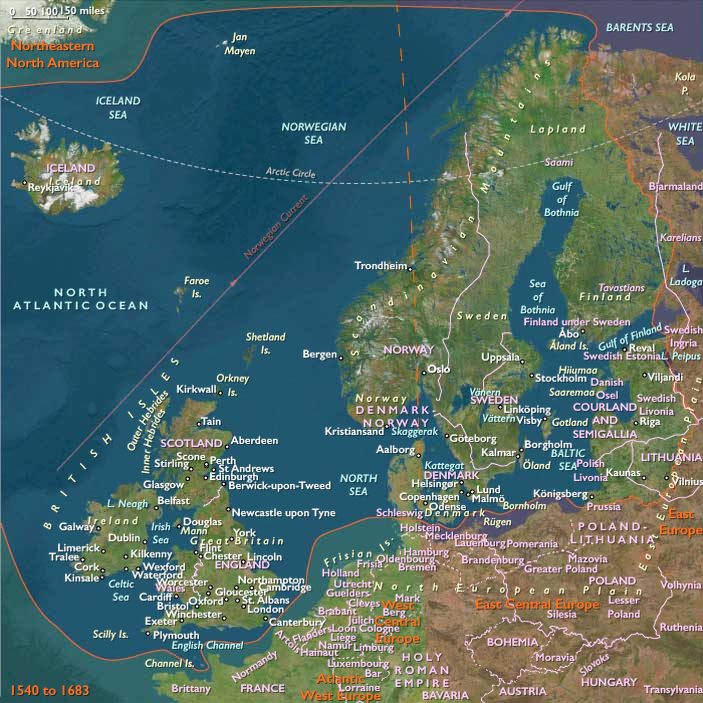
Northeast Europe (1636–1647 CE): Swedish Military Dominance, Diplomatic Realignments, and Cultural Flourishing
Between 1636 and 1647 CE, Northeast Europe experienced significant geopolitical changes, marked by Sweden’s military ascendancy during the latter stages of the Thirty Years’ War, shifting diplomatic alliances, economic resilience, and substantial cultural and intellectual advancements. Under the dynamic leadership of Queen Christina of Sweden and her influential chancellor, Axel Oxenstierna, Sweden emerged prominently as a leading European power.
Swedish Military Ascendancy in the Thirty Years’ War
Under the rule of the young Queen Christina (r. 1632–1654), guided by Chancellor Axel Oxenstierna, Sweden solidified its military dominance in Northern Europe. Swedish forces secured crucial victories in northern Germany, significantly altering regional geopolitics and asserting Sweden's influence beyond the Baltic. Strategic victories, notably at the Battle of Wittstock in 1636, reinforced Sweden’s continental position, despite ongoing logistical and financial pressures of extended warfare.
Diplomatic Realignments and Alliance Management
Amid shifting military fortunes, intricate diplomatic negotiations shaped Northeast Europe's political landscape. Sweden managed complex alliances within the Protestant coalition, engaging actively with France against the Habsburg Empire. These diplomatic efforts, led effectively by Oxenstierna, helped preserve and strengthen Swedish influence while navigating the shifting allegiances of various German principalities.
Denmark–Norway’s Strategic Neutrality and Economic Strength
King Christian IV of Denmark–Norway maintained cautious neutrality following earlier involvement in the Thirty Years' War. Leveraging stable diplomatic ties, Denmark–Norway strengthened internal governance, economic growth, and military readiness. Despite neutrality, Danish–Swedish tensions persisted, rooted deeply in competing Baltic territorial ambitions and historical rivalries.
Stability and Diplomatic Prudence in Prussia
Under Elector George William (r. 1619–1640), succeeded by Frederick William (the "Great Elector") in 1640, Brandenburg-Prussia adopted a cautious diplomatic approach during the latter stages of the war. Prioritizing internal stability and economic development, notably in Königsberg, the region effectively mitigated wartime disruptions and laid foundations for subsequent economic and military reforms under Frederick William’s leadership.
Economic Resilience in Urban Centers
Major urban centers including Reval (Tallinn), Riga, Königsberg, and Visby continued demonstrating significant economic resilience despite the disruptions of extended warfare. Stable governance, robust merchant networks, and ongoing maritime commerce sustained regional economic prosperity and provided stability amidst broader geopolitical instability.
Cultural and Intellectual Flourishing
This era was marked by considerable cultural and intellectual growth, notably within Sweden and Prussia. Queen Christina’s patronage turned Sweden into a prominent cultural and scholarly hub, attracting renowned European intellectuals such as René Descartes. Academic and intellectual networks expanded, significantly enhancing regional cultural prestige, education, and scholarly innovation.
Continuity and Development in Finland
Finland, under continued Swedish governance, enjoyed relative stability and economic development. Expansion of educational institutions, strengthening of regional administration, and improved economic integration enhanced Finland's strategic importance to Sweden, contributing significantly to broader regional stability and prosperity.
Impact of Religious and Educational Reforms
Lutheran and Protestant educational reforms continued shaping societal and cultural life. Protestant academies and universities, strengthened by the era’s educational advancements, promoted increased literacy, intellectual inquiry, and cultural development, leaving a lasting cultural legacy across Northeast Europe.
Legacy of the Era
The era from 1636 to 1647 CE profoundly reshaped Northeast Europe’s geopolitical and cultural landscape through sustained military success, strategic diplomatic realignments, and substantial intellectual advancements. Sweden's strengthened international position, Denmark–Norway’s strategic prudence, Prussia’s diplomatic caution, and cultural flourishing defined regional identities, diplomatic relationships, and territorial alignments for subsequent decades.
Gustav II Adolf's success in making Sweden one of the great powers of Europe, and perhaps the most important power in the Thirty Years' War after France and Spain, was due not only to his military brilliance, but also to important institutional reforms in Sweden's government.
The chief among these reforms had been the institution of the first Parish registrations, so that the central government could more efficiently tax and conscript its populace.
After his death, his wife initially keeps his body, and later his heart, in the castle of Nyköping for over a year.
Queen Maria Eleonora had ordered that the king should not be buried until she could be buried with him.
She also demanded that the coffin be kept open, and goes to see it every forenoon, patting it, taking no notice of the putrefaction.
(The king had fallen on November 6, 1632, but will not be buried until June 22, 1634, more than eighteen months later.
His remains, including his heart, now rest in Riddarholmskyrkan in Stockholm.)
The Swedish Riksdag of the Estates in February 1633, decides that his name will be styled Gustav Adolf the Great (or Gustaf Adolf den Store in Swedish).
No such honor has been bestowed on any other Swedish monarch before or since.
The crown of Sweden is inherited in the Vasa family, and from Charles IX's time has excluded those Vasa princes who had been traitors or descended from deposed monarchs.
Gustavus Adolphus' younger brother had died ten years before, and therefore there is only the King's daughter left as a female heir.
Queen Maria Eleonora and the king's five principal ministers, headed by Axel Oxenstierna, take over the government on behalf of Gustavus Adolphus' underage daughter Christina upon her father's death.
He leaves one other known child, his illegitimate son Gustav, Count of Vasaborg.
The Swedes, due to the death of their king, had failed to follow up after the Protestant victory in the Battle of Lützen two years before, As a result, the Imperial forces had begun to regain the initiative.
A Protestant Saxon and Swedish army invades Bohemia in 1634, threatening the Habsburg core territories.
The future Holy Roman Emperor, Ferdinand of Hungary, decides to attack the Protestant territories in Southern Germany to draw the main Swedish and German armies away from Bohemia.
Both sides are aware that Spanish reinforcements under his cousin the Cardinal-Infante Ferdinand are en-route from their dominions in Northern Italy.
The Spanish army has marched through the Stelvio Pass trying to open a new 'Spanish Road', and take their Commander to his governorship of the Spanish Low Countries.
The Protestant commanders decide they cannot ignore the threat and combine their two largest armies near Augsburg on July 12th, the Swabian-Alsatian Army under Gustav Horn and the so called Franconian Army under Bernhard of Saxe-Weimar.
Both armies are named after their main operation area and belong to the Heilbronn Alliance (Sweden's German-Protestant allies under the directorate of the Swedish chancellor Axel Oxenstierna).
They mainly consist of German ("the Blue brigade") and some Scottish mercenaries ("the Green brigade") with a few national Swedish/Finnish regiments (mostly cavalry) and one national Swedish infantry brigade ("the Yellow brigade").
Sweden's negotiating position with Poland is somewhat weakened after the recent setbacks that Sweden and its allies have suffered in Germany, such as the Battle of Nördlingen and the defection of the Electorate of Saxony.
The recent Polish victories against Muscovy and the Ottoman Empire have made many Swedes uneasy, as they remind themselves that the Commonwealth is a foe not easily defeated.
Nonetheless, the Swedes realize that their recent gains in Germany are much less easy to defend than the territories they have captured from the Commonwealth in Prussia and Livonia, and so they are more ready to give up German than Prussian territories.
They are, however, willing to give up their conquests in Prussia if Władysław will renounce his claim to the Swedish crown and they can retain their conquests in Livonia.
Sweden's position is also weakened by the disagreements within its government, as there is a power struggle between Swedish chancellor Axel Oxenstierna and his opponents in the Swedish Parliament.
Some of these struggles have led to leaks that have given leverage to the Polish side.
Many European powers are interested in the outcome of the negotiations between Sweden and Poland-Lithuania, and they had also been named as mediators by the 1629 Truce of Altmark, giving them ample opportunity to influence the outcome of the Polish–Swedish negotiations, which begin on January 24, 1635 in the Prussian village of Preussisch Holland (Pasłek).
Polish negotiators are led by Bishop and Chancellor Jakub Zadzik, and include Hetman Krzysztof Radziwill, Voivode of Bełsk Rafal Leszczyński, Crown referendarz Remigian Zaleski, Starost of Dorpat, Ernest Denhoff and Starost of Stężyce, Abraham Goluchowski.
Swedish negotiators are led by Per Brahe (the younger) and include the governor of Prussia, Herman Wrangel, and advisors Sten Bielke, Achacy Axelson and Johan Nicodemi.
The early negotiations are unsuccessful, as both sides play delaying tactics, disputing the titles of their monarchs, and awaiting most of the international mediators (only Brandenburg is present).
Although the Swedes expect that the delay will be to their benefit, Władyslaw plays their refusal to negotiate to the Sejm, and, with the support of some magnates, like Albrycht Stanisław Radziwill (who advocates the expansion of the Polish–Lithuanian Commonwealth Navy), the Sejm is persuaded to vote for new, significant taxes.
Even before the vote is passed, Władyslaw has gathered a new army of about twenty-one thousand soldiers, sent Jerzy Ossoliński to gather Polish allies in non-occupied Prussia, and with the help of Danzig (Gdańsk) merchant Georg Hewel (Jerzy), bought ten ships to be converted into warships, and established the 'Sea Commission' (Komisja Morska) led by Gerard Denhoff.
The military and political situation of Sweden has further worsened in the past few months, with more defeats in the field, and more allies defecting to the Holy Roman Empire.
The Swedes are more willing to discuss their retreat from Prussia, and are more wary of the war with Poland.
They are ready by the end of March to accept most of the Polish terms.
All Swedish resistance in the south of Germany had ended by the spring of 1635.
After that, the two sides meet for negotiations, producing the Peace of Prague (1635), which entail a delay in the enforcement of the Edict of Restitution for 40 years and allows Protestant rulers to retain secularized bishoprics held by them in 1627.
This protects the Lutheran rulers of northeastern Germany, but not those of the south and west (whose lands had been occupied by the Imperial or League armies prior to 1627).
Negotiations towards the agreement had been instigated by the Elector of Saxony, John George, who whilst being a Lutheran prince had nonetheless been an ally of the Emperor until the Swedish intervention in 1630.
Years of fighting, an inability to reimpose Roman Catholicism by force, and the need to put an end to the intervention of foreign powers in German affairs all combine to bring Ferdinand to the table with a degree of willingness to make concessions towards the Lutheran princes.
Calvinist Brandenburg is reluctant to sign, since besides the announced annulment of the Edict of Restitution, toleration of Calvinism is not mentioned.
To get Brandenburg to sign up, Sweden and Ferdinand promise her the succession in the Duchy of Pomerania in return.