Aurelius of Asturias
King of Asturias
Years: 740 - 774
Aurelius (Spanish: Aurelio) (c. 740 – 774) is the King of Asturias from 768 to his death.
Born in León, he is the son of Fruela (son of Peter of Cantabria); nephew of Alfonso I of Asturias; and a cousin of his predecessor, Fruela the Cruel.
His brother, Bermudo I, later reigns as king 789 – 791.

Related Events
Filter results
Showing 6 events out of 6 total
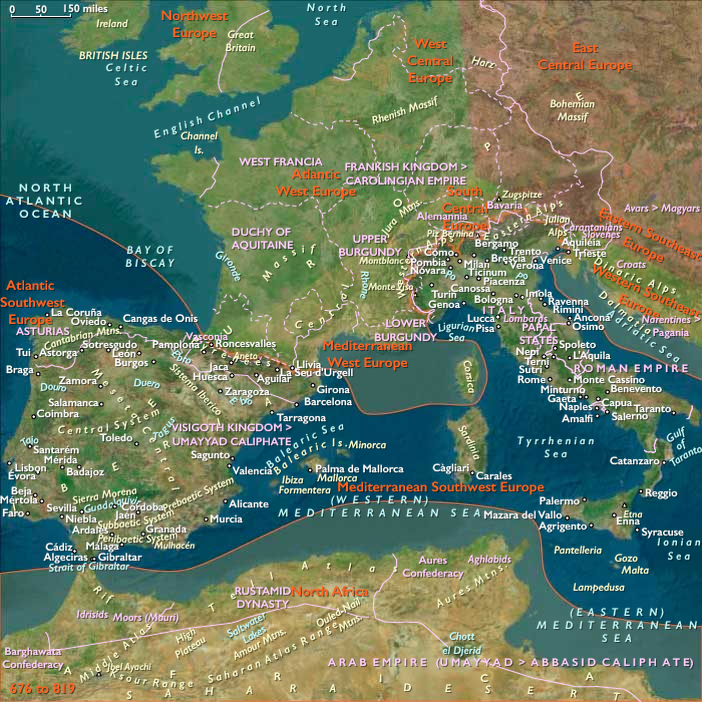
Atlantic Southwest Europe (676–819 CE): Fall of the Visigoths, Islamic Invasion, and Rise of the Asturian Kingdom
Between 676 and 819 CE, Atlantic Southwest Europe—comprising Galicia, northern and central Portugal, Asturias, Cantabria, and northern Spain south of the Franco-Spanish border (43.05548° N, 1.22924° W)—experienced a profound transformation. The period witnessed the final collapse of Visigothic rule, the dramatic impact of the Islamic conquest of Iberia, and the subsequent rise and consolidation of the Christian Kingdom of Asturias. The region emerged as the resilient heartland of Iberian Christian resistance, characterized by robust local governance, economic stability, distinctive cultural traditions, and strengthened ecclesiastical institutions.
Political and Military Developments
Visigothic Decline and Fragmentation (676–711 CE)
Initially, the region was under weakening Visigothic rule, with increasing internal divisions, aristocratic rivalry, and diminishing royal authority from Toledo. Local aristocrats, especially in Galicia, Asturias, and northern Lusitania, expanded their autonomous power, laying foundations for regional identities independent of central Visigothic governance.
Islamic Conquest and Christian Resistance (711–723 CE)
In 711 CE, Islamic forces decisively defeated the Visigoths at the Battle of Guadalete, rapidly conquering most of Iberia. Atlantic Southwest Europe initially felt significant disruption as Islamic armies occupied southern and central regions, including Emerita Augusta (Mérida) and Olissipo (Lisbon). In the mountainous northwest, resistance swiftly emerged, led by local Visigothic nobles, notably Pelagius (Pelayo). The pivotal Battle of Covadonga (c. 722 CE) symbolically marked the inception of the Asturian kingdom and initiated the centuries-long Reconquista.
Asturian Kingdom Establishment and Consolidation (724–771 CE)
From 724 CE, under Kings Pelagius, Favila, and especially Alfonso I (739–757 CE), Asturias stabilized and expanded territorially. Alfonso I strategically created the "Desert of the Duero," a defensive buffer zone limiting Islamic incursions. Under Fruela I (757–768 CE) and Aurelius (768–774 CE), central authority strengthened, diplomatic alliances were solidified, and regional stability enhanced despite brief internal tensions.
Dynastic Stability and Centralization under Alfonso II (772–819 CE)
After temporary instability following King Silo’s death (783 CE), Alfonso II ("the Chaste," 791–842 CE) decisively restored stability. His long reign firmly centralized royal authority, solidified regional alliances, and reinforced defensive borders against Islamic incursions. Asturias emerged as the undisputed center of Christian resistance, unifying regional aristocrats and ecclesiastical leaders under stable royal governance.
Economic Developments
Resilient and Prosperous Regional Economies
Despite political upheavals, regional economies demonstrated remarkable resilience. Villa-based agriculture (grain, olives, vineyards), livestock farming, artisanal crafts (pottery, textiles, metalwork), and mining—especially gold and silver extraction in Galicia and Asturias—consistently provided economic stability and moderate growth throughout the period.
Steady Maritime and Regional Trade
Coastal settlements, particularly Bracara Augusta (Braga) and smaller ports across Galicia and northern Portugal, maintained consistent maritime trade connections with Atlantic and Mediterranean networks. Although limited, these trade relations were crucial for regional economic continuity.
Cultural and Religious Developments
Increasing Ecclesiastical Influence and Monastic Expansion
Influential bishoprics—Braga, Lugo, Iria Flavia, Asturica Augusta—reinforced civic leadership roles, deeply integrating orthodox Christianity into community governance. Monastic communities expanded significantly, becoming crucial centers of education, cultural preservation, manuscript production, agricultural innovation, and social welfare, strongly shaping regional cultural identity and historical continuity.
Cultural Syncretism and Regional Identity
The persistent fusion of orthodox Christianity with indigenous Celtic and Iberian traditions, particularly in rural Galicia, Asturias, and northern Portugal, profoundly reinforced local identity and unity, providing significant cultural continuity amidst broader political transitions.
Rise of Santiago de Compostela (c. 813 CE)
The reputed discovery of the Apostle Saint James’s tomb dramatically reshaped regional religious and cultural identity. Under Alfonso II, Santiago de Compostela rapidly became a major pilgrimage destination, significantly enhancing regional cohesion, religious unity, and cultural prestige.
Civic Identity and Governance
From Local Autonomy to Asturian Centralization
Initially characterized by decentralized local autonomy amid Visigothic decline, the region transitioned to centralized governance under the Asturian monarchy. Kings Alfonso I, Fruela I, Aurelius, Silo, and especially Alfonso II successfully balanced royal authority with regional autonomy, solidifying a unified Asturian civic identity grounded in shared Christian resistance and ecclesiastical leadership.
Notable Tribal Groups and Settlements
-
Astures and Cantabri: Provided core political and military strength, decisively shaping the emerging Asturian kingdom’s identity and defensive strategies.
-
Galicians and Lusitanians: Maintained pragmatic local governance, economic resilience, and cultural autonomy, cooperating with the emerging Asturian kingdom.
-
Vascones: Retained longstanding political neutrality, cultural distinctiveness, and territorial independence, diplomatically engaging with Asturias but remaining largely insulated from broader regional conflicts.
Long-Term Significance and Legacy
Between 676 and 819 CE, Atlantic Southwest Europe:
-
Witnessed profound political transformations, transitioning from fragmented Visigothic rule through Islamic conquest to stable Asturian governance, firmly establishing a central Iberian Christian kingdom.
-
Maintained resilient regional economies, vibrant cultural traditions, and robust ecclesiastical structures, profoundly influencing the medieval character and trajectory of the region.
-
Initiated the enduring legacy of Santiago de Compostela as a pilgrimage center, decisively shaping religious, cultural, and social dynamics throughout medieval Iberia.
This pivotal era established enduring political, economic, and cultural foundations, significantly shaping Atlantic Southwest Europe’s medieval history and regional identity.
Atlantic Southwest Europe (760–771 CE): Strengthening Asturian Authority and Regional Stability
Between 760 and 771 CE, Atlantic Southwest Europe—covering Galicia, northern and central Portugal, Asturias, Cantabria, and northern Spain south of the Franco-Spanish border (43.05548° N, 1.22924° W)—experienced further political consolidation under the Asturian kingdom. The reign of King Fruela I (757–768 CE) and his successor Aurelius (768–774 CE) marked continued stabilization, economic resilience, enhanced ecclesiastical leadership, and strengthened regional identities amid ongoing pressure from Islamic al-Andalus.
Political and Military Developments
Asturian Centralization under Fruela I
King Fruela I, known for his energetic and ambitious rule, continued consolidating royal power and territorial security. He reinforced defensive measures along the kingdom’s southern frontiers, particularly the strategic "Desert of the Duero," effectively limiting Islamic incursions. Fruela’s assertive policies sometimes generated internal tensions, yet overall they bolstered central authority, enabling Asturias to emerge as a more unified political entity.
Regional Autonomy and Stability under Aurelius
After Fruela’s assassination in 768 CE, King Aurelius ascended to the throne, adopting a more diplomatic approach that reduced internal conflict. Aurelius respected regional autonomy and maintained cooperative relationships with local aristocrats, bishops, and tribal leaders. His reign stabilized the kingdom internally, setting the stage for sustained future growth.
Economic Developments
Stable and Expanding Regional Economies
Under Fruela I and Aurelius, regional economies continued their steady growth and diversification. Villa-based agriculture (grain, olives, wine), livestock husbandry, and artisanal production (textiles, pottery, metalwork) provided stable economic foundations. Mining, notably of gold and silver in Galicia and Asturias, remained economically significant, contributing considerably to the kingdom’s overall prosperity.
Moderate Revival of Maritime and Regional Trade
Coastal cities such as Bracara Augusta (Braga) and smaller ports along Galicia and northern Portugal sustained consistent maritime trade networks, connecting Atlantic Southwest Europe to broader Atlantic and Mediterranean commerce. Though modest, this renewed trade contributed essential economic stability.
Cultural and Religious Developments
Strengthened Ecclesiastical Governance
Influential bishoprics—particularly Braga, Lugo, Asturica Augusta, and Iria Flavia—further enhanced their roles as civic and cultural leaders. Bishops served as key administrators and moral authorities, significantly shaping local governance and embedding orthodox Christianity into regional identity.
Expansion and Influence of Monastic Communities
Monastic communities continued to expand, profoundly influencing regional culture, education, and economy. Monasteries functioned as vital centers of manuscript production, literacy, education, agricultural innovation, and social welfare, decisively shaping regional cultural continuity and religious devotion.
Enduring Cultural Syncretism
The synthesis of orthodox Christianity with indigenous Celtic and Iberian traditions remained robust, particularly in rural Galicia, Asturias, and northern Portugal. This enduring cultural blend reinforced regional identity, providing unity and continuity amid ongoing external challenges.
Civic Identity and Governance
Increasing Centralization of Regional Governance
Asturian political structures became increasingly centralized, especially under Fruela I’s active governance, though considerable local autonomy continued under Aurelius. Civic identities coalesced around Asturian royal authority, clearly identifying Asturias as the political center of Iberian Christian resistance.
Notable Tribal Groups and Settlements
-
Astures and Cantabri: Provided essential military strength and political stability, decisively shaping the emerging Asturian identity and governance structures.
-
Galicians and Lusitanians: Retained effective local governance, economic autonomy, and cultural identity, pragmatically cooperating with the Asturian kingdom.
-
Vascones: Maintained their historical neutrality, territorial independence, and cultural distinctiveness, largely isolated from broader Iberian conflicts.
Long-Term Significance and Legacy
Between 760 and 771 CE, Atlantic Southwest Europe:
-
Further solidified the Asturian kingdom’s central authority, enhancing territorial stability and governance, thus laying a robust foundation for future medieval kingdoms.
-
Reinforced regional economic prosperity, ecclesiastical authority, and resilient cultural identity, significantly shaping subsequent medieval society.
-
Sustained regional autonomy and distinctive cultural traditions, directly influencing the enduring medieval character of northern Iberia.
This era marked significant progress in Asturian political consolidation and provided lasting foundations for Atlantic Southwest Europe’s medieval trajectory.
Fruela I of Asturias: Marriage Alliance, Border Conflicts, and the Founding of Oviedo
During his reign, King Fruela I of Asturias successfully suppresses a Basque uprising, after which he takes the noblewoman Munia (or Munina) as his wife. The circumstances of their marriage are debated:
- Some accounts suggest that Munia was taken as a bride following his victory, marking a diplomatic triumphover the independent Basque Duchy.
- Others interpret the union as a strategic marriage alliance, intended to strengthen ties between the ruling housesof Asturias and the Basques of Álava, preventing their defection to the Banu Qasi in the Ebro Valley.
It remains unclear whether territory in Álava or other Basque lands were part of Munia’s dowry, but over the coming centuries, Asturias and Pamplona will continue to struggle for dominance over the border region, which remains culturally Basque until it is gradually integrated into the Crown of Castile under the Jimena dynasty.
Munia’s Legacy and Fruela’s Successor
Munia becomes the mother of Fruela’s successor, Alfonso II of Asturias, and, according to legend, also the mother of Jimena, who in turn is said to be the mother of Bernardo del Carpio, the legendary Asturian hero.
The Founding of Oviedo and Church Relations
During Fruela’s reign, the city of Oviedo is founded when Abbot Máximo and his uncle Fromestano construct a church dedicated to Saint Vincent on November 25, 761.
Like his father, Alfonso I "the Catholic", Fruela maintains strong ties with the Church, continuing a close alliance between the monarchy and religious institutions in the growing Christian kingdom of Asturias.
The Fall of Fruela I of Asturias
Fruela I's reign ends in turmoil and betrayal. His rule is marred by internal strife, particularly after he assassinates his own brother, Vimerano, an act that earns him his notorious nickname.
As noble unrest grows, Fruela attempts to secure the succession by naming Bermudo, the son of Vimerano, as his heir. However, this decision does not prevent court intrigue.
A plot forms against him, and Fruela is ultimately assassinated in Cangas de Onís, his royal capital. Instead of Bermudo, the throne passes to his cousin, Aurelius, marking another shift in the early Asturian monarchy.
Atlantic Southwest Europe (772–783 CE): Asturian Territorial Stability and Internal Consolidation
Between 772 and 783 CE, Atlantic Southwest Europe—encompassing Galicia, northern and central Portugal, Asturias, Cantabria, and northern Spain south of the Franco-Spanish border (43.05548° N, 1.22924° W)—entered a period marked by internal consolidation and relative political stability under the Asturian monarchy. The reigns of King Aurelius (768–774 CE) and his successor, King Silo (774–783 CE), reinforced regional governance, economic resilience, and ecclesiastical authority, firmly embedding the Asturian kingdom’s political and cultural identity within the broader context of ongoing Christian resistance against Islamic al-Andalus.
Political and Military Developments
Aurelius and Diplomatic Consolidation
King Aurelius’s reign (768–774 CE) emphasized diplomatic stability, effectively easing internal tensions following Fruela I’s tumultuous rule. He prioritized internal harmony through strategic alliances and cautious diplomacy, solidifying cooperative relationships with regional aristocrats, tribal leaders, and influential bishops. This diplomatic approach ensured stable governance and continued support for central Asturian authority.
Silo’s Reign and Political Stability
Following Aurelius’s death, King Silo (774–783 CE) maintained this strategy of internal consolidation. His marriage to Adosinda, daughter of King Alfonso I, strengthened royal legitimacy and reinforced dynastic continuity. Silo concentrated primarily on internal governance rather than aggressive territorial expansion, ensuring regional unity, securing Asturian borders, and maintaining stable diplomatic relations with neighboring Vascones and Galician nobility.
Economic Developments
Economic Stability and Moderate Growth
The relative internal stability of Aurelius’s and Silo’s reigns enabled steady economic progress. Regional villa-based agriculture continued prospering, particularly in grain production, vineyards, olive cultivation, and livestock husbandry. Mining activities—especially gold and silver extraction in Galicia and Asturias—remained economically significant, bolstering regional prosperity.
Sustained Maritime and Regional Commerce
Coastal towns such as Bracara Augusta (Braga) and smaller ports along Galicia and northern Portugal maintained modest but consistent maritime trade networks. These trade connections linked Atlantic Southwest Europe with broader North Atlantic and Mediterranean markets, supporting sustained economic continuity.
Cultural and Religious Developments
Strengthening of Ecclesiastical Institutions
Influential bishoprics—especially Braga, Lugo, Iria Flavia, and Asturica Augusta—continued reinforcing their roles as central civic and administrative authorities. Bishops provided critical social leadership, fostering education, administering local justice, and deeply embedding orthodox Christian practices into community life.
Monastic Expansion and Cultural Preservation
Monastic communities expanded steadily, serving as key cultural and educational centers. Monasteries actively preserved manuscripts, promoted literacy and scholarship, fostered agricultural innovation, and provided crucial social welfare. Their influence significantly shaped regional cultural identity and resilience.
Continued Cultural Syncretism
The persistent blending of orthodox Christianity with indigenous Celtic and Iberian traditions continued robustly, particularly in rural and mountainous regions like Galicia, Asturias, and northern Portugal. This enduring cultural synthesis reinforced local identities, ensuring cultural continuity and regional cohesion.
Civic Identity and Governance
Increasing Centralization with Continued Regional Autonomy
Under Aurelius and Silo, Asturian governance became gradually more centralized, yet still respected considerable local autonomy. Civic identities increasingly coalesced around Asturian royal authority and ecclesiastical leadership, clearly establishing the kingdom as the nucleus of Iberian Christian resistance and cultural unity.
Notable Tribal Groups and Settlements
-
Astures and Cantabri: Provided critical political and military stability, reinforcing Asturian governance structures and regional cohesion.
-
Galicians and Lusitanians: Maintained effective local governance, economic stability, and cultural autonomy, cooperating pragmatically with Asturian authority.
-
Vascones: Continued their longstanding political neutrality, territorial independence, and cultural distinctiveness, largely insulated from broader Iberian conflicts, though maintaining diplomatic relations with Asturias.
Long-Term Significance and Legacy
Between 772 and 783 CE, Atlantic Southwest Europe:
-
Experienced internal consolidation and diplomatic stability under Asturian royal authority, reinforcing regional cohesion and political unity.
-
Sustained resilient economies, ecclesiastical institutions, and strong local governance structures, shaping the medieval social and political fabric.
-
Preserved distinctive regional cultural identities, laying lasting foundations for the development of enduring medieval Iberian societies.
This era solidified the internal structures and cultural identity of the Asturian kingdom, decisively influencing Atlantic Southwest Europe’s medieval historical trajectory.
The Reign of Aurelius of Asturias (768–774 CE)
After the assassination of King Fruela I, the Asturian nobility elects Aurelius as king. He is believed to have been crowned in Sama, and his reign is characterized as relatively peaceful, with few mentions in medieval chronicles, suggesting a period of stability.
The First Recorded Peasant Revolt in Iberia
The only significant event recorded during Aurelius’ rule is a rebellion of serfs, which he successfully suppresses. Although the exact location of the uprising is unknown, this marks the first recorded instance of anti-seignorial revoltin Iberian history, hinting at early tensions between landowners and peasants.
Diplomacy with the Muslims
Following the custom of the time, Aurelius is believed to have negotiated peace with the Muslims who controlled the lands to the south. According to legend, this involved an exchange of brides, which supposedly gave rise to the place-name El Entrego—now part of San Martín del Rey Aurelio, the municipality where Aurelius resided and which likely served as the effective capital of Asturias during his reign.
Death and Succession
After six years on the throne, Aurelius dies of natural causes in 774 CE. There is no record of him having a wife or children. He is succeeded by his cousin-in-law, Silo, the husband of Adosinda, daughter of Alfonso I of Asturias.