The Middle East: 1053–910 BCE
Reshaping Power: Assyrian Resilience and Regional Realignment
Assyrian Stability Amid Regional Fragmentation
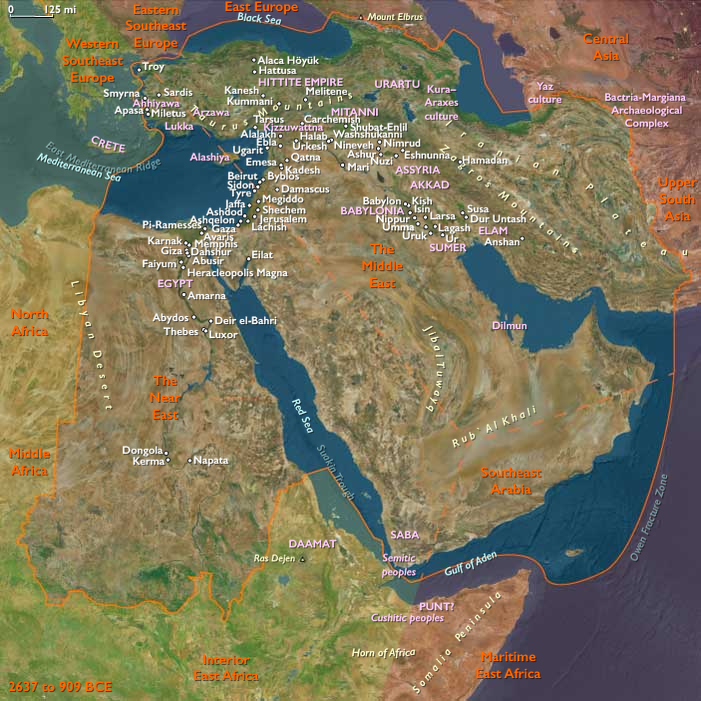
During this period, the city of Ashur, named after the Assyrian sun-god, thrives in the middle of the Tigris Valley despite broader regional upheaval. Following invasions around 1200 BCE by iron-producing peoples that had disrupted established empires across Mesopotamia and the Aegean, the Assyrians capitalize on shifting power dynamics. Although entering a comparative decline after the reign of Tiglath-Pileser I (ending 1076 BCE), Assyria remains resilient. Kings such as Ashur-rabi II, Ashurnasirpal I, Tiglath-Pileser II, and Ashur-Dan II maintain stability, securing borders and preserving military strength through a century and a half of relative isolation.
Phoenician Maritime Expansion and Cultural Contributions
Meanwhile, Phoenician city-states, notably Byblos, Sidon, and Tyre, leverage their maritime prowess to dominate trade routes across the Mediterranean and the Red Sea. Known for their innovations in navigation, glassmaking, ivory carving, and textile production, the Phoenicians establish far-reaching colonies in Cyprus, Rhodes, Crete, and notably Carthage, significantly expanding their trade networks. Their most enduring legacy is the thirty-letter Phoenician alphabet, which they transmit to Aramaeans and Greeks, transforming regional communication. Byblos emerges as a particularly influential center around 1000 BCE, famous for its goldsmiths and the earliest known Phoenician alphabetic inscriptions, such as that on the sarcophagus of Ahiram.
Trade Networks and Arabian Influence
The region's commercial landscape evolves dramatically around 1000 BCE, marked by competition between Red Sea and Persian Gulf trade routes and the rise of new land-based routes across Arabia, facilitated by camel domestication and saddle innovations. Oman, strategically positioned, fluctuates in power and influence, controlling key transshipment points for eastern goods. The increasing caravan trade through inland Arabia fosters deeper interactions between coastal and nomadic inland populations, gradually "arabizing" the Gulf region.
Cyprus: From Cultural Hub to Abandonment
On Cyprus, the city-state of Salamis emerges prominently around the eleventh century BCE, founded according to tradition by Teucer, a Greek hero unable to return home after the Trojan War. The island’s abundant copper resources make it an essential trading hub, influencing mainland Greece culturally during the Greek Dark Ages. Phoenician presence on Cyprus is attested through archaeological discoveries, including children's burials in Canaanite jars. However, after enduring several destructive episodes, Alashiya—another significant Cypriot center—faces abandonment by the eleventh century BCE. Cyprus also witnesses early opium cultivation, used medicinally and recreationally from about 1100 BCE.
Aramaean Expansion and the Syro-Hittite Realignment
The Aramaeans significantly reshape the geopolitical landscape during the eleventh and tenth centuries BCE, establishing powerful kingdoms such as Bit-Agushi, Bit-Adini, and Bit-Bahiani. These settlements proliferate across Greater Syria and Mesopotamia, influencing territories as diverse as Damascus, Hamath, and regions east of the Euphrates, known collectively as Aram-Naharaim. The presence of Aramaeans alongside Neo-Hittite states leads to the establishment of the "Syro-Hittite" entities. Archaeological finds, such as the Tel Dan Stele, reflect the interaction of these states with contemporary powers, including early Hebrew kingdoms.
Babylonia’s Instability and Neo-Elamite Obscurity
Babylonia experiences significant turmoil from 1025 to 977 BCE, marked by rapid transitions among Kassite, Aramaean, and Elamite dynasties. The Middle Babylonian kings are succeeded by foreign rulers who fail to achieve stability, plunging the region into prolonged unrest. Concurrently, the Neo-Elamite period (circa 1100–770 BCE) remains obscure historically, with Anshan maintaining partial Elamite rule, marked occasionally by alliances against Assyrian pressures.
Hasanlu and Cultural Exchange
The city of Hasanlu, destroyed around 1050 BCE, exemplifies resilience and cultural dynamism during this era. Rapid reconstruction following the devastating fire introduces elaborate architectural and ornamental features, and the abundance of Assyrian-style goods demonstrates strong cultural and economic ties with Assyria. The site marks the burgeoning prominence of iron technology, coinciding with Assyrian control of metal trade.
Palmyra and the Persistence of Urban Centers
Palmyra (Tadmor), though historically documented since the early second millennium BCE, continues to play a significant role as a desert oasis and trade stop for caravans. Its status fluctuates, appearing in Assyrian records of the eleventh century BCE and biblical texts linked to King Solomon, reflecting its persistent yet evolving significance.
This era, characterized by Assyrian resilience, Phoenician maritime ascendancy, significant Aramaean influence, and evolving trade dynamics, marks a transformative chapter in Middle Eastern history, setting the foundation for subsequent geopolitical developments.