Ashur-uballit I
king of Assyria
Years: 1395BCE - 1318BCE
Ashur-uballit I (Aššur-uballiṭ I), is king of the Assyrian empire (1365 BCE-1330 BCE or 1353 BCE – 1318 BCE).
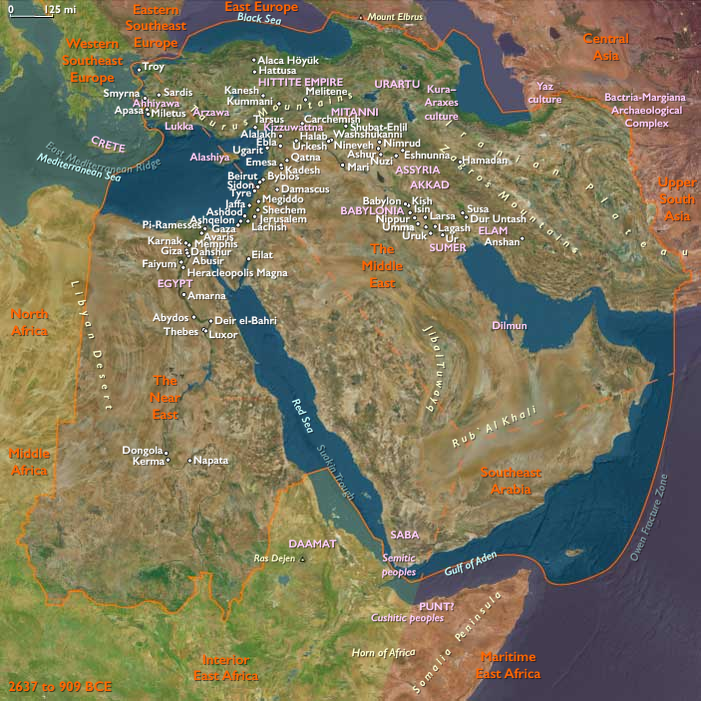
His reign marks Assyria's independence from the kingdom of Mitanni, by defeating Shuttarna II; and the beginning of Assyria's emergence as a powerful empire.
Later on, due to disorder in Babylonia following the death of the Kassite king Burnaburiash II, Ashur-uballit establishes Kurigalzu II on the Babylonian throne, in the first of what will become a series of Assyrian interventions in Babylonian affairs.




Related Events
Filter results
Showing 10 events out of 18 total
Shuttarna, a descendant and probably a son of the great Mitannian king Artatama I, is an ally of the Egyptian Pharaoh Amenhotep III; the diplomatic dealings of the kings are briefly recorded in the Amarna letters.
Shuttarna's daughter Kilu-Hepa (sometimes spelled Gilukhepa) is given to Amenhotep III in marriage to seal the alliance between the two royal houses in the Pharaoh's tenth regnal year, taking with her a great dowry.
The kingdom of Mitanni reaches its height of power and prosperity during the reign of Shuttarna.
From Alalakh in the west, Mitanni shares its border with Egypt in northern Syria approximately by the river Orontes.
The heart of the kingdom is in the Khabur River basin where the capital Washshukanni is situated.
Assyria as well as Arrapha in the east are vassal kingdoms of Mitanni.
The Hittites attempt to invade the northern border lands of Mitanni but Shuttarna defeats them.
Saushtatar, a king of Hanilgalbat (Hurrians of Mitanni) in the fifteenth century BCE, had sacked Ashur and made Assyria a vassal.
Assyria continues to pay tribute to Hanilgalbat until Mitanni power collapses from Hittite pressure from the northwest and Assyrian pressure from the east, enabling Ashur-uballit I (1365 BCE–1330 BCE) to again make Assyria an independent and conquering power at the expense of Babylonia.
Ashur-uballit I defeats Mattiwaza, the Mitanni king, despite attempts by the Hittite king Suppiluliuma to preserve his throne with military support.
The lands of the Mitanni are duly appropriated by Assyria, making it a large and powerful state.
Ashur-uballit, with Assyrian power firmly established, tarts to make contacts with other great nations.
A time comes when the Kassite king in Babylon is glad to marry the daughter of Ashur-uballit, whose letters to Akhenaten of Egypt form part of the Amarna letters.
His messages to the Egyptians angers his Babylonian neighbor Burnaburiash II, who himself writes to the Pharaoh: “with regard to my Assyrian vassals, it was not I who sent them to you.
Why did they go to your country without proper authority?
If you are loyal to me they will not negotiate any business.
Send them to me empty-handed!” Yet the new Assyrian power cannot be denied, and Burnaburiash even marries the daughter of the Assyrian king.
This marriage will eventually lead to disastrous results.
The Assyrians under Ashur-uballit stage a successful revolt against their Mitanni overlords to the west around 1350.
The Hittites simultaneously invade the Mitanni state, already weakened by the Hittite victory of 1380, ending the kingdom.
The Middle East: 1341–1198 BCE
Empires in Conflict: The Hittite Apex and Regional Transformation
Hittite Dominance and Military Innovation
During the fourteenth and thirteenth centuries BCE, the Hittite Empire reached its zenith, controlling territory extending from the Mediterranean Sea to the Persian Gulf. Their military success was largely attributed to innovations in chariot warfare and the early development of iron smelting. Hittite chariots, improved with lighter wheels featuring four spokes instead of eight and repositioned wheels that accommodated three warriors, dominated battles—most notably the largest known chariot battle at Kadesh on the Orontes River around 1274 BCE, where they decisively defeated Egyptian forces. However, despite their military prowess, Hittite dominance faced continuous unrest from vassal states and external threats, eventually contributing to their collapse in the early twelfth century BCE.
Egyptian Retreat and Phoenician Maritime Expansion
With Egypt weakening toward the late fourteenth century BCE, Phoenician city-states—Sidon, Tyre, Byblos, Ugarit, and Arvad—experienced renewed autonomy and significant maritime expansion. Phoenician merchants intensified Mediterranean trade, notably in Tyrian purple dye, cedar timber, luxury glassware, and metal goods, facilitated by advancements in shipbuilding. The invention and dissemination of the alphabetic cuneiform script from Ugarit further revolutionized communication and trade.
Cyprus and Alashiya's Commercial Peak
The Late Bronze Age was a formative period for Cyprus (Alashiya), a vital copper supplier to Egypt, Anatolia, and the Levant. The city of Enkomi flourished as an international commercial hub, adopting a structured urban grid reminiscent of Syrian cities, notably Ugarit. The Cypriot syllabic script was widely utilized, reflecting extensive trade and cultural exchanges with Mycenaean Greece and Near Eastern states. Cyprus remained politically stable as a Hittite client state, experiencing brief direct Hittite intervention around 1200 BCE to secure its crucial copper resources.
Mitanni’s Fall and Assyrian Ascendancy
The Hurrian state of Mitanni, centered on Washshukanni, collapsed under combined pressure from the Hittites and a resurgent Assyria. By 1270 BCE, Mitanni territory split, with Assyria absorbing its eastern portion and the Hittites annexing the west. Assyria, independent once more under rulers such as Ashur-uballit I (1365–1330 BCE), embarked on territorial expansion. Assyrian kings aggressively campaigned southward into Babylonia, temporarily overthrowing Kassite rule under Tukulti-Ninurta I (1244–1208 BCE). Assyria developed extensive botanical gardens and elaborate cultural customs, becoming a dominant Near Eastern power.
Kassite Babylon and Cultural Continuity
Despite intermittent conflicts, Kassite Babylonia endured as a significant regional power. Temples like the Temple of Karaindash at Uruk exemplified Kassite architectural advancements, incorporating sculpted bricks and orientation toward the rising sun. Babylon under Kassite governance remained culturally vibrant, with compositions such as the Enuma Elish epic reflecting its enduring spiritual and cultural centrality.
Middle Elamite Cultural Flourishing
In southwestern Iran, the Middle Elamite Period (circa 1500–1200 BCE) saw an unprecedented surge of cultural and architectural achievements. Under rulers like Untash-Napirisha (1265 BCE), monumental projects such as the temple complex at Choqa Zanbil emerged, demonstrating profound Elamite religious and artistic innovations. The period also marked a definitive linguistic shift toward the Elamite language, emphasizing a distinct cultural identity apart from Mesopotamian traditions.
Technological Innovations and Economic Networks
Economic and cultural exchanges flourished across the region, supported by advanced maritime and overland trade networks connecting Egypt, Cyprus, Anatolia, and Mesopotamia. The Hittites refined iron-smelting technologies by about 1400 BCE, contributing significantly to the onset of the Iron Age. Meanwhile, cities like Nuzi introduced early forms of brass metallurgy, highlighting extensive technological interactions throughout the Middle East.
Nomadic Influence and Regional Instability
Throughout this era, increasing aridity and weakened state control amplified the influence of nomadic groups such as the Ahlamû and the early Aramaeans. These groups, noted for their mobility and military prowess, disrupted established trade routes and challenged settled societies. Such pressures underscored the region’s gradual shift toward greater political fragmentation and the emergence of new social dynamics.
This period, defined by major shifts in power, technological breakthroughs, intensified trade, and increased nomadic influences, significantly reshaped the political and cultural landscape of the ancient Middle East, setting the stage for subsequent historical developments.
Saushtatar, king of Hanigalbat (Hurrians of Mitanni), had sacked Ashur in the mid- to late- fifteenth century BCE, and made Assyria a vassal.
The rulers of Ashur had begun raiding into the south and west after 1363 and have established themselves as a regional power.
Assyria continues to pays tribute to Hanigalbat until Mitanni power collapses from Hittite pressure from the northwest, enabling Ashur-uballit I (1365 BCE–1330 BCE) to again make Assyria an independent and conquering power at the expense of Babylonia.
Shalmaneser I of Assyria takes Babylon from the Kassites and defeats both the Hittites and the Hurrians.
The Assyrians then stage a successful revolt against their Mitanni overlords to the west.
According to Assyrian chronicles, Adad-Nirari, defeats two consecutive Mitanni kings in a series of undatable wars, and brings all of Mesopotamia under Assyrian control, with Hanigalbat remaining an enemy.
Simultaneously, the Hittites invade the Mitanni state, thereby ending the kingdom around 1270.
Having thus regained its independence, Assyria is able to retain it owing to the weakness of its neighbors.
Half of the former Mitanni state passes under Hittite control and the Assyrian state absorbs the rest of Mitannian territory as far as the Euphrates, previously a dominant sphere of Hittite control and influence.
The Assyrians, along with the Kassites, correspond with the kings of Egypt’s Nineteenth dynasty, who are interested in maintaining stability in Syria and Canaan.
Strategically, Ashur is smaller and less well-situated than …
…Kalhu (Nimrud), on the east bank of the Tigris, which Shalmaneser I establishes as his capital city, or …
…Nineveh, which, like the other principal cities of Assyria, is situated in the Tigris River valley.
The goddess’s cult statue at Nineveh had been sent to Pharaoh Amenhotep III of Egypt by orders of the king of Mitanni; the city had remained one of Mitanni's vassals until its seizure by Ashur-uballit.
With the rise of Assyrian power in the late second millennium, Nineveh becomes a royal residence.
At the end of the Bronze Age, Nineveh is much smaller than Babylon, but still one of the world's major cities (population is about thirty-three thousand).
All free male citizens are obliged to serve in the army for a time, a system called the ilku-service.
The Assyrian law code, notable for its repressive attitude towards women in their society, is compiled during this period.
Assyrian law is very similar to Sumerian and Babylonian law, however, notably more brutal than its predecessors.
Three Assyrian law collections have been found to date.
Such punishments as cutting of ears and noses are common, as in the Code of Hammurabi composed several centuries earlier.
In the case of murder, the victim’s family is allowed to decide the death penalty for the murderer.
Assyria has difficulties with keeping the trade routes open.
Unlike the situation in the Old Assyrian period, the Hittites and the Hurrians effectively dominate the Anatolian metal trade.
These people now control the Mediterranean ports, while the Kassites control the river route south to the Persian Gulf.
The Middle Assyrian kingdom is well organized, and in the firm control of the king, who functions as the High Priest of Ashur, the state god.
He has certain obligations to fulfill in the cult, and has to provide resources for the temples.
The priesthood becomes a major power in Assyrian society.
Conflicts with the priesthood are thought to have been behind the murder of king Tukulti-Ninurta I in 1207.