Ashoka
emperor of the Maurya dynasty
Years: 304BCE - 232BCE
Ashoka (ca.
304–232 BCE), also known as Ashoka the Great, is an Indian emperor of the Maurya Dynasty who rules almost all of the Indian subcontinent from ca.
269 BCE to 232 BCE.
One of India's greatest emperors, Ashoka reigns over most of present-day India after a number of military conquests.
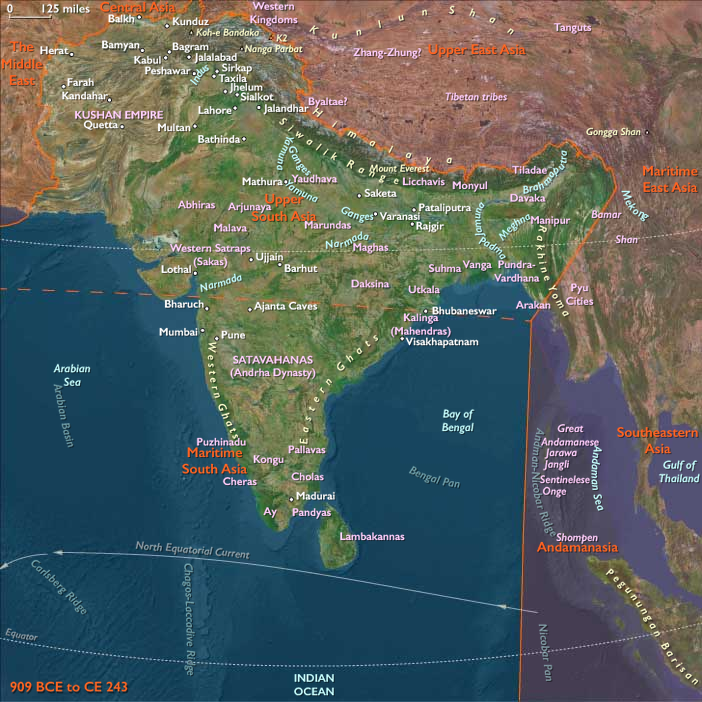
His empire stretches from present-day Pakistan and Afghanistan in the west, to the present-day Bangladesh and the Indian state of Assam in the east, and as far south as northern Kerala and Andhra Pradesh.
He conquers the kingdom named Kalinga, which none of his ancestors had conquered starting from Chandragupta Maurya.
His reign is headquartered in Magadha (present-day Bihar).
He embraces Buddhism after witnessing the mass deaths of the Kalinga War, which he himself had waged out of a desire for conquest.
He is later dedicated to the propagation of Buddhism across Asia and establishes monuments marking several significant sites in the life of Gautama Buddha.
Ashoka becomes a devotee of ahimsa (nonviolence), love, truth, tolerance and vegetarianism.
Ashoka is remembered in history as a philanthropic administrator.
In the history of India, Ashoka is referred to as Samraat Chakravartin Ashoka – the "Emperor of Emperors Ashoka".
His name "aśoka" means "painless, without sorrow" in Sanskrit.
In his edicts, he is referred to as Devānāmpriya (Pali Devānaṃpiya or "The Beloved Of The Gods"), and Priyadarśin (Pali Piyadasī or "He who regards everyone with affection").
Along with the Edicts of Ashoka, his legend is related in the later 2nd-century Aśokāvadāna ("Narrative of Asoka") and Divyāvadāna ("Divine narrative"), and in the Sri Lankan text Mahavamsa ("Great Chronicle").
Ashoka played a critical role in helping make Buddhism a world religion.
As the peace-loving ruler of one of the world's largest, richest and most powerful multi-ethnic states, he is considered an exemplary ruler, who tried to put into practice a secular state ethic of nonviolence.
The emblem of the modern Republic of India is an adaptation of the Lion Capital of Ashoka.