Anushtakin al-Dizbari
Fatimid statesman and general who becomes the most powerful Fatimid governor of Syria
Years: 990 - 1042
Sharaf al-Maʿālī Abu Manṣūr Anūshtakīn al-Dizbarī (died January 1042) is a Fatimid statesman and general who becomes the most powerful Fatimid governor of Syria.
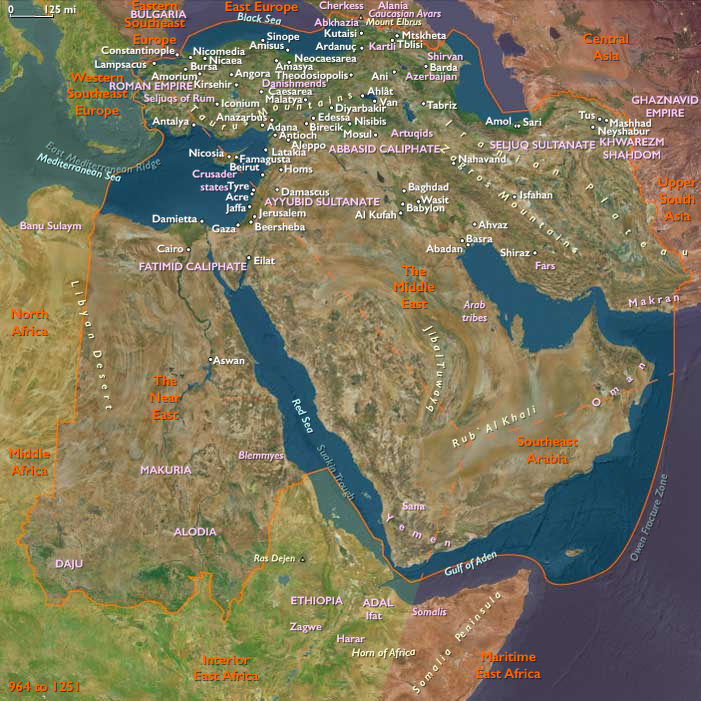
Under his Damascus-based governorship, all of Syria is united under a single Fatimid authority
The historians of his day, including Ibn al-Qalanisi and Ibn al-Adim, note Anushtakin's wealth, just rule and fair treatment of the population, with whom he is popular.
An ethnic Turk, Anushtakin had been enslaved in his homeland of Transoxiana and sold in Damascus in 1009 to Dizbar ibn Awnim, a Daylamite Fatimid officer.
After working as a guard for Dizbar's properties, Anushtakin becomes a ghulam (slave soldier) in Caliph al-Hakim's court in Cairo, and in 1014/15, is made an officer.
Between 1017 and 1023, Anushtakin grows wealthy, gains local renown, and develops a deep understanding of Syrian affairs during his governorship of Ba'albek and Caesarea.
Afterward, he is assigned to Ramla as military governor of Palestine and confronts the powerful Jarrahids, a leading family of the Banu Tayy bedouins that often menaces Palestine's inhabitants.
He is dealt significant battlefield defeats and is recalled and imprisoned in Cairo in 1026, but is soon after freed.
Two years later, vizier Ali al-Jarjara'i dispatches him with an army against the Tayy and Kilab tribes in Syria, whom Anushtakin routs near Lake Tiberias in 1029.
Anushtakin consolidates his authority over Syria by forming alliances with the local nobility, particularly Rafi ibn Abi'l Layl of the Kalb tribe, reining in Bedouin depredations, reconciling with the Jarrahids and acquiring numerous ghilman.
In the mid-1030s, tensions develop between Anushtakin and al-Jarjara'i because the latter fears Anushtakin's growing political ambition.
Al-Jarjara'i stokes conflict between Anushtakin and the Mirdasid emir of Aleppo, Shibl al-Dawla Nasr, which ends when Anushtakin defeats and killed Nasr in 1037.
The following year, Anushtakin captures Aleppo with little resistance, marking the first and last time all of Syria is ruled by a single Fatimid governor.
Anushtakin's rule in Damascus come to an end after an army mutiny engineered by al-Jarjara'i forces him to flee for the Aleppo citadel; he dies there amid accusations of betraying Caliph al-Mustansir.
Fifteen years later, the latter will honor Anushtakin by relocating his grave to Jerusalem.