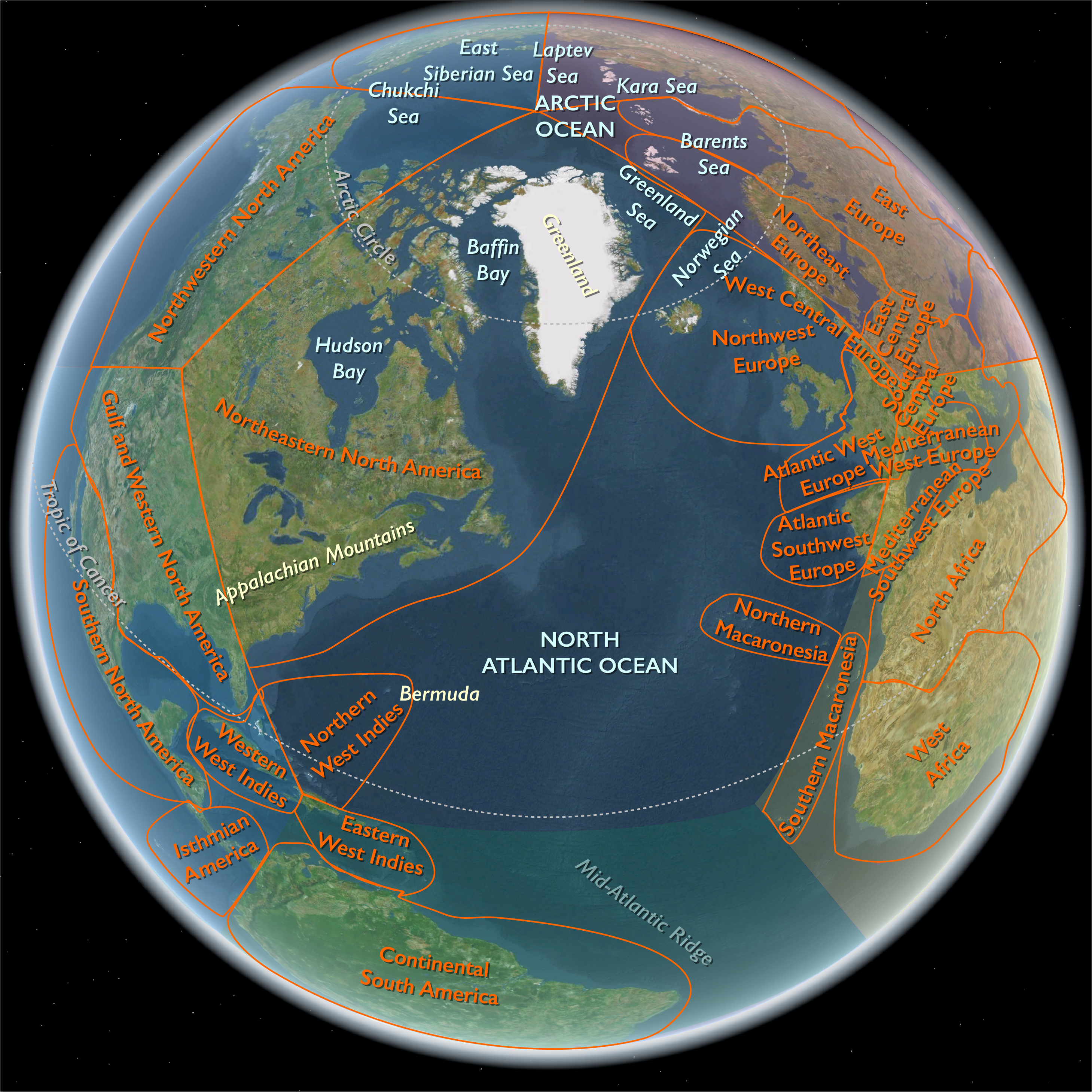
António de Oliveira Salazar
Portuguese statesman, academic, and economist
Years: 1889 - 1970
António de Oliveira Salazar GCTE GCSE GColIH GCIC (28 April 1889 – 27 July 1970) Is a Portuguese statesman, academic, and economist who serveS as Portugal's President of the Council of Ministers from 1932 to 1968.
Having come to power under the Ditadura Nacional ("National Dictatorship"), he reframes the regime as the corporatist Estado Novo ("New State"), with himself as a dictator.
The regime he createa lasted until 1974, making it one of the longest-lived authoritarian regimes in modern Europe.

Related Events
Filter results
Showing 10 events out of 11 total
Mediterranean Southwest Europe (1828–1971 CE): Nation-Building, Dictatorship, and the Reinvention of Mediterranean Economies
Geography & Environmental Context
Mediterranean Southwest Europe encompasses Italy (including Sardinia and Sicily), Malta, southeastern Spain (Andalusia, Murcia, Valencia, Catalonia’s southern coast, and the Balearic Islands). Anchors include the Po Valley and northern Italian plain, the Apennines, Mount Vesuvius and Etna, the Sicilian interior, the Ebro and Guadalquivir valleys, the Balearic archipelagos, and Malta’s limestone plateaus. This is a region of rugged Mediterranean coastlines, volcanic soils, and irrigated plains that supported agriculture, industry, and rapidly growing urban centers such as Rome, Milan, Naples, Palermo, Barcelona, Valencia, Seville, Palma de Mallorca, and Valletta.
Climate & Environmental Shifts
The climate remained characteristically Mediterranean: hot, dry summers and cool, wet winters. Drought cycles in Andalusia and Sicily produced periodic crop failures in the 19th century, while devastating floods affected northern Italy (notably the Adige flood of 1882). Volcanic eruptions at Etna and Vesuvius (most famously 1906 and 1944) threatened nearby settlements. Reforestation and irrigation works expanded in the 20th century, particularly under Fascist Italy’s land reclamation schemes (Pontine Marshes) and Spain’s Franco-era irrigation projects.
Subsistence & Settlement
-
Agriculture:
-
Italy: Wheat in the south; olives, vines, and citrus across peninsular and insular zones; dairy and maize in the Po Valley.
-
Spain: Wheat, citrus, rice (Valencia), and olives; Andalusia’s latifundia coexisted with smallholders.
-
Malta: Dryland farming of wheat and barley with reliance on imported food.
-
-
Industry:
-
Italy’s “industrial triangle” (Milan–Turin–Genoa) became Europe’s key steel, textile, and automotive hub.
-
Barcelona developed as Spain’s textile and industrial center.
-
Naples, Palermo, Andalusian cities lagged behind, locked in agrarian economies.
-
-
Urban growth: Rome became Italy’s capital (1871); Barcelona and Valencia expanded port industry; Valletta was transformed by British naval dominance. By the mid-20th century, rapid urbanization created sprawling suburbs and modernist housing.
Technology & Material Culture
-
Transport: Railways (Piedmont, Catalonia, Andalusia, Naples–Rome) and modern ports transformed connectivity in the 19th century. After WWII, motorways and airports (Milan Malpensa, Rome Fiumicino, Barcelona El Prat, Palma de Mallorca) anchored tourism.
-
Industry & energy: Coal in Asturias and Sardinia; hydroelectric in the Alps and Pyrenees; Fiat (Turin) symbolized Italian industrial growth; postwar petrochemicals reshaped Sicilian and Andalusian coasts.
-
Everyday life: Rural material culture—stone farmhouses, terraced vineyards, hand looms—gave way to urban consumer goods: radios, Vespa scooters, Fiat cars, and televisions by the 1960s.
Movement & Interaction Corridors
-
Migration:
-
19th century: Italians emigrated en masse to the Americas (Argentina, Brazil, the U.S.), and Spaniards to Cuba, Mexico, and Argentina.
-
20th century: Postwar flows sent workers to France, Germany, Switzerland, and Belgium; remittances fueled local economies.
-
-
Colonial ties:
-
Spain retained colonies in Africa until mid-20th century; Italy pursued expansion (Libya, East Africa, Albania, Dodecanese).
-
Malta, as a British fortress colony, was central in Mediterranean naval strategy until independence (1964).
-
-
Tourism: Began in the 19th century with aristocratic visits to Naples, Sicily, and the Balearics; exploded in the 1950s–60s with charter flights to Mallorca, Ibiza, Costa del Sol, Amalfi, and Capri.
-
War corridors: Italian unification wars (Risorgimento), Spanish Civil War (1936–1939), both World Wars, and Cold War naval deployments in Malta all militarized the region.
Cultural & Symbolic Expressions
-
Nationalism: Italy’s Risorgimento (Mazzini, Garibaldi, Cavour) culminated in unification (1861–1871). Spain oscillated between monarchy, republic, dictatorship, and Franco’s authoritarianism (1939–1975). Malta blended Catholic and British influences, asserting independence mid-century.
-
Arts & literature: Italian Romanticism (Verdi), Futurism, and postwar neorealist cinema (Rossellini, De Sica). Spanish cultural figures (Goya’s late works, Gaudí’s Barcelona architecture, Picasso, Miró, Lorca) shaped global modernism.
-
Religion & tradition: Catholicism dominated, with papal authority central in Italy; local fiestas, processions, and Mediterranean folk traditions persisted.
-
Tourist imagery: Romantic depictions of Capri, Amalfi, and Andalusia, later mass-marketed as sun-and-sea resorts, reshaped cultural perception of the Mediterranean.
Environmental Adaptation & Resilience
-
Agrarian reform: Land reforms in Italy (1950s–60s) and Spain (Franco’s agrarian policy) redistributed holdings, though inequality persisted.
-
Irrigation: Expansion of canals and reservoirs modernized citrus and rice production in Valencia and Sicily.
-
Terracing: Maintained soil fertility in hilly regions; mechanization after 1950 reduced reliance on labor-intensive terrace farming.
-
Urban resilience: Cities devastated in WWII (Naples, Rome, Barcelona, Valletta) were rebuilt with modernist architecture and new transport systems.
Political & Military Shocks
-
Italy: Unification (1861–71); Fascist rule (1922–43); WWII defeat and transition to republic (1946).
-
Spain: Carlist Wars; colonial loss in 1898; Civil War (1936–39) leading to Franco’s dictatorship; neutrality in WWII; tourism-led development by the 1960s.
-
Malta: Great Siege memories lived on under British rule; WWII bombardments earned it the George Cross; independence achieved in 1964.
-
Allied & Axis strategy: Mediterranean ports and islands were pivotal in both World Wars, especially Sicily, Malta, and Gibraltar’s approaches.
Transition
Between 1828 and 1971, Mediterranean Southwest Europe moved from agrarian economies under monarchy and empire toward industrialization, dictatorship, and postwar integration. Italy unified and industrialized unevenly, its north surging ahead while the south lagged. Spain suffered civil war and Francoist repression, yet by the 1960s pivoted toward mass tourism. Malta endured as a fortress colony, emerging into independence. Across the region, emigration and remittances provided lifelines, while the rise of modern tourism, consumer culture, and European integration marked the final transformation of this Mediterranean arc into a keystone of 20th-century Europe.
Southwest Europe (1828–1971 CE)
Nationhood, Civil War, and the Making of Modern Iberia
Geography & Environmental Context
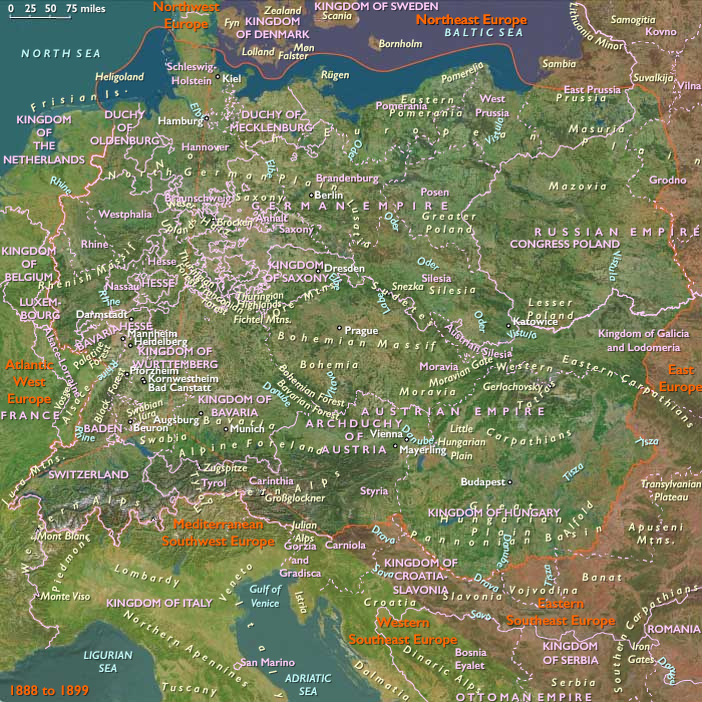
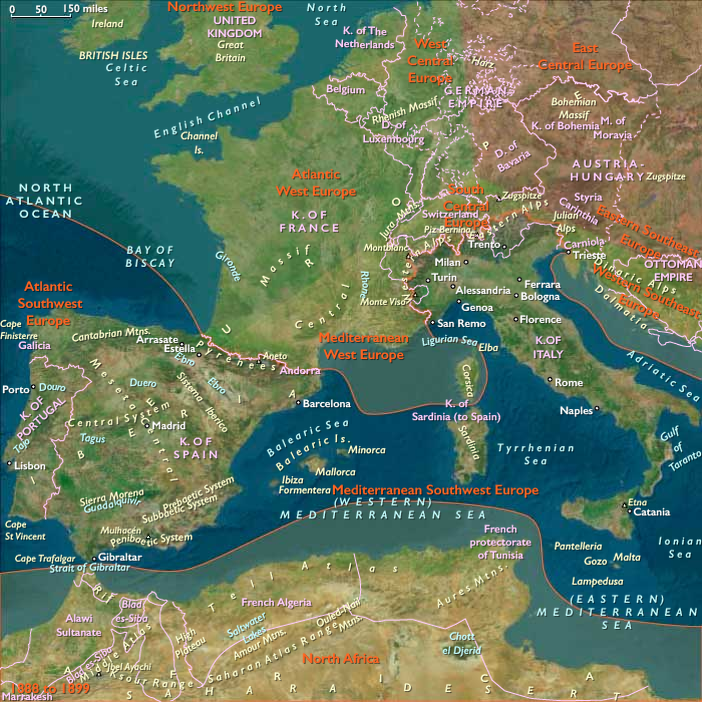
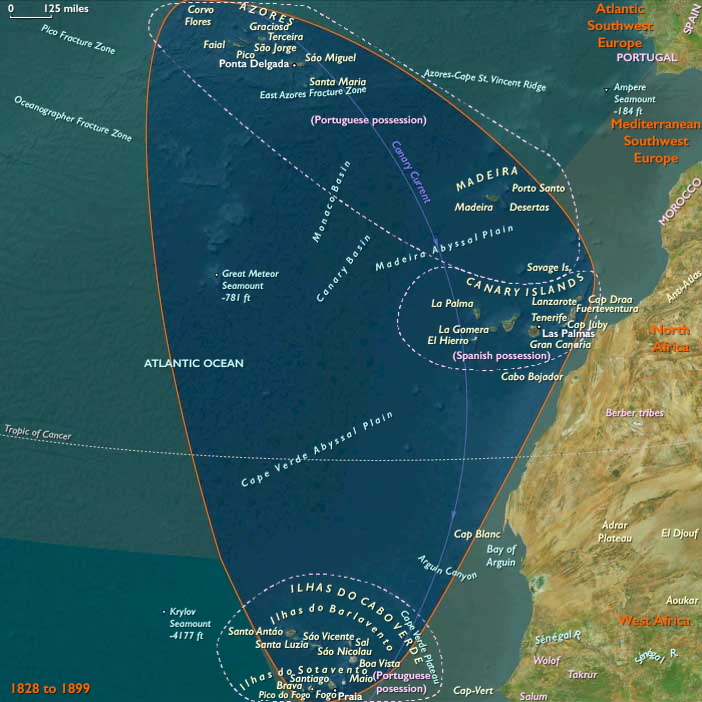
Southwest Europe comprises two fixed subregions:
-
Mediterranean Southwest Europe — Italy (including Sardinia and Sicily), Malta, southeastern Spain, and the Balearic Islands.
-
Atlantic Southwest Europe — northern Spain and central to northern Portugal, including Lisbon, the Tagus Valley, and the Cantabrian Mountains.
Anchors include the Apennines, the Po and Ebro valleys, the Italian Peninsula’s volcanic south, the Tagus, Douro, and Guadalquivir rivers, and key coastal and urban centers—Rome, Naples, Milan, Barcelona, Valencia, Lisbon, and Porto. The region bridges the Atlantic and Mediterranean, uniting maritime trade routes, mountain frontiers, and deep agricultural basins that have long sustained dense populations and layered civilizations.
Climate & Environmental Shifts
A Mediterranean climate of hot, dry summers and mild, wet winters dominated much of the south, while the northwest’s Atlantic façade received abundant rainfall. Deforestation and soil exhaustion from centuries of cultivation gave way to reforestation and terracing programs in the 19th century. Earthquakes occasionally struck southern Italy and Portugal’s coast. By the mid-20th century, irrigation and dam projects modernized agriculture, while industrialization, urban air pollution, and rural depopulation reshaped landscapes.
Subsistence & Settlement
-
Agriculture: Grain, olives, vines, and citrus remained staples; the 19th century saw agrarian reforms and consolidation under liberal monarchies. Mechanization and fertilizers expanded yields by mid-century, but sharecropping and land inequality persisted in southern Italy, Sicily, and Spain.
-
Urbanization: Lisbon, Barcelona, Milan, Rome, and Naples grew as administrative and industrial centers. Northern Italy industrialized rapidly after unification, while southern regions lagged.
-
Migration: Seasonal and transatlantic migration (to the Americas and later to northern Europe) served as economic safety valves. After WWII, internal migration filled factory towns in northern Italy and Catalonia.
-
Fishing and maritime trade: Coastal economies thrived on shipbuilding, sardine and tuna fisheries, and maritime commerce linking the Atlantic and Mediterranean basins.
Technology & Material Culture
Railways (Lisbon–Madrid, Milan–Turin, Naples–Rome) and telegraphs in the 19th century integrated national markets. Industrialization centered on textiles, steel, and shipbuilding, while southern agrarian zones remained semifeudal. After WWII, infrastructure and consumer industries (automobiles, household goods) expanded under European reconstruction aid. Architecture ranged from neoclassical state projects to fascist monumentalism and postwar modernism. Artistic modernism flourished: Gaudí’s Catalan designs, Marinetti’s Futurism, and Morandi’s minimalist painting exemplified divergent paths to modernity.
Movement & Interaction Corridors
-
Maritime corridors: The Mediterranean and Atlantic coasts connected ports like Genoa, Barcelona, and Lisbon to imperial routes across Africa and the Americas.
-
Rail and road networks: Bound the interior to ports; after 1950, highways and airports tied Iberia and Italy to Western Europe’s tourism boom.
-
Labor migration: Italians and Portuguese joined transatlantic migrations to Brazil, Argentina, and the U.S.; by the 1960s, many worked in France, Germany, and Switzerland.
-
Tourism routes: The French and Italian Rivieras, Spanish Balearics, and Portuguese Algarve became global tourist zones after WWII.
Cultural & Symbolic Expressions
Romantic nationalism merged with Catholic revival and liberal reform.
-
Italy: Giuseppe Verdi’s operas and Garibaldi’s campaigns symbolized unification (Risorgimento). Postwar cinema—Rossellini, De Sica, Fellini—portrayed social reconstruction.
-
Spain: Writers and artists such as Goya, Unamuno, and Picasso reflected political trauma and creative rebellion; Flamenco and Andalusian folk arts embodied enduring regional identities.
-
Portugal: Fado captured nostalgia under authoritarian rule; poets like Fernando Pessoa gave voice to existential modernism.
-
Malta and the Balearics: Maritime cultures blended Catholic ritual, seafaring craft, and multilingual exchange.
Catholicism remained culturally dominant, yet anticlerical movements and republicanism spurred secular education and reform.
Environmental Adaptation & Resilience
Irrigation and terrace maintenance stabilized fragile mountain agriculture; coastal marshes were drained; reforestation curbed erosion. Postwar hydroelectric and dam projects (notably on the Tagus and Po) modernized water and power supply. Cooperative farming and later Common Market integration improved productivity. Rural depopulation and emigration altered traditional village structures but relieved demographic pressure on marginal lands.
Political & Military Shocks
-
Liberal revolutions: Spain and Portugal alternated between monarchy and republic amid 19th-century liberal uprisings.
-
Italian Unification (Risorgimento, 1848–71) created a single kingdom under Victor Emmanuel II; regional disparities persisted.
-
Republics and dictatorships:
-
Spain’s First Republic (1873–74) failed amid instability; the Second Republic (1931–39) collapsed in the Spanish Civil War, leading to Francisco Franco’s dictatorship (1939–75).
-
Portugal’s Estado Novo, founded by António Salazar (1933), maintained corporatist authoritarianism until the Carnation Revolution (1974).
-
Italy’s Fascist regime under Mussolini (1922–43) joined the Axis powers; postwar reconstruction created a republic (1946).
-
-
World Wars: Italy fought on both sides; Spain and Portugal remained neutral in WWII but served as refuges and transit corridors.
-
Decolonization: Italy lost Libya, Eritrea, and Somaliland; Portugal clung to its African colonies; Spain withdrew from Morocco’s protectorate (1956).
-
Cold War: Italy and Portugal joined NATO (1949); Spain aligned with the U.S. (1953 agreements) despite Franco’s isolation.
Transition
Between 1828 and 1971, Southwest Europe traversed the arc from agrarian monarchies and fragmented kingdoms to industrial, authoritarian, and democratic states. The Risorgimento, Iberian revolutions, and postwar transitions forged modern nations marked by stark contrasts—prosperous industrial norths and impoverished rural souths, deep religiosity and militant secularism, dictatorship and democracy. The rebuilding after WWII brought integration into Western alliances and the first wave of tourism-led growth. By 1971, the region—its olive terraces, factory belts, and crowded ports—stood as both the southern pillar of Western Europe and a crossroads of lingering empires and emerging modern identities.
Atlantic Southwest Europe (1828–1971 CE)
Interior Vineyards, Coal Valleys, and Capitals under Dictatorships
Geography & Environmental Context
Atlantic Southwest Europe comprises northern Spain and central to northern Portugal (including Lisbon). It is an interior-leaning Atlantic rim: Galicia, Asturias, Cantabria, León, and the northern Meseta in Spain; Minho, Trás-os-Montes, Beira, and the Tagus–Douro valleys in Portugal—plus Lisbon as an estuarine capital. The landscape mixes rain-fed hills, granitic uplands, river terraces, and vineyard slopes (notably the Douro), with cool, wet winters and mild summers that favor grains, vines, and pasture.
Climate & Environmental Shifts
A temperate, ocean-modulated regime brought high rainfall to the northwest and drier interiors to the south and east. Crop failures periodically followed cold spells (1830s) and vine disease (phylloxera in the 1870s–1890s). Post-1945 damming moderated river floods and expanded irrigation, while mid-century reforestation (eucalyptus and pine, especially in Galicia and northern Portugal) altered fire regimes and rural economies.
Subsistence & Settlement
-
Farms & holdings: A mosaic of small plots—minifundio in Galicia/Minho—produced rye, maize, potatoes, wine, olives, and garden crops; communal pastures supported cattle and dairy. In some Portuguese districts, larger latifúndio-style estates lingered on the margins of the region.
-
Vine and olive belts: The Douro’s schist terraces supplied fortified wines; Dão and Bairrada developed quality table wines. Phylloxera devastation forced grafting onto American rootstocks and vineyard restructuring.
-
Mining & industry: Asturias and León expanded coal and iron (19th–early 20th c.), feeding steelworks and railways; textile workshops and paper mills dotted Minho and Beira; Lisbon drew food-processing, printing, and later electrical goods.
-
Urban network: Lisbon dominated administration, finance, and culture; Porto led wine trade and manufacturing; Oviedo, León, Santiago de Compostela, Braga, and Guimarães anchored regional services, schools, and markets.
Technology & Material Culture
Railways (Douro line to the Upper Douro; Minho and Beira lines; León–Asturias coal routes) linked interior valleys to capitals. Wine technology modernized with grafting, sulfur, and temperature-aware cellaring; cooperative dairies spread in Minho and Galicia. Hydropower projects (e.g., mid-century Douro/Tagus systems; Zêzere’s Castelo de Bode) electrified towns and mills. Rural material life shifted from stone farmsteads and hand looms to radio, bicycles, and, after 1950, tractors and household appliances—unevenly distributed.
Movement & Interaction Corridors
-
River corridors: The Douro and Tagus valleys funneled grain, wine, and timber toward Porto and Lisbon; Spain’s northern coal lines moved fuel to interior foundries and power.
-
Emigration: Recurring out-migration to the Americas (19th c.) and, after 1945, to France, Germany, Switzerland, and Luxembourg relieved rural pressure and sent remittances home.
-
Pilgrimage & learning: Roads to Santiago de Compostela sustained hospitality trades; universities in Santiago, Coimbra, and Lisbon shaped professional elites.
-
State arteries: Customs, conscription, and schooling integrated hinterlands into centralized regimes in Madrid and Lisbon.
Cultural & Symbolic Expressions
-
Portugal: Liberal Wars (1828–1834) gave way to constitutional monarchism, then the Estado Novo (from 1933), which promoted ruralist ideals and fado as urban folklore, while censoring dissent. Coimbra fado, literary modernism, and Lisbon cafés nurtured counter-cultures beneath official narratives.
-
Spain (north): The Carlist Wars repeatedly mobilized conservative rural communities; the Spanish Civil War (1936–1939) ruptured Galicia–Asturias–León, followed by Franco’s dictatorship. Galician letters (Castelao, later Celso Emilio Ferreiro) and regional languages persisted within censorship’s limits; craft festivals, romerías, and confraternities sustained local identity.
-
Common threads: Brotherhoods, harvest feasts, wine confraternities, and student tunas (song groups) bridged town and countryside; post-1945 football clubs, radio, and television reknit cultural space.
Environmental Adaptation & Resilience
Terracing and dry-stone walls conserved thin soils on vine slopes; crop rotations (maize–beans–fodder) stabilized yields; chestnut groves, dairy cooperatives, and small orchards buffered income. After phylloxera, grafting and hillside replanting rescued wine. Hydropower, rural electrification, and postwar road-building reduced isolation; remittances financed cisterns, masonry houses, and tractors. Forest cooperatives and parish firefighting faced new plantation fire risks.
Political & Military Shocks
-
Portugal: Liberal Wars (1828–1834); late-century republican agitation culminating in 1910 revolution; Estado Novo consolidation (1933–1971 within this period), wartime neutrality, and colonial wars beginning in the 1960s.
-
Spain: Carlist conflicts (1833–1876), industrial strikes in Asturias (early 20th c.), Civil War (1936–1939) with severe repression in the aftermath; autarky (1940s) followed by development plans (1960s) that spurred roads, dams, and migration.
These shocks redirected land tenure, taxation, and conscription, reshaping everyday life from village commons to university lecture halls.
Transition
From 1828 to 1971, Atlantic Southwest Europe shifted from smallholder mosaics and coal valleys into a region of terraced wines, electrified interiors, and authoritarian capitals. The Douro’s rebuilt vineyards, Lisbon’s bureaucratic and cultural gravity, Asturias’s coal districts, and Galicia–Minho’s emigrant networks defined its arc. Wars and dictatorships constrained politics, yet households adapted through cooperative dairies, hydropower, remittances, and education. By 1971, despite persistent rural poverty pockets, the region stood knitted to Western European markets and migration circuits—its hillsides of vine and maize, and its capitals’ ministries and cafés, poised for the democratic transformations and EEC integrations soon to follow.
Mediterranean Southwest Europe (1924–1935 CE): Consolidation of Authoritarianism and Social Change
The era from 1924 to 1935 CE in Mediterranean Southwest Europe—including the Italian Peninsula, southern and eastern Spain, southern Portugal, Andorra, the Balearic Islands, Sicily, Sardinia, and Malta—is dominated by the consolidation of authoritarian regimes, significant social transformations, economic challenges, and cultural evolutions.
Italy: Consolidation of Fascism and Totalitarian Rule
Under Benito Mussolini, Italy solidifies its transformation into a fascist state. Between 1924 and 1926, Mussolini systematically dismantles democratic institutions, suppresses opposition, and establishes a totalitarian regime characterized by aggressive nationalism, centralized control, and state intervention in the economy.
The Lateran Treaty of 1929 significantly stabilizes Mussolini’s regime by resolving the longstanding "Roman Question." The treaty establishes the Vatican City as an independent sovereign state and confirms Catholicism as Italy’s official religion, greatly enhancing Mussolini’s domestic legitimacy.
Despite authoritarian rule, Italy embarks on substantial modernization projects, notably in infrastructure, agriculture, and industry. Fascist policies promote demographic growth, social discipline, and militarization, setting the stage for Italy’s aggressive foreign policy leading toward war in the late 1930s.
Spain: The End of Primo de Rivera’s Dictatorship and the Rise of the Second Republic
General Miguel Primo de Rivera initially stabilizes Spain through authoritarian measures after his 1923 coup, but economic hardship, political discontent, and mounting opposition erode his regime’s support. In 1930, Primo de Rivera resigns under immense pressure, leading to the collapse of his military dictatorship.
Following a brief transitional period under King Alfonso XIII, Spain’s political landscape undergoes a dramatic shift. In April 1931, the monarchy is abolished, and the Second Spanish Republic is proclaimed. The republic initiates extensive reforms aiming at secularization, regional autonomy, land redistribution, and improved labor rights. These measures, however, sharply polarize Spanish society, setting the stage for escalating political tensions and violence.
Andorra: Continued Stability and Economic Development
Andorra continues its trajectory of stable governance and gradual economic modernization, maintaining its unique political arrangement under the dual sovereignty of the French President and the Bishop of Urgell. Benefiting from relative insulation from wider European turmoil, Andorra sees improvements in infrastructure and tourism, gradually integrating further into regional economic networks.
Malta: Constitutional Advances and Rising National Consciousness
In Malta, nationalist movements advocating greater autonomy from British colonial rule gain significant ground. The 1921 constitution, granting responsible self-government, faces setbacks due to political conflicts and colonial intervention but ultimately strengthens Maltese national identity and political awareness.
Malta experiences significant social change as labor movements grow stronger and political parties emerge advocating workers’ rights and greater autonomy, laying crucial foundations for Malta's eventual independence aspirations.
Portugal: Political Instability and the Rise of Salazar’s Estado Novo
Portugal endures chronic political instability following the collapse of the First Republic (1910–1926). Military coups and frequent government changes culminate in the military coup of 1926, ushering in a dictatorial regime under military leadership. In 1932, economist António de Oliveira Salazar becomes prime minister, establishing the authoritarian Estado Novo regime.
Salazar’s Estado Novo emphasizes conservative Catholic values, economic austerity, national unity, and a corporatist economic model. This regime brings political stability and economic control but severely restricts political freedoms and suppresses dissent, profoundly reshaping Portuguese society and governance for decades.
Conclusion: Era of Authoritarian Consolidation and Social Transformation
Between 1924 and 1935, Mediterranean Southwest Europe experiences an era defined by the consolidation of authoritarian regimes in Italy and Portugal, a tumultuous but transformative republican experiment in Spain, and growing nationalist aspirations in Malta. Andorra continues its steady evolution, successfully balancing tradition and modernization. This period fundamentally reshapes the political, economic, and social fabric of the region, influencing developments for generations to come.
Atlantic Southwest Europe (1924–1935): Dictatorship, Stabilization, and Rising Political Polarization
Between 1924 and 1935, Atlantic Southwest Europe—including northern and central Portugal, Galicia, Asturias, Cantabria, northern León and Castile, northern Navarre, northern Rioja, and the Basque Country—experienced authoritarian stabilization, economic modernization, and escalating political tensions. The era was defined by the establishment of authoritarian regimes in Portugal under António de Oliveira Salazar and Spain under Miguel Primo de Rivera, followed by the Second Spanish Republic’s brief democratic experiment. Meanwhile, deepening ideological divisions and intensified regional nationalism prepared the region for the turmoil of the late 1930s.
Political and Military Developments
Spain: Primo de Rivera’s Dictatorship (1923–1930)
-
In 1923, General Miguel Primo de Rivera seized power, establishing a military dictatorship to stabilize Spain amid severe political and social unrest. His regime initially restored public order and facilitated infrastructural projects, benefiting regions like the Basque Country (Bilbao’s port expansion), Cantabria, and Asturias.
-
Primo de Rivera curtailed regional autonomy, notably antagonizing Basque and Galician nationalists by suppressing cultural activities and limiting political expression, fueling further regional dissent.
The Second Spanish Republic and Rising Polarization (1931–1935)
-
Primo de Rivera’s resignation (1930) led to the proclamation of the Second Spanish Republic (1931–1939). Initial optimism for democracy gave way to profound political polarization, particularly intense in northern industrial and rural areas.
-
The Republic enacted extensive reforms, including secularization, land redistribution, and regional autonomy statutes. The Basque Country drafted an autonomy statute, reflecting growing nationalist strength, though tensions mounted as conservative sectors and the Catholic Church resisted republican reforms vehemently.
Portugal: Salazar’s Estado Novo (1933–1974)
-
Portugal’s chaotic First Republic ended definitively in 1926 with a military coup that installed a conservative dictatorship, solidified after António de Oliveira Salazar became finance minister in 1928 and prime minister in 1932. His regime—known from 1933 as the Estado Novo (“New State”)—established authoritarian, corporatist governance emphasizing social order, fiscal discipline, and conservative Catholic values.
-
Northern Portugal, particularly Porto, initially benefited from Salazar’s financial stabilization policies, gaining infrastructure improvements and economic growth, though at the cost of political freedoms and civil liberties.
Economic Developments: Stabilization and Modernization
Infrastructure and Industrial Growth
-
Under Primo de Rivera, northern Spain saw extensive infrastructure improvements, notably road-building, rail expansion, and urban renewal in cities like Bilbao, Oviedo, and Santander, promoting regional economic integration and industrial competitiveness.
-
The Basque Country, Asturias, and Cantabria experienced industrial stabilization, especially in steel, shipbuilding, and coal mining, although labor conditions remained harsh, fostering underlying social tensions.
Salazar’s Economic Policies and Stability in Portugal
-
Salazar’s disciplined fiscal policies ended Portugal’s inflationary cycles, restored public finances, and encouraged modest industrialization and infrastructure development, notably roads and railways connecting Porto, Braga, and Lisbon.
-
Northern Portugal’s textile, agricultural, and wine sectors benefited from improved stability, although economic growth was gradual and conservative, preserving significant regional and rural poverty.
Social and Urban Developments
Urban Expansion and Social Control
-
Under authoritarian regimes, cities such as Porto, Bilbao, and Santander witnessed controlled urban growth, infrastructural modernization, and improved public services, though accompanied by strict political surveillance and reduced civic freedoms.
-
Social inequalities persisted in industrial and rural areas, fueling underlying dissatisfaction, especially among working-class and rural populations in Galicia, Asturias, and northern León.
Labor and Social Tensions
-
Despite authoritarian stability, labor unrest periodically erupted due to poor working conditions and suppressed unions. Northern Spain’s industrial cities (Gijón, Bilbao, Oviedo) experienced occasional labor strikes and protests, harshly suppressed by authorities.
-
In Portugal, Salazar’s regime maintained tight control over labor movements, suppressing political dissent through strict censorship, surveillance, and occasional imprisonment of activists.
Cultural and Religious Developments
Resurgence of Catholicism and Conservative Values
-
Both Salazar’s Portugal and conservative sectors in Spain promoted Catholic traditionalism as fundamental to national identity, closely aligning Church and state. Catholic institutions regained prominence, influencing education, social policy, and cultural life, particularly strong in rural northern areas and cities such as Braga and Oviedo.
-
The Catholic Church strongly opposed republican secularization in Spain, becoming a central force in conservative opposition, particularly in northern Navarre, Rioja, and the Basque rural areas.
Strengthening of Regional and Nationalist Movements
-
Basque nationalism continued expanding, exemplified by the growth of the PNV, linguistic revitalization, and active cultural organizations promoting Basque identity. Similar, though milder, nationalist sentiment persisted in Galicia.
-
In Portugal, Salazar promoted centralized nationalism emphasizing unity, often suppressing regional distinctiveness. However, cultural life in Porto and northern universities (Coimbra, Braga) continued promoting regional pride within a framework acceptable to the regime.
Legacy and Significance
The period 1924–1935 in Atlantic Southwest Europe marked a critical turning point, defined by authoritarian stabilization, economic modernization, intensified political polarization, and rising regional nationalism. Primo de Rivera’s dictatorship and Salazar’s Estado Novo established stable but oppressive governance, temporarily quelling social unrest but embedding long-term tensions. Spain’s brief republican experiment heightened political polarization, laying critical foundations for the devastating Spanish Civil War (1936–1939). Simultaneously, Portugal under Salazar solidified authoritarian corporatism, shaping the country’s political and economic landscape for decades. Culturally, regional identities strengthened, particularly Basque nationalism, sowing seeds of future conflicts and autonomy movements.
Mediterranean Southwest Europe (1936–1947 CE): Civil War, Authoritarian Expansion, and Postwar Realignments
The era from 1936 to 1947 CE in Mediterranean Southwest Europe—encompassing the Italian Peninsula, southern and eastern Spain, southern Portugal, Andorra, the Balearic Islands, Sicily, Sardinia, and Malta—is marked by violent upheaval, aggressive authoritarian expansion, devastating warfare, and significant geopolitical and social realignments.
Spain: The Civil War and Rise of Franco’s Dictatorship
In Spain, escalating political polarization culminates in the outbreak of the brutal Spanish Civil War (1936–1939). General Francisco Franco leads a Nationalist rebellion against the Second Spanish Republic, backed by fascist regimes in Germany and Italy. Despite heroic Republican resistance, including international volunteers in the International Brigades, the Nationalists prevail, and Franco establishes a long-lasting authoritarian regime.
Under Franco, Spain becomes a repressive, corporatist state emphasizing conservative Catholicism, nationalism, and autarky. His regime systematically suppresses political opposition, regional autonomy, and workers' rights, leaving lasting divisions in Spanish society.
Italy: Fascist Aggression and World War II
Under Benito Mussolini, Italy aggressively expands its fascist ambitions, invading Ethiopia in 1935–1936, solidifying its position as a militarized fascist state. Italy allies itself closely with Nazi Germany through the Pact of Steel (1939), joining World War II as part of the Axis Powers in 1940.
Italy’s wartime experience is disastrous, characterized by military defeats in North Africa and Greece. By 1943, Mussolini is deposed following Allied invasions of Sicily and the Italian mainland. Italy suffers extensive devastation and becomes a battleground until liberation in 1945. Post-war, Italy transitions toward democracy with the abolition of the monarchy in 1946 and the establishment of the Italian Republic following a public referendum.
Portugal: Consolidation of the Estado Novo
In Portugal, António de Oliveira Salazar solidifies his Estado Novo authoritarian regime, emphasizing neutrality during World War II despite ideological sympathies with fascist powers. Salazar manages to maintain Portuguese neutrality, balancing cautiously between Axis and Allied pressures, and uses wartime conditions to reinforce domestic authoritarian control, severely limiting political freedoms and opposition activities.
Portugal’s neutrality allows it to benefit economically from trade with both sides during the war, consolidating the regime's strength and Salazar's personal rule.
Malta: World War II and the Struggle for Survival
Malta, strategically vital due to its position in the Mediterranean, endures severe bombardment and siege conditions during World War II, earning recognition as the most heavily bombed location in the conflict. The Maltese people’s resilience under constant attack earns the entire island the prestigious George Cross from King George VI in 1942, symbolizing civilian bravery and endurance.
Post-war, the valor demonstrated strengthens Maltese national identity and fuels demands for greater autonomy from British colonial rule.
Andorra: Neutrality and Continued Stability
Andorra maintains its traditional neutrality and political stability, remaining insulated from wartime upheavals. The principality continues to quietly develop its tourism and infrastructure, further integrating economically into regional markets. Andorra’s political and social structures remain largely unchanged, providing a stable contrast to broader regional turmoil.
Postwar Realignments and Reconstruction
By 1947, Mediterranean Southwest Europe emerges fundamentally transformed. Spain and Portugal remain under authoritarian regimes, insulated from broader postwar democratization efforts. Italy transitions to a democratic republic, becoming a central player in the emerging Western alliance system during the early Cold War. Malta’s wartime experiences bolster national consciousness and set the stage for its eventual path toward independence. Andorra, meanwhile, continues its trajectory of stability and gradual modernization.
This tumultuous era profoundly reshapes Mediterranean Southwest Europe, laying the foundation for significant geopolitical, social, and economic realignments in the decades following World War II.
Atlantic Southwest Europe (1936–1947): Civil War, Neutrality, and Authoritarian Consolidation
From 1936 to 1947, Atlantic Southwest Europe—including northern and central Portugal, Galicia, Asturias, Cantabria, northern León and Castile, northern Navarre, northern Rioja, and the Basque Country—experienced the dramatic upheaval of the Spanish Civil War, Portugal’s carefully maintained neutrality during World War II, and the consolidation of authoritarian regimes under Franco in Spain and Salazar in Portugal. The era fundamentally reshaped the region's political landscape, intensified ideological divisions, and deeply influenced economic, social, and cultural developments.
Political and Military Developments
The Spanish Civil War (1936–1939)
-
The Spanish Civil War erupted following General Francisco Franco’s military uprising against the democratic Second Republic in July 1936. Atlantic Southwest Europe became a strategic battleground:
-
The Basque Country and Asturias saw intense fighting. Bilbao and Gijón endured heavy bombardment, while Basque and Asturian militias fiercely resisted Franco's Nationalist forces.
-
In 1937, the bombing of Guernica by Nazi Germany’s Condor Legion symbolized wartime atrocities and civilian suffering, profoundly affecting international perceptions of the conflict.
-
Galicia, northern León, Navarre, and Rioja fell quickly under Franco’s control, serving as bases for Nationalist offensives, supported significantly by conservative sectors and the Catholic Church.
-
-
Franco’s victory in 1939 established a repressive authoritarian regime that systematically dismantled regional autonomy, especially targeting Basque and Galician nationalism.
Portugal’s Neutrality under Salazar
-
Portugal, governed by Salazar’s authoritarian Estado Novo, maintained strategic neutrality during World War II (1939–1945), carefully balancing relations with both Allied and Axis powers.
-
Northern Portuguese ports—particularly Porto—became essential for trade, intelligence gathering, and refugee movements, while Salazar leveraged neutrality to strengthen internal political stability and economic conditions.
Economic Developments: War and Reconstruction
Wartime Destruction and Francoist Autarky in Spain
-
The Civil War devastated northern Spain’s industrial infrastructure, notably the steel mills, shipyards, and coal mines in Asturias, Cantabria, and the Basque Country. The port cities of Bilbao, Santander, and Gijón suffered extensive physical destruction.
-
Franco imposed an autarkic (self-sufficient) economic policy to rebuild Spain’s economy, severely restricting foreign trade and imports. This policy led to prolonged economic hardship, shortages, and stagnation, deeply affecting daily life in Atlantic Southwest Spain.
Portugal: Economic Stability and Moderate Growth
-
Portugal’s wartime neutrality allowed for moderate economic benefits, particularly through trade with both Allied and Axis nations, promoting stability and modest growth in industries like textiles, wine production, and agriculture in northern regions, especially around Porto.
-
Salazar’s conservative fiscal policies and limited industrial investment sustained social stability but restricted broader industrial expansion, maintaining significant rural poverty.
Social and Urban Developments
Repression, Emigration, and Social Control in Franco’s Spain
-
Franco’s regime implemented severe political repression, including widespread imprisonment, executions, and forced labor camps, notably affecting the Basque Country, Asturias, and Galicia. This repression prompted significant emigration, particularly to Latin America and France.
-
Franco promoted traditional social hierarchies, enforced strict censorship, and tightly controlled labor movements, suppressing political dissent and regional identities to reinforce a unified Spanish nationalism.
Portugal: Controlled Stability and Emigration
-
Under Salazar’s Estado Novo, social stability persisted through strict political control and censorship. Despite improved economic conditions, northern Portugal experienced significant emigration, notably to Brazil, Angola, and later to other European countries, driven by rural poverty and limited economic opportunities.
-
Porto and northern urban centers expanded cautiously, with controlled urban growth, improved infrastructure, and moderate economic modernization under strict governmental oversight.
Cultural and Religious Developments
Catholic Nationalism and Cultural Control
-
Franco’s Spain heavily emphasized Catholic nationalism, promoting the Church’s role in education, social policy, and public morality. This significantly shaped cultural life, particularly strong in Galicia, Navarre, and rural areas of northern León and Castile.
-
Basque and Galician languages and cultures faced severe repression under Franco, with Basque institutions, cultural organizations, and media systematically suppressed, fueling underground nationalist resistance.
Portugal: Conservative Catholicism and Cultural Expression
-
Salazar reinforced conservative Catholic values, fostering close collaboration between state and Church. Cultural expression, especially in education and media, adhered strictly to regime-approved themes emphasizing nationalism, religious values, and social order.
-
However, northern universities (Coimbra, Porto, Braga) maintained intellectual vibrancy within limited frameworks, quietly nurturing regional cultural identities and scholarly activity despite political restrictions.
Legacy and Significance
Between 1936 and 1947, Atlantic Southwest Europe experienced profound trauma and transformation. The Spanish Civil War fundamentally reshaped northern Spain’s political and social landscape, resulting in severe economic disruption, brutal repression, and diminished regional autonomy. Franco’s regime solidified authoritarian control through enforced nationalism and Catholic orthodoxy, leaving lasting scars and resistance, especially in Basque and Galician regions. Portugal’s strategic neutrality and internal stability under Salazar allowed moderate economic benefits, though at significant social and political costs. This era thus set critical foundations for subsequent economic modernization, social transformations, and regional resistance movements in the post-war period, influencing Atlantic Southwest Europe’s historical trajectory deeply into the latter half of the 20th century.
Mediterranean Southwest Europe (1948–1959 CE): Postwar Recovery, Authoritarian Continuities, and Steps Toward Modernization
From 1948 to 1959 CE, Mediterranean Southwest Europe—comprising the Italian Peninsula, southern and eastern Spain, southern Portugal, Andorra, the Balearic Islands, Sicily, Sardinia, and Malta—experiences significant reconstruction, economic transformation, continuing authoritarianism, and the early stages of European integration.
Italy: Economic Miracle and Democratic Stabilization
Italy rapidly rebuilds after World War II, benefiting significantly from the Marshall Plan (1948–1952), which injects crucial funds into the devastated economy. This influx of aid initiates an "economic miracle" (miracolo economico), characterized by industrial expansion, infrastructure rebuilding, and the growth of the manufacturing and automobile industries—highlighted by the global rise of companies like Fiat.
Politically, Italy stabilizes under the leadership of Prime Ministers such as Alcide De Gasperi, who guides the country through postwar recovery and firmly positions Italy within Western alliances, joining NATO in 1949. The nation also becomes a founding member of the European Economic Community (EEC) in 1957, significantly strengthening its economic and political integration within Europe.
Spain: Franco’s Continued Rule and Economic Isolation
In Spain, General Francisco Franco maintains his authoritarian regime, continuing to suppress political dissent, maintain press censorship, and uphold strict social conservatism. International isolation following World War II initially restricts Spain's economic recovery, but by the early 1950s, shifting Cold War dynamics lead to gradual reintegration into Western diplomatic and economic spheres.
The 1953 Pact of Madrid marks a critical turning point as the United States provides economic and military assistance in exchange for military bases on Spanish territory, easing Spain's isolation. Despite political repression, Spain begins experiencing modest economic improvements, setting the stage for accelerated growth in subsequent decades.
Portugal: Salazar’s Stability and Economic Challenges
Portugal remains under the authoritarian control of António de Oliveira Salazar and his Estado Novo regime. Despite political stability and continued neutrality during the early Cold War, economic stagnation persists due to conservative economic policies, rigid social structures, and delayed industrial modernization.
However, by the late 1950s, Portugal begins cautious steps toward economic liberalization, including joining the European Free Trade Association (EFTA) as a founding member in 1960, signaling the regime’s willingness to engage more actively with Western Europe’s economic developments.
Malta: Toward Greater Autonomy
Malta, having demonstrated its strategic value during World War II, increasingly seeks political autonomy from British colonial rule. In 1947, Malta achieves internal self-government, and in the subsequent years, Maltese leaders, particularly Dom Mintoff, advocate for greater political and economic independence, laying the foundation for eventual independence.
The postwar period sees Malta developing a diversified economy focused increasingly on tourism and light industry, reducing its dependency on British military expenditures.
Andorra: Stability and Incremental Modernization
In Andorra, the principality continues its path of stable, incremental economic modernization, focusing heavily on tourism and trade. During this period, the government makes concerted efforts to improve infrastructure and strengthen its international economic relationships. Andorra maintains political stability and neutrality, benefiting from its peaceful and prosperous position amidst broader European transformations.
Regional Realignments and Early European Integration
By the end of 1959, Mediterranean Southwest Europe has significantly evolved from its immediate postwar conditions. Italy emerges economically vibrant and politically stable, deeply integrated into the Western European economic system. Spain and Portugal, though still authoritarian, begin opening their economies to international influences. Malta steadily moves toward independence, and Andorra continues its peaceful economic growth.
This era lays crucial groundwork for substantial political, social, and economic shifts that characterize Mediterranean Southwest Europe in the latter half of the 20th century.
Atlantic Southwest Europe (1948–1959): Authoritarian Stability, Gradual Modernization, and Emerging Resistance
From 1948 to 1959, Atlantic Southwest Europe—including northern and central Portugal, Galicia, Asturias, Cantabria, northern León and Castile, northern Navarre, northern Rioja, and the Basque Country—experienced political continuity under authoritarian regimes, gradual economic modernization, and early signs of cultural and political resistance. Franco’s Spain and Salazar’s Portugal pursued policies of cautious industrial growth, rigid social control, and cultural conservatism, even as regional dissatisfaction and underground resistance movements subtly intensified.
Political and Military Developments
Francoist Consolidation and International Integration
-
Under Francisco Franco (r. 1939–1975), northern Spain continued its authoritarian rule, reinforced by strong central government control, military oversight, and rigid censorship. Basque and Galician nationalist movements faced persistent repression, fueling underground activism.
-
Internationally, Spain began cautiously reintegrating into Western Europe, joining international bodies like the United Nations (1955), and signing the Madrid Pact (1953) with the United States, securing economic aid in exchange for military bases, indirectly benefiting northern Spanish ports like Santander and Bilbao.
Portugal’s Estado Novo under Salazar
-
Portugal maintained political stability through Salazar’s tightly controlled Estado Novo. Northern Portugal, particularly Porto and Braga, benefited modestly from stable governance, but remained subject to stringent political oversight and suppression of dissent.
-
Salazar’s government prioritized colonial consolidation, notably in Africa, creating an economic dependency that would profoundly shape Portugal’s future.
Economic Developments: Gradual Growth and Industrialization
Spain’s Economic Autarky and Early Liberalization
-
Franco’s rigid autarkic economic policies persisted into the early 1950s, hindering rapid economic growth in Galicia, Asturias, and the Basque Country. However, by the late 1950s, these policies gradually relaxed, paving the way for limited foreign investment and industrial modernization, notably benefiting Bilbao’s steel production and Santander’s maritime commerce.
-
Early infrastructure improvements, such as roads and electricity networks, initiated modest economic recovery and growth, laying the groundwork for future industrialization.
Portugal: Controlled Economic Modernization
-
Portugal experienced moderate economic growth under Salazar’s cautious policies, emphasizing fiscal conservatism, agricultural development, and gradual industrial expansion, particularly visible in Porto’s textile, wine, and manufacturing sectors.
-
Infrastructure improvements—roads, bridges, electricity—strengthened economic linkages between northern cities (Porto, Braga, Coimbra) and rural areas, yet significant rural poverty and emigration persisted, notably toward Brazil and France.
Social and Urban Developments
Controlled Urbanization and Social Stability in Spain
-
Northern Spanish cities like Bilbao, Santander, and Gijón underwent controlled urban expansion, driven by industrialization and improved infrastructure. Yet rural Galicia, Asturias, and Castilian regions continued facing economic stagnation, prompting migration toward urban centers or abroad.
-
Despite social stability enforced through strict censorship and security apparatus, underground political resistance and workers’ movements gradually increased, particularly in Basque industrial towns.
Portugal: Social Stability amid Rural Poverty
-
Portugal’s Estado Novo maintained social stability through conservative policies and limited urban growth. Porto, Braga, and Coimbra experienced controlled modernization, but rural northern Portugal suffered persistent poverty, driving continued emigration to Brazil, France, and later Germany.
-
Urban centers became focal points for modest social mobility, with middle-class expansion in commerce and industry cautiously managed under tight state oversight.
Cultural and Religious Developments
Franco’s National Catholicism and Regional Repression
-
Spain under Franco continued promoting Catholic nationalism as a core ideology, strongly influencing education, social policy, and cultural life across northern regions. The Church remained a powerful institution, reinforcing conservative values and regime legitimacy.
-
Despite official suppression, Basque and Galician cultural expressions subtly persisted underground, preserving regional languages, folklore, and nationalist sentiments, laying groundwork for later resurgence.
Portuguese Cultural Conservatism and Quiet Regional Identity
-
Under Salazar, Portugal reinforced conservative Catholic values through strict control over education and media. However, northern Portuguese universities—Coimbra, Porto, and Braga—served as quiet intellectual hubs, cautiously maintaining regional cultural identity and scholarly independence.
-
Regional folklore, literature, and artistic traditions subtly flourished in rural northern areas, balancing regime-approved conservatism with quiet assertions of local identity.
Emerging Resistance and Regional Identity
-
In northern Spain, particularly in the Basque Country, Galicia, and Asturias, underground political movements and labor activism quietly gained strength, challenging Francoist repression and advocating regional autonomy and democratic reform.
-
The Basque nationalist movement began reorganizing clandestinely, laying foundations for more assertive resistance in the subsequent decades. Similarly, Galicia experienced a subtle cultural revival, driven by intellectual circles quietly advocating regional identity.
Legacy and Significance
Between 1948 and 1959, Atlantic Southwest Europe witnessed stable authoritarian governance, modest economic modernization, and early emergence of regional resistance movements. Franco’s Spain and Salazar’s Portugal maintained political control and social stability through strict governance, economic caution, and cultural conservatism. Yet beneath this stability, subtle shifts toward economic liberalization and growing regional discontent foreshadowed future transformations. This era thus represented a critical transitional period, gradually setting the stage for the region’s subsequent economic modernization, political liberalization, and cultural revitalization in the decades ahead.
Mediterranean Southwest Europe (1960–1971 CE): Economic Expansion, Political Transitions, and European Integration
Between 1960 and 1971 CE, Mediterranean Southwest Europe—comprising the Italian Peninsula, southern and eastern Spain, southern Portugal, Andorra, the Balearic Islands, Sicily, Sardinia, and Malta—experiences significant economic growth, notable political transformations, continued integration into European institutions, and progressive social changes.
Italy: Economic Prosperity and Social Shifts
Italy continues to enjoy sustained economic growth throughout the 1960s, known as the miracolo economico, which substantially elevates living standards, expands the middle class, and fuels urbanization. However, this rapid industrialization brings social challenges, including internal migration from rural south to industrialized north and the resultant strain on urban infrastructure.
Politically, Italy sees increased governmental instability marked by frequent cabinet reshuffles and short-lived governments. Despite these challenges, Italy remains firmly anchored in Western Europe’s political framework, actively participating in European integration and supporting the development of the European Economic Community (EEC). Cultural movements, notably in cinema and literature, highlight Italy's evolving societal norms and growing liberalization.
Spain: Gradual Liberalization under Franco
Spain, still under General Francisco Franco's authoritarian regime, experiences significant economic liberalization and industrialization during this era, driven by the implementation of the Stabilization Plan of 1959, which opens the economy to international markets. This economic policy stimulates foreign investment, tourism growth, and urban development, especially along the Mediterranean coast.
Though political repression remains stringent, gradual societal liberalization emerges in cultural and economic spheres, setting the stage for eventual democratic reforms. Spain’s strategic partnership with the United States strengthens through continued military cooperation, while closer economic relations with Western Europe culminate in association agreements with the European Economic Community.
Portugal: Salazar’s Decline and Early Liberalization
Portugal sees continued authoritarian rule under António de Oliveira Salazar, whose governance increasingly faces international criticism for colonial wars in Africa. Salazar’s declining health in 1968 leads to his replacement by Marcelo Caetano, who cautiously introduces limited economic reforms and gradual political liberalization.
Portugal’s involvement in prolonged colonial conflicts, particularly in Angola and Mozambique, becomes a heavy economic and social burden, intensifying domestic pressures for political change. Nonetheless, economic modernization slowly progresses, marked by growth in tourism, industry, and closer economic ties to Western Europe through membership in the European Free Trade Association (EFTA).
Malta: Independence and Economic Development
Malta achieves independence from British colonial rule in 1964, becoming a constitutional monarchy within the British Commonwealth. Prime Minister George Borg Olivier leads the newly independent nation, overseeing economic diversification and substantial infrastructure investments.
Tourism significantly expands, alongside growing manufacturing industries and strengthened trade links with European markets. Politically, the era is marked by debates over Malta's future relationship with Britain, Europe, and NATO, eventually leading to increased neutrality and non-alignment policies advocated by Dom Mintoff, who returns to political prominence at the close of the period.
Andorra: Continued Stability and Economic Diversification
Andorra maintains its trajectory of stable economic and political development, increasingly diversifying its economy by enhancing tourism infrastructure and retail trade. Improved transport links and better integration with the broader European economic environment facilitate continued prosperity.
Despite regional political and social transformations, Andorra retains its neutrality and incremental modernization strategy, contributing to ongoing economic stability and steady increases in living standards.
Regional Integration and Societal Evolution
By 1971, Mediterranean Southwest Europe has significantly progressed in economic strength, social modernization, and regional integration. Italy stands as a core EEC member with a vibrant economy, while Spain and Portugal gradually shift toward economic liberalization and greater European engagement despite ongoing authoritarian rule. Malta emerges as an independent state pursuing economic diversification, and Andorra continues to thrive through steady modernization.
This era marks a foundational period for the deep political, economic, and social transformations that will define Mediterranean Southwest Europe throughout the latter decades of the twentieth century.