Anne of Brittany
Queen consort of France and Duchess of Brittany
Years: 1477 - 1514
Anne of Brittany (Breton: Anna; January 25, 1477 – January 9, 1514) is a French queen who reigna as Duchess of Brittany from 1488 until her death.
Upon her father's death in 1488, she becomes Sovereign Duchess of Brittany, Countess of Nantes, Montfort, and Richmond, and Viscountess of Limoges.
She becomes a central figure in the struggle for influence that leads to the union of Brittany and France.
She is highly regarded in Brittany as a conscientious ruler who defended the Duchy.

Related Events
Filter results
Showing 10 events out of 13 total
The Mad War and Brittany's Integration into France (1485–1491)
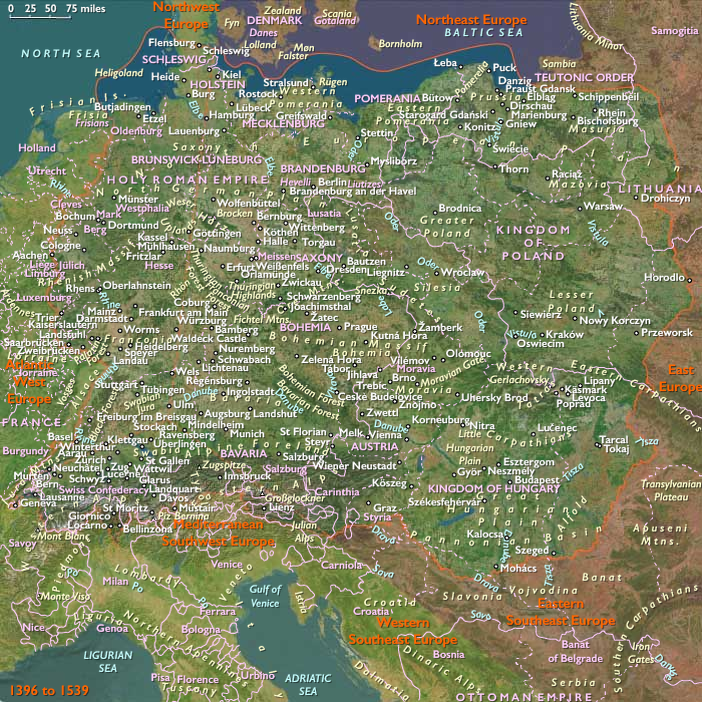
Following the death of King Louis XI in 1483, his thirteen-year-old son Charles VIII inherited a French kingdom fraught with instability. Initially governed by his elder sister, the intelligent and capable Anne of Beaujeu, and her husband, Pierre de Beaujeu, the French crown faced immediate challenges as influential princes sought to reverse Louis XI’s centralizing policies. This confrontation escalated into the conflict known as the Mad War (1485–1488), profoundly shaping French territorial integrity, most notably leading to the absorption of the fiercely independent Duchy of Brittany into France.
Regency and Early Instability (1483–1484)
Anne and Pierre skillfully maintained custody of the young king, significantly reducing unpopular taxes and employing diplomatic finesse at the States General of 1484 to pacify noble opposition. Despite their success, disgruntled powerful nobles soon rose in open rebellion, attempting to exploit the king's minority and regain feudal autonomy curtailed by Louis XI.
Outbreak of the Mad War (1485–1488)
Known as the Mad War (Guerre folle) (1485–1488), the rebellion was led principally by Louis II, Duke of Orléans(future King Louis XII), supported by Francis II, Duke of Brittany, René II of Lorraine, and other powerful nobles, such as Alain d'Albret. These princes, emboldened by Louis XI’s death, opposed Anne’s centralized governance and allied themselves with France’s foreign rivals, notably England, Spain, and Austria.
Principal Conflict and Alliances
The rebellion of 1485–1488 escalated rapidly into an international conflict, driven largely by the struggle for control over the strategically significant Duchy of Brittany. Francis II of Brittany’s participation was pivotal, as Brittany remained one of the last independent duchies within the French sphere, fiercely guarding its autonomy against royal centralization efforts.
Decisive Outcomes: Brittany’s Integration into France
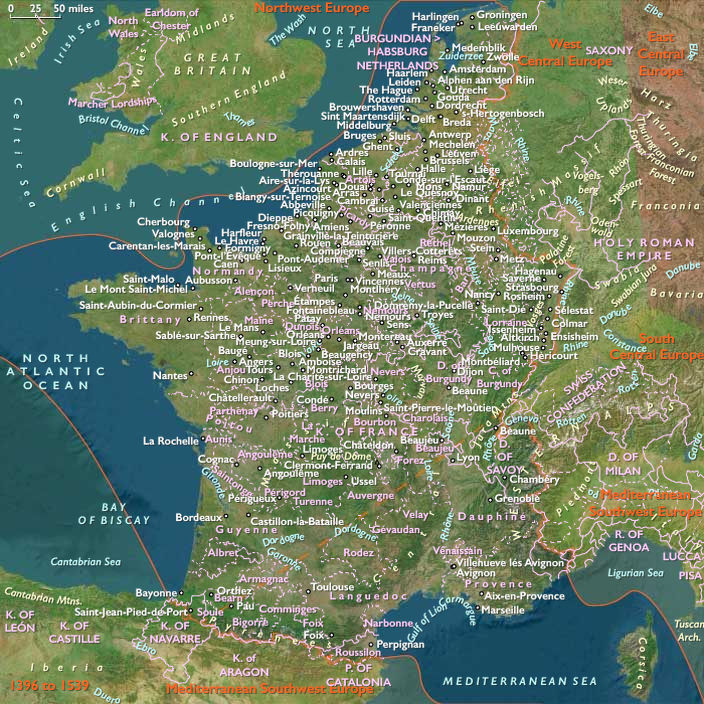
The war’s most enduring outcome was Brittany’s absorption into France. Although Brittany initially supported the princes’ rebellion against the French crown, Francis II’s defeat at the pivotal Battle of Saint-Aubin-du-Cormier(1488) ended Breton hopes of maintaining independence. Francis died shortly afterward, leaving his young daughter, Anne of Brittany, as the duchy’s heiress.
In 1491, in a decisive political move to secure Brittany permanently, King Charles VIII married fourteen-year-old Anne of Brittany. This marriage, initially driven by political necessity and strategic advantage, effectively integrated Brittany into the French kingdom, significantly expanding royal authority and bringing a lasting end to Brittany’s historical independence.
Diplomatic and Political Consequences
The defeat of the rebellious princes and the decisive incorporation of Brittany into France demonstrated the crown's determination to maintain and strengthen central authority. Anne of Beaujeu’s astute handling of opposition, combined with strategic diplomacy and military victories, reinforced royal supremacy and weakened noble opposition for generations.
Economic and Cultural Implications
Integrating Brittany into France had profound economic and cultural consequences. Brittany’s considerable economic resources, notably its prosperous maritime trade and distinctive artistic heritage, significantly enriched the kingdom. However, it also triggered a prolonged period of cultural and administrative assimilation, reshaping Brittany’s regional identity within the French nation-state.
Historical Significance
The Mad War (1485–1488) marked a critical transition period in late medieval French history, consolidating the kingdom’s territorial integrity and reinforcing the centralized monarchy established by Louis XI. Brittany’s incorporation into France marked a decisive endpoint to the independence of France’s major feudal principalities, symbolizing the irreversible rise of a centralized state that would dominate French political history well into the modern era. This pivotal development profoundly influenced European politics, as France’s territorial cohesion and royal authority grew significantly, reshaping diplomatic alliances and intensifying rivalries across Atlantic West Europe in subsequent centuries.
The Treaty of Sablé and the End of Breton Independence (1488)
The Treaty of Sablé, signed in August 1488, marked a decisive turning point in the centuries-long struggle between Brittany and the French crown. The treaty, resulting directly from Brittany’s catastrophic defeat at Saint-Aubin-du-Cormier, stripped away the duchy’s remaining political autonomy and set the stage for its annexation into France. This pivotal agreement reshaped the political and territorial landscape of late medieval Atlantic West Europe.
Terms of the Treaty
Under the Treaty of Sablé, England, whose support Brittany had previously counted upon, was forced to withdraw entirely from Breton affairs. The key terms severely curtailed Breton independence:
- Foreign troops, particularly the English, were compelled to leave Brittany, ending direct foreign involvement.
- Anne of Brittany, the young daughter and heir of Duke Francis II, was expressly forbidden to marry without the permission of the French king, Charles VIII, a stipulation intended to ensure Brittany’s absorption into France through marriage rather than force.
- Brittany’s military independence was severely limited, and its foreign policy was explicitly subordinated to French oversight.
Death of Francis II and Charles VIII's Move
Just two weeks after the treaty’s ratification, Duke Francis II of Brittany died on September 9, 1488, leaving his eleven-year-old daughter, Anne of Brittany, vulnerable and politically isolated. Capitalizing quickly on these circumstances, King Charles VIII of France promptly asserted direct claims over Brittany, insisting upon his right to determine Anne’s marriage—and ultimately aiming to wed her himself, thus definitively uniting Brittany with the French crown.
Geopolitical Consequences
The sudden death of Francis II enabled Charles VIII to swiftly press his advantage. His claim over Anne and her duchy marked the effective end of independent Breton sovereignty, triggering a political realignment in Western Europe. This outcome decisively thwarted English ambitions in Brittany, consolidating French territorial and dynastic power while further isolating England diplomatically.
Charles's strategic maneuver ensured a significant expansion of French royal power and removed a persistent thorn from France’s western flank, thereby dramatically strengthening the monarchy’s geopolitical position.
Long-Term Historical Significance
The Treaty of Sablé (1488) and subsequent annexation of Brittany were pivotal events in the formation of early modern France. By absorbing Brittany through marriage rather than outright conquest, Charles VIII skillfully legitimized the integration of the duchy into the French state. This not only reinforced royal centralization but also set a precedent for future territorial annexations through marital diplomacy—an approach characteristic of late medieval and early modern European statecraft.
The treaty also marked a critical defeat for England, ending decades of diplomatic and military attempts to maintain Brittany as a strategically independent counterweight to French power. The loss solidified French dominance in Western Europe, laying the groundwork for future conflicts, alliances, and territorial expansions that defined European politics for the next century.
Thus, the events surrounding the Treaty of Sablé fundamentally altered the geopolitical balance of power in late medieval Atlantic West Europe, accelerating the transition from a mosaic of semi-independent principalities toward a centralized, unified French monarchy.
The Breton Marriage Crisis and the Treaty of Laval (1489–1491)
Following the restrictive Treaty of Sablé (1488), the young duchess Anne of Brittany, determined to protect the sovereignty of her duchy, openly defied the French crown in 1489 by contracting a proxy marriage with the widowed Holy Roman Emperor-elect, Maximilian of Austria. This provocative act violated the terms of the earlier treaty, which explicitly required Anne to secure French royal permission before marrying. Anne’s bold decision immediately ignited a major international diplomatic crisis, drawing in major European powers including France, England, Austria, and Aragon.
Anne’s Proxy Marriage and European Responses (1489)
Anne’s proxy marriage to Maximilian profoundly alarmed King Charles VIII of France, who viewed the union as a direct threat to French interests, fearing Habsburg encirclement through Austria’s expanding territorial alliances. Charles quickly moved to counter this perceived Austrian threat by diplomatically isolating Anne and aggressively pressuring Brittany.
Simultaneously, Maximilian’s claim gained international backing, notably from King Henry VII of England and King Ferdinand II of Aragon. Both monarchs, wary of France’s growing influence, initially backed the Austrian claim to Brittany. However, Henry VII was cautious; he sought primarily to buy time, supporting a Breton regency while avoiding full-scale war with France.
Henry VII’s Diplomatic Strategy
England’s Henry VII, ever pragmatic, balanced diplomatic caution with measured military involvement. He supported the Breton regency, publicly pledged limited military assistance, and formed a strategic alliance with Aragon by arranging the future marriage of his heir, Prince Arthur, to Ferdinand’s infant daughter, Catherine of Aragon. This Anglo-Aragonese alliance was intended to counterbalance French dominance, reflecting the strategic complexity of late medieval diplomacy in Atlantic West Europe.
In practice, Henry’s military intervention remained limited and symbolic, meant more as diplomatic leverage than a genuine military challenge to France.
Treaty of Laval and Anne’s Submission (1491)
Faced with overwhelming French military pressure, Anne of Brittany's resistance ultimately proved untenable. Charles VIII, demonstrating formidable military strength by laying siege to Rennes, the Breton capital, compelled Anne into direct negotiations. Under severe pressure and increasingly isolated internationally, Anne reluctantly agreed to the Treaty of Laval (November 1491), renouncing her controversial marriage to Maximilian and consenting instead to marry Charles VIII.
Anne’s marriage to Charles was conditional: the French king was obliged, at least formally, to preserve Breton privileges and autonomy within the French state. Although Breton independence was effectively lost, Brittany maintained certain legal and administrative privileges, marking the compromise nature of Anne’s surrender.
Secret French-Aragonese Understanding
Behind the scenes, the geopolitical landscape had shifted. Aragon, previously supportive of Maximilian and allied with England, had secretly concluded a diplomatic understanding with France. This clandestine alliance, driven by mutual interest in isolating Maximilian’s expanding influence, further weakened Anne’s negotiating position and England’s diplomatic leverage. It underscored the shifting and often opaque alliances that characterized European diplomacy at this critical juncture.
Long-term Historical Significance
Anne’s marriage to Charles VIII under the Treaty of Laval fundamentally reshaped European geopolitics. Brittany was effectively annexed to France through dynastic marriage, ending centuries of fiercely defended Breton independence. For Maximilian and the Habsburgs, this represented a major diplomatic humiliation, exacerbating Franco-Habsburg rivalries that would dominate the European political landscape throughout the sixteenth century.
England, having lost its diplomatic foothold in Brittany, sought alternative alliances, notably strengthening ties with Spain through the Aragonese marriage alliance, which would later play a significant role in the complex dynastic and religious conflicts of the Tudor period.
In short, the Breton marriage crisis and the resulting Treaty of Laval profoundly reshaped the geopolitical dynamics of late medieval Atlantic West Europe, marking a pivotal step toward the consolidation of centralized monarchies and laying the groundwork for major conflicts and diplomatic alliances in the early modern era.
Anne of Brittany’s Marriage to Charles VIII and the Breton Succession Crisis (1491–1492)
In 1491, Anne of Brittany, the last independent ruler of the Duchy of Brittany, married King Charles VIII of France, marking a decisive turning point in the history of the duchy and significantly influencing the political landscape of late medieval Atlantic West Europe. Anne’s union with Charles, though negotiated under duress, was central to the eventual absorption of Brittany into the French royal domain and the conclusion of longstanding Anglo-French tensions regarding Breton sovereignty.
Strategic Marriage and Coronation at St. Denis (1492)
Anne married Charles VIII officially in December 1491, through the Treaty of Laval, under intense diplomatic and military pressure, effectively abandoning an earlier proxy marriage with Maximilian of Austria. Recognizing the immense political importance of this union, Anne was crowned Queen of France on February 8, 1492, in the revered royal basilica of St. Denis near Paris. She was the first queen crowned there and the first explicitly consecrated by anointing on both "head and chest," a ceremonial innovation marking the unique significance of her union to the French monarchy. Her coronation was officiated by André d'Espinay, Archbishop of Bordeaux, underscoring the event’s national importance.
Conflict over Breton Title and Identity
Although Anne’s marriage contract with Charles stipulated that the surviving spouse would retain control of Brittany, Charles explicitly forbade Anne from using her title of Duchess of Brittany, a symbolic but contentious demand reflecting the French crown’s determination to assert supremacy over the duchy. This prohibition soon emerged as a persistent source of tension in their marriage, emblematic of broader tensions surrounding Brittany’s status—independent duchy or mere French province.
Anne’s persistence in maintaining Breton identity and autonomy, even symbolically, heightened conflict between her and Charles, reflecting the underlying political struggle over Brittany’s place within the French kingdom.
Diplomatic Complications and Papal Intervention (1492)
Anne’s marriage had occurred under precarious legal circumstances. She had previously entered into a proxy marriage with the Habsburg Archduke Maximilian, an arrangement that Charles VIII nullified through aggressive diplomacy backed by military force. To legitimize the union, Pope Innocent VIII intervened, issuing a dispensation in early 1492, formally annulling Anne’s proxy marriage to Maximilian and sanctioning the new royal marriage despite Anne and Charles being related within the prohibited fourth degree of consanguinity.
This papal intervention was a critical diplomatic victory for France, neutralizing potential Habsburg claims to Brittany and enabling Charles VIII to integrate the strategically valuable duchy into his kingdom formally.
Marital Agreement and Breton Succession
The marriage treaty stipulated that whoever outlived the other would retain possession of Brittany, with implications clearly favoring the French crown's ambitions. Anne, despite resenting Charles’s insistence on limiting her use of the Breton title, accepted this provision, albeit reluctantly. This clause positioned Brittany’s eventual incorporation into France as practically inevitable, underscoring how royal marriage diplomacy reshaped territorial and political identities.
Anne’s Role as Queen Consort
Despite tensions over the title and identity of Brittany, Anne fulfilled her dynastic role, bearing multiple pregnancies, on average every fourteen months, during her marriage to Charles. Although most of these children did not survive infancy, Anne’s frequent pregnancies underscored her critical role as a vessel for dynastic continuity—further emphasizing the intense pressures and personal sacrifices that defined late medieval royal marriages.
Long-Term Consequences and Historical Significance
Anne’s marriage and the ensuing events represented a defining moment in French political and territorial consolidation. Brittany’s eventual absorption into the French kingdom (formally concluded by Anne’s subsequent marriage to Charles VIII’s successor, Louis XII) fundamentally reshaped political boundaries and heralded a new era of centralized royal authority within France.
Moreover, Anne’s forced marriage highlighted the intersection between personal dynastic ambition, geopolitical rivalry, and regional autonomy. Her efforts to maintain Breton autonomy, at least symbolically, remain influential in shaping historical memory and cultural identity in Brittany. The complex diplomatic arrangements, marital politics, and territorial ambitions surrounding Anne’s marriage reflect broader patterns of late medieval state formation, territorial centralization, and the rising power of nation-states within Atlantic West Europe at the dawn of the early modern period.
Maximilian of Austria, Margaret’s Betrothal, and the Treaty of Arras (1482–1492)
In 1482, Archduke Maximilian of Austria strategically betrothed his young daughter, Margaret of Austria, to the Dauphin of France (later Charles VIII) as part of the Treaty of Arras. This diplomatic arrangement—intended to ease tensions following the Burgundian succession crisis—would significantly impact relations between the Habsburgs and the French crown, shaping regional politics in Atlantic West Europe.
Diplomatic Context of Margaret’s Betrothal (1482)
The Treaty of Arras (1482) was negotiated in response to intense pressure from King Louis XI of France, Maximilian’s persistent adversary who contested the Burgundian inheritance following the death of Charles the Bold. Under the treaty’s terms, the three-year-old Margaret was engaged to Louis XI's young son, Charles, as part of an agreement intended to confirm peace between France and the Burgundian Netherlands.
In exchange, Maximilian reluctantly offered a substantial dowry: the territories of Burgundy, Artois, and Franche-Comté. These concessions significantly strengthened France’s territorial position in Atlantic West Europe.
Changing Fortunes and the Breton Marriage Crisis (1491)
Initially, Margaret remained at the French court awaiting her marriage to Charles VIII. However, circumstances dramatically shifted with the death of Francis II, Duke of Brittany, in 1488, leaving his duchy to his young daughter, Anne of Brittany. With the French crown eager to secure control of Brittany, the regent, Anne of France—Charles VIII’s elder sister—maneuvered to end Charles’s betrothal to Margaret.
In 1491, taking advantage of Maximilian’s distraction by dynastic disputes in Central Europe, Charles VIII decisively repudiated his earlier engagement to Margaret, compelled Anne of Brittany to repudiate her unconsummated marriage to Maximilian, and instead married Anne himself. Margaret, humiliated and left politically isolated, nevertheless remained at the French court.
Diplomatic Repercussions and Margaret’s Continued Residence in France
Margaret’s continued presence in France from 1482 to 1493, despite the repudiation of her betrothal, effectively rendered her a political hostage, ensuring Maximilian’s cooperation or at least restraint in matters involving France. Margaret’s detention at the French court symbolized ongoing diplomatic tensions, underscoring both her father's tenuous position and the complicated relations between France and the Habsburgs.
Resolution with the Treaty of Senlis (1493)
The situation was resolved only after Maximilian regained the upper hand militarily and diplomatically in 1493. The subsequent Treaty of Senlis on May 23, 1493, restored a measure of equilibrium. Margaret finally returned to her father, and the treaty adjusted territorial claims: Maximilian retained the Franche-Comté and Artois, while France held the Duchy of Burgundy itself, stabilizing the fragile Franco-Habsburg balance of power—albeit temporarily.
Long-Term Consequences and Historical Significance
The repudiation of Margaret’s betrothal had lasting diplomatic and dynastic implications. It deepened antagonisms between the French crown and the Habsburgs, tensions that would fuel future geopolitical rivalries. Margaret herself emerged as a prominent figure, notably as a capable governor of the Netherlands in later years, and became instrumental in subsequent Habsburg diplomatic negotiations. Meanwhile, Brittany's annexation reshaped French territorial integrity, permanently integrating the duchy into the French kingdom and symbolizing the royal drive towards centralized monarchy in late medieval Atlantic West Europe.
Thus, the complicated diplomatic maneuvers surrounding Margaret’s betrothal and its subsequent repudiation underscore the interplay of personal, dynastic, and political ambitions in shaping the geopolitics of late medieval Europe.
Artois and the Treaty of Senlis: Resolving Franco-Habsburg Rivalries (1477–1493)
The strategic and economically vibrant County of Artois had long been a contested region within Atlantic West Europe, shaping regional rivalries between the French crown and the House of Habsburg. The extinction of the male line of the Valois-Burgundy dukes following Charles the Bold's death at the Battle of Nancy (January 5, 1477) intensified dynastic claims over the Burgundian inheritance, including Artois, precipitating a period of fierce competition and diplomatic tension.
The Contested Burgundian Legacy (1477–1482)
After Charles the Bold’s demise, King Louis XI of France swiftly occupied the Burgundian territories, including Artois, incorporating the county into France’s administrative structure as a seneschalate. This rapid annexation triggered vehement opposition from Archduke Maximilian of Austria, who, as husband of Charles’s heiress, Mary of Burgundy, aggressively asserted Habsburg claims. In 1479, the ensuing conflict culminated at the Battle of Guinegate, where Maximilian’s forces secured a pivotal victory, temporarily safeguarding the Habsburg interests.
Nevertheless, following Mary’s untimely death in 1482, Maximilian was compelled, under the Treaty of Arras (1482), to cede both Artois and Franche-Comté to France as a dowry for the marriage of his daughter, Margaret of Austria, to the French dauphin, Charles VIII.
The Breton Marriage Crisis and Diplomatic Reversal (1491–1493)
The diplomatic landscape dramatically shifted when Charles VIII repudiated his engagement to Margaret in favor of Anne of Brittany, Maximilian’s intended bride. This breach inflamed Maximilian, prompting him to demand the restitution of Artois, Franche-Comté, and other territories ceded in 1482. By 1493, facing the challenge of his ambitious campaigns in Italy, Charles VIII sought reconciliation with Maximilian, recognizing that a secure northern frontier was crucial for his Italian ambitions.
The Treaty of Senlis (May 23, 1493)
The resulting Treaty of Senlis formally ended hostilities between France and the Burgundian Netherlands, decisively redefining their territorial relationship:
- Artois and Franche-Comté were restored to the Habsburgs, becoming officially integrated into the Holy Roman Empire.
- Flanders and the broader region of the Seventeen Provinces were consolidated under Habsburg authority.
- France, while relinquishing control of Artois and Franche-Comté, retained the strategically significant Duchy of Burgundy (with Dijon as its capital), ensuring continued French influence in the region.
Persistent French Claims and Strategic Outposts
Despite Habsburg territorial gains, France retained several crucial legal claims, feudal rights, and military outposts within Artois and Flanders. These strategic footholds preserved France’s influence, perpetuating a delicate balance of power along the contested northern frontier and setting the stage for ongoing Habsburg-Valois conflicts throughout the sixteenth century.
Long-Term Significance and Geopolitical Impact
The Treaty of Senlis had far-reaching implications:
- It secured the Low Countries firmly within the Habsburg patrimony, laying foundations for future Habsburg dominance in European geopolitics.
- The treaty underscored the ongoing rivalry between the French crown and the Habsburgs, intensifying a dynastic competition that would shape European political dynamics for generations.
- Artois became a focal point in later Franco-Habsburg struggles, notably during the protracted wars of the sixteenth and seventeenth centuries, influencing regional identities, alliances, and hostilities into the modern era.
Thus, the resolution achieved by the Treaty of Senlis (1493) significantly reshaped the territorial and diplomatic landscape of late medieval Atlantic West Europe, embedding tensions and rivalries that resonated throughout subsequent European history.
Regency and Queenship of Anne of Beaujeu and Anne of Brittany (1483–1495)
Anne of Beaujeu, who skillfully governed as regent for her brother Charles VIII from 1483 to 1491, reassumed a similar role when Charles embarked upon his Italian campaigns. Trusted and politically astute, she maintained stability within France during his prolonged absences, ensuring continuity of royal authority.
Anne of Brittany, though Queen of France, had limited political influence in both France and her native Brittany, and frequently endured separation from her children during their infancy. Her life was largely defined by her residency in royal castles such as Amboise, Loches, and Plessis, as well as in major towns including Lyon, Grenoble, and Moulins, particularly when Charles VIII conducted military operations in Italy.
At Amboise, Anne of Brittany often stayed at the nearby Clos Lucé, later famed as the residence of Leonardo da Vinci, where she commissioned the construction of her personal chapel. She attained additional titles, notably Queen Consort of Naples and Jerusalem, following Charles VIII's temporary conquest of Naples, further highlighting her prominence within European dynastic affairs of the late fifteenth century.
Death of Charles VIII and the Succession of Louis XII (1498)
On April 7, 1498, King Charles VIII of France died unexpectedly at the Château d'Amboise, a prominent residence constructed around 1495 along the Loire River valley. Charles's sudden death—caused by striking his head on a door lintel—occurred before he could reorganize his military forces for another expedition to Italy. His Château at Amboise, admired for its innovative integration of Italian Renaissance decorative elements with traditional Gothic architecture, symbolizes the cultural exchanges and artistic fusion emerging during this period.
Charles VIII's death marked a crucial dynastic turning point, extinguishing the senior line of the House of Valois. The French throne consequently passed to his thirty-six-year-old cousin, Louis, duc d'Orléans, who ascended as King Louis XII. Louis's accession initiated a significant shift in French foreign policy, characterized by his immediate pursuit of his hereditary claims, particularly to the Duchy of Milan, thereby ushering in a renewed period of Franco-Italian conflict and diplomacy.
Long-term Consequences and Significance
The abrupt transition from Charles VIII to Louis XII significantly altered France's political trajectory. Louis XII's ambitions in Italy intensified French involvement in European geopolitics, paving the way for persistent military engagements and diplomatic entanglements in the ensuing decades. Furthermore, Charles VIII's architectural patronage at Amboise left a lasting cultural legacy, reflecting the gradual but decisive shift towards Renaissance tastes in France, which profoundly influenced subsequent artistic developments across Atlantic West Europe.
Anne of Brittany Assumes Administration of Brittany (1498)
At just twenty-one years old, Anne of Brittany, widow of the recently deceased King Charles VIII, finds herself without surviving children and swiftly asserts direct control over the governance of the Duchy of Brittany. Demonstrating political decisiveness and administrative skill, Anne immediately reestablishes her authority by reinstating trusted advisor Philippe de Montauban to the Chancellery of Brittany. She also names Jean de Châlon, Prince of Orange, as Hereditary Lieutenant General of Brittany, assembles the Estates of Brittany, commissions the minting of a gold coin inscribed with her name, and entrusts responsibility for the strategic Château de Brest to the loyal Philippe de Montauban.
Anne’s rule extends beyond political administration, reflecting her deep cultural sophistication and artistic patronage. She cultivates a celebrated court enriched by influential figures, including prominent humanists and literary scholars such as the Italian humanist Publio Fausto Andrelini—a significant conduit for Renaissance ideas in France—as well as historian Jean Lemaire de Belges and poet Jean Marot. She also secures the services of the era’s foremost composers and musicians, notably Johannes Ockeghem, Antoine de Févin, Loyset Compère, and Jean Mouton. Anne’s court becomes a vibrant center for intellectual exchange, artistic innovation, and cultural patronage, reflecting broader Renaissance trends influencing Atlantic West Europe.
Anne's assertive political role as both administrator and patron underscores her distinct historical status as one of France’s earliest queens to actively engage in independent political authority and extensive cultural patronage.
Consequences and Legacy:
Anne's administration signaled a unique phase of relative autonomy for Brittany within the French realm, demonstrating the Duchy's ongoing assertion of independent regional identity amid growing centralization. Her patronage notably advanced the spread of humanist culture in Atlantic West Europe, setting precedents for subsequent royal patronage of Renaissance arts and scholarship in France. Additionally, Anne's complex marital status—further complicated by the existing marriage between King Louis XII and Joan of France—foreshadowed significant political and dynastic tensions central to subsequent French and Breton history.
Queen Anne of Brittany Agrees to Marry Louis XII (1498)
On August 19, 1498, at Étampes, Anne of Brittany agreed to marry the newly crowned French king, Louis XII, contingent upon his securing an annulment from his wife, Joan of France, within one year. This strategic agreement marked Anne’s continued political maneuvering to safeguard Brittany’s autonomy and her personal influence within the shifting landscape of French politics.
Within days, Louis XII initiated annulment proceedings against Joan, officially on grounds of consanguinity and the marriage's alleged non-consummation. Meanwhile, Anne returned to Brittany, perhaps cautiously awaiting the outcome, mindful of the high stakes involved in aligning the Duchy of Brittany more closely with the French crown under favorable terms.
The annulment proceedings rapidly gained momentum, reflecting Louis XII's urgency in solidifying his legitimacy and succession by marrying Anne, whose personal and territorial inheritance provided significant strategic advantages. The swift action by Louis underscored the crown's increasing ability to leverage ecclesiastical authority in pursuit of political objectives.
Consequences and Significance:
Anne’s conditional agreement at Étampes set into motion critical changes in dynastic alliances, significantly affecting the balance of regional and national power. The annulment, if successful, promised to consolidate Brittany more firmly within the French realm, redefining Brittany’s political future and substantially altering the landscape of power across Atlantic West Europe.