Anne of Bohemia and Hungary
Queen consort of the Romans, Bohemia and Hungary
Years: 1507 - 1578
Anna of Bohemia and Hungary (Buda, Hungary, July 23, 1503 – Prague, Bohemia, January 27, 1547), sometimes known as Anna Jagellonica, is Queen of the Romans (Germany), Bohemia and Hungary as the wife of King Ferdinand I, later Holy Roman Emperor.
Related Events
Filter results
Showing 10 events out of 25 total
East Central Europe (1504–1515 CE): Jagiellonian-Habsburg Rivalry, Ottoman Encroachment, and Dynastic Alliances
From 1504 to 1515 CE, East Central Europe experienced intense geopolitical shifts driven by escalating rivalry between the Jagiellonian dynasty (in Hungary, Bohemia, and Poland-Lithuania) and the ascendant Habsburg dynasty, as well as growing Ottoman pressures from the south. Diplomatic realignments, including strategic dynastic marriages, reshaped alliances, setting the stage for future Habsburg dominance and enduring regional tensions.
Political and Military Developments
Jagiellonian Rule and Internal Struggles
-
Under Vladislaus II Jagiellon (r. 1490–1516), Hungary and Bohemia increasingly faced internal aristocratic conflicts and weakening royal authority. Vladislaus’s ineffective governance led to greater political fragmentation and noble autonomy.
-
Poland-Lithuania, ruled by Sigismund I the Old (r. 1506–1548), faced continued threats from the Teutonic Order and Moldavia, prompting intensified military and diplomatic efforts to secure eastern and northern frontiers.
Escalation of Jagiellonian-Habsburg Rivalry
-
Habsburg Emperor Maximilian I (r. 1493–1519) pursued an aggressive strategy to assert dominance over Hungarian and Bohemian territories, heightening rivalry with the Jagiellonians.
-
Diplomatic tensions culminated in the First Congress of Vienna (1515), resulting in strategic marriages between the Jagiellonian and Habsburg houses, profoundly influencing future dynastic successions. The treaties at this congress arranged double marriages: Vladislaus’s children, Louis II of Hungary and Bohemia, and Anne Jagiellon, married into the Habsburg dynasty, profoundly reshaping regional alliances.
Increasing Ottoman Threats to Hungary
-
The Ottoman Empire, under Sultan Selim I (r. 1512–1520), intensified its incursions into southern Hungarian territories, significantly straining Hungary’s resources and defenses. Frequent Ottoman raids prompted increased military expenditures and defensive strategies.
Economic and Technological Developments
Continued Urban Prosperity and Trade
-
Economic vitality persisted, particularly within Hanseatic cities (Gdańsk, Toruń, Elbląg, Stettin) and urban centers such as Prague, Kraków, Vienna, and Buda, driven by strong commercial networks trading grain, textiles, metals, and luxury goods.
-
Increased artisanal productivity and expanding mercantile activities significantly enhanced regional economic stability and urban wealth.
Mining and Metallurgical Growth
-
Notably in Hungarian and Slovak mining centers (Banská Štiavnica, Banská Bystrica, Kremnica), robust extraction of precious metals (gold, silver, copper) continued, significantly contributing to regional prosperity and enhancing Hungary’s economic influence.
Cultural and Artistic Developments
Renaissance Flourishing under Jagiellonian and Habsburg Patronage
-
Hungarian Renaissance culture thrived under Vladislaus II, who continued fostering intellectual, artistic, and architectural developments, especially in Buda and Esztergom, further enhancing Hungary’s cultural prestige.
-
Polish cities, notably Kraków under Sigismund I, experienced significant Renaissance cultural patronage, reflected in humanist scholarship, artistic achievements, and architectural innovations.
Bohemian Artistic Continuity
-
Bohemian culture continued blending Gothic and emerging Renaissance influences, particularly in Prague, where royal patronage sustained artistic and architectural projects, despite Vladislaus’s largely absent governance.
Settlement and Urban Development
Defensive Urban Fortification
-
Persistent Ottoman threats and regional conflicts led to enhanced urban fortifications across Hungary, notably Buda, Pest, Székesfehérvár, and along frontier regions, significantly shaping urban development and military infrastructure.
Expansion and Urbanization in Poland and Bohemia
-
Urban centers like Kraków, Lublin, and Prague continued to expand and prosper, driven by robust trade, artisanal activities, and growing populations, reflecting stable urban economies and effective civic governance.
Social and Religious Developments
Nobility’s Growing Power and Influence
-
Aristocratic power significantly expanded, particularly in Hungary, Bohemia, and Poland-Lithuania. Noble diets, notably the Hungarian Diet and Polish Sejm, increasingly dominated royal decision-making, fiscal policy, and regional governance.
-
Nobility’s rising influence contributed to weakened royal authority, internal divisions, and more decentralized governance structures, profoundly shaping regional political dynamics.
Religious Stability and Ecclesiastical Influence
-
The Catholic Church remained influential across East Central Europe, promoting ecclesiastical scholarship, education, and artistic patronage, reinforcing cultural cohesion. Monastic and ecclesiastical institutions notably influenced education, religious practices, and social norms.
Long-Term Consequences and Historical Significance
The era 1504–1515 CE proved pivotal for East Central Europe, significantly reshaped by escalating Jagiellonian-Habsburg rivalry, strategic dynastic marriages from the Congress of Vienna (1515), and intensified Ottoman threats. Diplomatic alliances secured at Vienna laid foundations for eventual Habsburg dominance in Bohemia and Hungary, significantly influencing Central European geopolitics throughout the 16th century. Continued economic vitality and cultural flourishing under Renaissance patronage strengthened regional prosperity, despite rising external threats and internal divisions. These developments profoundly influenced East Central Europe’s trajectory, establishing political and cultural patterns that endured through the early modern period.
East Central Europe (1516–1527 CE): Ottoman Conquest of Hungary, End of the Jagiellonians, and Rise of Habsburg Dominance
Between 1516 and 1527 CE, East Central Europe experienced dramatic geopolitical changes marked by the collapse of Jagiellonian power in Hungary and Bohemia, the devastating Battle of Mohács (1526), and the decisive expansion of Habsburg authority into the region. This era witnessed the irreversible transformation of Hungary’s medieval kingdom, significant shifts in regional alliances, and increasing Ottoman dominance, profoundly reshaping East Central Europe's political landscape.
Political and Military Developments
End of Jagiellonian Rule and the Battle of Mohács (1526)
-
Following the death of Vladislaus II Jagiellon in 1516, his young son Louis II ascended the thrones of Hungary and Bohemia, inheriting weakened royal authority and an unstable kingdom.
-
On 29 August 1526, Hungarian forces suffered catastrophic defeat at the Battle of Mohács against Ottoman Sultan Suleiman the Magnificent (r. 1520–1566). Louis II was killed, leading to Hungary's political fragmentation and subsequent partition.
Fragmentation of Hungary and Ottoman Occupation
-
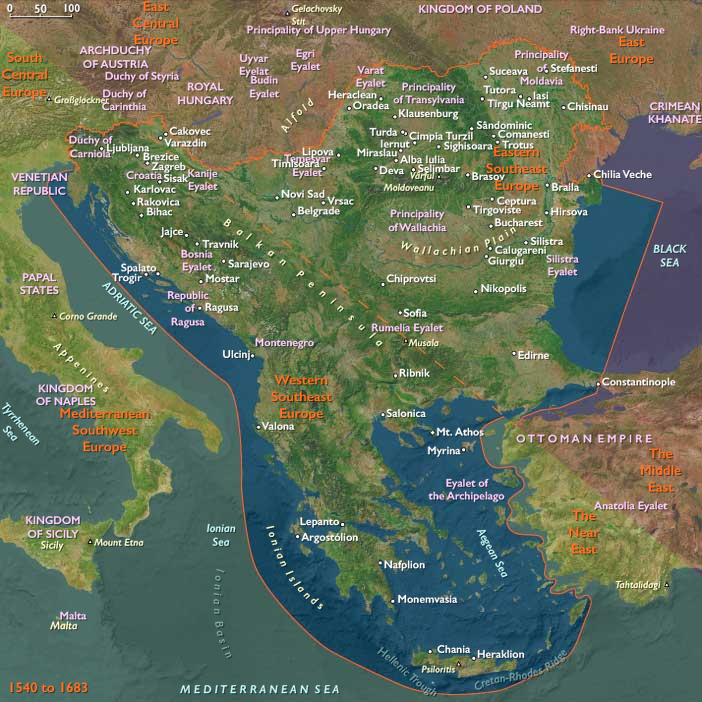
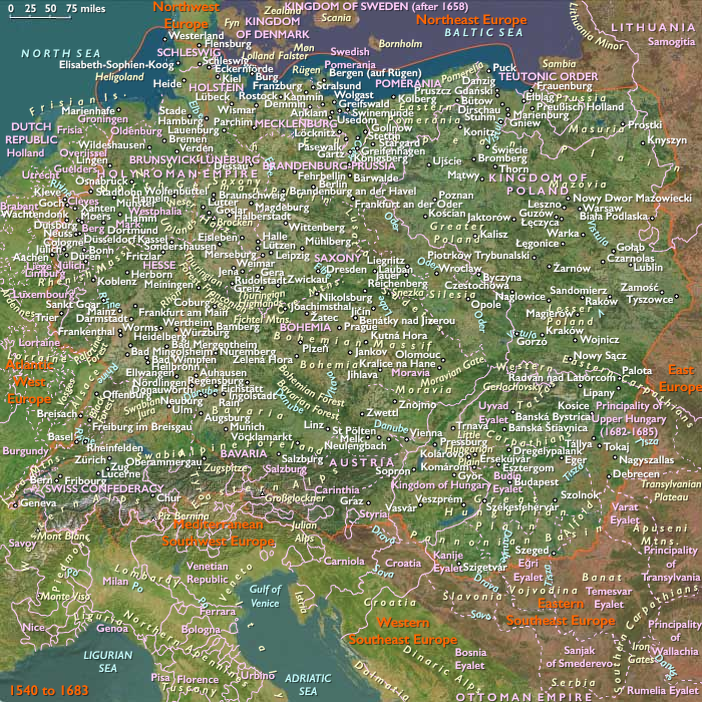
The aftermath of Mohács shattered the medieval Kingdom of Hungary, partitioning it into three parts:
-
Royal Hungary under Habsburg control in the north and west (including parts of modern Slovakia, western Hungary, and Croatia).
-
Ottoman Hungary (central and southern regions), directly administered by the Ottomans.
-
Principality of Transylvania in the east, a semi-autonomous entity under Ottoman suzerainty, governed by Hungarian princes.
-
-
These divisions significantly reshaped Hungary’s political and cultural identity for centuries.
Rise of Habsburg Dominance in Bohemia and Hungary
-
Following Mohács, Ferdinand I of Habsburg (brother of Emperor Charles V and husband of Louis II's sister, Anne Jagiellon) asserted dynastic claims, being crowned King of Bohemia in 1526, and subsequently as King of Hungary in 1527 at Székesfehérvár.
-
Ferdinand’s accession marked a fundamental shift toward long-term Habsburg rule, effectively ending Jagiellonian influence in these key Central European kingdoms.
Polish-Lithuanian Stability under Sigismund I
-
Poland-Lithuania, ruled by Sigismund I the Old (1506–1548), maintained relative stability, successfully repelling external threats, notably from Muscovy and Crimean Tatars, reinforcing Poland’s eastern borders.
Economic and Technological Developments
Economic Disruption and Regional Reorientation
-
Hungary’s partition severely disrupted traditional economic networks, prompting substantial commercial realignments. Trade shifted northward toward Bohemia, Poland-Lithuania, and the Habsburg lands, notably benefiting Vienna, Prague, Kraków, and the northern Hanseatic cities (Gdańsk, Toruń, Elbląg).
-
The collapse of Hungarian control of key southern trade routes to the Balkans and Mediterranean significantly reshaped regional commerce, redirecting flows through safer northern routes.
Cultural and Artistic Developments
Impact of Ottoman Occupation on Hungarian Culture
-
Ottoman occupation deeply impacted Hungarian culture, introducing Islamic and Ottoman architectural and artistic styles in occupied regions, notably in southern Hungarian towns and fortresses.
-
Conversely, regions under Habsburg influence experienced increased cultural alignment with Renaissance Vienna, fostering intensified artistic and intellectual exchanges.
Bohemian and Polish Renaissance Flourishing
-
Bohemia under Ferdinand I and Poland under Sigismund I continued experiencing Renaissance cultural prosperity. Prague and Kraków emerged as prominent cultural centers, promoting humanist scholarship, architectural innovation, and literary production, strongly influenced by Italian and German Renaissance trends.
Settlement and Urban Development
Urban Fortification and Military Infrastructure
-
Cities throughout East Central Europe, particularly along new Ottoman borders (e.g., Vienna, Győr, Esztergom), significantly reinforced defensive infrastructure, reflecting heightened military threats.
-
Kraków, Prague, and major Hanseatic cities continued prospering economically and expanding urban fortifications to secure trade routes against disruptions and regional instability.
Social and Religious Developments
Increased Noble Autonomy and Feudal Fragmentation
-
The collapse of centralized Hungarian royal authority accelerated noble autonomy, particularly in Ottoman Hungary and Transylvania. Local magnates increasingly dominated regional governance, fostering decentralized and feudalized political structures.
-
Polish and Bohemian aristocratic diets maintained significant influence, balancing noble privileges against royal authority, reflecting stable yet decentralized governance patterns.
Religious Resilience and Ecclesiastical Influence
-
The Catholic Church faced significant challenges in Ottoman-occupied regions but maintained strong influence in Habsburg-controlled Bohemia and Royal Hungary, actively supporting religious education, monastic patronage, and ecclesiastical arts.
-
Emerging Protestant Reformation ideas began influencing East Central Europe, notably among urban elites and nobility in Bohemia, Poland, and Royal Hungary, foreshadowing future religious conflicts.
Long-Term Consequences and Historical Significance
The era 1516–1527 CE marked a watershed moment in East Central Europe's historical trajectory, defined by Hungary's devastating defeat at Mohács and the subsequent rise of Habsburg rule. The partition of Hungary profoundly transformed regional geopolitics, embedding long-lasting divisions that endured for centuries. Increased Ottoman threats reshaped military priorities and economic networks, while the Jagiellonian dynasty’s collapse fundamentally realigned political alliances. Concurrently, Polish and Bohemian cultural flourishing continued, reinforcing distinct national identities and intellectual traditions. These complex transformations critically shaped East Central Europe's subsequent development, decisively influencing regional dynamics into the early modern era.
Archduchess Mary of Austria, becomes queen of Hungary and Bohemia on the death of her father-in-law in 1516.
Born in Brussels on September 15, 1505, between ten and eleven in the morning, Mary was the fifth child of King Philip I and Queen Joanna of Castile.
Her birth was very difficult; the Queen's life was in danger and it took her a month to recover.
On September 20, she was baptized by Nicolas Le Ruistre, Bishop of Arras, and named after her paternal grandmother, Mary of Burgundy, who had died in 1482.
Her godfather is her paternal grandfather, Holy Roman Emperor Maximilian I, who had promised, on March 17, 1506, to marry her to the first son born to King Vladislaus II of Hungary.
At the same time, the two monarchs decided that a brother of Mary would marry Vladislaus' daughter Anne.
Three months later, Vladislaus' wife, Anne of Foix-Candale, gave birth to a son, Louis Jagiellon.
Queen Anne died in childbirth and the royal physicians made great efforts to keep the sickly Louis alive.
After the death of Mary's father in September 1506, her mother's mental health had begun to deteriorate.
Mary, along with her brother, Archduke Charles, and her sisters, Archduchesses Eleanor and Isabella, had been put into the care of her paternal aunt, Archduchess Margaret, while two other siblings, Archduke Ferdinand and posthumously born Archduchess Catherine, remained in Castile.
Mary, Isabella, and Eleanor had been educated together at their aunt's court in Mechelen.
Their music teacher was Henry Bredemers.
Mary had been summoned to the court of her grandfather Maximilian in 1514.
On July 22, 1515, Mary and Louis had been married in St. Stephen's Cathedral, Vienna.
At the same time, Louis' sister Anne had been betrothed to an as yet unspecified brother of Mary, with Emperor Maximilian acting as proxy.
Due to their age, it was decided that the newly married couple would not live together for a few more years.
Anne had eventually married Mary's brother Ferdinand and had come to Vienna, where the double sisters-in-law are educated together until 1516, when the death of Mary's father-in-law makes Louis and Mary king and queen of Hungary and Bohemia.
Mary moves to Innsbruck, where she will be educated until 1521.
Maximilian encourages her interest in hunting, while childhood lessons prompt an interest in music.
This passion will later be demonstrated during her tenure as governor of the Netherlands.
Ferdinand of Habsburg was born in Alcalá de Henares, Spain, the second son of the Trastamara Princess Joanna ("Joanna the Mad"), and Habsburg Archduke Philip the Handsome, who was heir to Maximilian I, Holy Roman Emperor.
Ferdinand shares his customs, culture, and even his birthday with his maternal grandfather Ferdinand II of Aragon.
He was born, raised, and educated in Spain, and had not learned German when he was young.
On the death of his grandfather Maximilian I and the accession of his nineteen-year-old brother, Charles V, to title of Holy Roman Emperor in 1519, Ferdinand had been entrusted with the government of the Austrian hereditary lands, roughly modern-day Austria and Slovenia.
He is Archduke of Austria from 1521.
Anne of Bohemia and Hungary, the elder child and only daughter of King Vladislaus II of Bohemia and Hungary and his third wife Anne of Foix-Candale, is an older sister of Louis II of Hungary and Bohemia.
Her paternal grandparents were King Casimir IV of Poland, Grand Duke of Lithuania, of the Jagiellon dynasty, and Elisabeth of Austria, one of the heiresses of Bohemia, duchy of Luxembourg and duchy of Kujavia.
Her maternal grandparents were Gaston de Foix, Count of Candale and Catherine de Foix, Infanta of the Kingdom of Navarre She was born in Buda (now Budapest).
The death of Vladislaus II on March 13, 1516, had left both siblings in the care of Maximilian I, Holy Roman Emperor.
It had been arranged that Anna marry his grandson, Archduke Ferdinand of Austria.
Anna marries Ferdinand on May 26, 1521 in Linz, Austria.
It is stipulated that Ferdinand should succeed Anne's brother in case he dies without male heirs.
King Francis I of France had been defeated at the Battle of Pavia on February 24, 1525 by the troops of the Habsburg Holy Roman Emperor, Charles V. After several months in prison, Francis had been forced to sign the Treaty of Madrid.
In a watershed moment in European diplomacy, Francis had come to an understanding with the Ottoman Empire, which has led to a formal Franco-Ottoman alliance.
The objective for Francis I is clearly to find an ally against the powerful Habsburg Emperor, in the person of Ottoman Sultan Suleiman.
The Ottoman-French strategic, and sometimes tactical, alliance will last for about three centuries.
It does, however, cause quite a scandal in the Christian world.
To relieve the Habsburg pressure on France, Francis has asked Suleiman to make war on the Holy Roman Empire, and the road from Turkey to the Holy Roman Empire leads across Hungary.
The request of the French king coincides nicely with the ambitions of Suleiman in Europe and gives him an incentive to attack Hungary in 1526.
The Ottomans see the growing alliance between Hungary and Bohemia and the Habsbugs as a threat to their power in the Balkans and have worked to break this alliance.
After Suleiman I came to power in 1520, the High Porte had made the Hungarians at least one and possibly two offers of peace.
It is unclear why King Louis refused the offer.
It is possible that Louis is well aware of Hungary's situation (especially after the Battle of Chaldiran and Polish-Ottoman peace from 1525) and he believes that war is a better option than peace.
Even in peacetime the Ottomans raid Hungarian lands and conquer small territories (with border castles), but a final battle still offers a glimmer of hope.
To such ends, an Ottoman army had set out from Istanbul on April 16, 1526, led by Suleiman the Magnificent personally.
In the Hungarian kingdom, riven by social and national divisions stimulated by the Reformation, a general call to arms is proclaimed, but the most important forces—those from Transylvania and Croatia—are late in obeying it.
Louis hurriedly assembles a force of some sixteen thousand men and advances from Buda to meet the Turks.
The Hungarian nobles, who still do not realize the dimensions of the approaching danger, do not heed their King's call to arms.
Louis II orders them to encamp on July 2 but no one reports on this day—not even the King.
Only when Louis himself furnishes an example with his appearance in the camp do things start to move.
The Hungarian war council—without waiting for their reinforcements only a few days march away—makes a serious tactical error by choosing the battlefield near Mohács, an open but uneven plain with some swampy marshes.
The Hungarian army is divided into three main units: the Transylvanian army under John Zápolya, charged with guarding the passes in the Transylvanian Alps, with between eight thousand and thirteen thousand men; the main army, led by Louis himself (beside numerous Spanish, German, Czech and Serbian mercenaries); and another smaller force, commanded by the Croatian count Christoph Frankopan, numbering around five thousand men.
Due to geography, the Ottoman army's ultimate goal could not be determined until it was crossing the Balkan Mountains.
Unfortunately for the Hungarians, by the time the Ottoman army had crossed, the Transylvanian and Croatian army was further from Buda than the Ottomans were.
Contemporary historical records, though sparse, indicate that Louis preferred a plan of retreat, in effect ceding the country to Ottoman advances, rather than directly engaging the Ottoman army in open battle.
The Hungarian forces choose the battlefield, an open but uneven plain with some swampy marshes near Mohács leading down to the Danube.
The Ottomans had been allowed to advance almost unopposed.
While Louis waited in Buda, they had besieged several towns and crossed the Sava and Drava Rivers.
Louis has assembled around twenty-five thousand to thirty thousand soldiers (with Croatian and Polish contingents and about eight hundred to one thousand soldiers of the Papal States) while the Ottoman army was long thought to have numbered around fifty thousand.
However, military history books from the twenty-first century will calculate the number of the Ottoman Army around one hundred thousand men.
In addition, the Ottoman forces have up to one hundred and sixty cannon.
Most of the Ottoman Balkan forces registered before this battle are labeled as Bosnians or Croats, as a designation of the territory in which they had been they were recruited.
The Hungarian army is arrayed to take advantage of the terrain and hopes to engage the Ottoman army piecemeal.
The only advantage the Magyars have is that their troops are well-rested, while the Turks have just completed a strenuous march in scorching summer heat.
Rather than attacking their fatigued enemy, however, the Hungarians merely watch as they struggle through the marshy terrain.
It would be "unchivalrous" to attack the enemy when they are not yet ready for battle.
Hungary has built up an expensive but obsolete army, structured similarly to that of King Francis I at the Battle of Pavia mostly reliant on old fashioned heavily armored knights on armored horses (gendarme knights).
The Hungarian line consists of two lines, the first with a center of mercenary infantry and artillery and the majority of the cavalry on either flank.
The second line is a mix of levy infantry and cavalry.
The Ottoman army is a more modern force built around the elite, musket-armed Janissaries, and artillery.
The rest of the army consists of feudal Timari cavalry and conscripted levies from Rumelia and the Balkans.
Like the uncertainty over the number of actual combatants, there is debate over the length of the battle.
Its starting time is generally placed between 1:00 PM and 2:00 PM, but the endpoint is difficult to ascertain.
As the first of Suleiman's troops, the Rumelian army, advance onto the battlefield, they are attacked and routed by Hungarian troops led by Pál Tomori.
This attack by the Hungarian right is successful in causing considerable chaos among the irregular Ottoman troops, but even as the Hungarian attack presses forward, the Ottomans rally with the arrival of Ottoman regulars deployed from the reserves.
While the Hungarian right advances far enough at one time to place Suleiman in danger from Hungarian arrows that strike his cuirass, the superiority of the Ottoman regulars and the timely charge of the Janissaries, the elite troops of the Ottomans, probably overwhelms the attackers, particularly on the Hungarian left.
The Hungarians take serious casualties from the skillfully handled Turkish artillery and musket volleys.
The Hungarians cannot hold their positions, and those who do not flee are surrounded and killed or captured.
The result us a disaster, with the Hungarians advancing into withering fire and flank attacks.
The king leaves the battlefield sometime around twilight but is thrown from his horse in a river at Csele and dies, weighed down by his heavy armor.
Some one thousand other Hungarian nobles and leaders are killed also.
It is generally accepted that more than fourteen thousand Hungarian soldiers were killed in the initial battle.
The Ottoman army does not retreat from the field and enter camp after the battle; instead, they remain on the field all night without food, water, or shelter.
Given that the Ottoman historians all note that it was raining, it seems likely that had the battle been short and ended early in the afternoon, by 5:00 PM at the latest, when the Sultan would have ordered his army to camp or at least to return to their baggage.
The few reliable sources indicate that Louis left the field at twilight and made his escape under cover of darkness; since the sun would not have set until 6:27 PM on August 29, 1526, this would imply that the battle lasted significantly longer than two to three hours (perhaps as long as four or five).
The Turks have also suffered heavy losses, particularly among the sultan’s elite Janissary corps, but Süleyman regroups his forces and advances on Buda.
Suleiman cannot believe that this small, "suicidal" army is all that the once powerful country could muster against him, so he waits at Mohacs for a few days before moving cautiously against Buda.