Andronikos IV Palaiologos
East Roman (Byzantine) emperor
Years: 1348 - 1385
Andronikos IV Palaiologos (or Andronicus IV Palaeologus) (April 2, 1348 – June 28, 1385) is East Roman (Byzantine) Emperor from 1376 to 1379.
Related Events
Filter results
Showing 10 events out of 21 total
Amadeus VI of Savoy initiates a minor crusade (with fifteen ships and seventeen hundred men) in 1366 against Murad I of the Ottoman Empire to aid his cousin, the Emperor John V Palaiologos, son of the Dowager Empress, Anne of Savoy.
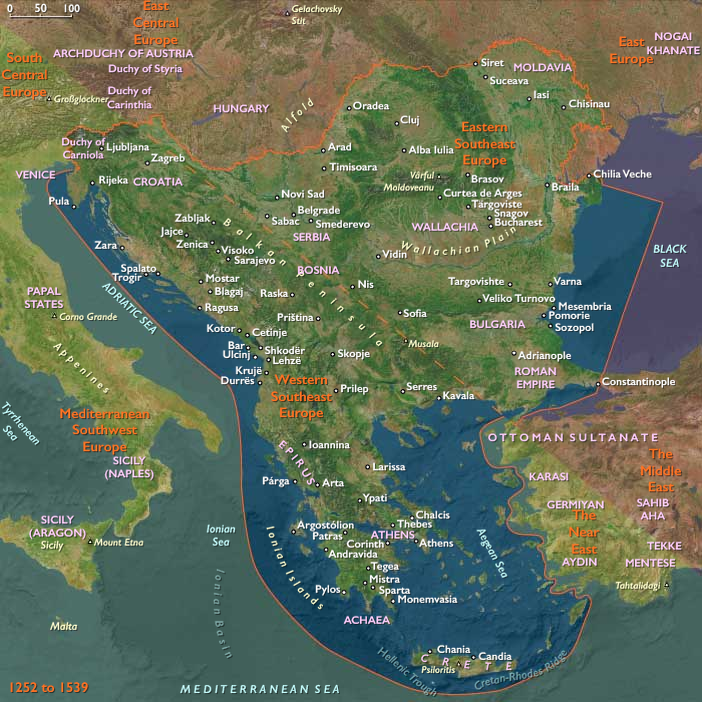
On this campaign, Amadeus joins forces with Francesco I of Lesbos, and Hungarian king Louis the Great, and they drive the Turks from Gallipoli. (This victory will be short-lived, though, for they will lose Gallipoli to the Turkish Sultan Murad I when, after three years of civil war between John V and his son, Andronikos IV, it will handed over to the Ottomans by the latter as payment for their support.)
The crusaders are hoping for assistance from Emperor John V Palaiologos, but the pope has made it dependent on his bringing the Greek Orthodox Church back into communion with the Roman Catholic Church—and under papal supremacy—even though it is the Constantinople and its empire that the crusade is seeking to relieve from Turkish pressure.
The crusaders also expect support from Louis of Hungary, although all that will ever be received is two royal squires who will serve Amadeus "in the Bulgarian provinces" (in partibus Burgarie).
John V travels in the spring of 1366 to the Hungarian court to accept military aid and swear an oath on behalf of himself and his sons to convert to Catholicism.
Pope Urban had extended to Louis the Crusade indulgence on July 1, but on July 22 a letter from the pope had suspended the privileges granted earlier that month for one year, postponing assistance to the Greeks until after their return to the Catholic fold and convincing Louis not to assist the "schismatic", although the pope had not expressly forbid him to.
On his return through Bulgaria, so recently attacked by his would-be ally, John finds himself trapped, either imprisoned or surrounded by Bulgarian forces, and unable to continue to his own domain, where his son, Andronikos IV, married to Keratsa, daughter of the Bulgarian tsar, has taken control of the government.
Amadeus and John V are first cousins; John's mother, Anna, is the sister of Amadeus's father, Aymon.
After being apprised of the situation in Bulgaria and of the Turkish positions in Europe, Amadeus leads his fleet into the Dardanelles, where it is joined by a flotilla under Francesco I Gattilusio, Prince of Lesbos, and son-in-law of the trapped emperor.
They may also have been met by a detachment of the imperial army under the Patriarch of Constantinople, as the Savoyard chronicles record.
The combined crusader fleet launches an attack on Gelibolu (Gallipoli), the second city of the European Turks, on August 22.
While the army begins the siege with an assault on the walls, during the night the Turks abandon the city and in the morning the inhabitants open the gates to the crusaders.
The sources shed limited light on this brief episode.
It is known from the count's register that both town and citadel are in Savoyard hands by August 26, and garrisons and commanders are appointed for each—Giacomo di Luserna for the city and Aimone Michaele for the citadel, with responsibility for not just defending Gelibolu but also for guarding the entrance to the straits.
On August 27, a messenger is sent westward with news of the count's victory.
The chronicles explain the rapid success by the Turkish retreat, but it is also known that on September 12, at Beyoğlu (Pera) in Constantinople, the count was preparing the funerals of several of his men who died in the attack on Gelibolu.
Simon de Saint-Amour and Roland de Veissy, both knights of the Collar, had been killed, and the count's bursar, Antoine Barbier had purchased eighteen escutcheons bearing the "device of the Collar" (devisa collarium) for their funeral, while eighty-one wax torches and alms were paid for the burial of Girard Mareschal from Savoy and Jean d'Yverdon from the Vaudois.
A large storm in the Sea of Marmora had initially prevented the remainder of the crusade from leaving Gelibolu, but by September4 they had arrived by sea at Constantinople.
The fleet has landed at Beyoğlu (Pera), the Genoese quarter where most of his men stay, although some take lodgings in Galata, the borgo de Veneciis (Venetian quarter), and Amadeus himself purchases a house in the city proper, which he has to furnish.
Besides the cost of furniture and funerals, the count has to pay his interpreter Paulo three months' wages.
Amadeus sends a Savoyard embassy from Constantinople, to John V, who is apparently at Vidin.
He seems to have asked for armed intervention to free him to return to his capital.
His empress, Helena Kantakouzene, offers the count of Savoy money for a military expedition into Bulgaria, although Amadeus has no warrant from the pope to attack the Bulgarians, fellow Christians albeit schimastics (non-Catholics).
Leaving a contingent behind in Constantinople, the count leads a fleet up the Black Sea coast of Bulgaria on October 4.
In two days they reach the port of "Lorfenal" (l'Orfenal) and then Sozopolis, which was long supposed to have been in imperial hands, but now appears to have belonged to the Bulgars.
No battle takes place, and it is not clear if the city surrendered or was simply bypassed.
The expense accounts of Amadeus VI show him to have been "at Sozopolis" (apud Tisopuli) for 17–19 October, but he may have only camped outside its walls.
He may, however, have captured Burgas.
The city of Nesebar (Mesembria) and its citadel are captured on October 20.
The Mesembrians, having put up a stiff resistance that has caused the death of many Christian knights and squires, are put to the sword, women and children not spared, and the city is pillaged.
Pomorie, which the Savoyards call Lassillo or l'Assillo (from Axillo, or Anchialus) is next captured, and perhaps also Macropolis (Manchopoly) and Scafida (Stafida), and the Savoyards control the Gulf of Burgas.
The coastal region of Bulgaria, modern Dobruja, is at this time the semi-independent Principality of Karvuna, ruled by Dobrotitsa as a frontier march of the Bulgarian empire.
Its chief city, formerly a metropolis, is Varna.
On October 25, the crusaders arrive before Varna, and send an embassy to the citizens asking them to surrender.
They refuse, but promised to send their own messengers to Tsar Ivan Shishman, whose capital is at Veliko Tarnovo (Tirnovo), requesting him to allow John V to pass, although Shishman does not control Vidin at this time, which is in the hands of his brother, Ivan Sratsimir.
In the meantime, the Varnans supply the crusading army and several embassies are exchanged between Tarnovo and the count of Savoy's camp.
Amadeus, in order to strengthen his bargaining position, attacks and captures Emona (Lemona, l'Emona), a fortress on Cape Emine, further south along the coast.
The Emonans rise in rebellion after their capitulation and have to be crushed.
Amadeus establishes a garrison there and returns to Varna.
As the truce between Varna and the count of Savoy drags on, a band of youthful crusaders venture by sea to take the small castle of "Calocastre" by night.
They are discovered by the guards as they try to scale the walls and massacred.
Amadeus, although expressing disapproval of their independent action, leads a retaliatory expedition which results in the slaughter of the population of Calocastre.
Negotiations with the Bulgars continue into mid-November, and, possibly at the insistence of the tsar, Amadeus raises the siege of Varna and withdraws to Nesebar, leaving a garrison in Emona, before November 18.
Tsar Shishman had sent word to Amadeus on December 23 that the emperor was being permitted to go from Vidin to Kaliakra, in Dobrotitsa's domain.
The count sends a welcoming party to await him there, and passes the winter at Nesebur, where he administers the city thoroughly, extracting taxes of all kinds.
The count moves his court early in January 1367 across the gulf to Sozopolis, where the emperor finally arrives on January 28, without having stopped at Kaliakra.