Andrew II of Hungary
King of Hungary and Croatia
Years: 1177 - 1235
Andrew II the Jerosolimitan (c. 1177 – 21 September 1235) is King of Hungary (1205–1235) and Croatia (1205–1235).
He is the younger son of King Béla III of Hungary, who invests him with the government of the Principality of Halych.
However, the boyars of Halych rebel against his rule and expel the Hungarian troops.
Following their father's death, Andrew continuously conspires against his brother, King Emeric of Hungary, who has to grant him the government of Croatia and Dalmatia.
When his brother and his infant son die, Andrew ascends the throne and starts to grant royal domains to his partisans.
He participates in the Fifth Crusade but he cannot achieve any major military success.
He is obliged to issue the Golden Bull confirming the privileges of the noblemen of Hungary and later he is also obliged to confirm the special privileges of the clergy.
During his long reign, the central power and royal authority potentially weaken.
He has several quarrels with his sons.

Related Events
Filter results
Showing 10 events out of 30 total
The king's power remains paramount in Hungary until the end of the twelfth century.
He is the largest landowner, and income from the crown lands nearly equals the revenues generated from mines, customs, tolls, and the mint.
In the thirteenth century, however, the social structure changes, and the crown's absolute power begins to wane.
As the crown lands become a less important source of royal revenues, the king finds it expedient to make land grants to nobles to ensure their loyalty.
King Andrew II (1205-35), a profligate spender on foreign military adventures and domestic luxury, makes huge land grants to nobles who fight for him.
These nobles, many of whom are foreign knights, soon make up a class of magnates whose wealth and power far outstrip that of the more numerous, and predominantly Magyar, lesser nobles.
When Andrew tries to meet burgeoning expenses by raising the serfs' taxes, thereby indirectly slashing the lesser nobles' incomes, the lesser nobles rebels.
In 1222 they force Andrew to sign the Golden Bull, which limits the king's power, declares the lesser nobles (all free men not included among the great Barons or magnates) legally equal to the magnates, and gives them the right to resist the king's illegal acts.
The lesser nobles also begin to present Andrew with grievances, a practice that evolves into the institution of the parliament, or Diet.
Andrew II's son Béla IV (1235-79) tries with little success to reestablish royal preeminence by reacquiring lost crown lands.
His efforts, however, create a deep rift between the crown and the magnates just as the Mongols are sweeping westward across Russia toward Europe.
Aware of the danger, Béla orders the magnates and lesser nobles to mobilize.
Few respond, and the Mongols rout Béla's army at Mohi on April 11, 1241.
Béla flees first to Austria, where Duke Frederick of Babenberg holds him for ransom, then to Dalmatia.
The Mongols reduce Hungary's towns and villages to ashes and slaughter half the population before news arrives in 1242 that the Great Khan Ögedei has died in Karakorum.
The Mongols withdraw, sparing Béla and what remains of his kingdom.
Prince Vladimir II Yaroslavich of Halych, who had been dethroned by his boyars, seeks refuge in the court of Béla III in 1188.
Béla leads his armies against Halych and occupies it, but afterwards he grants the principality to his second son, Andrew and has prince Vladimir arrested.
Béla had on May 31, 1189, welcomed Frederick I, who is making his Crusade to the Holy Land, and on the emperor's request he had set free his brother, Géza, who then departed for Constantinople.
Afterwards, when Emperor Frederick I enters into a controversy with Emperor Isaac II, Béla mediates between them.
However, in the meantime, Prince Vladimir II escapes from Hungary and reoccupies his principality.
East Central Europe (1192–1203 CE): Přemyslid Restoration under Ottokar I, Emergence of Andrew II in Hungary, Continued Polish Decentralization, and Austria’s Ascendant Babenberg Dynasty
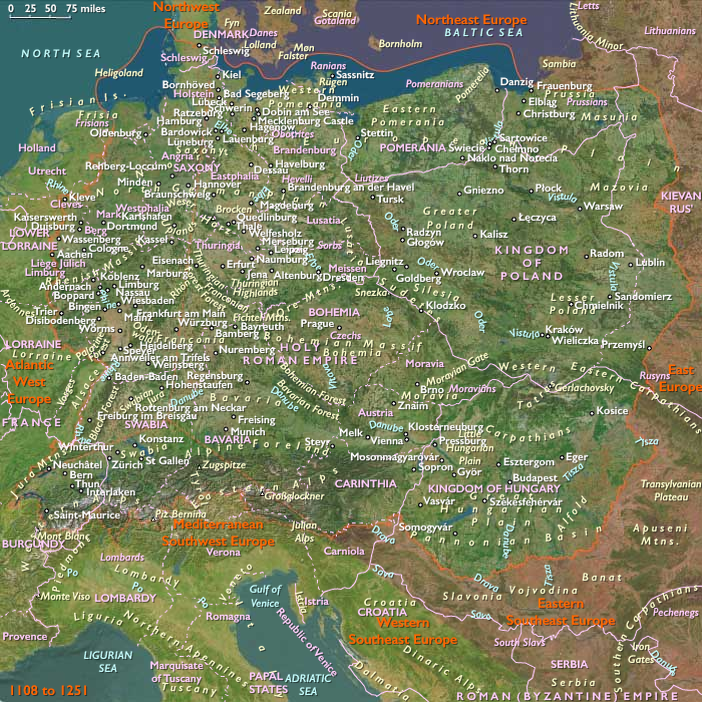
Between 1192 and 1203 CE, East Central Europe—including modern-day Poland, Czechia, Slovakia, Hungary, and eastern regions of Germany and Austria east of 10°E and north of the defined southeastern boundary—experienced critical political transitions, dynastic realignments, and continued territorial consolidation. Bohemia saw renewed Přemyslid strength under Ottokar I, Hungary navigated succession struggles leading toward the ascendancy of Andrew II, Poland remained politically fragmented with strong regional principalities, and Austria continued its growth and stabilization under the prominent Babenberg dynasty. This era was pivotal in establishing lasting political frameworks, economic prosperity, and enduring cultural traditions across the region.
Political and Military Developments
Přemyslid Restoration under Ottokar I in Bohemia
-
In 1197, Ottokar I Přemysl (r. 1197–1230) secured power, bringing renewed stability and reinvigorating Přemyslid authority after prolonged dynastic strife. His effective governance restored Bohemia’s regional influence and solidified its alliance with the Holy Roman Empire.
-
Ottokar’s political acumen laid foundations for future Bohemian royal autonomy, leading eventually to his hereditary royal title recognition in 1198 by Philip of Swabia, bolstering the Přemyslid dynasty’s long-term prominence.
Hungarian Succession Struggles and Rise of Andrew II
-
Hungary entered a period of complex succession disputes after Béla III’s death (1196). His sons, Emeric (1196–1204) and Andrew II (1205–1235), contended for power, causing brief internal instability.
-
Emeric, ruling from 1196, attempted to stabilize royal power but faced challenges from his ambitious younger brother Andrew, whose eventual ascendancy in the following era (1205) would profoundly impact Hungarian politics.
Persistent Polish Decentralization and Regional Autonomy
-
Poland continued its fragmented political landscape, divided among powerful Piast principalities such as Silesia under Duke Henry I the Bearded, Greater Poland, Masovia, and Lesser Poland. Rivalry among these territories persisted, further decentralizing political authority and strengthening local aristocratic rule.
Austria’s Stability and Expansion under Leopold V and Frederick I
-
Under Duke Leopold V (r. 1177–1194) and his successor, Frederick I (r. 1195–1198), the Austrian Babenberg dynasty further solidified territorial cohesion, political stability, and regional influence within the Holy Roman Empire.
-
Austria’s expansion and strengthening of ducal authority prepared the foundation for greater autonomy and influence throughout the medieval period.
Imperial Transition after Frederick Barbarossa’s Death
-
The death of Emperor Frederick Barbarossa (1190) during the Third Crusade shifted imperial dynamics, temporarily affecting the political balance in East Central Europe. His successor, Henry VI (r. 1190–1197), and the subsequent imperial interregnum significantly influenced regional politics, alliances, and dynastic stability.
Economic and Technological Developments
Continued Economic Expansion and Urban Prosperity
-
Economic growth remained robust, supported by vibrant trade networks connecting regional economies with Baltic, Byzantine, Western European, and Mediterranean markets. Major urban centers like Prague, Vienna, Esztergom, Kraków, and Wrocław expanded as prosperous commercial hubs.
Agricultural Productivity and Technological Advancements
-
Continued adoption of advanced agricultural practices, including improved plowing techniques and systematic crop rotation, increased agricultural productivity. These innovations supported urban growth, population expansion, and regional prosperity.
Cultural and Artistic Developments
Bohemian Cultural Revival under Ottokar I
-
Ottokar I strongly supported ecclesiastical institutions, architectural projects, and manuscript production, significantly contributing to Bohemia’s cultural flourishing and reestablishing Prague as an influential intellectual and artistic center.
Hungarian Ecclesiastical and Cultural Continuity
-
Despite internal succession disputes, Hungary maintained robust cultural and religious activities. Ecclesiastical institutions, monasteries, and scholarly communities flourished, ensuring continuity and resilience in Hungarian cultural life.
Cultural Stability in Fragmented Poland
-
Polish cultural continuity remained resilient amid political fragmentation. Monasteries and ecclesiastical institutions continued scholarly and artistic traditions, preserving regional cultural and religious identities.
Settlement and Urban Development
Urban Consolidation and Expansion in Bohemia
-
Under Ottokar I, Bohemian towns such as Prague significantly expanded, enhancing fortifications, administrative structures, and economic infrastructure. This urban growth supported Přemyslid centralization and regional prominence.
Hungarian Urban Development Despite Instability
-
Hungarian urban centers, notably Esztergom and Székesfehérvár, maintained growth and infrastructure development, despite succession disputes, reflecting continued economic prosperity and strong local governance structures.
Austrian Territorial Cohesion and Urban Growth
-
Austria’s urban centers, especially Vienna, flourished under Babenberg rule, consolidating territorial cohesion, economic vitality, and regional administrative authority, reinforcing Austria’s long-term significance within East Central Europe.
Social and Religious Developments
Strengthened Ecclesiastical Structures and Religious Identity
-
Ecclesiastical institutions expanded and strengthened throughout the region, shaping governance, education, and cultural identities. Monasteries, bishoprics, and religious orders played vital roles in societal cohesion, education, and cultural preservation.
Aristocratic Dominance and Dynastic Stability
-
Aristocratic governance and dynastic authority continued to shape regional politics significantly. Bohemia’s Přemyslid restoration under Ottokar I, Austria’s Babenberg stability, and Hungary’s aristocratic power structures highlighted the pivotal role of nobility. Poland’s regional aristocratic autonomy deepened amid persistent fragmentation.
Long-Term Consequences and Historical Significance
The era 1192–1203 CE critically shaped East Central Europe’s political landscape, economic vitality, and cultural identity. The restoration of Přemyslid authority in Bohemia under Ottokar I, Hungary’s succession struggles leading toward Andrew II’s significant future rule, Austria’s territorial and political strengthening, and Poland’s persistent decentralization deeply influenced regional trajectories. These developments laid enduring foundations for the distinct political structures, economic patterns, and cultural identities characterizing East Central Europe throughout the medieval period and beyond.
East Central Europe (1204–1215 CE): Andrew II’s Hungarian Ascendancy, Bohemian Royal Consolidation under Ottokar I, Polish Regional Power under Henry the Bearded, and Austria’s Stability under Leopold VI
Between 1204 and 1215 CE, East Central Europe—including modern-day Poland, Czechia, Slovakia, Hungary, and eastern regions of Germany and Austria east of 10°E and north of the defined southeastern boundary—experienced significant political realignments, territorial consolidation, and cultural developments. Hungary entered a vibrant era under King Andrew II, Bohemia solidified Přemyslid royal authority under Ottokar I, Poland’s fragmentation continued but saw growing regional strength under Henry the Bearded in Silesia, and Austria prospered under Leopold VI of the Babenberg dynasty. These developments significantly influenced regional stability, economic expansion, and cultural flourishing.
Political and Military Developments
Hungarian Stability and Expansion under Andrew II
-
In 1205, following King Emeric’s death, his brother Andrew II (r. 1205–1235) ascended Hungary’s throne, ushering in a politically active and culturally vibrant reign. Andrew pursued ambitious foreign and domestic policies, seeking greater political influence across East Central Europe and actively engaging in Crusades.
-
His governance significantly strengthened Hungary’s regional standing, despite occasional internal disputes and aristocratic challenges.
Bohemian Royal Authority Strengthened under Ottokar I
-
King Ottokar I Přemysl (r. 1197–1230) reinforced royal authority, stabilizing Bohemia after previous dynastic conflicts. His strong leadership earned recognition of hereditary royal status from the Holy Roman Empire in the Golden Bull of Sicily (1212), enhancing Přemyslid autonomy and political prestige.
-
Ottokar’s reign marked significant administrative reform, territorial consolidation, and increased Bohemian political influence within imperial affairs.
Polish Fragmentation and Silesian Power under Henry the Bearded
-
Poland’s political fragmentation persisted with principalities operating autonomously. The most prominent was Silesia under Duke Henry I the Bearded (r. 1201–1238), who consolidated power, enhanced economic prosperity, and fostered diplomatic alliances.
-
Henry’s leadership elevated Silesia as the strongest of Poland’s regional duchies, significantly influencing broader Polish and Central European politics.
Austrian Stability and Prosperity under Leopold VI
-
Duke Leopold VI of Austria (r. 1198–1230) ensured political stability, territorial security, and economic prosperity within Austria. His rule strengthened urban centers, fortified regional influence, and reinforced Austria’s prominence in the Holy Roman Empire.
-
Leopold VI actively supported crusading efforts, fostering diplomatic relations across Europe and enhancing Austria’s international prestige.
Imperial Authority under Otto IV and Frederick II
-
The period featured contested imperial succession between Otto IV (r. 1198–1215) and Frederick II (r. 1212–1250), affecting regional politics. East Central European rulers navigated shifting imperial alliances, notably Bohemia under Ottokar I, whose support for Frederick II strengthened his position and royal autonomy.
Economic and Technological Developments
Prosperous Regional Economies and Expanded Trade
-
Economic prosperity continued through robust trade networks connecting Baltic, Western Europe, and Mediterranean markets. Major urban centers—Prague, Vienna, Esztergom, Kraków, and Wrocław—thrived commercially, becoming vital hubs of regional trade.
Agricultural Innovations and Population Growth
-
Agricultural productivity increased due to widespread adoption of advanced techniques, such as improved plows, crop rotation, and land management practices, supporting significant urbanization and population expansion.
Cultural and Artistic Developments
Hungarian Cultural and Artistic Flourishing under Andrew II
-
Andrew II patronized extensive ecclesiastical foundations, artistic endeavors, and intellectual developments, greatly enhancing Hungarian cultural life. Manuscript production, ecclesiastical architecture, and scholarly activities flourished, influenced by Western European and Byzantine traditions.
Bohemian Intellectual and Cultural Revival under Ottokar I
-
Bohemia’s cultural prominence significantly increased, particularly in Prague, driven by royal patronage of monastic scholarship, manuscript illumination, and architectural projects. Prague became an influential cultural and intellectual center within Central Europe.
Silesian Cultural and Economic Vitality under Henry the Bearded
-
Duke Henry the Bearded fostered cultural and economic vitality in Silesia, promoting monasteries, urban development, and artistic patronage. His support solidified Silesia’s role as a prominent cultural and commercial region within fragmented Poland.
Settlement and Urban Development
Urban Expansion in Hungary under Andrew II
-
Hungarian urban centers, notably Esztergom and Buda, expanded significantly, benefiting from improved fortifications, administrative organization, and flourishing commerce. This urban development reflected Andrew’s effective governance and economic policies.
Bohemian Town Consolidation and Growth
-
Under Ottokar I, Prague and other Bohemian urban centers experienced notable growth, infrastructure improvements, and commercial expansion. Prague’s prominence as a regional economic and administrative center was significantly enhanced.
Austrian Urban Prosperity and Infrastructure Development
-
Austria’s towns, particularly Vienna, experienced considerable prosperity under Leopold VI, supported by infrastructure enhancements, fortified settlements, and growing regional trade connections, reinforcing Austria’s economic strength and political influence.
Social and Religious Developments
Expansion and Strengthening of Ecclesiastical Structures
-
Ecclesiastical institutions expanded significantly, shaping regional governance, education, and cultural identities. Monasteries and bishoprics played critical roles in societal cohesion, intellectual development, and cultural continuity across East Central Europe.
Dynastic and Aristocratic Governance Structures
-
Aristocratic authority and dynastic leadership remained pivotal. Hungarian royal strength under Andrew II, Přemyslid consolidation in Bohemia, Austrian stability under Leopold VI, and Silesian prominence under Henry the Bearded emphasized the critical role of nobility and dynastic influence in regional governance.
Long-Term Consequences and Historical Significance
The era 1204–1215 CE represented a decisive period of regional consolidation and political realignment in East Central Europe. Andrew II’s reign solidified Hungarian regional prominence, Ottokar I secured lasting Přemyslid royal authority and autonomy in Bohemia, Henry the Bearded elevated Silesia within fragmented Poland, and Austria prospered under Leopold VI’s strong rule. These developments significantly shaped regional political identities, economic patterns, and cultural traditions, profoundly influencing East Central Europe’s medieval trajectory and future historical developments.
King Emeric's five-year-old son, crowned on August 26, 1204, while his dying father was still alive, had in June 1205 upon his father's death of acceded to the Hungarian throne as Ladislaus III.
With the coronation, Emeric had wanted to ensure his son's succession to the throne.
Emeric had made his brother, Duke Andrew, who had rebelled against the king several times, promise that he would protect the child and help him in the governance until he became an adult.
Andrew, promising this, had been released from prison and is appointed as regent during the minority of his nephew.
The following year Andrew deposes Ladislaus and takes the throne as Andrew II.
The Dowager Queen, Constance of Aragon, escapes with her son to Vienna to Leopold VI, Duke of Austria, but Ladislaus soon dies there on May 7.
The former Regent and now King Andrew II of Hungary takes the body of his nephew and buries him in the Royal Crypt of Székesfehérvár.
Duke Leopold sends Constance back to Aragon.
The first German colonists (the future Transylvanian Saxon community) arrive in Transylvania, following grants by Andrew II of Hungary.
The Teutonic Knights, under the leadership of the grand master Hermann von Salza, begin transferring their main center of activity from the Holy Land to eastern Europe.
The order's first European enterprise starts in Hungary in 1211, when King Andrew II invites a group of the Teutonic Knights to protect his Transylvanian borderland against the Cumans by colonizing it and by converting its people to Christianity.
The Knights establish Kronstadt (modern Brasov), a city in the region of present central Romania on the northern slope of the Transylvanian Alps, in 1211.
East Central Europe (1216–1227 CE): Golden Bull of Hungary, Bohemian Consolidation, Polish Regional Rivalries, and Babenberg Influence in Austria
Between 1216 and 1227 CE, East Central Europe—encompassing modern-day Poland, Czechia, Slovakia, Hungary, and the eastern regions of Germany and Austria east of 10°E and north of the defined southeastern boundary—witnessed pivotal political and institutional developments. Hungary under Andrew II saw profound social and political change through the Golden Bull of 1222, Bohemia further solidified royal authority under Ottokar I Přemysl, Polish territories experienced intensified regional rivalry, and Austria flourished culturally and politically under Duke Leopold VI of the Babenberg dynasty. Collectively, these events significantly shaped regional governance, social structures, and cultural dynamics.
Political and Military Developments
Hungary’s Golden Bull and Aristocratic Power under Andrew II
-
In 1222, King Andrew II (r. 1205–1235) issued the Golden Bull of Hungary, a landmark charter limiting royal power, guaranteeing noble privileges, and establishing foundational political rights. This document significantly reshaped Hungarian governance by solidifying aristocratic authority and curbing royal absolutism, echoing England’s Magna Carta (1215).
-
Andrew’s rule, though marked by occasional internal conflict, significantly expanded Hungarian regional influence, notably in frontier regions such as Transylvania and along the Adriatic coast.
Consolidation of Bohemian Royal Authority under Ottokar I
-
Under Ottokar I Přemysl (r. 1197–1230), Bohemia saw significant political stability and institutional development. The Golden Bull of Sicily (1212) continued to define his reign, confirming hereditary royal authority and enhancing Přemyslid autonomy within the Holy Roman Empire.
-
Ottokar’s effective governance and diplomatic skill solidified Bohemian territorial integrity and political stability, elevating Prague as a crucial regional political and cultural hub.
Intensified Polish Regional Rivalries and Silesian Strength
-
Poland remained deeply fragmented, with autonomous Piast duchies increasingly competing for dominance. Henry I the Bearded of Silesia (r. 1201–1238) emerged prominently, expanding influence over neighboring territories and elevating Silesia as a major power center within fragmented Poland.
-
Despite Henry’s successes, regional rivalry and persistent dynastic disputes among Polish duchies continued to limit centralized royal authority.
Austria’s Continued Prosperity under Leopold VI
-
Duke Leopold VI of Austria (r. 1198–1230) maintained stability, prosperity, and cultural vibrancy within Austria. His reign was characterized by effective administration, territorial security, economic flourishing, and active participation in European crusading politics.
-
Leopold significantly strengthened Austria’s territorial integrity, enhancing Vienna’s political prominence within East Central Europe.
Imperial Influence of Frederick II
-
Emperor Frederick II (r. 1212–1250) expanded his political influence across East Central Europe, notably affecting Bohemia, Hungary, and Austria. Regional rulers navigated shifting alliances, with imperial relations significantly impacting regional stability and governance.
Economic and Technological Developments
Regional Economic Expansion and Commercial Vitality
-
East Central Europe experienced robust economic expansion driven by thriving trade networks connecting Baltic, Mediterranean, Byzantine, and Western European markets. Major urban centers, including Prague, Vienna, Esztergom, Kraków, and Wrocław, flourished as prosperous trade hubs.
Agricultural Productivity and Technological Advancements
-
Continued adoption of advanced agricultural techniques—improved plowing methods, systematic crop rotation, and enhanced livestock management—significantly increased productivity, supporting urbanization, population growth, and economic prosperity.
Cultural and Artistic Developments
Cultural Flourishing in Hungary under Andrew II
-
Andrew II strongly supported ecclesiastical and cultural institutions, fostering extensive manuscript production, architectural projects, and scholarly activities. The artistic and intellectual vibrancy of Hungary notably increased, influenced by Western European and Byzantine traditions.
Bohemian Cultural and Ecclesiastical Vitality under Ottokar I
-
Bohemia, particularly Prague, experienced a cultural revival through royal patronage of monasteries, manuscript illumination, architectural development, and scholarly activities, establishing it as a significant intellectual and cultural center.
Silesian Cultural and Artistic Prominence under Henry the Bearded
-
Silesia under Henry I the Bearded emerged as a leading cultural center within fragmented Poland, marked by substantial monastic foundations, artistic patronage, manuscript production, and urban development, significantly influencing broader Polish culture.
Settlement and Urban Development
Hungarian Urban Growth under Andrew II
-
Hungarian towns such as Esztergom, Székesfehérvár, and Buda continued to expand significantly, supported by stable governance, fortified infrastructure, thriving commerce, and active royal patronage.
Bohemian Urban Consolidation and Expansion
-
Under Ottokar I, Prague and other Bohemian cities saw significant infrastructure improvements, commercial expansion, and strengthened administrative structures, reinforcing their roles as vital regional economic and political hubs.
Austrian Urban Prosperity under Leopold VI
-
Austria’s urban centers, notably Vienna, flourished economically and politically under Leopold VI’s effective governance, enhanced fortifications, administrative efficiency, and expanded trade networks, significantly influencing regional economic stability.
Social and Religious Developments
Ecclesiastical Institutional Expansion and Influence
-
The region experienced extensive ecclesiastical institutional growth, shaping social organization, governance, and education. Monasteries, bishoprics, and religious orders played central roles in regional cultural continuity, intellectual development, and societal cohesion.
Aristocratic Dominance and Dynastic Governance
-
Aristocratic power continued to influence governance significantly. The Golden Bull in Hungary explicitly strengthened noble rights and power. Bohemia under Ottokar, Austria under Leopold, and Silesia under Henry highlighted the pivotal role of dynastic and aristocratic leadership in regional governance structures.
Long-Term Consequences and Historical Significance
The era 1216–1227 CE significantly influenced East Central Europe’s political institutions, economic prosperity, and cultural vitality. Hungary’s Golden Bull of 1222 established lasting legal precedents that profoundly shaped Hungarian politics. Bohemia’s consolidation under Ottokar I, Silesia’s regional prominence under Henry the Bearded amid persistent Polish fragmentation, and Austria’s stable prosperity under Leopold VI significantly impacted regional stability, governance, and identity. Collectively, these developments formed enduring foundations for the political, economic, and cultural landscapes characterizing East Central Europe throughout the subsequent medieval period.