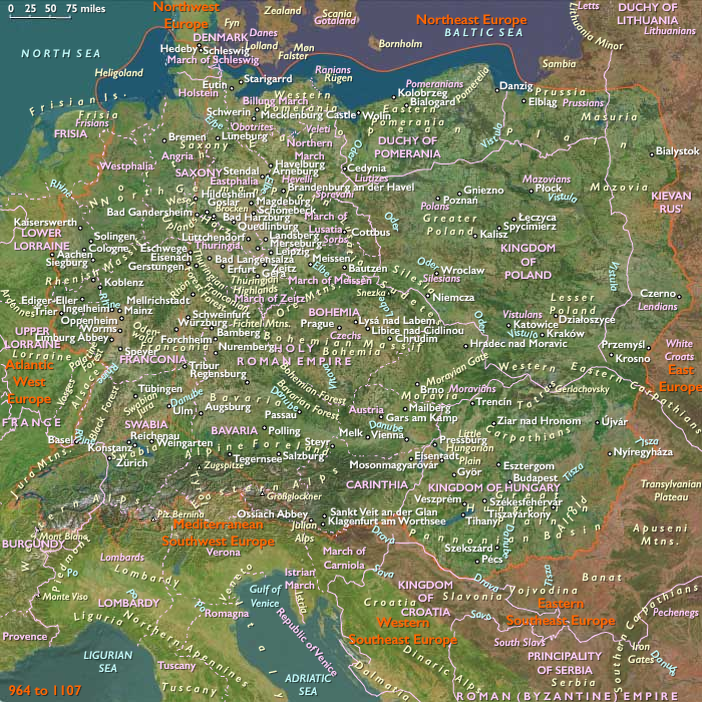
The audacious King Peter Urseolo of Hungary confiscates Queen Giselle's property and takes her into custody.
She seeks help from Hungarian lords, who blame one of Peter's favorites (Budo) for the monarch's misdeeds and demand that Budo be put on trial.
When the king refuses, the lords seize and murder his unpopular advisor and depose the monarch in 1041.
They elect a new king, Samuel Aba, who is a brother-in-law or another nephew of King Stephen I. Samuel had held important offices during the reign of King Stephen; he was a member of the royal council and became the first palatine of Hungary.
Samuel's family, according to the anonymous author of the Gesta Hungarorum, descends from two "Cuman" chieftains, Ed and Edemen, who had received "a great land in the forest of Mátra" from Árpád, Grand Prince of the Hungarians.
In contrast, the fourteenth-century Hungarian chronicles describe Ed and Edemen as the sons of Csaba —himself a son of Attila the Hun—by a lady from Khwarezm.
Since all Hungarian chronicles emphasize the Oriental—either "Cuman" or "Khwarezmian"—origin of Ed and Edemen, the historians Gyula Kristó, László Szegfű and others propose that the Aba clan descending from them ruled the Kabars, a people of Khazar origin who had joined the Hungarians before their arrival in the Carpathian Basin.
Kristó argues that both Samuel's Khazar origin and his first name suggest that he was born to a family that adhered to Judaism.
Despite the uncertainty over the clan's origins, Samuel undoubtedly descends from a distinguished family, since an unnamed sister of Stephen I, the first King of Hungary, had been given in marriage to a member of the Aba clan around 1009.
However, historians still debate whether Samuel himself or Samuel's father married the royal princess.
If Samuel was her husband, he must have been born before 990 and converted—either from Judaism or paganism—to Christianity when he married Stephen I's sister.
This is further evidenced by Samuel's establishment of an abbey at Abasár, which was recorded by Hungarian chronicles.
According to Gyula Kristó and other historians, Samuel's conversion coincided with the creation of the Roman Catholic Diocese of Eger, encompassing the Mátra region.
As king, Samuel abolishes all laws introduced by Peter the Venetian and has many of his predecessor's supporters killed or tortured.
Hungarian chronicles sharply criticize him for socializing with the peasants instead of the nobles.
Samuel even abolishes some levies payable by the commoners.