Alvise Cadamosto
Venetian slave trader and explorer
Years: 1432 - 1483
Alvise Cadamosto or Alvide da Ca' da Mosto (also known in Portuguese as Luís Cadamosto; c. 1432 – July 16, 1483) is a Venetian slave trader and explorer, who is hired by the Portuguese prince Henry the Navigator and undertakes two known journeys to West Africa in 1455 and 1456, accompanied by the Genoese captain Antoniotto Usodimare.
Cadamosto and his companions are credited with the discovery of the Cape Verde Islands and the points along the Guinea coast, from the Gambia River to the Geba River (in Guinea-Bissau), the greatest leap in the Henrican discoveries since 1446.
Cadamosto's accounts of his journeys, including his detailed observations of west African societies, have proven invaluable to historians.
Related Events
Filter results
Showing 9 events out of 9 total
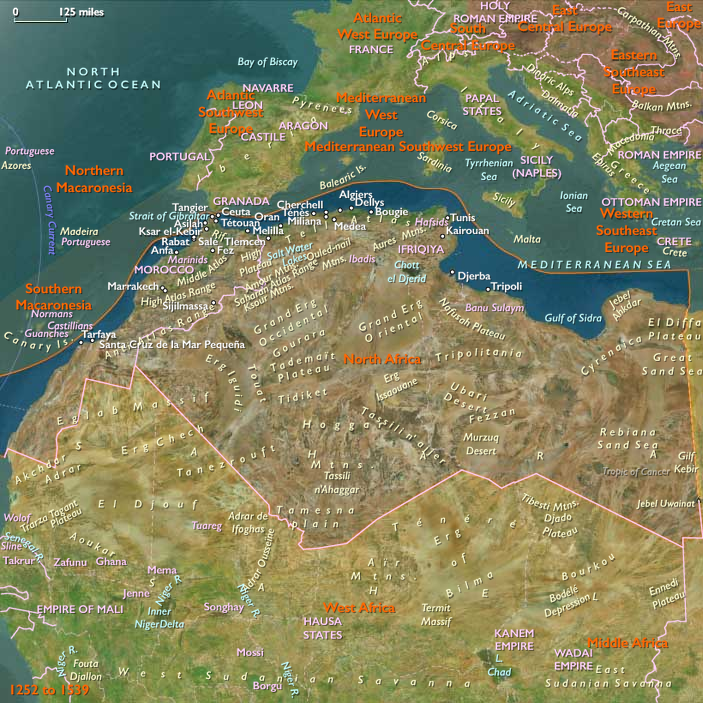
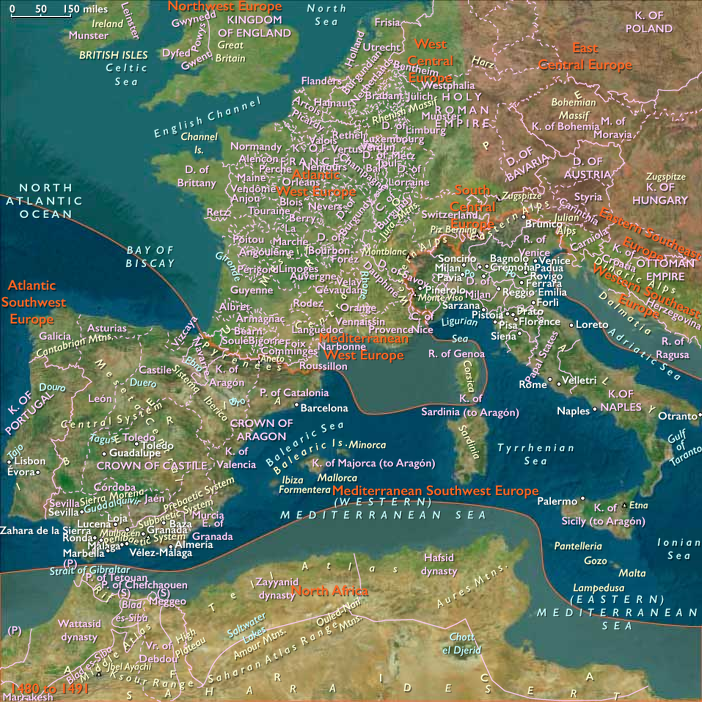
Atlantic Southwest Europe: Maritime Dominance and Regional Struggles (1444–1455)
Between 1444 and 1455, Atlantic Southwest Europe underwent critical transformations marked by Portuguese maritime breakthroughs, persistent political strife in Castile, and contested successions in Navarre. This era saw heightened economic prosperity linked to overseas expansion, contrasted with enduring internal rivalries that reshaped political dynamics across the region.
Political and Military Developments
-
Portugal:
- Under regent Infante Pedro, Duke of Coimbra (1439–1448), maritime exploration expanded significantly, culminating in expeditions past Cape Verde (1444) and establishing Portugal’s claim over African coastal trade routes.
- After a brief civil conflict, King Afonso V (r. 1438–1481) ended Pedro’s regency violently in 1449, shifting Portugal’s internal politics toward increased royal centralization and expansionist ambitions.
-
Northern Castile and León:
- Ongoing instability under King Juan II of Castile (r. 1406–1454) intensified due to the influential minister Álvaro de Luna’s controversial control, leading to escalating feuds among noble factions and weakening royal authority in northern provinces.
- The execution of Álvaro de Luna (1453) brought temporary calm, yet political fragmentation persisted, allowing greater regional autonomy in territories such as Galicia, Asturias, and the Basque Country.
-
Navarre:
- Succession crises intensified under Charles, Prince of Viana, whose disputed inheritance after Queen Blanche’s death (1441) drew Navarre into deeper conflict, particularly with the ambitions of John II of Aragon, destabilizing governance and increasing external interference in Navarrese politics.
Economic and Maritime Expansion
-
Portuguese Trade Networks:
- Portuguese expeditions along West Africa’s coast led to significant economic gains from gold, ivory, and slave trade, consolidating Lisbon as a thriving Atlantic port and financial hub.
- Madeira’s sugar plantations, established in prior decades, matured into prosperous enterprises, significantly influencing future patterns of plantation agriculture and Atlantic commerce.
-
Urban and Commercial Vitality:
- Atlantic ports in northern Iberia, notably Bilbao and Santander, benefited from trade stability, especially with northern Europe, strengthening their economic standing despite Castilian political fragmentation.
- Basque maritime traditions flourished through shipbuilding and fisheries, reinforcing the region’s economic independence and international trade connections.
Cultural and Social Developments
-
Intellectual Growth and Humanism:
- Portuguese courts embraced Renaissance humanism and maritime innovation, sponsoring mapmakers, astronomers, and navigators such as Diogo Gomes and Alvise Cadamosto, whose work refined Europe’s geographic knowledge.
- Cultural exchanges through pilgrimage routes to Santiago de Compostela continued to foster literary and scholarly interactions across the Pyrenean territories.
-
Regional Identity and Autonomy:
- Basque territories and northern Navarre reinforced traditional legal privileges (fueros), promoting distinctive regional identities and autonomy amid Castile’s internal struggles.
- Galicia and Asturias preserved vibrant local cultures, resisting centralized pressures through the strength of traditional communal institutions and networks centered around religious and cultural hubs.
Significance and Legacy
The years 1444–1455 marked a significant juncture in Atlantic Southwest Europe's trajectory, consolidating Portugal’s ascendancy as a maritime power while deepening internal divisions within Castile. The period shaped critical economic patterns through expanded Atlantic commerce and set the stage for further Portuguese global exploration. Simultaneously, the struggle for regional autonomy in northern Spain—particularly in Navarre and the Basque territories—established enduring political and cultural frameworks that would continue influencing the region’s historical evolution.
Alvise Cadamosto was born at the Ca' da Mosto, a palace on the Grand Canal of Venice from which his name derives.
His father was Giovanni da Mosto, a Venetian civil servant and merchant, and his mother Elizabeth Querini, from a leading patrician family of Venice.
Alvise is the eldest of three sons, having younger brothers Petro and Antonio.
At a remarkably young age, Cadamosto had cast out as a merchant adventurer, sailing with Venetian galleys in the Mediterranean.
From 1442 to 1448, Alvise has undertaken various trips on Venetian galleys to the Barbary Coast and Crete, as a commercial agent of his cousin, Andrea Barbarigo.
He had been appointed noble officer of the marine corps of crossbowmen on a galley to Alexandria in 1451.
The next year, he had served the same position on a Venetian galley to Flanders, returning to find his family disgraced and dispossessed.
His father, caught in a bribery scandal, had been banished from Venice, and taken refuge in the Duchy of Modena.
His Querini relatives had taken the opportunity to seize possession of his family's property.
This setback had marred the future prospects of Cadamosto's career in Venice, and probably encouraged his spirit of adventure, hoping to restore his family name and fortune by great feats of his own.
At the age of twenty-two, Alvise and his brother Antonio had embarked in August, 1454, on a Venetian merchant galley, captained by Marco Zen, destined for Flanders.
On the outward journey, the galley had been detained by bad weather near Cape St. Vincent, Portugal.
While waiting for the weather to improve, the Portuguese Prince Henry the Navigator, who has his seat nearby at Sagres, had dispatched a couple of his commercial agents, led by his secretary Antão Gonçalves and the local Venetian consul Patrizio di Conti, to interest the stranded Venetian merchants into opening trade contracts for sugar and other goods from the prince's Madeira island.
Informed by the visitors of Henry's recent discoveries in Africa, Cadamosto immediately applies to Prince Henry at his residence at Raposeira to undertake an expedition on his behalf.
Henry hires him on the spot.
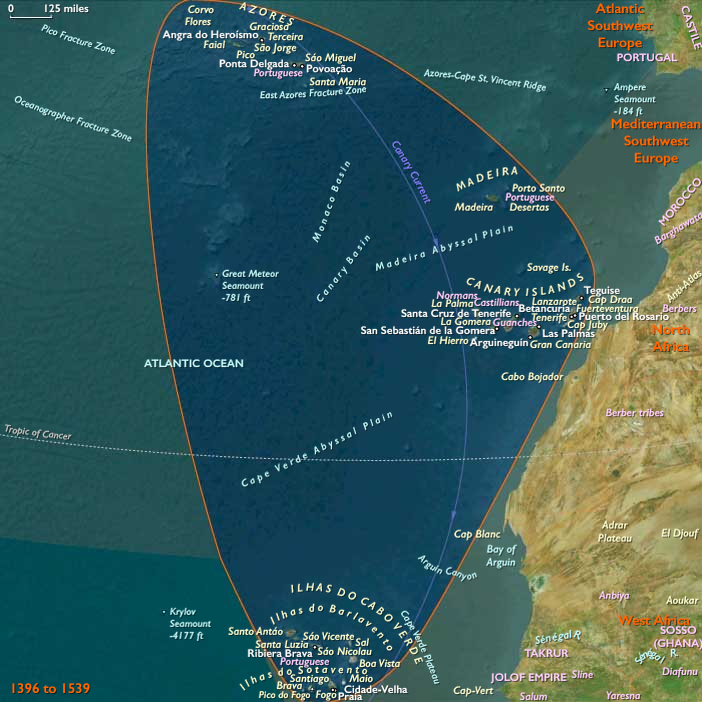
Setting out on March 22, 1455, on a forty-three-ton caravel supplied by Prince Henry, with Vicente Dias as ship master, Cadamosto had proceeded to Porto Santo and Madeira, and thereafter has woven his way through the Canary Islands, making stops in La Gomera, El Hierro and La Palma before reaching the African coast around Cape Blanc.

Cadamosto makes note of the existence of the Portuguese factory-fort at Arguin, but does not seem to have stopped there himself.
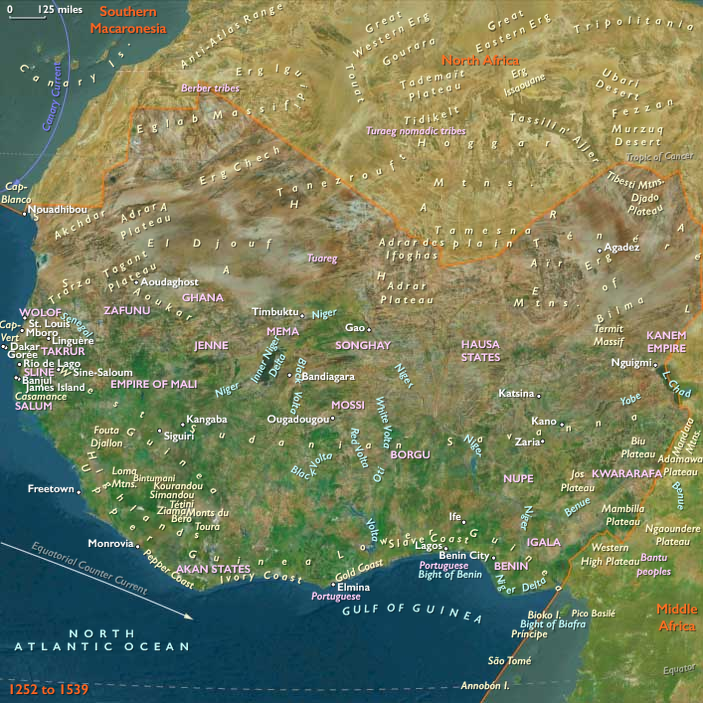
Cadamosto cruises down the west African coast to the mouth of the Senegal River (which he calls the Rio do Senega, the first recorded use of that name.)
He does not seem to have stopped here, his destination being further south, …
…at an anchorage point along the Grande Côte he calls the Palma di Budomel (location uncertain, probably around Mboro, 15°09′42″N 16°55′45″W).
Cadamosto notes that this spot (or resgate) was already used by Portuguese traders.
He dates that trade between the Portuguese and the Wolof people of the Senegal region was opened around 1450 ("five years before I went on this voyage").
Cadamosto had sought to trade Iberian horses for black slaves, the principal line of business at this resgate.
Horses are highly valued on the Senegalese coast, and traded at a rate of between nine and fourteen slaves per horse.
Cadamosto is said to have sold seven horses and some woolen goods (a total value of around three hundred ducats) for about a hundred slaves.
While at the anchorage, Cadamosto is surprised to be met by the ruler himself, the Damel of Cayor (whom he calls Budomel), accompanied by his retinue.
The Damel invites him inland while the details of the trade are finalized.
Cadamosto spends nearly an entire month in an inland village, hosted by the prince Bisboror (Budomel's nephew), during which time he delights in observing much about the local country and customs.
His trade in Cayor completed, rather than return home with his human cargo, Cadamosto decides to cruise further down the coast, towards the Cape Vert peninsula.
This is intended as a pure exploratory jaunt, "to discover new countries" beyond the Cape, more specifically the mysterious "kingdom called Gambra", where Prince Henry has heard (from earlier slave captives) that gold is found in abundance.
Cadamosto comes across two Portuguese caravels, one of which is commanded by Antoniotto Usodimare, a Genoese captain in Prince Henry's service, the other by an unnamed squire of Henry's household.
Meeting around Cape Vert in June 1455, they agree to join forces and proceed south together.
After a brief fishing stop on some unnamed islands (probably Îles des Madeleines), ...
...Cadamosto, Usodimare and the Portuguese squire sail south, down the Petite Côte until they reach the Sine-Saloum delta, a stretch inhabited by the Sereri (Serer people).
Cadamosto has nothing good to say about the Serer, characterizing them as savage idolaters "of great cruelty" (his information is being drawn principally from Wolof interpreters).
Cadamosto claims he was the one who named the Saloum River as the Rio di Barbacini, the name by which it would remain known on European maps thereafter.
Cadamosto and Usodimare try to put in here, but quickly decide against it when an interpreter they land to make contact with the local Serer natives gathered on the beaches is killed on the spot.
Pressing south, Cadamosto and Usodimare finally discover the mouth of the Gambia River in late June or early July, 1455.
They set about sailing upriver, but their advance faces unremitting hostility from the Mandinka inhabitants upriver.
Subjected to intense missile fire, they barely fend off a massed canoe attack that seeks to trap and board them.
According to Cadamosto's interpreters, the Mandinka believe the Portuguese are cannibals, that they have come to the region to buy black men to eat.
Urged by their frightened crews (and probably desirous to keep his human cargo intact—he has been carrying a shipload of slaves since Cayor), Cadamosto decides to call off venturing further and backs out of the river.
Cadamosto does not supply details of the return trip to Portugal.
At the mouth of the Gambia, Cadamosto makes a note of the near-disappearance of the northern Pole Star on the horizon, and roughly sketches a bright constellation to the south, believed to be the first known depiction of the Southern Cross constellation (albeit wrongly positioned and with too many stars—a more accurate rendition will have to wait until Mestre João Faras in 1500.)
Cadamosto calls it the carro dell' ostro (southern chariot).
It is known that the fleet was back in Portugal before the end of the year, as Antoniotto Usodimare will write a letter dated December 12, 1455, to his creditors back in Genoa, reporting the results of his voyage (albeit with much exaggeration, and without mentioning Cadamosto).
The Cape Verde Islands, an arid, mountainous archipelago, volcanic in origin, consist of ten main islands and five islets located in the Atlantic Ocean some four hundred and fifty miles (seven hundred and twenty-five kilometers) west of their namesake, Cape Verde ("Green Cape"), the western tip of Africa.
The first written record of Cape Verde can be found in the works De choreographia by Pomponius Mela and Historia naturalis by Pliny the Elder, who called the islands "Gorgades" in remembering the home of the mythical Gorgons killed by Perseus and afterwards interpreted (against the written original statement) as the site where the Carthaginian Hanno slew two female "Gorillai" and brought their skins into the temple of the female deity Tanit (the Carthaginian Juno) in Carthage.
According to Pliny the Elder, the Greek Xenophon Lampsacenus states that the Gorgades (Cape Verde) were situated two days from "Hesperu Ceras"—today called Cap-Vert, the westernmost part of the African continent.
According to Pliny the Elder and his citation by Solinus, the sea voyage time from Atlantis (Madeira) crossing the Gorgades to the islands of the Ladies of the West (Hesperides) was around forty days.
The Isles of the Blessed written of by Marinos of Tyre and referenced by Ptolemy in his Geographia may have been the Cape Verde islands.
The islands of the Cape Verde archipelago are rediscovered around 1456 by Genoese and Portuguese navigators, who describe them as "uninhabited".
However, given the prevailing winds and ocean currents in the region, the islands may well have been visited by Moors or Wolof, Serer, or perhaps Lebou fishermen from the Guinea Coast.
Folklore suggests that the islands may have been visited by Arabs, centuries before the arrival of the Europeans.
The Portuguese explorer Jaime Cortesão reported a story that Arabs were known to have visited an island which they referred to as "Aulil" or "Ulil" where they took salt from naturally occurring salinas.
Some believe they may have been referring to Sal Island.
Whatever the case may have been, the population (if there is any) at the time of arrival of the Portuguese is insufficiently well established to resist their complete penetration.
According to Portuguese official records, the first discoveries were made by Genoa-born António de Noli, who is afterwards appointed governor of Cape Verde by Portuguese King Afonso V. Other navigators mentioned as contributing to discoveries in the Cape Verde archipelago are Diogo Gomes (who was with António de Noli and claimed to have been the first to land on and name Santiago island), Diogo Dias, Diogo Afonso and the Italian (Venice-born) Alvise Cadamosto.