Alonso de Ojeda
Spanish navigator, governor and conquistador
Years: 1466 - 1515
Alonso de Ojeda (ca.1468 (some sources state 1466) – 1515) is a Spanish navigator, governor and conquistador.
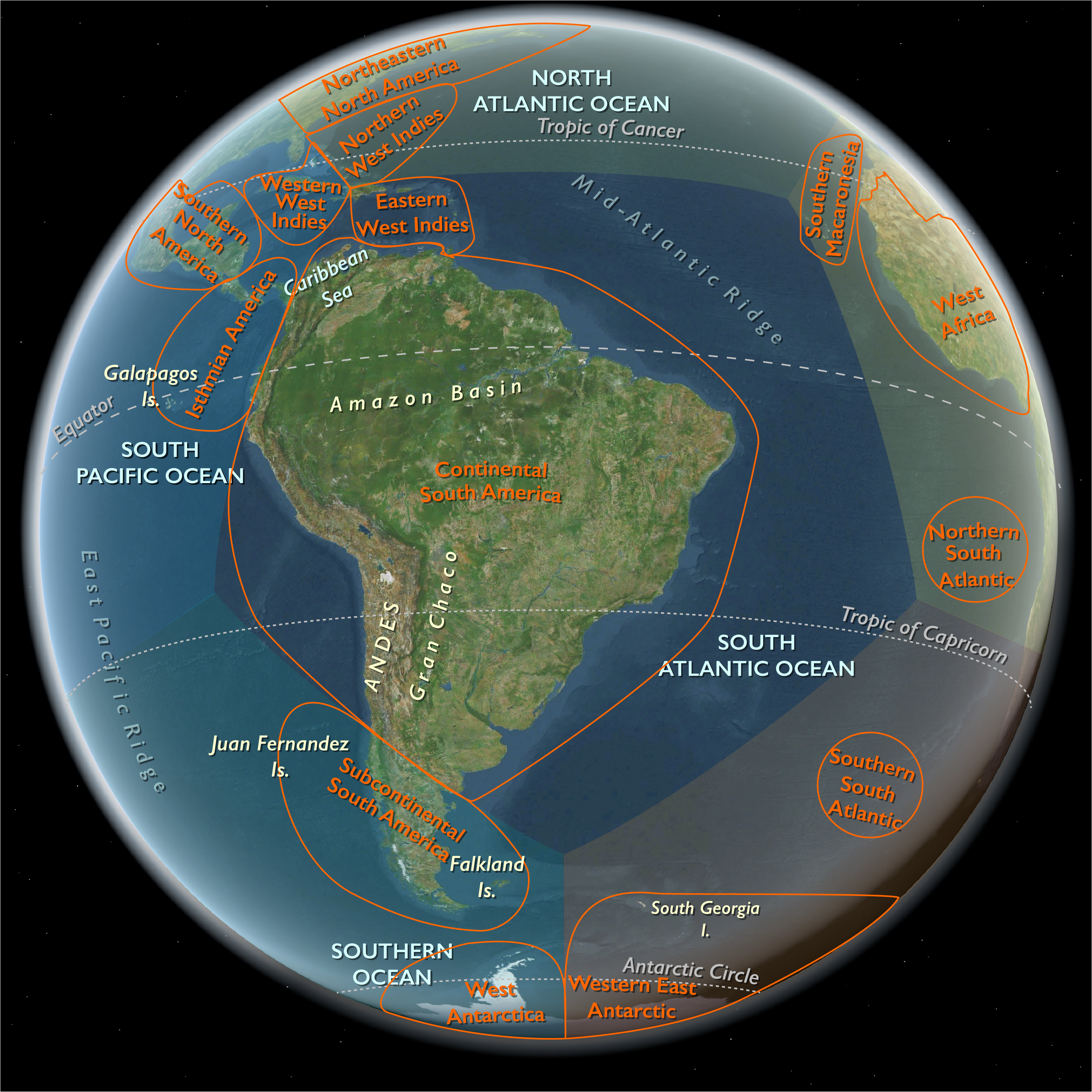
He travels through Guyana, Venezuela, Trinidad, Tobago, Curaçao, Aruba and Colombia.
He is famous for having named Venezuela, which he explores during his first two expeditions, for having been the first European to visit Guyana, Colombia, and Lake Maracaibo, and later for founding Santa Cruz (La Guairita).
Related Events
Filter results
Showing 10 events out of 28 total
Aboriginal people inhabited the territory of what is now Colombia by 10,500 BCE.
Nomadic hunter-gatherer tribes existed near present-day Bogotá (at El Abra and Tequendama sites) which traded with one another and with cultures living in the Magdalena River Valley.
Between 5000 and 1000 BCE, hunter-gatherer tribes transitioned to agrarian societies; fixed settlements were established, and pottery appeared.
Beginning in the first millennium BCE, groups of natives including the Muisca, Quimbaya, and Tairona develop the political system of cacicazgos with a pyramidal structure of power headed by caciques.
The Muiscas inhabit mainly the area of what is now the Departments of Boyacá and Cundinamarca high plateau (Altiplano Cundiboyacense).
They farm maize, potato, quinoa and cotton, and trade gold, emeralds, blankets, ceramic handicrafts, coca and salt with neighboring nations.
The Taironas inhabit northern Colombia in the isolated Andes mountain range of Sierra Nevada de Santa Marta.
The Quimbayas inhabit regions of the Cauca River Valley between the Occidental and Central cordilleras.
The Incas expand their empire on the southwest part of the country.
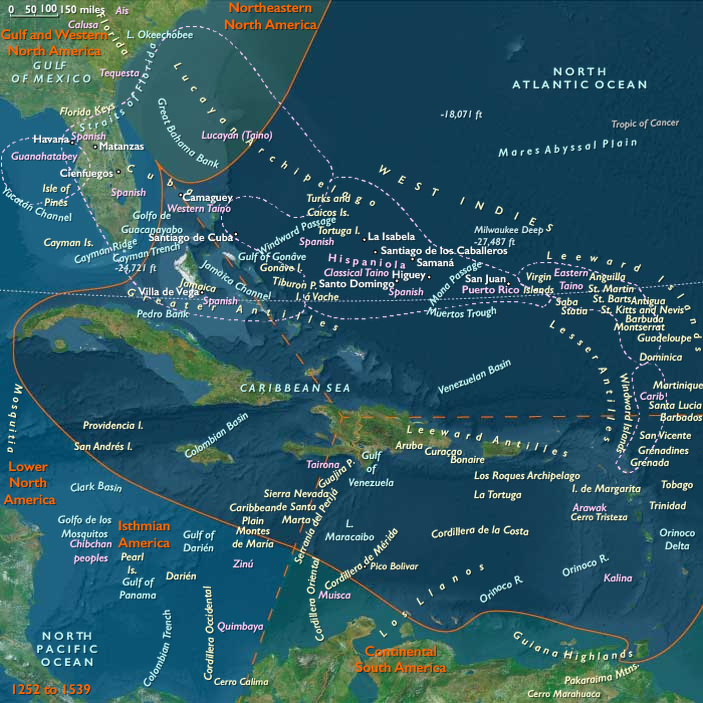
Alonso de Ojeda (who had sailed with Columbus) had reached the Guajira Peninsula in 1499.
Spanish explorers, led by Rodrigo de Bastidas, had made the first exploration of the Caribbean littoral in 1500.
Christopher Columbus navigates near the Caribbean in 1502.
Amerigo Vespucci, trained for a business career, is the third son of Ser Nastagio (Anastasio), a Florentine notary, and Lisabetta Mini.
Amerigo had been educated by his uncle, Fra Giorgio Antonio Vespucci, a Dominican friar of the monastery of San Marco in Florence.
While his elder brothers had been sent to the University of Pisa to pursue scholarly careers, Amerigo Vespucci had embraced a mercantile life, and had been hired as a clerk by the Florentine commercial house of Medici, headed by Lorenzo de' Medici.
Vespucci had acquired the favor and protection of Lorenzo di Pierfrancesco de' Medici, who had become the head of the business after the elder Lorenzo's death in 1492.
In March of that year, the Medici dispatched the thirty-eight-year-old Vespucci and Donato Niccolini as confidential agents to look into the Medici branch office in Cádiz, whose managers and dealings were under suspicion.
In April 1495, by the intrigues of Bishop Juan Rodríguez de Fonseca, the Crown of Castile had broken their monopoly deal with Christopher Columbus and had begun handing out licenses to other navigators for the West Indies.
Just around this time, Vespucci, engaged as the executor of Giannotto Berardi, an Italian merchant who had recently died in Seville, had organized the fulfillment of Berardi's outstanding contract with the Castilian crown to provide twelve vessels for the Indies.
After these were delivered, Vespucci had continued as a provision contractor for Indies expeditions, and is known to have secured beef supplies for at least one (if not two) of Columbus' voyages.
A letter published in 1504 purports to be an account by Vespucci, written to Florentine statesman Piero Soderini, of a lengthy visit to the New World, leaving Spain in May 1497 and returning in October 1498.
However, modern scholars have doubted that this voyage took place, and consider this letter a forgery.
Whoever did write the letter makes several observations of native customs, including use of hammocks and sweat lodges.
The names of Amerigo Vespucci's ships were the San Antiago, Repertaga, Wegiz, and Girmand.
About 1499–1500, Vespucci joins an expedition in the service of Spain, with Alonso de Ojeda (or Hojeda) as the fleet commander.
The intention is to sail around the southern end of the African mainland into the Indian Ocean.
The first Europeans to visit what is now Colombia are the crew of Alonso de Ojeda, who in 1499 leads an expedition to the north coast of South America.
It reaches Cabo de la Vela, on the Peninsula de La Guajira, but does not tarry, because these visitors are interested in trading for gold and pearls, not in colonization.
Amerigo Vespucci, as a member of Ojeda's expedition, is among the first to explore the Colombian coasts.
Other early expeditions also come to trade, or to seize indigenous people as slaves for sale in the West Indies.
Ojeda, on returning to Spain, had been commissioned by the Catholic Monarchs, without the permission of Columbus, to sail for America again, which he does on May 18, 1499, with three caravels.
He travels with the pilot and cartographer Juan de la Cosa and the Italian navigator Amerigo Vespucci.
This is the first of a series of what have become known as the "minor journeys" or "Andalusian journeys" that are made to the New World.
Pedro Alonso Niño: Spanish Explorer and Navigator of the Early Americas (1499–1505)
Pedro Alonso Niño, a Spanish navigator of African descent, played a significant role in early European exploration, serving as a pilot on Columbus's expeditions before launching his own independent voyage in search of wealth and trade opportunities.
Early Life and Exploration with Columbus
- Born in Palos de Moguer, Spain, to a Spanish father and an enslaved African mother, Niño grew up in a seafaring environment.
- He explored the West African coast in his early years, acquiring navigational experience.
- In 1492, he piloted one of Columbus's ships on the first voyage to the New World.
- He later accompanied Columbus's third voyage (1498–1500), during which he witnessed the discovery of Trinidad and the Orinoco River delta.
Independent Expedition to the Indies (1499–1500)
- After returning to Spain, Niño sought to explore the Indies independently, focusing on gold and pearls rather than new lands.
- The Council of Castile granted him permission, with the condition that he must avoid Columbus’s discoveries and pay 20% of his profits to the Crown.
- He partnered with Luis and Cristóbal de la Guerra, a wealthy merchant and a skilled pilot, to finance and lead the expedition.
- In May 1499, they departed from Sanlúcar, reaching Maracapana (Venezuela) in 23 days.
Trade and Discoveries in the Caribbean
- Traded with indigenous peoples, exchanging trinkets for pearls at the islands of Margarita, Coche, and Cubagua, securing a large fortune.
- Sailed along the Venezuelan coast, where they discovered the salt mines at Punta Araya, which later became a major Spanish resource.
Return to Spain and Arrest (1500–1505)
- After just two months, Niño and his crew returned to Baiona, Spain, with immense wealth.
- However, he was accused of cheating Queen Isabella out of her rightful share of the expedition’s profits.
- He was arrested, his property confiscated, and placed on trial.
- Before the trial concluded, Pedro Alonso Niño died in 1505.
Legacy
- One of the first Afro-Spanish explorers, Niño helped expand European knowledge of the Caribbean and South America.
- His voyage demonstrated the economic potential of pearl trading, leading to further Spanish exploitation of the region.
- Despite his early success, his downfall reflected Spain’s strict enforcement of royal taxation and control over exploration profits.
Pedro Alonso Niño’s life and career embody both the opportunities and dangers of early European exploration, making him a significant but often overlooked figure in the Age of Discovery.
A second Spanish expedition, just one year later, is led by Alfonso de Ojeda and the Florentine Amerigo Vespucci.
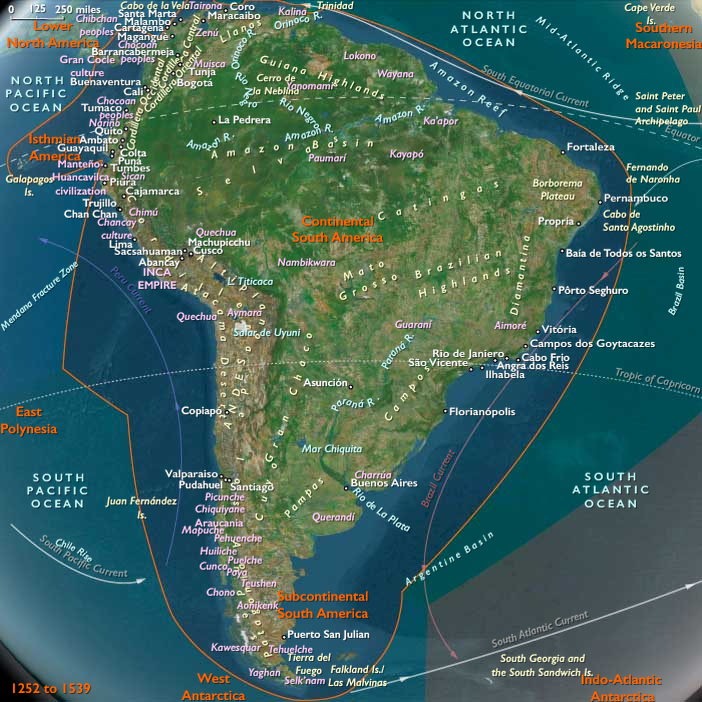
They sail westward along the coast of Tierra Firme (as South America is known at this time) as far as Lago de Maracaibo.
Here, native huts built on piles above the lake remind Vespucci of Venice, thus leading him to name the discovery Venezuela, or Little Venice.
Alonso de Ojeda’s flotilla, on leaving Spain, had sailed along the west coast of Africa to Cape Verde before taking the same route that Columbus had used a year before on his third voyage.
After making landfall, Vespucci decides to separate from the flotilla and he sails south towards Brazil.
The main flotilla arrives at the mouths of the rivers Essequibo and Orinoco in the Gulf of Paria.
It also visits the peninsulas of Paria and Araya, the islands of Trinidad and Margarita and travels along the continental coast, always in search of a passage towards India.
The flotilla then sails along the Paraguaná Peninsula and sights the island of Curacao.
Ojeda, arriving in Curaçao in 1499, lands also on a neighboring island that is almost certainly Bonaire, whose earliest known inhabitants are the Caquetio.
Archaeological remains of Caquetio culture have been found at certain sites northeast of Kralendijk and near Lac Bay.
Caquetio rock paintings and petroglyphs have been preserved in caves at Spelonk, Onima, Ceru Pungi, and Ceru Crita-Cabai.
The Caquetios are apparently a very tall people, for the Spanish name for today’s ABC Islands is 'las Islas de los Gigantes' or 'the islands of the giants.'
During the same journey, Ojeda constructs a ship and visits the Las Aves archipelago and …
… the island of Aruba, whose first inhabitants are thought to have been Caquetíos Amerinds from the Arawak tribe, who had migrated there from Venezuela to escape attacks by the Caribs.
Fragments of the earliest known Indian settlements date back to 1000 CE.
The Caiquetios had probably migrated to Aruba, Curaçao and Bonaire in canoes made from hollowed out logs they used for fishing.
Such crossings from the Paraguana peninsula in Venezuela, across the seventeen miles of open sea to Aruba, would be possible in the canoes the Caiquetios of Venezuela built.
As sea currents make canoe travel to other Caribbean islands difficult, Caquetio culture remains more closely associated with that of mainland South America.
Europeans first learn of Aruba following the explorations for Spain by Amerigo Vespucci and Alonso de Ojeda in the summer of 1499.
Both describe Aruba as an "island of giants", remarking on the comparatively large stature of the native Caquetíos compared to Europeans.
Perhaps as many as six hundred live in Aruba at the time of the Spanish discovery.