Ali ibn Isa ibn Mahan
prominent Abbasid military leader
Years: 765 - 811
Ali ibn Isa ibn Mahan (died 3 July 811) is a prominent Abbasid military leader of the late 8th and early 9th centuries.

Related Events
Filter results
Showing 10 events out of 14 total
Isa ibn Mahan, who had been an early follower of the Abbasids, had mutinied after the Abbasid Revolution and was executed by Abu Muslim.
Isa’s son Ali had first appeared first in the reign of al-Mahdi (775–785) as commander of the caliphal guard (haras) and secretary of the army department (diwan al-jund), and had continued in these offices under al-Hadi (r. 785–786), having in addition the powerful post of chamberlain (hajib).
Under Harun al-Rashid, he had continued to serve as commander of the guard until 796, when he was named governor of Khurasan.
As a leader of the abna′ al-dawla, the troops that form the core of the Abbasid army in Iraq, he has antagonized the Khurasanis and oppressed them through heavy taxation, with the revenue diverted for the upkeep of the abna′ and for filling his own coffers; during his tenure, Ali has amassed a vast fortune.
Harun al-Rashid personally investigates complaints against Ali, whose ruthless exploitation of the province and oppressive fiscal measures has caused much resentment among the local elites.
Hearing of no wrongdoing and being showered with gifts, the caliph confirms Mahan in his office and departs for Baghdad.
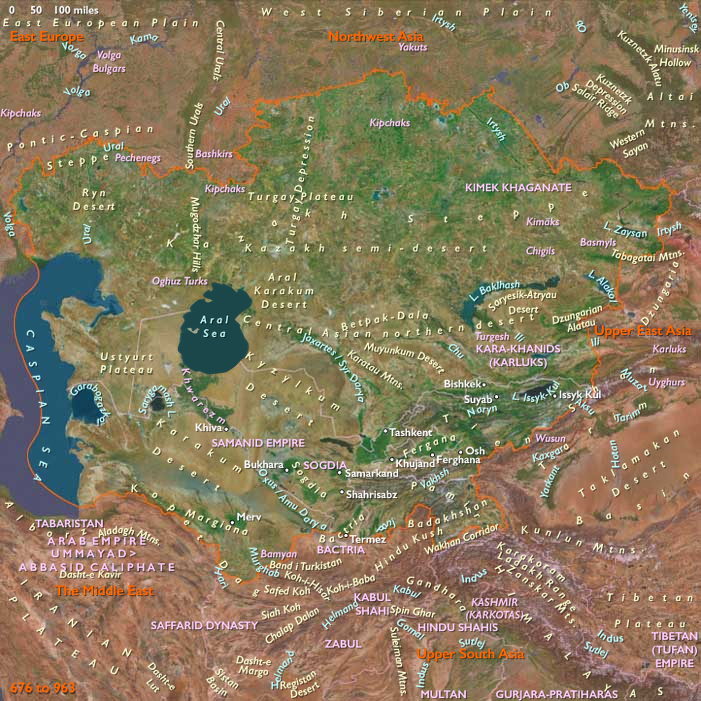
The governor of Samarkand, Rafi ibn al-Layth, the grandson of the last Umayyad governor of Khurasan, Nasr ibn Sayyar,immediately organizes a revolt against the governor, defeating Mahan’s troops in Transoxania in 806.
Ali flees the province and the caliph, requesting an end to the revolt, pledges a new government sympathetic to the rebels’ demands, but fighting continues.
The revolt spreads quickly across Khurasan, finding support both among the Arabs and the Iranian natives.
Rafi also secures the support of the Oghuz and Karluk Turks.
Harthama ibn A'yan had first appeared during the reign of the second Abbasid Caliph, al-Mansur (reigned 754–775), as one of the supporters of the Abbasid prince and heir-apparent Isa ibn Musa.
Isa had been forced to renounce his claim on the throne in favor of al-Mansur's son, al-Mahdi (r. 775–785), who had Harthama brought to Baghdad in chains and kept him under arrest throughout his reign.
Under al-Mahdi's son and successor al-Hadi (r. 785–786), however, he was released and rose to prominence as one of the Caliph's closest advisors.
At one point he is said to have recommended that the Caliph should execute his younger brother and heir-apparent, the future caliph Harun al-Rashid (r. 786–809) to open the path for the succession of al-Hadi's own sons, but this plan had been foiled through the intervention of the Caliph's mother, al-Khayzuran.
Nevertheless, when al-Hadi died it was Harthama himself who had released Harun from prison.
He has continued to enjoy a privileged position and high office under Harun as well, serving as governor of Palestine, Egypt, Mosul and then Ifriqiya, before assuming command of the caliphal guard (haras) under the supervision of Harun's trusted vizier, Ja'far ibn Yahya the Barmakid.
From this post he had played a role in the downfall of the Barmakids in 803, and had established himself as one of the Caliphate's senior military leaders.
He also led two summer raids into Asia Minor against the Empire.
When the large-scale rebellion of Rafi ibn al-Layth broke out in Khurasan in 805–806 and the local governor, Ali ibn Isa ibn Mahan, proved himself incapable of suppressing it, al-Rashid had sent Harthama to replace him, following himself shortly after, in 808.
Al-Fadl ibn al-Rabi', born in 757–8 CE, is the son of al-Rabi' ibn Yunus, a former slave who had risen to occupy the influential post of chamberlain (hadjib) under caliphs al-Mansur (r. 754–775) and al-Mahdi (r. 775–785).
Rabi's power relied on his control of the access of outsiders to the Caliph, as well as his de facto leadership of the Caliph's numerous and influential mawla (servants, freedmen).
Fadl had effectively inherited his father's position at court, and benefited from the high esteem in which Harun al-Rashid held him: upon his accession, the Caliph placed Fadl in charge of his personal seal, and in 789–90 he was made head of the diwan al-Nafaqat (the "Bureau of Expenditure").
In 795–6, he was named to his father's old post of hadjib, reportedly after succeeding in finding the poet Ibn Jami, who had been exiled under al-Hadi (r. 785–786).
Fadl, utterly loyal to his master, serves as Harun's trusted agent.
Despite his apparently good personal relations to the Barmakid patriarch Yahya ibn Khalid, stories portray Fadl as the Barmakids' chief rival at court.
Following the fall of the Barmakid family from power, Fadl had succeeded Yahya as wazir, in effect becoming the Caliph's chief minister and advisor.
However, Fadl lacks the almost plenipotentiary powers that Harun had granted Yahya, and his remit is limited to a supervisory role over expenditure and in the handling of petitions to the Caliph, while the actual financial administration is entrusted to another official.
As vizier, al-Fadl ibn ar-Rabi' lacks the efficiency of the Barmakids, and the personal decisions of Harun may carry more weight.
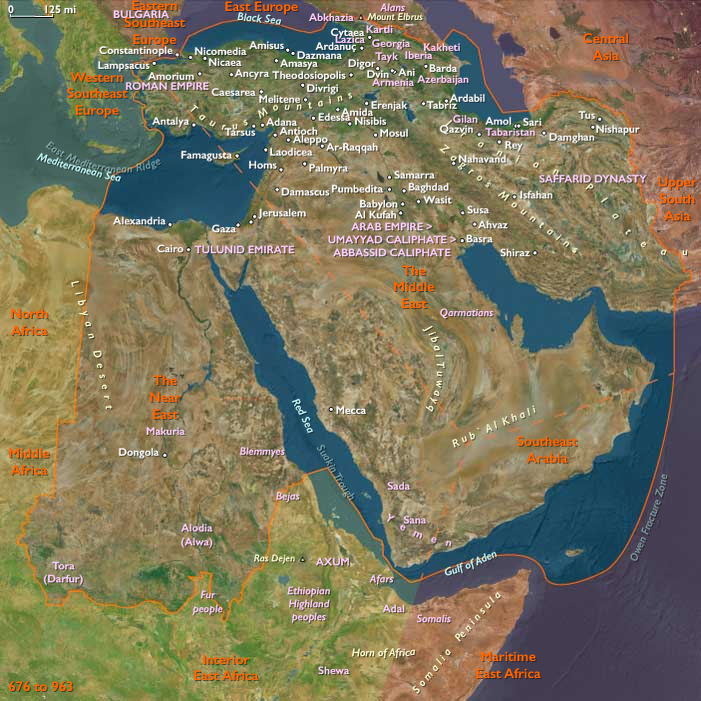
The Caliphate has conducted further successful operations against the East Roman Empire, but Harun falls ill at Tus (near modern Meshed) in the autumn of 808, while on his way to Khorasan to deal personally with the serious two-year-old revolt of Rafi ibn al-Layth.
Harun had arranged the division of the Abbasid empire between his sons, a step that accelerates the caliphate’s administrative decline and political disintegration.
In the last days of Harun's life his health is declining and sees in a dream Musa ibn Jafar sitting in a chamber praying and crying, which makes Harun remember how hard he had struggled to establish his own caliphate.
He knows the personalities of both his sons and decides that for the good of the Abbasid dynasty, al-Maʾmūn should be caliph after his death; this he confides to a group of his courtiers before his death on March 24, 809.
One of the courtiers, Fadl ibn Rabi', does not abide by Harun's last wishes and persuades many in the realm that Harun's wishes had not changed.
Later, the other three courtiers of Harun, who had sworn loyalty to Harun by supporting al-Maʾmūn, namely 'Isa Jarudi, Abu Yunus, and Ibn Abi 'Umran find loopholes in Fadl's arguments, and Fadl admits Harun had appointed al-Maʾmūn after him, but, he argues, since Harun was not in his right mind, his decision should not be acted upon.
Al-Maʾmūn is reportedly the older of the two brothers, but his mother is a Persian woman while al-Amin's mother is a member of the reigning Abbasid family.
Fadl ibn al-Rabi causes the army to pledge its allegiance (bay'ah) to Harun's heir al-Amin, who has remained behind in Baghdad.
Amin, who had need of Fadl's experience, sends letters to him urging him to return to the capital, and to bring with him the treasury, which Harun had taken along, as well as the entire expeditionary army assembled to crush the rebellion.
Al-Ma'mun, who is tasked with the governance of Khurasan, regards the withdrawal of the entire army as a betrayal, and vainly tries to dissuade Fadl from this move.
Al-Ma'mun had been vested with the administration of the eastern Khorasan region following his father’s death.
Although Amin acknowledges his brother's almost absolute sovereignty over the eastern provinces of the empire, with his seat at Merv in Khorasan, relations between the brothers soon break down.
Al-Ma'mun, open to new movements of thought and outside influences, courts the support of Iranian figures and of the eastern provinces.
Al-Amin, in contrast to his brother, emphasizes traditionalism and Arab culture.
Back in Baghdad, Fadl remains Amin's leading advisor, but his role in the governance of the state seems to have been limited.
Nevertheless, he is the leading figure among those in the Abbasid establishment who pressure Amin into reversing his father's succession plans and depriving Ma'mun of his Khurasani governorate as well as his place in the succession in favor of Amin's son Musa.
This policy increases the already existing polarization of the Abbasid elites between the two princes, with the Khurasani nobility, headed by Ma'mun's wazir al-Fadl ibn Sahl, flocking to Ma'mun, whom they see as the champion of their interests against the central government in Baghdad.
The breach between the two sides is complete in November 810, when Amin drops Ma'mun's name from the Friday prayer.
This leads to a chain of mutual acts that result in the outbreak of open civil war (the "Fourth Fitna") between the two brothers.
Al-Ma'mun, effectively stripped by al-Amin of his rights to the succession, is supported by al-Fadl ibn Sahl, whom he is to make his vizier, as well as by an Iranian general, Tahir ibn al-Husayn, descended from the mawali of the great Arab leader to whom his forbears had become clients in eastern Khorasan.
Open hostilities begin in January 811.
Caliph al-Amin appoints Ali ibn Isa ibn Mahan as governor of Khurasan, and sends him with an army against his brother al-Ma'mun, thereby beginning the Abbasid Civil War or Fourth Fitna.
General Tahir's victory over al-Amin's army on the outskirts of the present Tehran allows al-Ma'mun's troops to occupy western Iran.
Tahir’s Khorasanian rebel forces had arrives in Mesopotamia, besieged Baghdad, conquered most of the caliphate’s Mesopotamian provinces, and finally take the Abbasid capital in late 811.