Alexios II Komnenos
Emperor of the Eastern Roman (Byzantine) Empire
Years: 1169 - 1183
Alexios II Komnenos or Alexius II Comnenus (10 September 1169 – 24 September 1183, Constantinople), Byzantine emperor (1180–1183), is the son of Emperor Manuel I Komnenos and Maria, daughter of Raymond, prince of Antioch.
He is the long-awaited male heir, and is named Alexios as a fulfillment of the AIMA prophecy.
Related Events
Filter results
Showing 8 events out of 8 total
Béla is the second son of King Géza II of Hungary by his wife Euphrosyne of Kiev.
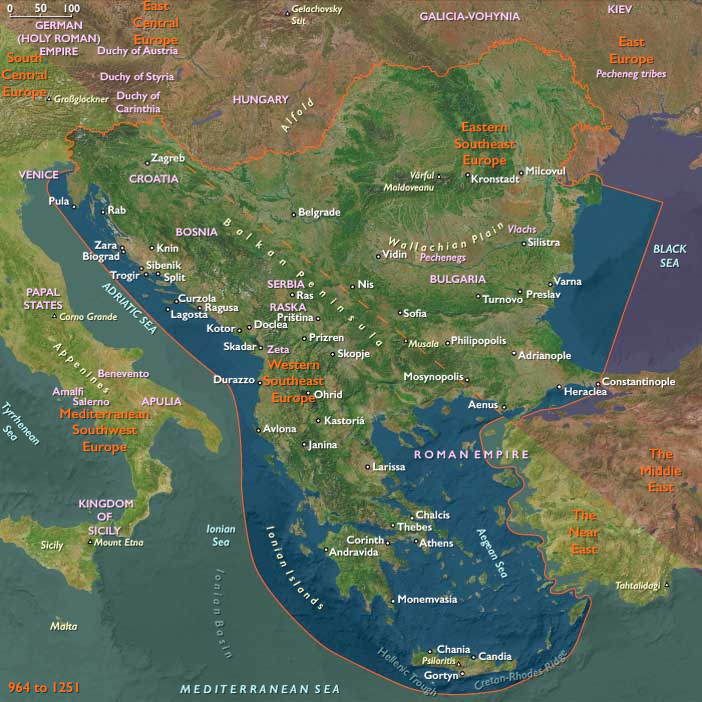
In 1161, his father had granted him the Duchies of Croatia and Dalmatia as appanage, which was later confirmed by his brother, King Stephen III, who had ascended the throne after their father's death on 31 May 1162.
In 1164, Emperor Manuel I Komnenos had concluded a treaty with King Stephen, and according to the treaty, Béla had been sent to Constantinople to be educated at the imperial court.
The emperor, who had no legitimate sons, had intended that Béla should marry his daughter, Maria Komnene, and eventually succeed him as Emperor.
Béla has received a Greek name, Alexios, and the newly created courtly title of despotes, which enjoys the highest position of honor below the emperor.
Béla had followed the Emperor in 1164 and 1165 on his campaigns against Hungary, which had aimed at the occupation of Béla's "paternal inheritance", i.e., Croatia, Dalmatia and Syrmia.
However, when King Stephen III transferred the three provinces to Manuel I, they had been incorporated into the Empire.
In the autumn of 1165, Mánuel had officially assigned his daughter and Béla as his heirs.
In the beginning of 1166, Manuel I and Béla had co-chaired the synod of the Orthodox Church in Constantinople.
When Alexios II was born as a son of Manuel and his second wife Maria of Antioch in 1169, Béla's engagement to Maria had been canceled.
Béla had been deprived also of his title, and he was granted the lower title of kaisar, but Manuel had helped negotiate another marriage for him, this time to Agnes of Antioch, who is the half-sister of Maria of Antioch; therefore by this marriage Manuel I and Béla have become brothers-in-law.
After their marriage, Béla (Kaisar Alexios) and his wife go on a pilgrimage to Jerusalem, where he makes a donation for the Knights Hospitaller.
Emperor Manuel I Komnenos has sought throughout his reign in Constantinople to revive the Roman Empire, negotiating unsuccessfully or reunification of the Orthodox and Catholic churches.
Manuel's policies have antagonized many of his own people as well.
His favoritism to the Latins is unpopular, as is his lavish granting of estates in pronoia (by favor of the emperor).
Shortly after his death on September 24, 1180, a reaction sets in, originated by his cousin Andronikos Komnenos, who opposes the unpopular regency of the dowager empress Maria, daughter of Raymond, Prince of Antioch, and mother of eleven-year-old Alexios II Komnenos.
She, in turn, entrusts the government to her favorite, the unpopular and incapable Alexios the prōtosebastos, Manuel's nephew, who is popularly believed to be her lover.
The empire looks impressive at the death of Manuel, having just celebrated the betrothal of his son Alexios II to the daughter of the king of France.
Thanks to the diplomacy and campaigning of Alexios, John, and Manuel, the empire is a great power, economically prosperous, and secure on its frontiers; but there are serious problems as well.
Internally, the imperial court requires a strong leader to hold it together, and after Manuel's death stability is seriously endangered from within.
Some of the foreign enemies of the Empire are lurking on the flanks, waiting for a chance to attack, in particular the Turks in Anatolia, whom Manuel had ultimately failed to defeat, and the Normans in Sicily, who have already tried but failed to invade the Empire on several occasions.
Even the Venetians, the single most important western ally of Constantinople, are on bad terms with the empire at Manuel's death.
Given this situation, it will take a strong emperor to secure the Empire against the foreign threats it now faces, and to rebuild the depleted imperial treasury.
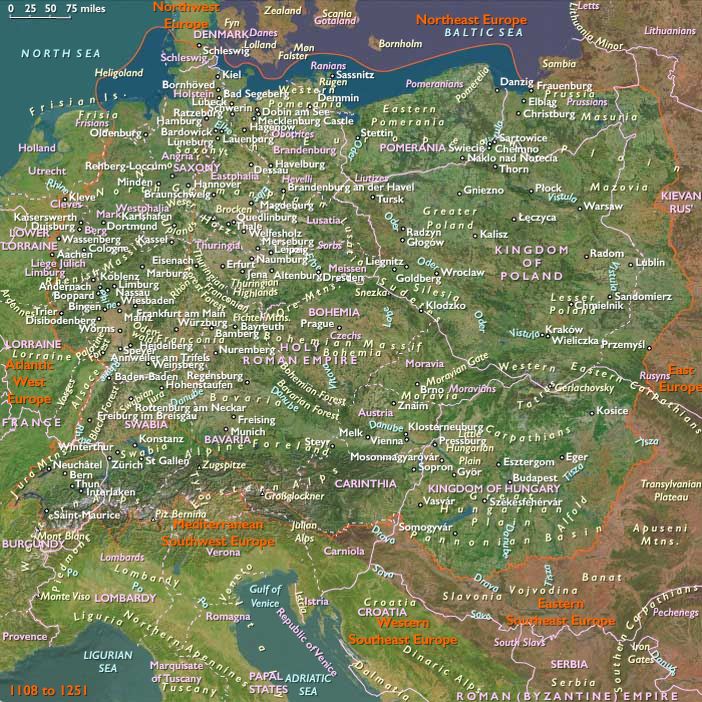
King Béla III of Hungary, involved since 1181 in a war with Venice, breaks his treaty with Constantinople and, claiming to be the avenger of the Dowager Empress (a Westerner), invades the empire and sacks several cities.
The Latin princess Maria of Antioch, has acted as regent to her infant son Alexios II Komnenos since the death of Manuel I in 1180.
Her regency is notorious for the favoritism shown to Latin merchants and the big aristocratic landowners.
Since the late eleventh century, Western merchants, primarily from the Italian city-states of Venice, Genoa and Pisa, had started appearing in the East.
The first had been the Venetians, who had secured large-scale trading concessions from Emperor Alexios I Komnenos.
Subsequent extensions of these privileges and Constantinople’s own naval impotence at the time resulted in a virtual maritime monopoly and stranglehold over the Empire by the Venetians.
Alexios' grandson, Manuel I Komnenos, wishing to reduce their influence, had begun to reduce the privileges of Venice while concluding agreements with her rivals: Pisa, Genoa and Amalfi.
Gradually, all four Italian cities had also been allowed to establish their own quarters in the northern part of Constantinople itself, towards the Golden Horn.
The predominance of the Italian merchants has caused economic and social upheaval in Constantinople: it has accelerated the decline of the independent native merchants in favor of big exporters, who have become tied with the landed aristocracy, who in turn have increasingly amassed large estates.
Together with the perceived arrogance of the Italians, it fuels popular resentment among the middle and lower classes both in the countryside and in the cities.
The religious differences between the two sides, who view each other as schismatics, further exacerbates the problem.
The Italians have proved uncontrollable by imperial authority: in 1162, for instance, the Pisans, together with a few Venetians, had raided the Genoese quarter in Constantinople, causing much damage.
Emperor Manuel had subsequently expelled most of the Genoese and Pisans from the city, thus giving the Venetians a free hand for several years.
In early 1171, however, when the Venetians attacked and largely destroyed the Genoese quarter in Constantinople, the Emperor had retaliated by ordering the mass arrest of all Venetians throughout the Empire and the confiscation of their property.
A subsequent Venetian expedition in the Aegean had failed: a direct assault was impossible due to the strength of the imperial forces, and the Venetians had agreed to negotiations, which the Emperor had stalled intentionally.
As talks dragged on through the winter, the Venetian fleet waited at Chios, until an outbreak of the plague forced them to withdraw.
The Venetians and the Empire had remained at war, with the Venetians prudently avoiding direct confrontation but sponsoring Serb uprisings, besieging Ancona, Byzantium's last stronghold in Italy, and signing a treaty with the Norman Kingdom of Sicily.
Relations have only gradually been normalized: there is evidence of a treaty in 1179, although a full restoration of relations will only be reached in the mid-1180s.
Meanwhile, the Genoese and Pisans have profited from the dispute with Venice, and by 1180, it is estimated that up to 60,000 Latins live in Constantinople.
During the brief reign of Alexios II, the Empire is invaded by King Béla III, losing Syrmia and Bosnia to the Kingdom of Hungary in 1181; later, even Dalmatia will be lost to the Venetians.
Kilij defeats the imperial forces at the Siege of Cotyaeum in 1182, resulting in the loss of Cotyaeum and Sozopolis.
Friends of the young Alexios II now try to form a party against the empress mother and the prōtosebastos.
Empress Maria’s Latin origins and culture have led to creeping resentment from her Greek subjects (who felt insulted enough by the late Manuel's Western tastes, let alone being ruled by his Western wife), building up to an explosion of rioting that almost becomes a full civil war when Alexios II's half-sister Maria, wife of Caesar John (Renier of Montferrat), stirs up riots in the streets of the capital in early April 1182.
Andronikos Komnenos, having raised an army, is waiting at Chalcedon when anti-Latin riots break out.
Taking advantage of these disorders to aim at the crown, he enters Constantinople, where he is received with almost divine honors, and overthrows the government.
The defection of the commander of the imperial navy, megas doux Andronikos Kontostephanos, and the general Andronikos Angelos, play a key role in allowing the rebellious forces to enter Constantinople.
The unpopular regent is captured and blinded, and Andronikos enters Constantinople posing as the protector of the young emperor Alexios II.
Almost immediately, the celebrations spill over into violence towards the hated Latins, and after entering the city's Latin quarter, a mob begins attacking the inhabitants.
Many had anticipated the events and escape by sea.
The ensuing massacre is indiscriminate: neither women nor children are spared, and Latin patients lying in hospital beds are murdered.
Houses, churches, and charitable institutions are looted.
Latin clergymen receive special attention, and Cardinal John, the papal legate, is beheaded and his head is dragged through the streets at the tail of a dog.
Although Andronikos himself has no particular anti-Latin attitude, he allows the massacre to proceed unchecked.
The bulk of the Latin community, estimated at over sixty thousand at the time, is wiped out or forced to flee.
The Genoese and Pisan communities especially are decimated, and some four thousand survivors are sold as slaves to the Turks.
A few years later, Andronikos I himself will be deposed and handed over to the mob of Constantinople citizenry, and will be tortured and summarily executed in the Hippodrome by Latin soldiers.
The massacre further worsens the image of Constantinople in the West, and although regular trade agreements will soon be resumed between Constantinople and Latin states, the underlying hostility will remain, leading to a spiraling chain of hostilities: a Norman expedition under William II of Sicily in 1185 will sack Thessalonica, the Empire's second largest city, and the German emperors Frederick Barbarossa and Henry VI will both threaten to attack Constantinople.
The worsening relationship will culminate with the brutal sack of the city of Constantinople by the Fourth Crusade in 1204, which will lead to the permanent alienation of Eastern Orthodox and Roman Catholics.
After allowing Alexios II to be crowned, Andronikos promptly has most of the young emperor's actual or potential defenders executed, including his half-sister, the Caesar, and the dowager empress Maria, whose death warrant her son Alexios is made to sign.
He refuses to allow Alexios the smallest voice in public affairs.
This troubled succession weakens the dynastic continuity and solidarity on which the strength of the empire has come to rely.
All hope of effective cooperation between Constantinople and the Latins vanishes.
The betrothal in 1180 of Alexios II to Agnes of France, daughter of Louis VII of France and his third wife Adèle of Champagne and at the time a child of nine, had not apparently been followed by their marriage.
Andronikos is now formally proclaimed as co-emperor before the crowd on the terrace of the Church of Christ of the Chalkè, and not long afterwards, on the pretext that divided rule is injurious to the Empire, he causes Alexios II to be strangled with a bowstring in October 1183).
To legitimize his usurpation, the sixty-five-year-old regicide marries the latter’s thirteen-year-old fiancé.
Andronikos attempts to improve life in the provinces by reforming the decaying political system, prohibiting the sale of offices, punishing corrupt officials, and, above all, checking the power of the great feudal nobles and landowners whose privileges undermine the unity of the empire.
In repudiating the pro-Western policy pursued by Manuel and asserting the independence of the Eastern Church, he arouses the hostility of Western Christians.
Andronikos poses as the champion of Greek patriotism and of the oppressed peasantry, but to enforce his reforms he behaves like a tyrant.
By undermining the power of the aristocracy, he weakens the empire's defenses and undoes much of Manuel's work.
He also resumes trade and political relations with Venice in 1183, promising compensation for their losses.
By November 1183, Andronikos has associated his younger legitimate son John Komnenos on the throne.
A Venetian embassy visits Constantinople in 1184 and an agreement is reached that compensation of fifteen hundred gold pieces will be paid for the losses incurred in 1171.