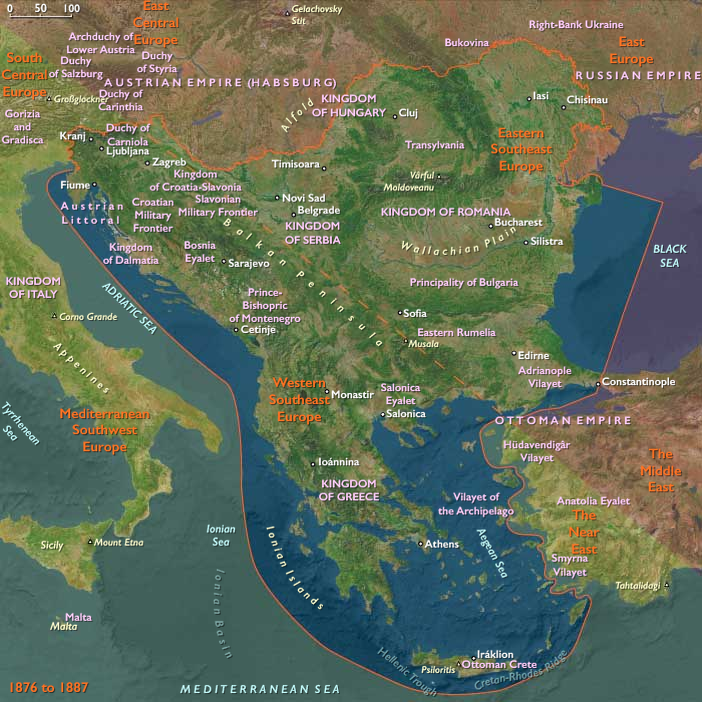
Greece has little industry and few roads, the basis of the social and economic structure being a collection of small agricultural towns acting as marketplaces for the surrounding villages.
Prime Minister Alexandros Koumoundouros, hoping that the development of a railway system would go some way towards redressing this lack of internal and external communication, had in 1881 signed four contracts for the laying of standard gauge (1.43 meter) lines, intending to make Greece a pivotal point on the journey between Europe and India.
Charilaos Trikoupis, prime minister for short periods in 1875, 1878, and 1880, has sought to develop resources and an industrial base for Greece and to create a strong army and navy, but his periods in office have been too short to implement his ideas.
After Trikoupis becomes prime minister for the fourth time in March 1882, he immediately strives to strengthen Greek finances.
Trikoupis, possessed of a different political vision for the railways, cancels the Koumoundouros contracts, replacing them with four of his own.
Viewing rail service as a way of stimulating the internal growth of Greece, he proposes a four hundred and seventeen kilometer-narrow gauge (one meter) system encircling the Northern Peloponnese, with a separate system in Thessaly linking the Port of Volos with the Town of Kalambaka on the other side of the Thessalian plain.
There is also a line of seventy-six to be laid from Athens to Lavrion, on the peninsula to the south of Athens.
Although Trikoupis prefers narrow gauge over standard gauge due to cheaper initial construction costs, the line linking Athens to Larissa, which is planned to eventually join with the European system, will be constructed to Standard Gauge. (The network will take twenty-five years to complete, twenty years longer than the five anticipated by Trikoupis.)