Alexander I, King of the Scots
King of the Scots
Years: 1078 - 1124
Alexander I (c. 1078 – 23 April 1124), (Medieval Gaelic: Alaxandair mac Maíl Coluim; Modern Gaelic: Alasdair mac Mhaol Chaluim) and nicknamed "The Fierce", is King of the Scots from 1107 to his death.
Related Events
Filter results
Showing 10 events out of 11 total
The events leading up to the next invasion are unclear, but in November 1093, Malcolm leads an army into Northumbria and begins to besiege Alnwick.
Malcolm is accompanied by Edward, his eldest son by Margaret and probable heir-designate (or tánaiste), and by Edgar.
Even by the standards of the time, the ravaging of Northumbria by the Scots is seen as harsh.
At this time, Robert de Mowbray is Earl of Northumbria, having been pardoned following his part in the Rebellion of 1088, against William II.
He is also governor of Bamburgh Castle, a stronghold on the Northumbrian coast.
Mowbray does not have a sufficient force at his command to oppose the Scottish army in open battle.
However, he sets out to try to relieve Alnwick.
He arrives here with his forces on November 13 (known as St. Brice’s Day) and catching the Scottish army by surprise, the English knights attack them before the ramparts of Alnwick.
While marching north again, Malcolm is ambushed near Alnwick on November 13, 1093, by Robert de Mowbray, whose lands he has devastated.
Here he is killed by Arkil Morel, steward of Bamburgh Castle.
The conflict becomes known as the Battle of Alnwick.
Edward is mortally wounded in the same fight.
With Malcolm’s death, the Scottish army finds itself leaderless, and heads back to Scotland.
Malcolm's body is taken to Tynemouth Priory for burial.
The king's body is sent north for reburial, in the reign of his son Alexander, at Dunfermline Abbey, or possibly Iona.
Malcolm’s death is soon followed by that of his queen, Margaret of Wessex, just days after receiving the news of her husband's death in battle.
The death of Malcolm and his heir means that there is a dispute over the succession between Malcolm’s surviving sons and his younger brother Donald Bane.
Donald's activities during the reign of his elder brother Malcolm III (Máel Coluim mac Donnchada) are not recorded.
It appears that he was not his brother's chosen heir, contrary to earlier custom, but that Malcolm had designated Edward, his eldest son by Margaret of Wessex, as the king to come If this was Malcolm's intent, his death and that of Edward have confounded his plans.
John of Fordun reports that Donald invaded the kingdom after Margaret's death "at the head of a numerous band", and laid siege to Edinburgh with Malcolm's sons by Margaret inside.
Fordun has Edgar Ætheling, concerned for his nephews' well-being, take the sons of Malcolm and Margaret—Edmund and his younger brothers Edgar, Alexander and David—to England.
Andrew of Wyntoun's much simpler account has Donald become king and banish his nephews.
The Anglo-Saxon Chronicle records only that Donald was chosen as king and expelled the English from the court.
The event allows Duncan, the eldest son of Malcolm and his first wife Ingibiorg Finnsdottir, given over as a hostage by his father in 1072, to lay claim to the throne.
In his attempt to depose his uncle, he has the support of William II, in exchange of an oath of fealty to his patron.
Duncan’s father, who had many sons, appears to have made no effort to obtain Duncan's return.
He had been raised in the Anglo-Norman court of William I, becoming familiar with the culture, education, and institutions of his hosts.
Trained as a Norman knight, he had participating in the campaigns of William I.
According to Florence of Worcester, in 1087, when William I died, and his eldest surviving son Robert Curthose succeeded him as Duke of Normandy, Robert released Duncan from custody and had him officially knighted.
Allowed to leave the Duchy of Normandy, Duncan chose to join the court of Robert’s younger brother William Rufus.
Edward, the eldest paternal, half-brother of Duncan had been designated heir in his absence.
Duncan had notably chosen to stay with his adoptive culture, partly due to the influence of fifteen years of Norman life, partly in pursuit of personal wealth and glory.
Donald III has been unable to gain the support of certain landowners and church officials of the Scottish Lowlands, who had ties to the regime of his predecessor.
Duncan takes advantage, negotiating alliances with these disgruntled supporters of his fathers.
Gaining essential military and financial support for his cause.
While William II himself has no intention to join in the campaign, he lends Duncan part of the Norman army.
Duncan is able to recruit further levies from local barons and towns of England, and buys support with promises of land and privilege, estates and title.
Duncan invades in May 1094 at the head of an army of Anglo-Normans and Northumbrians, aided by his half-brother Edmund and his father-in-law Gospatric, Earl of Northumbria.
This invasion succeeds in placing Duncan on the throne as Duncan II, but an uprising defeats his allies and he is compelled to send away his foreign troops.
Duncan is then killed on November 12, 1094 by Máel Petair, Mormaer of Mearns, a supporter of Donald III.
The Annals of Ulster say that Duncan was killed on the orders of Donald (incorrectly called his brother) and Edmund.
Donald resumes power, probably with Edmund as his designated heir.
Donald is an elderly man by the standards of the day, approaching sixty years old, and without any known sons, so that an heir is clearly required.
William of Malmesbury says that Edmund bargained "for half the kingdom", suggesting that Donald granted his nephew an appanage to rule.
Edgar claims the kingship in early 1095.
His older brother Edmund sides with Donald, presumably in return for an appanage and acknowledgment as the heir of the aging and son-less Donald.
Edgar receives limited support from William II as Duncan had before him; however, the English king is occupied with a revolt led by Robert de Mowbray, Earl of Northumbria, who appears to have had the support of Donald and Edmund.
Rufus campaigns in northern England for much of 1095, and during this time Edgar gains control only of Lothian.
A charter issued at Durham at this time names Edgar "... son of Máel Coluim King of Scots ... possessing the whole land of Lothian and the kingship of the Scots by the gift of my lord William, king of the English, and by paternal heritage."
Edgar's claims have the support of his brothers Alexander and David—Ethelred is Abbot of Dunkeld, and Edmund is divided from his siblings by his support of Donald—and his uncle Edgar Ætheling as these witness the charter at Durham.
Alexander, who had been named after Pope Alexander II, is the fifth son of Malcolm III by his wife Margaret of Wessex, grandniece of Edward the Confessor.
He was the younger brother of King Edgar, who is unmarried, and his brother's heir presumptive by 1104 (and perhaps earlier).
In that year he was the senior layman present at the examination of the remains of Saint Cuthbert at Durham prior to their re-interment.
He holds lands in Scotland north of the Forth and in Lothian.
He succeeds to the Scottish crown in 1107 on the death of Edgar, but in accordance with Edgar's instructions, their brother David is granted an appanage in southern Scotland.
Edgar's will grants David the lands of the former kingdom of Strathclyde or Cumbria, and this is apparently agreed in advance by Edgar, Alexander, David and their brother-in-law Henry I of England.
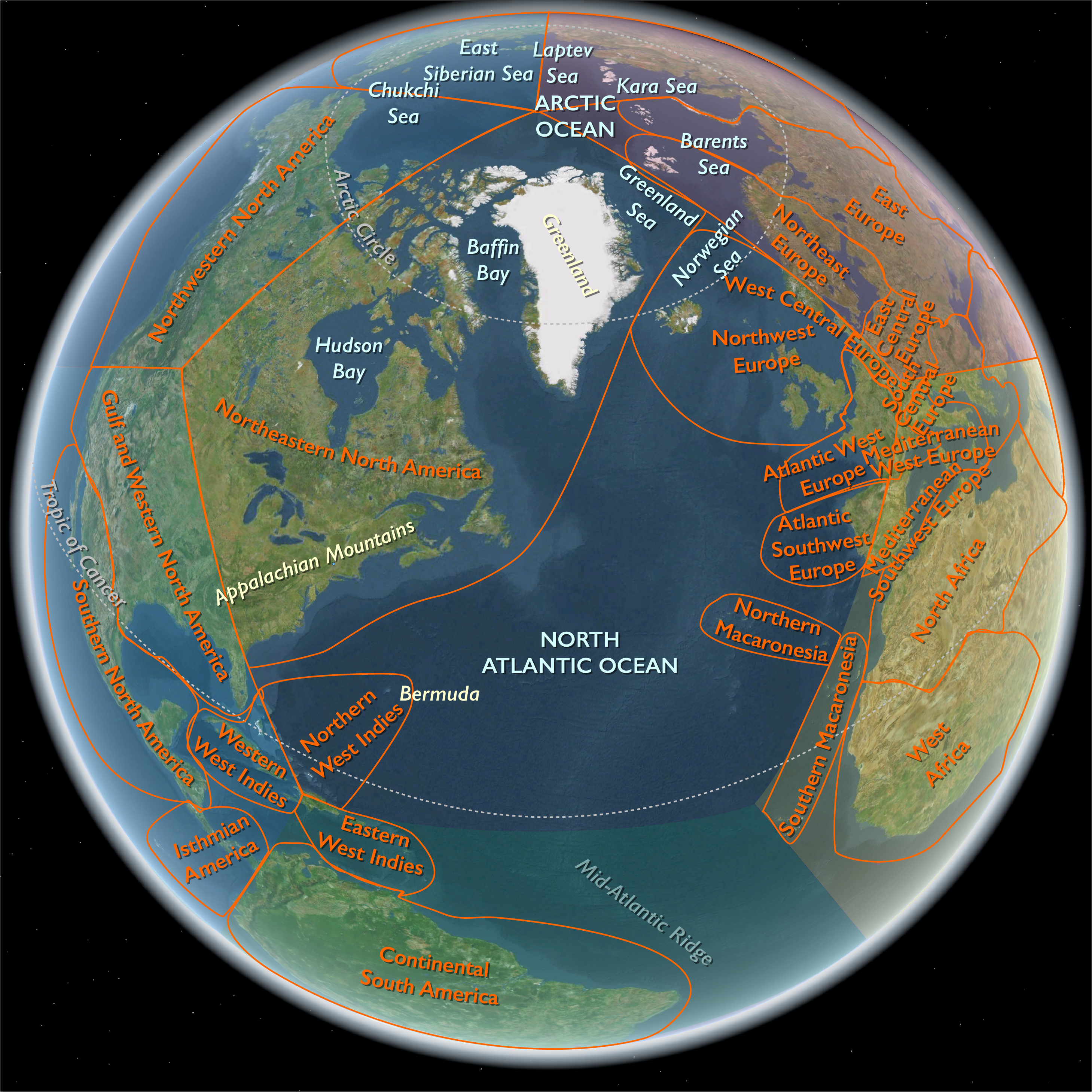
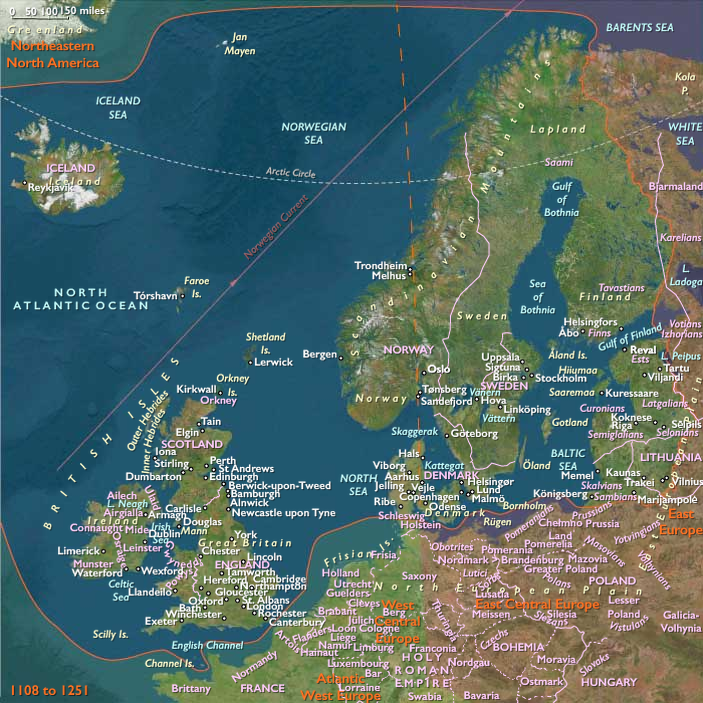
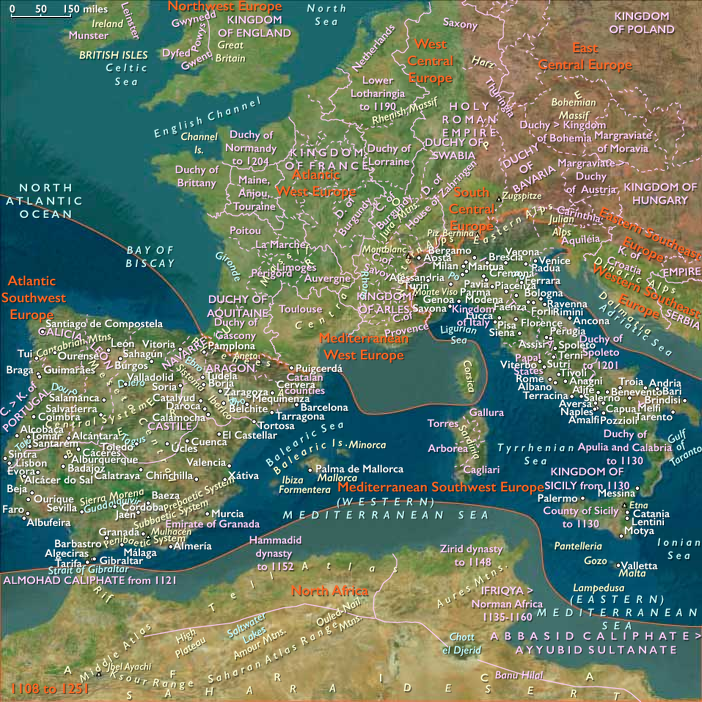
Northwest Europe (1108–1119 CE): Royal Administration and Crusading Influence
England: Consolidation under Henry I
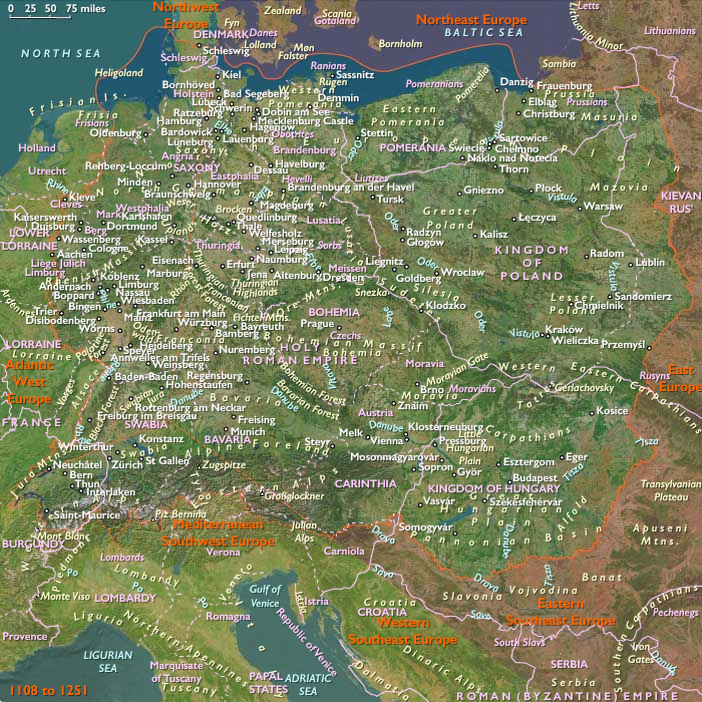
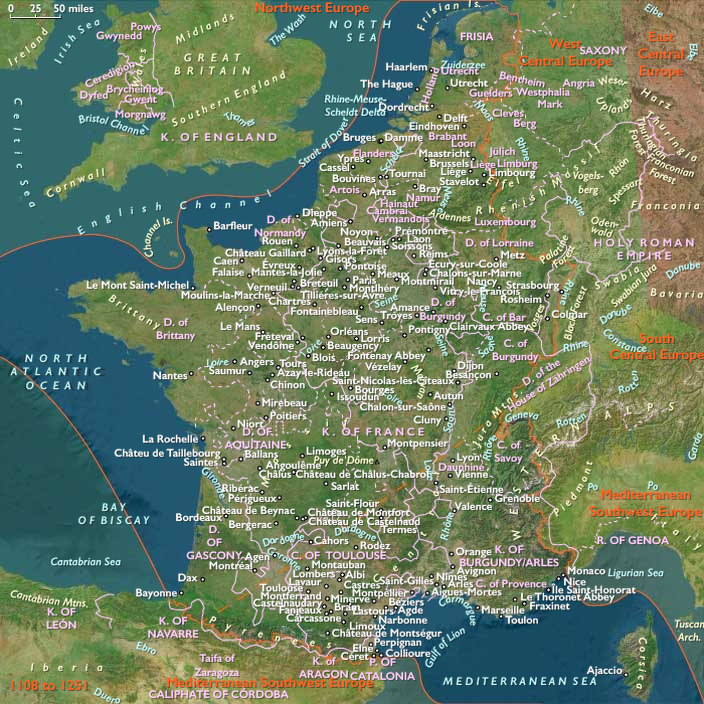
From 1108 to 1119, Henry I strengthened the administrative structure of England, enhancing the power of the monarchy through institutional reforms. His most significant achievement was the formalization of the Exchequer, a sophisticated system to oversee royal finances and taxation. Henry actively promoted legal reforms and improved governance, earning a reputation for justice and effectiveness. The decisive Battle of Tinchebray (1106) had firmly reestablished English control over Normandy, allowing Henry to focus on internal affairs and fortify royal authority.
Scotland: Stability under Alexander I
Alexander I of Scotland (r. 1107–1124) continued the policies of stability and Norman integration initiated by his predecessors. He maintained peaceful relations with England, especially given his familial connections through his sister Matilda's marriage to Henry I. Alexander fostered ecclesiastical reform, aligning the Scottish Church more closely with Continental practices, and encouraged monastic foundations, which contributed significantly to the kingdom’s cultural and economic advancement.
Ireland: Flourishing Trade amid Political Fragmentation
Ireland remained politically fragmented during this period, yet its Norse-Gaelic coastal cities—especially Dublin and Limerick—continued to flourish economically. These urban centers thrived through maritime commerce and trade networks across the Irish Sea and beyond. Although no significant political unification occurred, the prosperity of these towns ensured Ireland’s continued economic relevance within Northwest Europe.
Denmark and Norway: Peaceful Prosperity and Crusading Ventures
In Denmark, the reign of King Niels (r. 1104–1134) continued to be marked by internal stability, economic growth, and ecclesiastical patronage. Niels supported the construction and expansion of religious institutions, strengthening the monarchy’s cultural legitimacy and influence.
Norway’s international prominence increased under King Sigurd I Jorsalfar (r. 1103–1130), notably due to his participation in the Norwegian Crusade (1107–1110). Sigurd’s successful expedition to the Holy Land brought significant prestige and treasures back to Norway, enhancing his kingdom’s standing both domestically and abroad. This crusading effort reflected broader European religious fervor and illustrated Norway’s integration into European affairs.
Iceland and North Atlantic Settlements: Continued Cultural Strength
Iceland continued its cultural and economic stability, with the Althing sustaining its role as a central institution of governance. The North Atlantic communities preserved their cultural vitality through literary and historical traditions, thereby maintaining a distinct identity within the Norse cultural sphere.
Religious and Cultural Impact
The crusading ideals prevalent in Europe continued to profoundly influence Northwest European society. Ecclesiastical establishments expanded significantly, reflecting broader European trends towards religious reform and the growth of monasticism. This period saw increased cultural exchanges, driven by the experiences and influences of crusaders like Sigurd I, which fostered broader European integration.
Legacy of the Era
By the close of 1119 CE, Northwest Europe had experienced significant administrative, religious, and cultural consolidation. England’s administrative reforms under Henry I, Scotland’s internal stability under Alexander I, Denmark’s peaceful prosperity, and Norway’s enhanced international prestige through crusading adventures shaped a period of notable growth and integration. Ireland's economic strength continued despite political fragmentation, and Iceland and the North Atlantic communities maintained their cultural heritage, further embedding the region within the broader fabric of medieval European civilization.
Owain, the eldest son of Cadwgan ap Bleddyn, prince of part of Powys,is first recorded in 1106, when he killed Meurig and Griffri, the sons of Trahaearn ap Caradog, who held lands in Arwystli.
Owain's father Cadwgan in 1109, had given a great feast at his court in Ceredigion, and at this feast Owain was told of the beauty of Nest, whose husband Gerald of Windsor holds the castle of Cenarth Bychan (possibly Cilgerran Castle).
He had decided to visit Cenarth Bychan to see for himself, and having done so fell in love with Nest and determined to have her.
Owain and fifteen companions one night at Christmas 1109 burrowed underneath the gate to get into the castle then rushed in to abduct Nest and her children and set fire to the castle.
Her husband, Gerald, had fled through a garderobe.
Owain's actions lead to his father being confronted with an invasion, as the justiciar of Shropshire, Richard de Beaumais, has promised the members of the cadet branches of the ruling house of Powys extensive lands if they will attack Cadwgan and Owain.
Owain had fled to Ireland while Cadwgan surrendered to King Henry I of England and lost all his lands.
Ceredigion is later returned to Cadwgan, under the condition of paying a fine of one hundred pounds and promising to have nothing more to do with Owain.
Owain had soon returned to Powys from Ireland and made an alliance with Madog ap Rhiryd.
The king had responded by releasing Owain's uncle, Iorwerth ap Bleddyn, from captivity in 1110 and returning the rule of Powys to him.
Owain had been driven out of Powys by Iorwerth and retreated to Ceredigion, whence he made raids on Dyfed, selling his captives in the Irish slave markets.
He also killed a prominent member of the Flemish colony, William of Brabant.
King Henry had responded by stripping Cadwgan of all his lands and forcing him to live as an exile in England, while Owain again fled to Ireland.
However Iorwerth had been killed by Owain's ally Madog ap Rhiryd in 1111 and the rule of Powys was returned to Cadwgan, who was allowed to recall Owain.
When Cadwgan was also killed by Madog the same year, Owain had become ruler of much of Powys.
He employs his uncle Maredudd ap Bleddyn as penteulu (captain of the guard), and in 1113 Maredudd is able to capture Madog ap Rhiryd and send him to Owain.
Owain takes vengeance for the killing of his father by blinding Madog.
The situation in Wales is meanwhile deteriorating.
Henry had conducted a campaign in South Wales in 1108, pushing out royal power in the region and colonizing the area around Pembroke with Flemings.
Some of the resident Norman lords are under attack by 1114, while in Mid-Wales, Owain ap Cadwgan has blinded one of the political hostages he is holding, and in North Wales Gruffudd ap Cynan threatens the power of the Earl of Chester.
In an attack mainly aimed against Gruffydd ap Cynan, Henry sends three armies into Wales this year, with Gilbert Fitz Richard leading a force from the south, Alexander, King of Scotland, pressing from the north and Henry himself advancing into Mid-Wales.
Owain and Gruffudd sue for peace, and Henry accepts a political compromise.
Henry reinforced the Welsh Marches with his own appointees, strengthening the border territories.
After peace terms have been agreed, Henry takes Owain with him when he visits Normandy later this year and knights him.
Nest had borne Owain two sons, Llywelyn and Einion, before eventually being returned to her husband Gerald of Windsor.
Owain returns with the Henry in 1115 and in 1116 takes to arms to assist the king in putting down the rebellion of Gruffydd ap Rhys of Deheubarth.
Gerald, who is fighting on the same side, takes the opportunity for vengeance, attacking Owain when he has only ninety men with him and killing him.
Most of Powys now passes to his uncle, Maredudd.