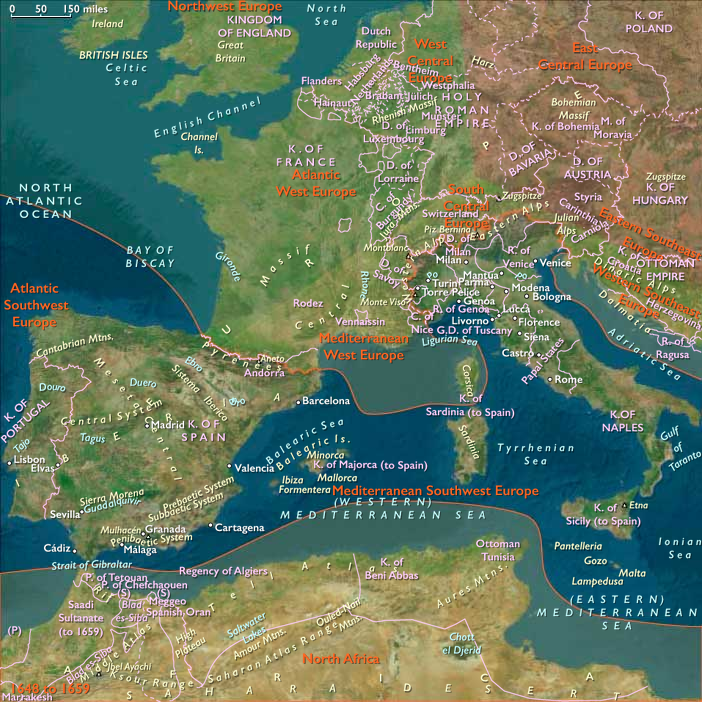
Venice, by the time Aldus Manutius settled here in 1490, was not only a major printing center but it also had a large library of Greek manuscripts from Constantinople and a population of Greeks who could assist with their translation.
He soon afterward printed editions of Hero and Leander by Musaeus Grammaticus, the Galeomyomachia, and the Greek Psalter.
He calls these "Precursors of the Greek Library."
He began gathering Greek scholars and compositors around him, employing as many as thirty Greeks in his print shop and speaking Greek at home.
Instructions to typesetters and binders are given in Greek.
The prefaces to his editions are written in Greek.
Greeks from Crete collate manuscripts, read proofs, and give samples of calligraphy for casts of Greek type.
Manutius had issued the first volume of his edition of Aristotle in 1495; four more volumes completed the work in 1497–1498.
Nine comedies of Aristophanes appeared in 1498.
Thucydides, Sophocles, and Herodotus follow in 1502.
In addition to editing Greek classics from manuscripts, Manutius reprints editions of classics that had originally been published in Florence, Rome, and Milan, at times correcting and improving the texts.
His Aldine Press becomes noted for its anchor and dolphin signature, or colophon, which first appears in 1502.
In order to promote Greek studies, Manutius founds an academy of Hellenists in 1502 called the "New Academy."
Its rules are written in Greek, its members are obliged to speak Greek, their names are Hellenized, and their official titles are Greek.
Members of the "New Academy" include Desiderius Erasmus and the Englishman Thomas Linacre.
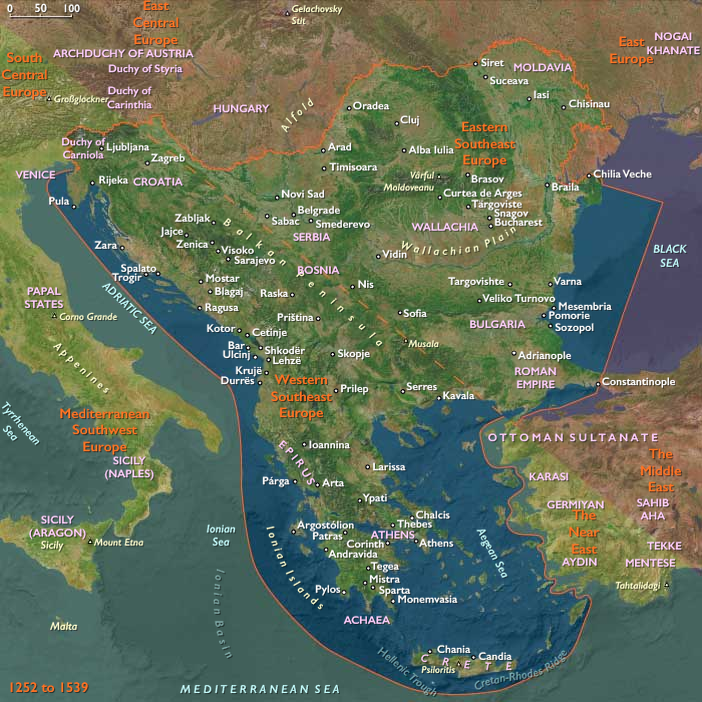
It is possible that during this period, in his printing works, Hieromonk Makarije was educated, who will later found the Obod printing works of Cetinje and print the first books in Serbian and Romanian.
Forty-two-year-old physician and philosopher Judah Abravanel, with his father Isaac a resident of Naples and now Venice during the decade since the expulsion of Jews from Spain, writes Dialoghi d'Amore (“Dialogues of Love”) by 1502.
Taking, as his central theme, love as the major creative force in the universe, he professes that love of God is the ultimate goal of the human soul.
A circle of love therefore leads from God's creation in love to man's return to God through love.
Abravanel is also a minor poet.