Albertus Magnus
German Dominican friar and a bishop
Years: 1206 - 1280
Albertus Magnus, O.P.
(1193/1206 – November 15, 1280), also known as Albert the Great and Albert of Cologne, is a Catholic saint.
He is a German Dominican friar and a bishop who achieves fame for his comprehensive knowledge of and advocacy for the peaceful coexistence of science and religion.
Those such as James A. Weisheipl and Joachim R. Söder have referred to him as the greatest German philosopher and theologian of the Middle Ages, an opinion supported by contemporaries such as Roger Bacon.
The Catholic Church honors him as a Doctor of the Church, one of only 35 persons with that honor.

Related Events
Filter results
Showing 10 events out of 11 total
Medieval alchemists, in seeking to transmute base metals, such as lead, into gold, know and use tin and its compounds.
Tin is an Anglo-Saxon name; the symbol Sn is from stannum, the Latin word for the metal.
Three species of “arsenic” are recognized by the thirteenth century white (arsenic trioxide, As4O6); yellow(As2S3) and red (As4S4).
The element's name derives from Latin arsenicum, which folk etymology connects with yellow and maleness.
The eminent alchemist, natural scientist, and scholar Albertus Magnus notes the appearance of a metal-like substance when arsenicum, another name for As2S3, is heated with soap, but he may not actually observe the free element.
Albertus Magnus first describes a method of manufacturing arsenic in about 1250: the mineral arsenopyrite is heated and decomposes with the liberation of arsenic gas; the gas can then be condensed on a cold surface.
Dominic Guzmán’s Order of Preachers, approved in 1216 by Pope Honorius III, had quickly spread, including to England, where they had appeared in Oxford in 1221.
The thirteenth century is to be the classic age of the Order, the witness to its brilliant development and intense activity, manifested especially in the work of teaching.
The Order by preaching is to reach all classes of Christian society; fight heresy, schism, and paganism by word and book; and by its missions to the north of Europe, to Africa, and Asia will pass beyond the frontiers of Christendom.
Its schools will spread throughout the entire Church; its doctors will write monumental works in all branches of knowledge and two among them, Albertus Magnus, and especially Thomas Aquinas, are to establish a school of philosophy and theology which is to rule the ages to come in the life of the Church.
The Intellectual Foundations of Scholasticism: Tommaso d'Aquino, Bonaventure, and Franciscan Thought
Tommaso d'Aquino: The Early Years of a Dominican Scholar
Tommaso d'Aquino (Thomas Aquinas), born into the Counts of Aquino at Roccasecca in central Italy, was destined for a monastic career from childhood. At the age of five, he was placed in the Benedictine monastery at Monte Cassino, where his uncle had served as abbot. His family harbored high ecclesiastical ambitions for him, possibly envisioning him as a future abbot or bishop.
However, the political turmoil of the era disrupted these plans. When Monte Cassino became a battlegroundbetween papal and imperial forces, Tommaso withdrew and enrolled at the University of Naples, where he first encountered members of the Dominican Order.
Despite violent opposition from his family, the twenty-year-old Tommaso resolved to join the Dominican friars in 1244. His family, outraged by his decision to choose mendicant poverty over Benedictine prestige, attempted to kidnap and detain him, but he ultimately escaped.
In 1245, Tommaso traveled north to study at the University of Paris, where he became a disciple of Albert the Great (Albertus Magnus), the foremost Aristotelian scholar of the age. This mentorship laid the groundwork for his eventual synthesis of Christian theology and Aristotelian philosophy, which would define Scholastic thought.
Bonaventure and the Franciscan Intellectual Tradition
Unlike Aquinas, who pursued a Dominican path, Bonaventure was a Franciscan scholar whose thought would shape the Franciscan school of theology.
Born in Tuscany, Bonaventure studied philosophy and the arts at the University of Paris from 1234 to 1242. By 1243, at the age of twenty-six, he joined the Franciscan Order and subsequently studied theology under Alexander of Hales, a pioneer of Franciscan Scholasticism.
Bonaventure’s Franciscan approach to theology emphasized mystical contemplation, divine illumination, and a more Platonic view of knowledge, distinguishing it from Aquinas’s Aristotelian logic and empirical reasoning. His thought, which deeply influenced later Franciscan scholars, was steeped in Augustinian tradition and saw knowledge as a pathway to God through divine grace rather than pure reason alone.
John of la Rochelle and the Franciscan Summa
John of la Rochelle, another Franciscan theologian, was a disciple of Alexander of Hales and became Master of Theology under his guidance. He is credited with compiling the Summa Fratris Alexandri, a foundational text of Franciscan theology. This work would influence the formation of a distinct Franciscan school, shaping thinkers such as Bonaventure and later Duns Scotus.
Legacy of These Thinkers
The mid-13th century saw the rise of two dominant Scholastic traditions:
- The Dominican Scholasticism of Thomas Aquinas, grounded in Aristotelian logic, systematic reasoning, and a synthesis of faith and reason.
- The Franciscan Scholasticism of Bonaventure, emphasizing mysticism, divine illumination, and a Platonic-Augustinian approach to theology.
These competing yet complementary schools of thought would define medieval Christian philosophy, influencing Catholic theology, university education, and intellectual traditions for centuries to come.
The Conflict Between Aristotelian and Augustinian Thought in 13th-Century Scholasticism
During the mid-13th century, Albertus Magnus and his student Thomas Aquinas sought to synthesize Aristotle’s philosophy with Augustinian theology, establishing a rational framework for Christian thought. Their position maintained that:
- Aristotle was correct in matters within the grasp of reason (e.g., logic, natural sciences, ethics).
- What is beyond reason—divine mysteries such as the Trinity and the Incarnation—could only be known through faith.
This Aristotelian synthesis profoundly influenced Scholastic theology, but it also provoked controversy within the Church. More extreme Aristotelian schools emerged, some interpreting Aristotle in a way that seemed to undermine Christian doctrine. The resulting tensions led to Church condemnations of certain Aristotelian positions, as well as aspects of Aquinas’s and Albertus’s teachings.
Bonaventure’s Augustinian Mysticism and Opposition to Aristotelianism
At the same time, Bonaventure, a Franciscan contemporary of Aquinas, defended a more mystical, Augustinian approach to Christian knowledge.
- While he was well acquainted with Aristotelian philosophy, Bonaventure feared its use in Christian theology, believing it could diminish divine revelation’s primacy.
- Instead, he favored Saint Augustine’s more traditional, introspective philosophy, which often stood in opposition to the rational synthesis developed by Aquinas.
Bonaventure’s Defense of the Mendicants and His Theological Works
- During his years at the University of Paris, Bonaventure successfully defended the Mendicant orders’ right to teach, responding to criticism from secular clergy and university authorities.
- Between 1255 and 1256, he set forth his mystical, essentially Augustinian view of Christian knowledge in Retracing the Arts to Theology (De Reductione Artium ad Theologiam).
- This treatise proposed that all human knowledge—including philosophy, science, and the liberal arts—should ultimately be oriented toward theology and divine truth.
- On February 2, 1257, Bonaventure was elected Minister General of the Franciscan Order, leading him to retire from university teaching to focus on reforming and guiding the Franciscan movement.
- In 1259, he expanded his Augustinian mystical theories in The Itinerary of the Mind into God (Itinerarium Mentis in Deum), a spiritual guide to divine union that became a cornerstone of Franciscan theology.
Aquinas in Rome: Service to the Papal Court (1259)
While Bonaventure continued to shape Franciscan thought, Thomas Aquinas left Paris for Rome in 1259, where he was appointed as an attaché to the papal court of Pope Alexander IV.
- During this period, Aquinas engaged in theological and administrative work for the Papacy, further refining his systematic approach to faith and reason.
- His time in Rome allowed him to develop his most influential works, including sections of the Summa Theologica, in which he continued his integration of Aristotelian thought into Christian doctrine.
Long-Term Impact of the Aristotelian-Augustinian Divide
The intellectual divide between Aquinas’s Aristotelian synthesis and Bonaventure’s Augustinian mysticismpersisted throughout the Middle Ages, shaping the Dominican and Franciscan schools of theology.
- The Dominicans, led by Aquinas, defended the use of reason and Aristotle in theology.
- The Franciscans, influenced by Bonaventure, emphasized mystical experience and divine illumination.
This theological tension would later influence medieval and Renaissance philosophy, as well as Church teachings on faith, reason, and divine knowledge.
The Early Life and Academic Rise of Thomas Aquinas (c. 1225–1259)
Thomas Aquinas, born Tommaso d’Aquino around 1225 at his father Count Landulf's castle of Roccasecca, in the Kingdom of Naples, was of noble lineage. His mother, Theodora, Countess of Theate, connected him to the Hohenstaufen dynasty of Holy Roman Emperors, making his early career prospects particularly significant.
Early Education and Dominican Vocation
- Aquinas began his education at the Benedictine monastery of Monte Cassino, where his uncle, Sinibald, served as abbot. His family intended for him to follow his uncle’s path and pursue a prestigious ecclesiastical career.
- At age 10, he was sent to the University of Naples, where he spent six years (c. 1239–1244) studying the liberal arts, philosophy, and theology. It was here that he encountered members of the Order of Preachers (Dominicans), who sought to recruit the most promising young scholars into their rapidly expanding mendicant order.
The Dominicans and Franciscans represented a new challenge to the well-established clerical hierarchy of medieval Europe, prioritizing poverty, preaching, and academic rigor over monastic isolation and traditional clerical privileges.
Family Resistance and Dominican Entry
- At 16, Thomas declared his desire to join the Dominicans, but his noble family strongly opposed this decision, seeing it as a betrayal of their ambitions for him.
- His family kidnapped him and held him in confinement for over a year, attempting to dissuade him from the mendicant life.
- Finally, in 1244, Pope Innocent IV intervened, and Thomas officially became a Dominican friar.
Studies with Albertus Magnus and the Paris Controversy
- Recognizing his extraordinary intellect, Thomas’s superiors sent him to Cologne, where he studied under Albertus Magnus, one of the most influential philosophers and theologians of the age.
- In 1245, Thomas accompanied Albertus to the University of Paris, where he engaged in the controversy over the rights of the mendicant orders to teach at the university.
- The secular clergy of the university, led by Guillaume de Saint-Amour, opposed the mendicants’ growing influence, arguing that they should not have equal privileges in teaching and administration.
- Thomas defended his order, writing pamphlets and speeches in support of the Dominican cause, ultimately defeating Guillaume de Saint-Amour in theological debate.
- With papal backing, the mendicants secured their teaching privileges, and Thomas graduated as a Bachelor of Theology in 1248.
Teaching Career and Theological Development
- In 1248, Aquinas returned to Cologne, where he was appointed second lecturer and magister studentium under Albertus Magnus.
- Over the following years, he developed into a comprehensive scholar, permanently adopting Aristotle’s method of logical inquiry, which he would later synthesize with Christian theology.
Recognition as Doctor of Theology (1256) and Advisory Role
- In 1256, Thomas and his friend Bonaventure were both granted the title of Doctor of Theology, a milestone that allowed them to lecture independently in Paris, Rome, and various Italian cities.
- He frequently undertook long and arduous journeys, both for academic purposes and to advise the papacy on matters of theology, law, and state affairs.
- In 1259, Thomas was present at a major Dominican assembly in Valenciennes, marking his growing influence within his order and his role in shaping Dominican intellectual priorities.
Legacy of His Early Career
By the end of the 1250s, Thomas Aquinas had established himself as:
- One of the most brilliant minds in Christian theology, synthesizing Aristotelian reason with Augustinian faith.
- A key defender of the mendicant orders, securing their place in university life.
- An advisor to the papal court, shaping the relationship between the Church and philosophical inquiry.
His work during these years laid the foundation for his later magnum opus, the Summa Theologica, and his enduring influence on Catholic theology, philosophy, and Western intellectual tradition.
Bavarian-born Albert of Cologne, educated principally at Padua, where he received instruction in Aristotle's writings, had in 1223 (or 1221) become a member of the Dominican Order, against the wishes of his family, and studied theology at Bologna and elsewhere.
Selected to fill the position of lecturer at Cologne, Germany, where the Dominicans had a house, he taught for several years there, at Regensburg, Freiburg, Strasbourg and Hildesheim.
In 1245 he had gone to Paris, received his doctorate and taught for some time as a master of theology with great success.
During this time Thomas Aquinas began to study under Albertus.
Serving as provincial of the Dominicans from 1254 to 1257; he publicly defended the Dominicans against attacks by the secular and regular faculty of the University of Paris, commented on the Gospel of John, and answered the errors of the Arabian philosopher Averroes.
Made bishop of Regensburg from 1260 by Pope Alexander IV, he resigns after three years and becomes a preacher of the Crusades.
His main work, however, has been paraphrasing and commenting on Aristotle's philosophy; in so doing, he adds new areas of investigation.
As the first medieval scholar to apply Aristotle's philosophy to Christian thought, he has achieved fame for his comprehensive knowledge of and advocacy for the peaceful coexistence of science and religion.
Contemporaries such as Roger Bacon apply the term "Magnus" to Albertus during his own lifetime, referring to his immense reputation as a scholar and philosopher.
Regarded as the greatest German philosopher and theologian of the Middle Ages, beatified in 1622 and canonized in 1931, Albertus Magnus is honored by Catholicism as a Doctor of the Church, one of only thirty-three men and women with this honor.
The Arsenites in Constantinople and elsewhere fanatically oppose the pro-Latin policy of Eastern Roman Emperor Michael VIII Palaiologos, professing obedience to the Holy See in the name of their emperor, accept papal supremacy over the Greek Church.
Bonaventure, after having successfully defended his order against the reproaches of the anti-mendicant party, had been elected Minister General of the Franciscan Order.
On November 24, 1265, he had been selected for the post of Archbishop of York; however, he was never consecrated and resigned the appointment in October 1266.
Bonaventure has steered the Franciscans on a moderate and intellectual course that will make them the most prominent order in the Catholic Church until the coming of the Jesuits.
His theology is marked by an attempt completely to integrate faith and reason.
He thinks of Christ as the “one true master” who offers humans knowledge that begins in faith, is developed through rational understanding, and is perfected by mystical union with God.
Bonaventure had been instrumental in procuring the election of Pope Gregory X, who on May 28, 1273, had rewarded him with the title of Cardinal Bishop of Albano, and insisted on his presence at the Second Council of Lyon, convoked to bring about church reform, to launch of a new Crusade to the Holy Land, and to achieve union between the Eastern and Western churches.
Bonaventure and Albertus Magnus are among the better known participants in the council; Thomas Aquinas had died on his way to attend.
The council, convened to consider the liberation of the Holy Land via Crusades and address the East-West Schism with the Eastern church, eventually approves a tithe to support efforts to liberate the Holy Land from Muslims, and works out a tenuous reunion of the two churches (but the Eastern clergy, whose hostility toward the West had greatly intensified after the sacking of Constantinople in 1204 by the Fourth Crusade, will never actually accept it).
The council defines the official Roman Catholic teaching on purgatory (from the Latin purgare, "to cleanse") as the place or state after death where those who have died in a state of grace but not free from imperfection expiate their remaining sins before entering the visible presence of God and the saints. (The damned, on the other hand, go straight to Hell.)
Bonaventure, known as the Seraphic Doctor, resigns soon afterwards as Franciscan minister general on account of illness, which proves mortal.
After his significant contributions lead to a union of the Greek and Latin churches, Bonaventure dies suddenly and in suspicious circumstances on July 15, 1274.
The Catholic Encyclopedia has citations that suggest he was poisoned.
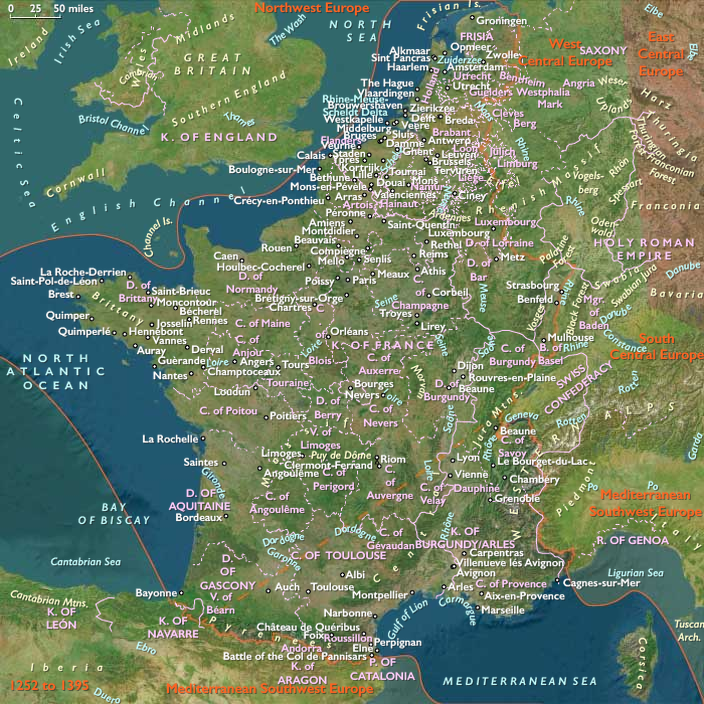
Atlantic West Europe (1276–1287): Tensions, Diplomacy, and Cultural Flourishing
Between 1276 and 1287, Atlantic West Europe, spanning the Low Countries, Brittany, Normandy, Burgundy, Aquitaine, central France, Alsace, and Franche-Comté, experienced intensified regional tensions, pivotal diplomatic maneuvers, and continued cultural and economic advancement. This era witnessed ongoing struggles between royal authority and regional autonomy, evolving trade relationships, and significant artistic and intellectual achievements.
Political and Military Developments
-
France: Consolidation Amidst Tensions
-
Philip III (the Bold, r. 1270–1285) sought further consolidation of royal authority, encountering resistance from powerful regional lords, notably in Aquitaine and Burgundy.
-
Diplomatic and dynastic alliances were pursued to stabilize the kingdom, including marriage alliances strengthening the Capetian lineage.
-
-
Aquitaine and Gascony: Anglo-French Rivalries
-
Continuing Anglo-French territorial disputes marked the period, exacerbating tensions and leading to intermittent skirmishes along contested borders in Aquitaine and Gascony.
-
-
Low Countries: Urban Independence and Conflict
-
Cities in Flanders and Brabant continued their pursuit of autonomy, clashing periodically with local nobility but generally maintaining their privileges and economic influence.
-
Growing economic independence of Flemish cities increasingly positioned them as influential political actors.
-
-
Burgundy, Alsace, and Franche-Comté: Balancing Powers
-
The Duchy of Burgundy maintained its semi-autonomous status through strategic marriage alliances and diplomacy, balancing Capetian royal interests and local independence.
-
Alsace and Franche-Comté remained critical areas of contention between French and imperial influences, strengthening their local political institutions.
-
-
Brittany and Normandy: Negotiating Authority
-
Brittany continued to navigate between French royal influence and English support, reinforcing regional autonomy under Duke John II (r. 1286–1305).
-
Normandy experienced greater integration into French administration, though local resistance persisted at a lower intensity.
-
Economic and Social Developments
-
Urbanization and Economic Expansion
-
Flanders' cities like Bruges, Ghent, and Ypres maintained prominence in international wool and cloth trade, reinforcing economic prosperity despite periodic political unrest.
-
Atlantic ports, particularly Bordeaux, La Rochelle, and Nantes, saw sustained growth through extensive maritime trade, especially in wine exports.
-
-
Agricultural Stability and Market Networks
-
Improved agricultural techniques contributed to increased productivity, reinforcing local economies and supporting regional fairs, particularly in Champagne and Burgundy.
-
Cultural and Intellectual Developments
-
Gothic Architecture and Urban Culture
-
Architectural innovations continued, with significant advances in Gothic design reflected in cathedrals such as Bourges, Strasbourg, and Beauvais.
-
-
Educational and Intellectual Expansion
-
The University of Paris remained a leading intellectual center, fostering significant developments in theology and philosophy, notably through figures such as Thomas Aquinas and Albertus Magnus.
-
Religious Developments
-
Monastic Influence and Reform Movements
-
Monastic orders, particularly the Cistercians, maintained strong influence in regional governance and economic affairs, contributing to intellectual and spiritual life.
-
Growing emphasis on mendicant orders (Franciscans and Dominicans) shaped religious practice and outreach to urban populations.
-
Legacy and Significance
The era 1276–1287 saw Atlantic West Europe navigating complex political dynamics, maintaining economic vibrancy, and achieving cultural milestones. These developments solidified foundations for subsequent eras, balancing royal centralization with regional autonomy, fortifying economic prosperity, and fostering significant cultural and intellectual growth.
The 1277 Condemnation of Aristotelianism at the University of Paris
By the 13th century, Aristotle had been firmly reintroduced into the Western intellectual tradition, becoming the dominant philosophical authority in medieval Scholasticism. After initial resistance, his works, particularly in logic, metaphysics, and natural philosophy, were embraced, especially through the efforts of Albertus Magnus and Thomas Aquinas.
Aquinas’s Synthesis and the Rise of Radical Aristotelianism
- Albertus Magnus and his student Thomas Aquinas successfully synthesized Aristotle’s philosophy with the Augustinian Christian tradition, arguing that:
- Reason (natural knowledge) can grasp certain truths about the world.
- Faith (revealed knowledge) is necessary for divine mysteries beyond reason.
- However, more extreme Aristotelian schools emerged, particularly among the Latin Averroists, such as Siger of Brabant.
- These thinkers took Aristotle’s philosophy further, at times separating reason from faith entirely, leading to accusations of "double truth"—the idea that something could be true in philosophy but false in theology.
The Condemnation of March 7, 1277
- On March 7, 1277, Bishop Étienne Tempier of Paris, acting with papal encouragement, issued a decree prohibiting the discussion of 219 philosophical propositions, many of which were derived from Aristotle and his interpreters.
- The condemnation targeted radical Aristotelianism, particularly claims that:
- The world is eternal and uncreated (denying divine creation).
- God does not know particulars (denying divine omniscience).
- There is no individual immortality (contradicting Christian eschatology).
- Some propositions associated with Aquinas’s synthesis were also condemned, reflecting the Church’s growing caution toward Aristotelian natural philosophy.
Impact on Medieval Thought
- The Condemnation of 1277 placed philosophy under tighter theological control, leading to a temporary decline in Aristotelian influence in university discourse.
- However, rather than ending debate, it stimulated new discussions on the relationship between faith, reason, and the natural world, influencing later medieval and Renaissance philosophy.
- Figures such as John Duns Scotus and William of Ockham responded by further developing theological and philosophical distinctions, shaping the course of Scholastic thought in the 14th century.
Legacy
While initially restricting Aristotelian philosophy, the Condemnation of 1277 ultimately played a role in reshaping Scholastic discourse, paving the way for later intellectual developments in the late Middle Ages and the early modern period.