Albert II of Germany
King of Hungary and Croatia; King of Bohemia
Years: 1397 - 1439
Albert the Magnanimous KG (August 10, 1397 – October 27, 1439) is King of Hungary and Croatia from 1437 until his death.
He is also King of Bohemia, elected (but never crowned) King of Germany as Albert II, duke of Luxembourg and, as Albert V, archduke of Austria from 1404.
Related Events
Filter results
Showing 10 events out of 11 total
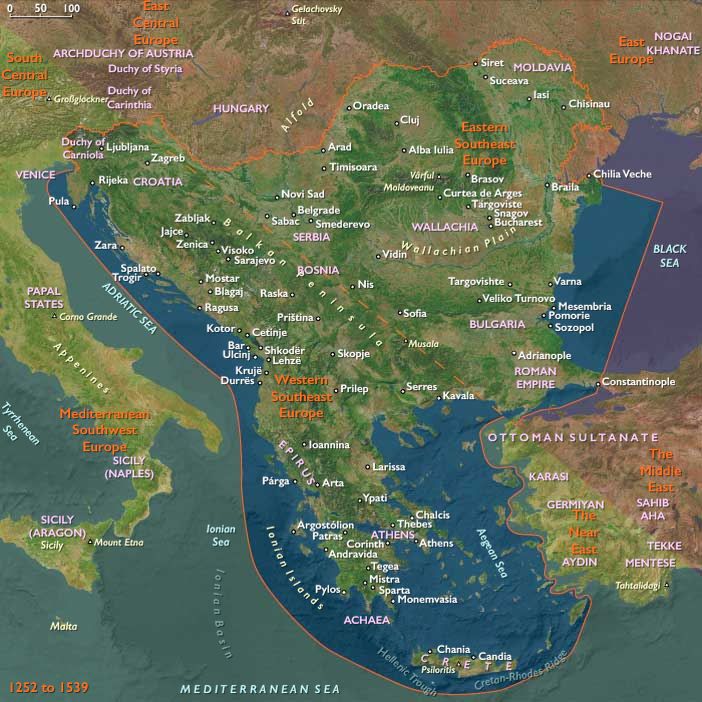
Additional turmoil erupts when the Ottoman Turks expand their empire into the Balkans.
They cross the Bosporus Straits in 1352, subdue Bulgaria in 1388, and defeat the Serbs at Kosovo Polje in 1389.
Sigismund leads a crusade against them in 1396, but the Ottomans rout his forces at Nicopolis, and he barely escapes with his life.
Tamerlane's invasion of Anatolia in 1402-03 slows the Turks' progress for several decades, but in 1437 Sultan Murad prepares to invade Hungary.
Sigismund dies the same year, and Hungary's next two kings, Albrecht V of Austria (1437-39) and Wladyslaw III of Poland (1439-44), who is known in Hungary as Ulaszlo I, both die during campaigns against the Turks.
The Bohemian estates elect Albert of Austria as Sigismund's successor at the latter's death in 1437.
Albert dies, however, and his son, Ladislas the Posthumous—so called because he was born after his father's death—is acknowledged as king.
During Ladislas's minority, Bohemia is ruled by a regency composed of moderate reform nobles who are Utraquists.
Internal dissension among the Czechs provides the primary challenge to the regency.
A part of the Czech nobility remains Catholic and loyal to the pope.
A Utraquist delegation to the Council of Basel in 1433 had negotiated a seeming reconciliation with the Catholic Church.
The Council's Compact of Basel accepts the basic tenets of Hussitism expressed in the Four Articles of Prague: communion under both kinds; free preaching of the Gospels; expropriation of church land; and exposure and punishment of public sinners.
The pope, however, rejects the compact, thus preventing the reconciliation of Czech Catholics with the Utraquists.
Nagy-Várad, the settlement that will become the city of Oradea is considered to have been relatively unimportant until the eleventh century when King Ladislaus I of Hungary founded a bishopric near it, the present Roman Catholic Diocese of Oradea.
The city flourished both economically and culturally during the thirteenth century, when the Citadel of Oradea, first mentioned in 1241 during the Mongol invasion, was first built.
It will be destroyed and rebuilt several times over the course of following centuries.
The fourteenth century had proved to be of the most prosperous periods in the city's history up to that point.
Many works of art have been added to the city, including statues of St. Stephen, Emeric and Ladislaus, all erected before 1372, and the equestrian sculpture of St. Ladislaus in 1390.
St. Ladislaus' fabled equestrian statue is the first such in a European public square.
Bishop Andreas Báthori, Bisop from 1329 to 1345, rebuilt the cathedral in Gothic style.
From that age date also the Hermes, now preserved at Györ, which contains the skull of King Ladislaus, and which is a masterpiece of the Hungarian goldsmith's art.
Sigismund dies on December 9, 1437 at Znojmo (German: Znaim), Moravia (now Czech Republic), and as ordered in life, he is buried at Nagyvárad next to the tomb of the king Saint Ladislaus I, who is the ideal of the perfect monarch, warrior and Christian for this time and was deeply venerated by Sigismund.
By his second wife, Barbara of Celje, he leaves an only daughter, Elisabeth of Luxembourg, who is married to Albert V, duke of Austria (later German king as Albert II) whom Sigismund names as his successor.
As he leaves no sons, his line of the House of Luxembourg becomes extinct on his death.
East Central Europe (1432–1443 CE): Hussite Negotiations, Ottoman Pressures, and Internal Consolidation
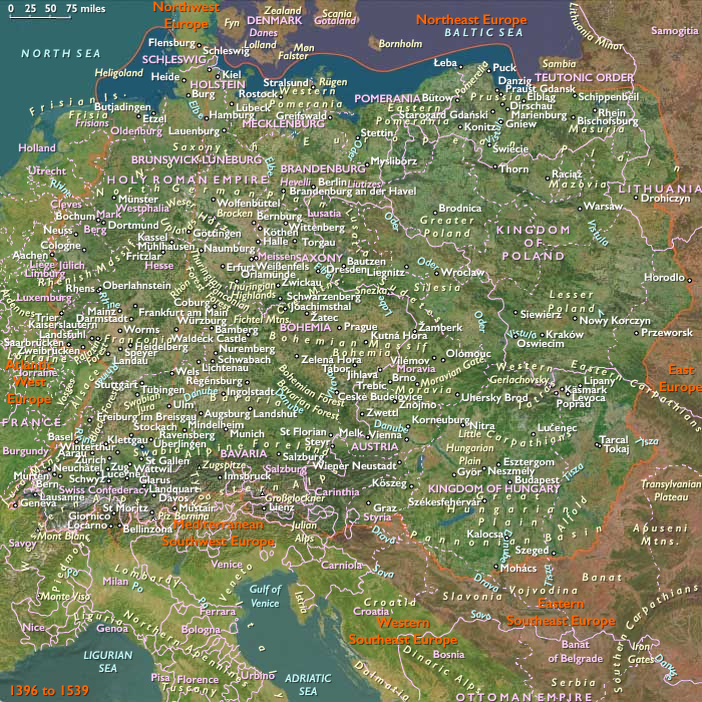
Between 1432 and 1443 CE, East Central Europe entered a phase of cautious recovery, diplomatic maneuvering, and internal consolidation following the intense conflicts of the Hussite Wars. The Council of Basel (1431–1449) sought compromise with Hussite Bohemia, gradually ending the period of open warfare. Meanwhile, the Kingdom of Hungary, under Sigismund of Luxemburg and his successor Albert II, grappled with escalating Ottoman threats, while the Polish-Lithuanian Union managed internal dynastic stability and economic growth, asserting regional influence.
Political and Military Developments
Council of Basel and Hussite Compromise (1431–1436)
-
Initiated in 1431, the Council of Basel negotiated intensively with moderate Hussites, known as the Utraquists, culminating in the Compactata of Basel (1436), which allowed communion under both species (bread and wine), effectively legitimizing Hussite religious reforms.
-
This agreement restored relative peace in Bohemia, facilitating the return of Emperor Sigismund as King of Bohemia in 1436. However, radical Hussite factions, particularly the Taborites, remained dissatisfied, weakening internal stability.
Death of Sigismund and Succession of Albert II (1437)
-
Sigismund of Luxemburg died in 1437, ending a complex reign marked by imperial ambitions, Hussite conflicts, and Hungarian internal struggles. He was succeeded by his son-in-law Albert II of Habsburg (r.1437–1439), briefly unifying the crowns of Hungary, Bohemia, and the German kingship.
-
Albert II's sudden death in 1439 prompted a dynastic crisis, exacerbating political fragmentation across Hungary and Bohemia, and intensifying regional instability.
Ottoman Incursions and Hungarian Defense
-
The Kingdom of Hungary increasingly confronted Ottoman incursions along its southern borders, culminating in frequent raids and heightened military preparedness under governors like John Hunyadi, who emerged as a significant military leader by the early 1440s.
Polish-Lithuanian Stability and Dynastic Continuity
-
In Poland-Lithuania, King Władysław III (r.1434–1444), successor to Władysław II Jagiełło, oversaw internal stability and diplomatic balancing acts, strengthening the union's regional standing while cautiously addressing external threats, particularly from the Teutonic Order.
Economic and Technological Developments
Post-War Economic Recovery
-
Following prolonged conflicts, Bohemia experienced cautious economic recovery after 1436, benefiting from restored peace, revitalized trade routes, and returning population stability.
-
Polish-Lithuanian cities like Kraków, Lublin, and Vilnius thrived economically, profiting from stable governance, expanding Baltic trade networks, and internal market growth.
Trade Realignments and Northern Prosperity
-
Hanseatic cities—including Lübeck, Rostock, Toruń, and Gdańsk—continued to flourish, expanding Baltic maritime trade, which compensated for disruptions elsewhere, further enhancing their economic importance and autonomy.
Cultural and Artistic Developments
Hussite Cultural Influence and Legacy
-
The Hussite movement left lasting impacts on Czech culture, strengthening vernacular literature, popular religious practice, and education, shaping Bohemia’s distinctive intellectual and religious identity.
-
Artistic and literary works in Bohemia increasingly incorporated Hussite themes, reflecting evolving religious attitudes and emphasizing Czech linguistic and cultural identity.
Courtly Culture in Hungary and Poland
-
Hungarian and Polish royal courts continued to patronize vibrant cultural and artistic activities. Gothic architecture, illuminated manuscripts, and chivalric literature flourished under aristocratic patronage, particularly in Kraków and Buda.
Settlement and Urban Development
Urban Revival and Fortification
-
Towns and cities across Bohemia, Hungary, and Poland recovered gradually from wartime disruptions. Reconstruction of urban centers such as Prague, Kutná Hora, and Pressburg (Bratislava) restored prosperity and improved fortifications.
-
Border towns and frontier fortresses in Hungary received particular attention, significantly improving defenses against Ottoman raids and incursions.
Social and Religious Developments
Religious Compromise and Hussite Legacy
-
The Compactata of Basel introduced a moderate religious settlement in Bohemia, integrating Hussite practices into official ecclesiastical structures and reducing religious tensions, though radical groups remained marginalized.
-
Hussite-inspired religious attitudes persisted, significantly influencing future religious reforms and social transformations within Bohemia.
Strengthened Aristocratic Authority
-
Throughout Hungary and Poland-Lithuania, the aristocracy solidified its political and economic influence, leveraging dynastic instability and weakened central authority to reinforce local autonomy and privileges.
Long-Term Consequences and Historical Significance
The era 1432–1443 CE represented a critical transitional phase in East Central European history. The diplomatic resolution of the Hussite Wars through the Council of Basel established lasting religious reforms and social realignments in Bohemia. In Hungary, Albert II's brief reign underscored increasing dynastic instability and escalating Ottoman threats, foreshadowing significant future conflicts. Meanwhile, Polish-Lithuanian stability under Władysław III solidified regional influence, providing a crucial foundation for subsequent economic prosperity and political strength, shaping East Central Europe's trajectory through the late medieval period.
A Polish faction opposes the installment of Albert Habsburg as Holy Roman Emperor and king of Bohemia and Hungary, their choice being Wladyslaw III of Poland.
Wladyslaw is only fourteen; most of the major decisions are either made or manipulated by the regent, Zbigniew Olesnicki, who is a powerful Polish noble, bishop of Kraków, and had also been a close adviser to his father.
Sigismund of Luxembourg, finally crowned as Holy Roman Emperor in 1433, has proposed badly needed reforms from 1434-37 but has been unable to persuade the German princes to adopt them.
Before his death at sixty-nine, on December 9, 1437, the childless monarch, his treasury depleted, arranges for the succession of his titles to his forty-year-old son-in-law, Albert Habsburg, thus passing to this powerful family, for the first time, the crown of the Holy Roman Empire.
Albert Habsburg is on January 1, 1438, crowned king of Hungary, elected king of Germany on March 18, and, despite opposition, actually crowned king of Bohemia on June 29.
Calling a diet at Nürnberg 1438, he ends all feuds based on the right of private warfare and appoints arbiters to settle disputes.
He further divides Germany into administrative circles, again with the maintenance of peace in mind.
The forces of Wladyslaw and Albert prepare for war, but the brewing Polish-Bohemian conflict ends with Albert’s death from dysentery in 1439 while fighting the Turks in Hungary.
Albert has left his wife pregnant, and a crisis immediately develops concerning his succession to the throne of Hungary.
The Hungarian nobles choose Wladyslaw, who is supported by the successful aristocratic general Janos Hunyadi, whom Albert had recently appointed military governor (ban) of Severin in Wallachia.
Albert II, elected in 1438 to succeed Sigismund as king of Hungary and Bohemia as well as Germany, has devoted his brief reign to suppressing a revolt in Bohemia and fighting the Turks in Hungary, where he dies from dysentery on October 27, 1439, leaving as his only heir a posthumous son, Ladislas.
East Central Europe (1444–1455 CE): Ottoman Confrontation, Hungarian Leadership under Hunyadi, Polish-Lithuanian Dynamics, and Bohemian Stabilization
Between 1444 and 1455 CE, East Central Europe experienced significant geopolitical upheaval marked by renewed Ottoman incursions, the rise of John Hunyadi as Hungary's military leader, critical developments within the Polish-Lithuanian Union, and continued stabilization efforts in post-Hussite Bohemia. These developments profoundly shaped the region's late medieval political landscape, underscoring persistent external threats and internal realignments that redefined East Central European politics and society.
Political and Military Developments
Battle of Varna and Death of Władysław III (1444)
-
In 1444, a major European crusade against the Ottoman Empire ended disastrously at the Battle of Varna, resulting in the death of King Władysław III of Poland and Hungary. This catastrophic defeat severely destabilized Hungary and plunged Poland into a dynastic crisis.
John Hunyadi’s Ascendancy and Regency in Hungary (1446–1453)
-
Following the battle, Hungarian noble John Hunyadi emerged as the kingdom's de facto ruler, becoming regent for the underage Ladislaus the Posthumous (1440–1457), son of Albert II. Hunyadi consolidated his authority, reorganized Hungary’s military forces, and strengthened defenses against Ottoman advances.
-
In 1453, after Ladislaus came of age, Hunyadi relinquished the regency but retained significant influence as Hungary’s foremost military commander and political leader.
Ottoman Pressure and Battle of Kosovo (1448)
-
Ottoman threats persisted relentlessly, culminating in another major conflict at the Second Battle of Kosovo (1448). Despite Hunyadi’s strategic skill, his army suffered defeat against Sultan Murad II, underscoring Ottoman military supremacy and deepening Hungary's defensive vulnerability.
Polish-Lithuanian Union: Dynastic Transition and Kazimierz IV (1447–1492)
-
In 1447, following a three-year interregnum, Kazimierz IV Jagiellon (Casimir IV) ascended to the Polish throne. His accession reinforced the Jagiellonian dynasty, stabilizing Poland-Lithuania politically and strengthening its international standing.
-
Kazimierz IV prioritized internal reforms, improved royal governance, and cautiously balanced external diplomacy, especially managing relations with Hungary, Bohemia, and the Teutonic Order.
Bohemian Stability and George of Poděbrady
-
Post-Hussite Bohemia gradually stabilized, especially under the rising influence of Czech nobleman George of Poděbrady. Appointed governor in 1452, he effectively governed Bohemia on behalf of the young Ladislaus the Posthumous, emphasizing internal peace, economic recovery, and moderate religious tolerance.
Economic and Technological Developments
Hungarian and Polish Economic Recovery
-
Despite continuous Ottoman threats, Hungary under Hunyadi and Poland under Kazimierz IV enjoyed periods of cautious economic recovery, benefiting from revived agricultural productivity, growing commercial trade, and renewed urban prosperity.
-
Key urban centers, including Kraków, Gdańsk, and Buda, regained prominence, strengthening their roles in regional and international trade networks.
Hanseatic League and Baltic Trade Expansion
-
Northern trade networks flourished as Hanseatic cities like Lübeck, Gdańsk, and Toruń deepened commercial ties, profiting significantly from the stability and economic expansion of the Polish-Lithuanian Union.
Cultural and Artistic Developments
Bohemian Renaissance and Cultural Flourishing
-
Bohemia experienced cultural revival under George of Poděbrady’s governorship, emphasizing literacy, vernacular literature, and intellectual exchanges shaped by moderate Hussite religious legacies.
-
Gothic architecture and artistic patronage remained vibrant, particularly in Prague and Kutná Hora, highlighting sustained cultural prosperity despite recent conflicts.
Polish-Lithuanian Royal Patronage
-
Under Kazimierz IV, Poland-Lithuania saw significant cultural and artistic patronage. Kraków thrived as a major intellectual and artistic hub, home to flourishing universities, courtly literature, and ecclesiastical art.
Settlement and Urban Development
Defensive Infrastructure and Fortifications
-
Heightened Ottoman threats led Hungary to substantially fortify frontier regions, reinforcing border castles, fortresses, and urban defenses, significantly enhancing defensive capabilities.
-
Cities across Bohemia and Poland continued urban expansion, improved civic infrastructure, and strengthened defenses, contributing to urban resilience and demographic growth.
Social and Religious Developments
Continued Religious Diversity and Hussite Influence
-
Bohemia maintained religious diversity, integrating moderate Hussite traditions into local religious practice, sustaining religious tolerance and shaping distinctive cultural and religious identities.
Social Realignment and Noble Power
-
Throughout the region, especially in Hungary and Poland-Lithuania, the nobility leveraged dynastic crises and royal dependency on aristocratic support, significantly strengthening noble privileges, local autonomy, and political influence.
Long-Term Consequences and Historical Significance
The era 1444–1455 CE represented a pivotal period for East Central Europe, defined by dramatic geopolitical shifts and internal consolidation. The devastating Battle of Varna altered the region’s political trajectory, prompting Hungarian military reforms under Hunyadi and reshaping Polish-Lithuanian dynastic structures under Kazimierz IV. Persistent Ottoman threats necessitated significant defensive innovations, fundamentally shaping Hungary’s political and social landscape. Simultaneously, Bohemian stabilization under George of Poděbrady consolidated internal peace and cultural revival, laying foundations for future political and cultural transformations that deeply influenced East Central Europe through the late medieval and early modern eras.