Alauddin Khilji
2nd ruler of the Turkic Afghan Khilji dynasty in India
Years: 1250 - 1316
Ali Gurshap Bam better known by his titular name as Sultan Ala-ud-din Khilji (died 1316) is the second ruler of the Turkic Afghan Khilji dynasty in India.
He is considered the most powerful ruler of the dynasty, reigning from 1296 to 1316.
His historic attack on Chittor in 1303, and the folklore about his hearing of the beauty of queen of Chittor, Rani Padmini, the wife of King Rawal Ratan Singh and the subsequent story, is immortalized in the epic poem Padmavat, written by Malik Muhammad Jayasi in the Awadhi language in 1540.
He is a brilliant strategist and an outstanding military commander who commands forces over the length and breadth of Indian subcontinent.
Sultan Ala-ud-din Khilji is also noted in history for being one of the few rulers in the world to have repeatedly defeated the invasions of the Mongols.

Related Events
Filter results
Showing 10 events out of 32 total
South Asia (1252–1395 CE): Sultanates, Temples, and Oceanic Gateways
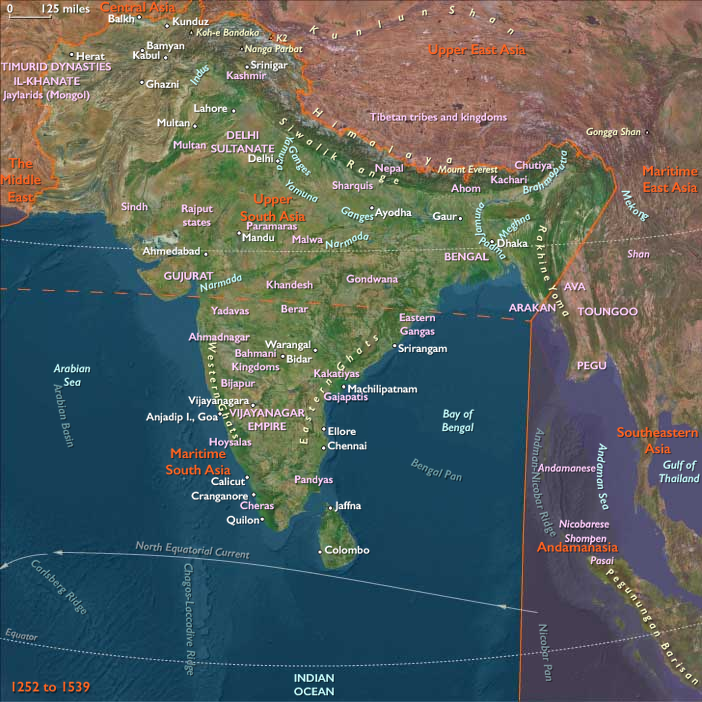
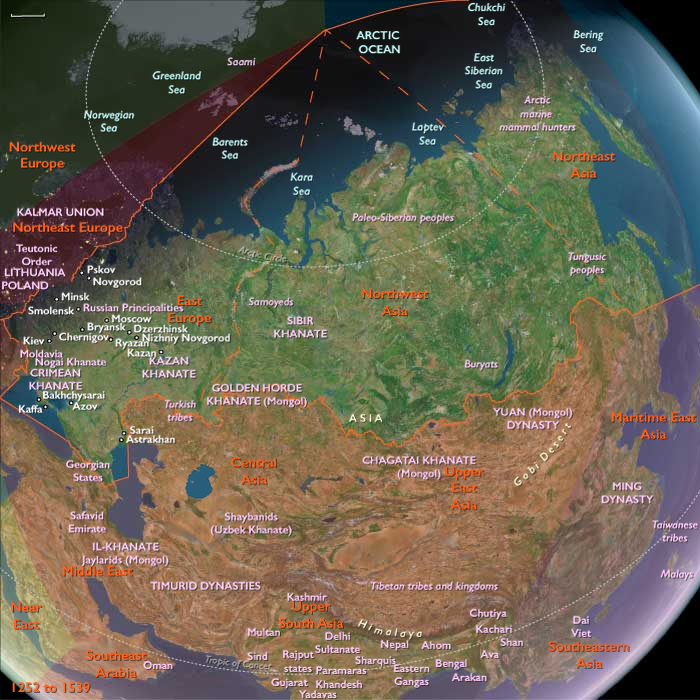
From the passes of Afghanistan to the lagoons of Kerala and the island atolls of the Maldives, South Asia in the Lower Late Medieval Age was a world of shifting capitals, converging faiths, and expanding sea routes. The monsoon remained the great architect of life, its alternating abundance and scarcity driving hydraulic ingenuity, agricultural diversity, and mercantile enterprise. By the fourteenth century, the subcontinent was knit together by caravan and sea, by shared institutions of devotion and trade, and by the political duality of the Delhi Sultanate in the north and the twin powers of Bahmani and Vijayanagara in the south.
The Delhi Sultanate, centered on the Punjab–Doab, inherited a century of consolidation. Under Alauddin Khalji (r. 1296–1316), frontier raids were repelled, revenue reforms rationalized, and the Sultan’s authority pressed deep into the Deccan. His successor, Muhammad bin Tughluq (r. 1325–1351), extended campaigns from Gujarat to Madurai but overreached; famines, revolts, and failed experiments in currency and administration frayed the realm. Firoz Shah Tughluq (r. 1351–1388) restored order through canal works, madrasas, and endowments that linked state and faith, but within a decade of his death the empire disintegrated. Timur’s invasion of 1398 CE devastated Delhi and the upper Ganga plain, closing a cycle of central dominance.
To the northwest, Afghan and Khurasani frontiers remained gateways of exchange. The Karts of Herat and later Timurid commanders dominated the trans-Hindu Kush approaches; horse caravans, falcons, and precious textiles passed through Kabul and Ghazni toward Lahore and Delhi. In Kashmir, the establishment of the Shah Mir sultans(from 1339) introduced Islam to the court without extinguishing the valley’s Sanskrit learning and artistry.
Eastward, Bengal broke decisively from Delhi’s control. The Ilyas Shahi dynasty (from 1352) ruled from Gauda and Pandua, maintaining fleets on the deltaic channels and embanking the rivers for rice, jute, and cane cultivation. Prosperous and cosmopolitan, Bengal’s silver tanka coinage and river ports connected it to Chittagong, Arakan, and the eastern seas. Along the Naf–Kaladan corridor, the Launggyet kingdom of northern Arakan mediated between Bengal and Upper Myanmar, its rice, salt fish, and elephants moving with the tides toward the Chindwin gateway and the rising Burmese capital of Ava.
In the Himalayan crescent, Nepal’s Malla era flowered. The city-states of Kathmandu, Patan, and Bhaktapur built tiered pagodas and brick–timber palaces; artisans forged gilt copper images and repoussé ornaments that blended Vajrayana and Hindu devotion. To the east, the valleys of Bhutan coalesced around monastic estates of the Drukpaorder; dzong-like fortresses presided over a landscape where pastoral and agrarian life merged with Himalayan Buddhism. The passes of Kuti, Kerung, and Nathu carried salt, wool, and paper between Tibet, Nepal, and the plains, sustaining a centuries-old vertical trade.
Across this vast northern arc, canals, embankments, and riverboats underwrote resilience. The Tughluq canals linked Yamuna and Ganga tracts; Bengal’s earthen polders contained the floods of the Brahmaputra–Meghna; and Newar stone spouts (hiti) distributed water through urban courtyards. Even amid invasion and rebellion, agrarian cycles and market towns endured. Sufi hospices offered refuge and credit; temple endowments and monastic networks stabilized rural life. The Chishti and Suhrawardi orders spread devotional Islam across towns and villages, while Bhakti poets in Maharashtra and the north began to reinterpret older Hindu spirituality in the vernacular.
South of the Narmada, a new political balance emerged. Delhi’s Deccan campaigns shattered older dynasties—the Yadavas, Hoysalas, and Kakatiyas—but opened space for regional power. In 1347, Ala-ud-Din Bahman Shahestablished the Bahmani Sultanate at Gulbarga (later Bidar), claiming the mantle of Persianate Islam in the Deccan. Within a decade, the brothers Harihara I and Bukka Raya I founded the Vijayanagara Empire on the Tungabhadra, creating a Hindu imperial center whose granite walls, tank-fed gardens, and towering temples at Hampi proclaimed resilience against northern invasion. Between these two great states stretched a frontier of forts, irrigation tanks, and shifting alliances that defined peninsular politics for the next two centuries.
The southern littoral remained the meeting ground of oceans. The Pandya realm of Madurai collapsed under Khalji and Tughluq incursions; a brief Madurai Sultanate (1335–1378) yielded to Vijayanagara. Along the western coast, Calicut rose under the Zamorin as a premier Indian Ocean port. The Malabar backwaters and Kerala pepper gardens fed demand from the Red Sea to the South China Sea, while Quilon, Goa, and Nagapattinam thrived as multiethnic harbors. Chinese junks arrived in Yuan and early Ming decades, exchanging silks and copper for spices, pearls, and cottons.
In Sri Lanka, irrigation in the northern plains declined with the fall of Polonnaruwa. Highland and coastal polities at Gampola and Kotte shared the island with the Tamil Jaffna kingdom, its rulers mediating between South Indian and Sri Lankan trade. Buddhism persisted but lost its royal patronage, while Tamil Saivism and mercantile guilds dominated the northern coast. Across the open sea, the Maldives flourished as an Islamic sultanate and hub of cowrie export. Cowries served as small currency from Bengal to East Africa, while tuna, coir, and coral jewelry reached every shore of the Indian Ocean. The Lakshadweep islands integrated into Malabar’s spice circuits, and the distant Chagos atolls, still uninhabited, served as navigational markers for Arab and Indian seafarers.
Despite climatic cooling and intermittent famine, South Asia’s ingenuity endured. Canal and tank systems buffered monsoon irregularities; double-cropping spread across Bengal and the Deccan; and horse trade through the Afghan passes and maritime networks through Hormuz and Aden kept markets supplied. Islamic and Hindu institutions coexisted—mosques, madrasas, and khanqāhs beside temples, monasteries, and shrines—forming a dense spiritual landscape that bridged rural and urban life.
By 1395 CE, the subcontinent had become a mosaic of sultanates, temple kingdoms, and oceanic polities. Delhi remained a wounded but symbolic capital; Bengal flourished as an independent deltaic power; Kashmir and Nepal perfected their courtly arts; Bhutan and Arakan linked the Himalayas to the Bay; and in the south, the twin empires of Bahmani and Vijayanagara defined the political frontier. The Maldives exported currency to half the known world, while Calicut and Quilon stood as the new hinge between the Indian Ocean and the China seas.
Amid transition and turbulence, South Asia preserved its rhythms of irrigation, devotion, and exchange—a civilization resilient in its regional diversity and poised to enter the early modern age as one of the great centers of global commerce and culture.
Upper South Asia (1252 – 1395 CE): Delhi Sultanate, Himalayan Courts, and the Bengal–Arakan–Chindwin Gateways
Geographic and Environmental Context
Upper South Asia includes Afghanistan, Pakistan, North India, Nepal, Bhutan, Bangladesh, and northwestern Myanmar (the northern Arakan/Yakhine sector and the Chindwin valley).
-
Anchors: the Kabul–Gandhara corridors; Punjab–Doab–Ganga–Brahmaputra plains; Kathmandu Valley and Himalayan foothills of Nepal–Bhutan; the deltaic lowlands of Bengal; and the northern Arakan/Chindwin gateway into Upper Myanmar.
Climate and Environmental Shifts
-
The late Medieval Warm Period eased into the early Little Ice Age after c. 1300: generally reliable monsoons with episodic droughts and floods.
-
Canalized tracts in the Doab and upper Ganga–Yamuna buffered dry years; the Brahmaputra–Meghna swells shaped Bengal’s rice calendars and riverine trade.
Societies and Political Developments
-
Delhi Sultanate (North India, Pakistan):
-
Mamluk and Khalji rule gave way to the Tughluqs (1320–1414).
-
Alauddin Khalji (r. 1296–1316) stabilized frontiers against Mongol raids, reorganized the revenue base, and asserted control over the Punjab–Doab.
-
Muhammad bin Tughluq (r. 1325–1351) expanded toward the Deccan but overextended; administrative experiments and famine eroded authority.
-
Firoz Shah Tughluq (r. 1351–1388) repaired canals, patronized madrasas and khanqāhs, and regularized land assignments (iqṭāʿ).
-
Timur’s invasion (1398–99) devastated Delhi and the upper Doab at the period’s close, fragmenting sultanate control.
-
-
Afghanistan & Khurasan marches:
-
Karts of Herat and later Timurid forces dominated the northwest approaches; Kabul–Ghazni linked Central Asian horses and trade to the Punjab.
-
-
Kashmir:
-
Transition from Hindu dynasties to the Shah Mir sultans (from 1339) introduced court Islam while preserving a rich Kashmiri literary and artistic milieu.
-
-
Bengal (Bangladesh & lower Ganga):
-
After periods under Delhi, the Bengal Sultanate consolidated under the Ilyas Shahi (from 1352), ruling from Gauda (Lakhnauti) and Pandua, later Sonargaon as a deltaic entrepôt.
-
Naval power and embankment-building underwrote autonomy; gold and silver tanka coinages flourished.
-
-
Nepal (Kathmandu Valley):
-
The Malla era (c. 1200–1768) matured: Kathmandu, Patan, and Bhaktapur city-states patronized Newar brick–timber palaces, pagodas, and gilded metalwork; syncretic Hindu–Buddhist courts thrived.
-
-
Bhutan:
-
Fragmented valley polities received monastic influences (notably Drukpa lineages from Tibet); dzong-like hill sites and temple estates expanded local authority.
-
-
Northwestern Myanmar (northern Arakan/Chindwin):
-
In Arakan, the Launggyet kingdom (from c. 1250) rose on the Naf–Kaladan corridors, mediating between Bengal and Upper Myanmar.
-
The Chindwin valley linked delta goods to the Ava polity (founded 1364) in Upper Myanmar; Theravāda Buddhism and cross-border trade connected the hills and plains.
-
Economy and Trade
-
Agrarian cores:
-
Doab–Ganga: irrigated wheat, barley, and cash crops under iqṭāʿ revenue systems.
-
Bengal: multi-cropped rice, jute, sugarcane; embanked polders and river ports.
-
Kathmandu Valley: irrigated paddy, millets; artisan–court economies.
-
-
Frontier staples & exchange:
-
Afghan passes supplied horses and falcons; Kabul–Lahore–Delhi caravans moved textiles, metals, and dyes.
-
Bengal–Arakan–Chindwin moved rice, salt fish, cottons, and elephants; Muslim and Buddhist merchants shared portage and brokerage.
-
Himalayan corridors carried salt, wool, and paper between Tibet–Bhutan–Nepal and the plains.
-
-
Coinage & markets: silver tanka and copper jital circulated in the sultanate; Bengal minted abundant tanka; bazars clustered along caravanserais and ghats.
Subsistence and Technology
-
Irrigation & hydraulics: Tughluq canal works (e.g., Yamuna link canals); Bengal embankments; Nepalese stone spouts (hiti) and tank systems.
-
Military & logistics: composite bows, armored cavalry; river flotillas in Bengal and Arakan; later-14th-century gunpowder traces at sieges.
-
Crafts: Delhi inlaid metalwork, carved stone; Bengal textiles and terracotta; Newar gilt copper repoussé and woodcarving.
-
Architecture: sultanate mosques and madrasas; Kashmiri and Bengali brick mosques; Newar tiered temples and palace squares.
Movement and Interaction Corridors
-
Khyber & Bolan passes: Afghan remounts and Central Asian goods into Punjab–Delhi.
-
Grand Trunk precursor: Lahore–Delhi–Gaya–Bengal trunk routes; ferry ghats knit riverine towns.
-
Delta & littoral lanes: Ganga–Brahmaputra distributaries to Chittagong/Sonargaon; coastal shuttles to Launggyet and the Chindwin.
-
Himalayan passes: Kuti, Kerung, and Nathu tied Nepal and Bhutan to Tibet; yak caravans moved salt and wool south, grain north.
Belief and Symbolism
-
Islam: sultanate legitimacy rested on sharīʿa patronage, madrasas, khanqāhs, and Friday mosques; Sufi orders (Chishtiyya, Suhrawardiyya) spread across towns and countryside—Nizamuddin Auliya (d. 1325) emblematic.
-
Hindu traditions & Bhakti: temple endowments persisted in Rajput and peripheral zones; early bhakti currents (e.g., Namdev, Ramananda on the horizon) reshaped devotion.
-
Buddhism & Himalayan syncretism: Nepalese Vajrayana and Hindu worship intertwined; Bhutan’s monastic houses expanded; Theravāda anchored Arakan and Upper Myanmar.
-
Kashmir: Islamization at court coexisted with Sanskrit scholastic traditions through the century.
Adaptation and Resilience
-
State flexibility: when the sultanate overreached, provincial elites (Bengal, Kashmir) localized authority without halting agrarian growth.
-
Hydraulic redundancy: canals, embankments, and floodplain mobility cushioned monsoon shocks.
-
Commercial pivots: Afghan pass traffic and Bengal’s river–sea trade maintained supplies during warfare; Himalayan corridors provided alternative staples (salt, wool).
-
Ritual and social glue: Sufi hospices, temple networks, and monastic centers mediated famine relief, dispute resolution, and credit.
Long-Term Significance
By 1395, Upper South Asia had become a continent-spanning mosaic:
-
The Delhi Sultanate remained the titular hegemon in the northwest–Doab despite fragmentation and Timur’s incursion.
-
Bengal emerged as a powerful, maritime-facing sultanate.
-
Kashmir and Nepal matured distinct court cultures; Bhutan’s valleys cohered around monasteries.
-
The Bengal–Arakan–Chindwin hinge integrated South and Southeast Asian worlds.
These trajectories set the stage for 15th-century realignments—Timurid influences from the northwest, Bengal’s coastal expansion, Ava and Arakan’s contests in the east, and enduring Himalayan polities shaping the northern front.
Maritime South Asia (1252 – 1395 CE): Bahmani–Vijayanagara Rivalry, Pandyan Decline, and Maritime Networks
Maritime South Asia includes peninsular India south of the Narmada River (Tamil Nadu, Kerala, Karnataka, Andhra Pradesh, Telangana, Maharashtra, Goa, Dadra and Nagar Haveli and Daman and Diu, southern Odisha, southern Chhattisgarh), Sri Lanka, Lakshadweep, the Maldives, and the Chagos Archipelago.
-
Anchors: the Tamil plains, Deccan plateau, Kerala backwaters, Sri Lanka’s dry and wet zones, and the Maldives–Chagos island chains.
Climate and Environmental Shifts
-
The onset of the Little Ice Age (~1300) brought greater rainfall variability, including occasional monsoon failures and drier Deccan interiors.
-
Coastal Kerala and Tamil Nadu remained stable rice-and-spice producers, buffered by maritime trade.
-
Sri Lanka experienced decline in large-scale irrigation as the Polonnaruwa system fell into disrepair, with highland and coastal polities relying more on rainfall-fed fields.
-
Maldives thrived as a cowrie-exporting hub despite fragile freshwater conditions; Lakshadweep integrated more deeply into Malabar’s pepper trade; Chagos continued as uninhabited atolls used incidentally by passing mariners.
Societies and Political Developments
-
Delhi Sultanate campaigns (14th c.): Alauddin Khalji and Muhammad bin Tughluq invaded Deccan, weakening Yadavas, Hoysalas, and Kakatiyas.
-
Bahmani Sultanate (founded 1347): ruled from Gulbarga, later Bidar; rivaled Vijayanagara.
-
Vijayanagara Empire (founded 1336): by Harihara I and Bukka Raya I, became bulwark of Hindu rule, centered at Hampi.
-
Pandyas: waned, replaced by Madurai Sultanate (1335–1378), then absorbed into Vijayanagara.
-
Sri Lanka: fractured between Sinhalese highland polities (Gampola, Kotte) and Tamil Jaffna kingdom.
-
Maldives: Islamic sultanate flourished; cowries, tuna, coir exported.
-
Lakshadweep & Chagos: sparsely populated, integrated into Malabar–Hormuz circuits.
Economy and Trade
-
Rice, millet, pulses farmed inland; irrigation tanks vital.
-
Pepper, cardamom, cinnamon, pearls, elephants, horses dominated commerce.
-
Cowries (Maldives) used as global currency; exported to Bengal, East Africa.
-
Ports: Calicut rose as premier Indian Ocean hub; Quilon, Goa, and Nagapattinam important.
-
Chinese merchants arrived under Yuan–early Ming demand.
Belief and Symbolism
-
Hinduism: Vijayanagara temples (Virupaksha at Hampi) monumentalized kingship.
-
Islam: Bahmani mosques, Sufi shrines; Maldives consolidated Muslim identity.
-
Buddhism: persisted in Sri Lanka but weakened under Tamil and regional wars.
Long-Term Significance
By 1395, Maritime South Asia was divided between Bahmani and Vijayanagara, with Sri Lanka fragmented, Maldives firmly Islamic, and the Lakshadweep–Maldives–Chagos arc firmly embedded in Indian Ocean currency and spice networks.
The Turks, the ultimate victors in the contest for control of the Delhi Sultanate, had established the ruling Khalji dynasty in 1290 under the elderly Jalal-ud-Din Firuz Khalji.
The second Khalji ruler, 'Ala'-ud-Din Khalji, who had assassinated his uncle to usurp his throne, determines to replenish Delhi’s treasury by subjugating the rebellious Hindu princes.
Initiating a series of raids and sieges, …
…'Ala'-ud-Din attacks Gujarat in 1297 and subdues it within the year.
With the defeat of Karandev of the Vaghela dynasty, the last Hindu ruler of Gujuarat, the region not only becomes part of the Muslim empire but the Rajput hold over Gujarat is lost forever.
Alauddin Khilji sends his generals to conquer Gujarat on February 24, 1299.
Against advice, the sultan attacks the Mongols of the Chagati Khanate.
The advance guard of the Khilji army defeats the Mongols and pursues them as they withdraw.
However, the Mongol general Qutlugh Khwaja tricks the Khijli commander into a position where he is surrounded and killed by the Mongols.
In face of Alauddin's continued offensives, however, the Mongols have to retreat north.
The Mongols, after taking some time to rally, attack at the worst time possible for Alauddin Khilji—when he is occupied with besieging Chittor.
A Mongol army of twelve thousand, now traveling light, moves to Delhi in a swift attack; many governors cannot send their troops to Delhi in time.
Alauddin Khilji is forced to retreat to Siri for about two months.
The Mongols attack and pillage not only the surrounding areas, but Delhi itself.
Alauddin Khilji continues to hold the fortress at Siri; the Mongols withdraw the siege after a few months and leave the area.
Barani, a contemporary historian at that time, attributes this "marvel" to the prayers of the Sufi mystic Shaikh Nizamuddin Auliya.
The Khilji Dynasty, an Indo-Afghan ruling dynasty that is made-up of mamluks (slaves), is the second Muslim dynasty to rule the Delhi Sultanate of India, ruling from 1290 over a large area in Indian subcontinent.
Having subjugated Gujarat, Sultan Alauddin Khilji has turned his attentions to Malwa, while also busy repelling the intermittent Mongol invasions that had begun in 1299.
A series of hard-fought, bloody sieges against strongly fortified centers begins with the capture of Ranthambore Fort in 1301.
Chittor is famous in the annals of the Mewar Dynasty as its first capital (prior to this, the Guhilots, forerunners of the Mewar Dynasty, ruled from Idar, Bhomat, and Nagda), and renowned in India's long struggle for freedom.
By tradition, it is to remain the Mewar capital for eight hundred and thirty-four years.
With only brief interruptions, the fort will always remain in possession of the Sisodias of the Guhilot (or Gehlot/Guhila) clan of Rajputs.
One such interruption comes at the hands of Alauddin Khilji, who supposedly had been enamored by the beauty of Mewar’s Rani Padmini, of which he had only heard, and in 1303 mounts a relentless siege of the massive Chittorgarh Fort.
The defenders’ situation becomes hopeless, and the queen, preferring death to abduction and dishonor, commits jauhar (an act of self immolation by leaping into a large fire) along with all the other ladies of the fort.
After casting their wives on the funeral pyres, all the men leave the fort in saffron robes to fight the enemy to the death.
Elderly people assume the responsibility to raise the surviving children of the slain.
The glory and wealth of the Kakatiya kingdom having attracted the attention of Khilji, the first foray by the Delhi Sultanate into the Telugu lands is made in 1303 by the Sultan’s armies led by Malik Fakruddin.
The valiant resistance of the Kakatiya army in the battle at Upparapalli (Karimnagar District) proves disastrous for the expedition.