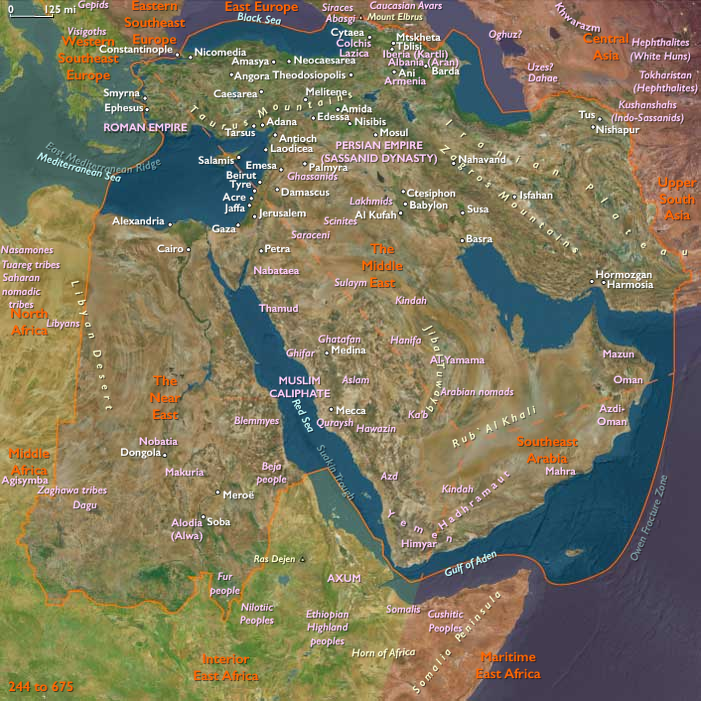
The fate of the deposed Lakhmid king Al-Nu'man III ibn al-Mundhir after his arrival at Ctesiphon is largely disputed, even in near-contemporary sources; he was either immediately executed or imprisoned for a period of time and then executed, but in 609 he is certainly dead and his former friend Iyas ibn Qabisah al-Ta'i, an Arab of the tribe of Tayy, has been installed, marking the end of the dynasty, although Nu'man's son al-Mundhir will try to revive the kingdom during the Ridda wars (632-33) and will rule the Bahrain region for a short period of eight months until he is captured.
At an indeterminate date, an open clash between the Persians and their Arab auxiliaries, on one hand, and Arab tribesmen, on the other, occurs at Dhi Qar.
According to certain Muslim traditions, the battle took place in the year 623 or 624.
Modern scholars have narrowed this range to 604-11.
Arab sources number the Persian force at two thousand soldiers, with three thousand Arabs led by Iyas ibn Qabisah.
The Arab force opposing the Persians, with their Arab auxiliaries, is from the Bakr ibn Wa'il, a large tribal confederation whose territory extends from southwestern Iraq into the eastern Arabian peninsula.
The most prominent constituent tribe is the Banu Shayban, the other groups being the Banu 'Ijl, Banū Zohl, Banu Qays ben Thalaba, Banu Taym Allah ben Thalaba, and Banu Yashkor.
These groups do not seem to have coordinated their efforts on the battlefield, nor did they have a single commander in chief.
Rather, leadership seems to have shifted among various warriors.
Nevertheless, the Banu Bakr defeat the combined Persian and Arab forces.
Some scholars, apparently influenced by the Muslim tradition, have interpreted the battle of Dhi Qar as part of a prolonged Arab rebellion against the Persians, which culminated in the Muslim conquest of the Persian empire.
As Shaybani tribesmen, led by Mosannā ben Haresa, assisted in the conquest of Iraq, it has been argued that the Bakr, and especially the Shayban, had followed a distinct anti-Sasanian policy since Dhi Qar.
Scholars have shown, however, that the Shayban who supported the Muslims and those who were prominent at Dhi Qar belonged to different, even rival clans; some Shaybani leaders allied themselves with the Persians after Dhi Qar, and others even opposed the Muslims during the conquest of Iraq.
The battle of Dhi Qar thus appears to have had ideological and symbolic meaning for the Arabs far beyond its military and political significance.