Afonso V of Portugal
King of Portugal and the Algarves
Years: 1432 - 1481
Afonso V (15 January 1432 – 28 August 1481), called the African (Portuguese: o Africano), is King of Portugal and the Algarves.
His sobriquet refers to his conquests in Northern Africa.

Related Events
Filter results
Showing 10 events out of 81 total
The Portuguese continue after the death of Prince Henry to explore the coast of Africa, but without their earlier singleness of purpose.
A dispute has arisen among the military aristocracy over whether Portugal can best achieve its strategic objectives by conquering Morocco or by seeking a sea route to India.
Duarte had continued his father's Moroccan policy and had undertaken a military campaign against Tangiers but was unsuccessful. Afonso V orders several expeditionary forces to Morocco.
In 1458 he conquers Alcazarquivir; in 1471 he takes Arzila, followed by Tangiers and Larache.
Afonso's successors continue this policy of expansion in Morocco, especially Manuel I (r. 1495-1521), who conqueras Safim and Azamor.
The Moroccan empire is expensive because it keeps Portugal in a constant state of war; therefore, it is abandoned by João III (r. 1521-57), except for Ceuta and Tangiers.
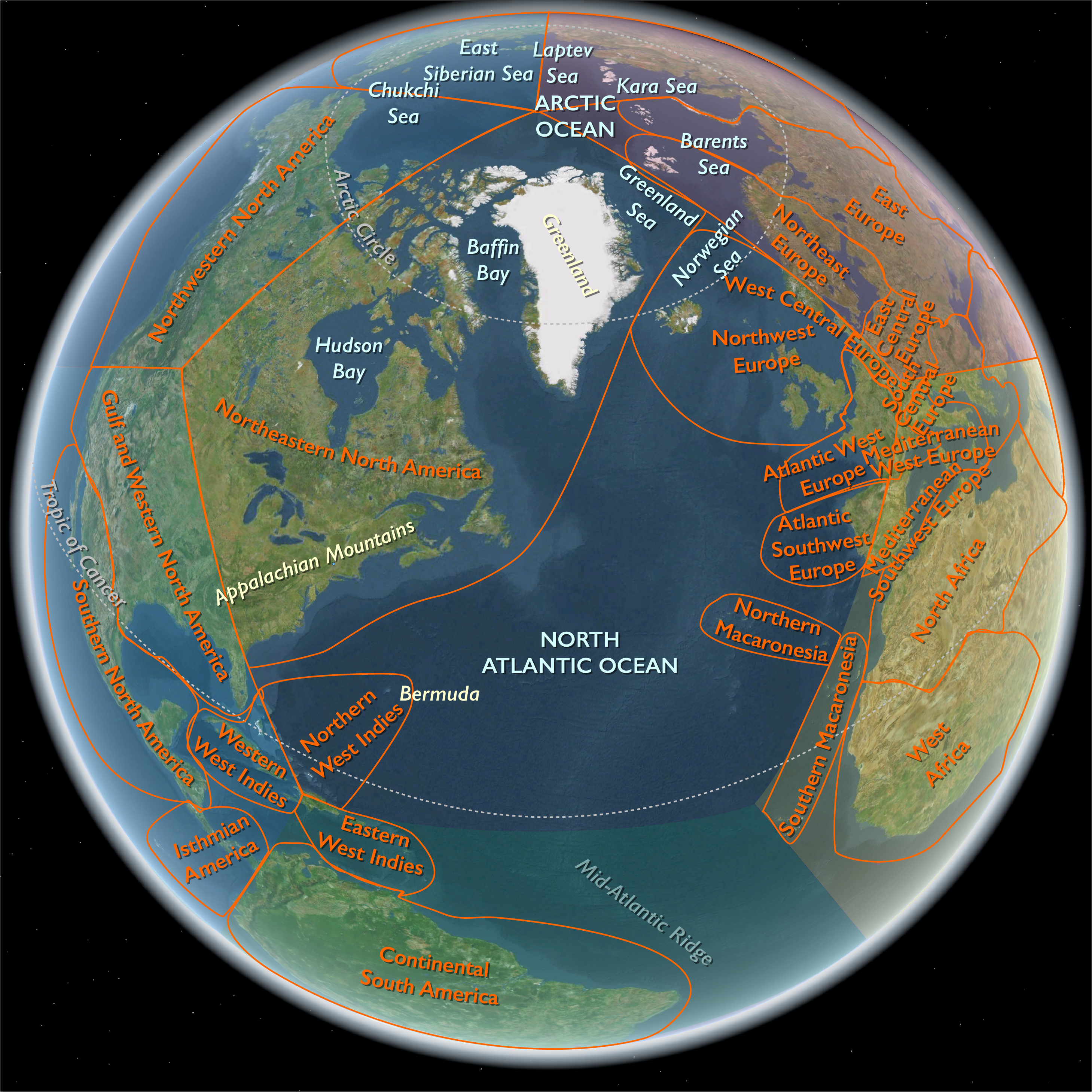
Atlantic Southwest Europe (1396–1539 CE): Estuaries, Shipyards, and the First Oceanic Empires
Geographic & Environmental Context
The subregion of Atlantic Southwest Europe includes continental Portugal and Spain’s Atlantic façade from the Gulf of Cádiz to the Bay of Biscay—the Tagus, Sado, Mondego, Douro, and Minho estuaries; Portugal’s Alentejo and Algarve coasts; Spain’s Guadalquivir–Cádiz seaboard; and the Cantabrian–Galician rías (A Coruña, Vigo, Gijón, Santander) and Basque capes (Bilbao–San Sebastián). These shorelines and river corridors bound maritime towns to grain-and-vine interiors and iron-rich uplands.
Climate & Environmental Shifts
The Little Ice Age brought cooler winters, stormier seas, and variable rains:
-
Iberian west & south coasts: more frequent Atlantic gales and bar shifts at estuary mouths (Douro, Tagus, Guadalquivir), alternately silting and scouring channels.
-
Northwest (Galicia–Asturias–Cantabria): heavy rainfall and rough seas; rich upwelling sustained fisheries.
-
Interior hinterlands: periodic droughts hit Alentejo and Andalusian cereal zones; frosts checked vines and olives in bad years; good years yielded ample wheat, wine, and oil.
Subsistence & Settlement
-
Rural belts: Wheat, rye, barley, olives, and vines; cork oak montado in Alentejo; gardens and orchards along river terraces.
-
Fisheries: Sardine and tunny on the Portuguese and Andalusian shelves; cod and whale began to matter for Basque fleets in the early 16th century. Saltworks (Aveiro, Setúbal, Cádiz) underwrote fish preservation and trade.
-
Ports & river towns: Lisbon (Tagus) and Porto (Douro); Seville and Cádiz (Guadalquivir–Cádiz); A Coruña–Vigo (rías), Santander, Bilbao and San Sebastián on the Bay of Biscay; Viana do Castelo, Figueira da Foz, Setúbal along Portugal’s coast. Urban workshops produced sails, rope, barrels, and victuals for ocean-going fleets.
Technology & Material Culture
-
Shipbuilding & navigation: The caravel (lateen rig, shoal-draft) matured on Portugal’s south coast; rounder naos carried freight across oceans. Magnetic compass, sternpost rudder, astrolabe, cross-staff, portolan charts, and toleta de marteloio tables improved blue-water navigation.
-
Maritime institutions: In Portugal, the Order of Christ’s revenues (successor to the Templars) and the crown’s Casa da Guiné and later Casa da Índia in Lisbon centralized Atlantic/Indian trade. Basque iron and timber supported Biscayan yards.
-
Urban & courtly arts: Manueline architecture (rope, coral, armillary motifs) crowned Lisbon/Belém; Mudéjar–Plateresque blended in Andalusia; guild crafts (textiles, leather, ceramics) supplied ships and cities.
Movement & Interaction Corridors
-
Estuary arteries: The Tagus, Douro, and Guadalquivir funneled grain, wine, oil, salt fish, and hides from interior plains to oceanic convoys; return flows brought spices, gold, and slaves by the early 1500s.
-
Atlantic lanes: Portugal’s Volta do Mar looped down the African coast and home via mid-ocean westerlies; Andalusian–Cantabrian coasting linked Biscay iron and salt fish to southern shipyards and markets.
-
Pilgrimage & fairs: Santiago de Compostela drew pilgrims through Galician ports; Lisbon and Seville fairs knit merchants from Italy, Flanders, and the Maghreb.
-
Imperial routes (first phase): After 1498, spice fleets sailed India–Lisbon; after 1492, Castilian fleets used the Guadalquivir–Seville corridor to the Caribbean.
Cultural & Symbolic Expressions
-
Religious life: Cathedrals and confraternities structured urban devotion; seafarers’ brotherhoods honored Our Lady of Good Voyage; shrines dotted headlands and capes (e.g., Cape St. Vincent).
-
Court and chronicle: Portuguese chronicles (Gomes Eanes de Zurara) celebrated exploration; Iberian courts patronized cartography and cosmography.
-
Communal identities: Fisher guilds, ship carpenters, ropewalkers, coopers, and salt-pan communities developed strong customs and saints’ days; Basque whalers forged distinctive sea rituals.
Environmental Adaptation & Resilience
-
Risk-spreading portfolios: Mixed farming (cereal–vine–olive), stock-raising, and salt-fish curing buffered bad harvests; riverine mills and terraces stabilized yields.
-
Harbor works: Jetties and dredging (Lisbon, Porto, Seville) fought bar siltation; salt granaries and fish warehouses bridged lean seasons.
-
Maritime provisioning: Biscayan and Portuguese fleets salted fish and whale meat; victualing yards stockpiled biscuit, wine, oil, and salted pork for oceanic voyages.
Technology & Power Shifts (Conflict Dynamics)
-
Iberian realignments: The Conquest of Ceuta (1415) opened Portugal’s North African gateway and Atlantic thrust; the War of the Castilian Succession (1475–1479)—including the Battle of Toro (1476)—ended with the Treaty of Alcáçovas (1479), fixing early Atlantic spheres between Castile and Portugal. The Treaty of Tordesillas (1494) divided extra-European worlds meridionally.
-
Oceanic breakout: Vasco da Gama’s voyage (1497–1499) linked the Tagus to India; Pedro Álvares Cabral (1500) reached Brazil; Portugal’s Estado da Índia took shape after the Battle of Diu (1509) and the Capture of Malacca (1511), routing Eastern spices to Lisbon.
-
Castile’s Atlantic: From 1492, Columbus’s voyages (out of Palos/Cádiz) opened Caribbean routes; Seville’s Casa de la Contratación (from 1503) regulated fleets.
-
Privateering & defense: Biscay–Galician coasts armed against English, Breton, and Norman raiders; corsair warfare flickered in the Bay of Biscay and off the Algarve.
Transition
By 1539 CE, Atlantic Southwest Europe had transformed from a cluster of estuarine towns into the launchpad of two oceanic empires. Lisbon and Seville–Cádiz rose as global entrepôts; Biscayan and Galician ports provisioned fleets and pioneered whaling and Atlantic cod. Inland cereals, vines, and olives still fed the system, but caravel and nao had redrawn horizons—binding Iberian estuaries to Africa, Asia, and the Americas, and setting the stage for a sixteenth century of maritime hegemony and imperial rivalry.
The Regency Struggle and the Afonsine Ordinances (1433–1446)
Following the death of King João I of Portugal in 1433, the crown passed to his eldest son, Duarte I, whose brief five-year reign (1433–1438) was cut short by the plague. His death left the kingdom in political uncertainty, as his heir, Afonso V, was only six years old.
Duarte I’s Reforms and the Afonsine Ordinances
- Before his death, Duarte had convened a Cortes to begin the compilation of Portuguese royal law.
- This legal work would not be completed until the reign of Afonso V, when it was published as the Afonsine Ordinances (Ordenações Afonsinas).
- Duarte also declared that the land grants given by his father João I must be confirmed at the start of each reign, ensuring royal authority over noble holdings.
The Struggle for the Regency (1438–1446)
Upon Duarte’s death in 1438, his widow, Queen Eleanor of Aragon, assumed the regency, but she faced strong opposition from the nobility and the populace, who refused to accept a woman as sole ruler.
The Rival Factions
-
Infante Pedro, Duke of Coimbra (Duarte’s brother)
- Popular in Lisbon and supported by the merchants and middle class.
- A skilled administrator and advocate for strong royal authority over the nobility.
- Sought to strengthen his influence by marrying his daughter Isabel to the young King Afonso V.
-
Afonso, Duke of Bragança (João I’s eldest illegitimate son)
- Leader of the old nobility, including those who had gained extensive land grants under João I.
- Opposed Pedro’s regency, as he feared it would curb noble privileges.
- Attempted to secure power by marrying his own daughter to Afonso V.
Pedro’s Victory and Regency (1439–1448)
- The Lisbon populace strongly favored Infante Pedro, and he was officially recognized as regent after convening the Cortes of Évora in 1439.
- To secure his position, he arranged for his daughter, Isabel of Coimbra, to marry Afonso V once the young king reached his majority.
- When Afonso V turned 14 in 1446, he upheld the marriage agreement and requested Pedro to continue governing.
Aftermath and Future Conflicts
- Although Pedro remained in power, tensions with Afonso, Duke of Bragança, did not subside.
- When Afonso V fully assumed power in 1448, Bragança’s faction maneuvered to have Pedro removed.
- This power struggle would ultimately lead to the Battle of Alfarrobeira in 1449, where Pedro was killed, marking the triumph of the nobility over royal centralization.
The Afonsine Ordinances, the Lisbon merchants’ support for Pedro, and the ducal rivalry between Pedro and Bragança all shaped the political structure of Portugal for decades, reinforcing tensions between royal authority and aristocratic power.
John II of Portugal (r. 1481–1495): The Subjugation of the Nobility and the Triumph of the Crown
When John II of Portugal ascended the throne in 1481, the House of Bragança and its noble allies had reached the height of their power, dominating the Portuguese state and rivaling the authority of the Crown. However, unlike his father, Afonso V, John II was a decisive and ruthless monarch who sought to reassert royal supremacy over the nobility, reshaping the political structure of Portugal for generations.
The Cortes of Évora (1481–1482): Strengthening Royal Power
- Upon taking the throne, John II convened a cortes at Évora, where he introduced sweeping reforms to weaken the power of the nobility.
- The nobles were forced to swear a new written oath, pledging to surrender any castles or towns they held from the Crown.
- Commoners complained about abuses by the nobility, including:
- Private justice (where noble lords acted as independent rulers in their territories).
- Corrupt tax collection practices that burdened the peasantry.
- In response, John II ordered an investigation into noble estates, requiring:
- All nobles to present their titles of privilege for review.
- Royal constables to inspect their territories for administrative abuses.
These measures were direct attacks on aristocratic privilege, setting the stage for conflict between the Crown and the nobility.
The Conspiracy of the Duke of Bragança and His Execution (1483–1484)
- Fernando II, Duke of Bragança, head of the most powerful noble house in Portugal, led a noble conspiracyagainst the king.
- He sought support from John II of Castile, planning to undermine John II’s rule.
- However, John II uncovered the treasonous correspondence, leading to:
- Fernando’s arrest and trial in Évora.
- A swift conviction for treason and his execution by beheading on June 29, 1484, in the main square of Évora.
- The king confiscated the Bragança estates, effectively dismantling their territorial power.
- Other conspirators were also executed, imprisoned, or forced into exile.
The Duke of Viseu’s Conspiracy and the Final Blow to the Nobility (1484–1485)
- A second plot emerged, this time led by Diogo, Duke of Viseu, another powerful noble with royal connections.
- The conspiracy was quickly discovered, and John II personally intervened to eliminate the threat.
- In Setúbal, the duke of Viseu was killed—possibly by the king’s own hand, in a direct demonstration of royal authority.
The Supremacy of the Crown Over the Nobility
With the House of Bragança crushed and the Duke of Viseu eliminated, John II had firmly established royal supremacy:
- The nobility’s independent power was destroyed, ensuring that no noble house could challenge the Crown again.
- Portugal transitioned into a centralized monarchy, with the king as the absolute ruler.
- The confiscation of noble lands allowed the Crown to expand its wealth and resources, strengthening Portugal’s imperial ambitions and exploration efforts.
John II’s brutal but effective policies laid the groundwork for Portugal’s golden age, ensuring that the kingdom remained a strong, centralized, and dominant power on the world stage.
The Battle of Alfarrobeira (1449): The Fall of Infante Pedro and the Rise of the House of Bragança
Following Afonso V’s assumption of full power in 1448, the Duke of Bragança successfully turned the young king against his uncle, Infante Pedro, Duke of Coimbra, claiming that Pedro was plotting to seize the throne. This manipulation led to Pedro’s dismissal from the regency and his exile to his estates.
Pedro’s Attempt to Regain Power
- As rumors of a plot against him spread, Pedro decided to resist rather than submit.
- He marched on Lisbon, where he enjoyed strong support from the merchants and populace.
- Afonso V, under the influence of the House of Bragança, declared Pedro a traitor and gathered an army to confront him.
The Battle of Alfarrobeira (May 24, 1449)
- Pedro’s army met the royalist forces, led by Afonso V and the Duke of Bragança, near Alfarrobeira, north of Lisbon.
- The battle was swift and decisive—Pedro was killed on the field, and his forces were crushed.
- The defeat eliminated the greatest advocate for strong royal authority, leaving Afonso V heavily influenced by the Bragança family.
Consequences of Pedro’s Defeat
-
The Rise of the House of Bragança
- The House of Bragança emerged as the dominant noble house in Portugal, vastly increasing its land, wealth, and political influence.
- The Braganças became "a state within a state", controlling vast territories and challenging the power of the monarchy.
-
Afonso V Becomes a Puppet of the Nobility
- Without Pedro’s guidance, the pliable Afonso V fell under the control of the nobility, particularly the Braganças.
- His reign was characterized by military adventures in Morocco and Castile, often influenced by aristocratic ambitions.
-
Weakening of Royal Centralization
- Pedro’s defeat marked a victory for the aristocracy over royal authority.
- The monarchy remained dependent on noble factions until later kings, such as John II (r. 1481–1495), took steps to curb noble power.
Legacy: The Path to Future Conflict
- The Battle of Alfarrobeira (1449) ensured the dominance of the House of Bragança, but it also set the stage for future confrontations between the Crown and the nobility.
- By the time John II ascended the throne in 1481, he saw the Braganças as a direct threat to the monarchy and took drastic measures to reduce their influence, culminating in the execution of the 3rd Duke of Bragança in 1483.
Thus, the Battle of Alfarrobeira was a turning point in Portuguese history, reinforcing aristocratic power at the expense of the Crown, but also laying the groundwork for future monarchical reforms and conflicts.
Atlantic Southwest Europe (1432–1443 CE): Portuguese Maritime Advances and Early Renaissance Humanism, Castilian Political Stability under John II, and Navarrese Diplomatic Prudence
Between 1432 and 1443 CE, Atlantic Southwest Europe—including Galicia, northern and central Portugal, Asturias, Cantabria, and northern Spain south of the Franco-Spanish border (43.05548° N, 1.22924° W)—experienced decisive advances in Portuguese maritime exploration and early Renaissance cultural developments, sustained governance stability and emerging humanist influences in Castile, and careful diplomatic continuity in Navarre. This era laid crucial foundations for the broader Iberian Renaissance, enhanced regional economic prosperity, and strengthened political coherence throughout the region.
Political and Military Developments
Portuguese Maritime Exploration and Overseas Expansion
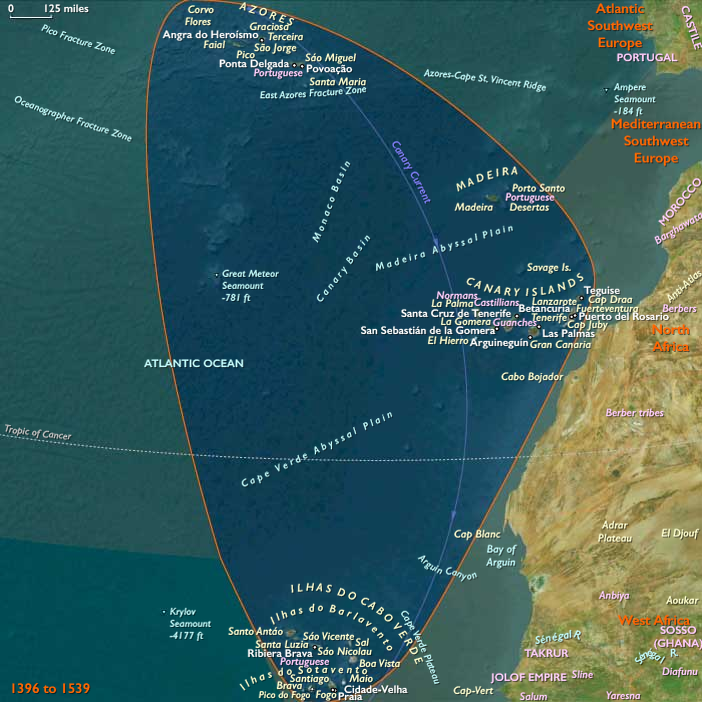
Under the stable rule of King Duarte I (1433–1438 CE) and subsequently King Afonso V (1438–1481 CE)—both strongly influenced by their uncle, Prince Henry the Navigator—Portuguese maritime expansion intensified significantly. During this era, Portuguese explorers systematically charted the West African coast, expanding trade networks and securing the Atlantic islands (Azores, Madeira, and Cape Verde). This decisive expansion laid crucial economic, strategic, and cultural foundations for Portugal’s future global empire.
Castilian Governance Stability under John II
Castile, governed effectively by King John II (1406–1454 CE), enjoyed sustained political stability and administrative coherence. During this period, John II effectively contained aristocratic factionalism and significantly strengthened royal authority, consolidating Castilian governance, territorial integrity, and economic prosperity. His court increasingly engaged with early humanist scholars and cultural influences, setting crucial intellectual foundations for Castile’s future Renaissance.
Navarrese Diplomatic Prudence under Queen Blanche I
Navarre, under Queen Blanche I (1425–1441 CE) and subsequently her husband, King John II of Aragón (from 1425 onward as co-ruler), decisively maintained diplomatic neutrality and careful governance. Navarre’s rulers skillfully balanced political relationships with Castile, Aragón, and France, significantly preserving territorial autonomy, internal stability, and geopolitical coherence through prudent diplomacy.
Economic Developments
Agricultural Stability and Economic Prosperity
Regional agriculture decisively remained robust, supported by diversified cultivation—especially grain, vineyards, olives, citrus fruits, and almonds—and consistent livestock production. Mining (gold and silver, notably from Galicia and Asturias) remained economically significant, decisively supporting regional economic resilience and demographic stability.
Expansion of Portuguese Maritime Trade Networks
Portuguese maritime trade decisively expanded, notably through the ports of Lisbon, Porto, Braga, and Coimbra. Systematic exploration of Africa and the Atlantic islands significantly enhanced commercial exchanges with northern Europe (England, Flanders, Normandy, Brittany) and established Portugal as an emerging maritime power, reinforcing regional economic prosperity.
Pilgrimage Economy and Regional Vitality in Galicia
The pilgrimage route to Santiago de Compostela continued decisively to support regional economic vitality, bolstering hospitality industries, artisanal commerce, infrastructure projects, and cultural exchanges. Persistent pilgrimage activity significantly reinforced Galicia’s economic resilience and international prominence.
Cultural and Religious Developments
Early Portuguese Renaissance and Humanist Scholarship
Portuguese cultural and intellectual life flourished significantly, decisively influenced by early humanist scholarship and sustained royal patronage. Under Duarte I and the young Afonso V, scholars, artists, and humanist thinkers—benefiting from increased contacts with Italy and northern Europe—shaped Portuguese educational reforms, literary traditions, scientific inquiry, and artistic expression, marking a clear beginning of Portugal’s Renaissance era.
Castilian Intellectual Continuity and Early Renaissance Humanism
Castilian culture remained decisively vibrant, significantly shaped by early humanist influences facilitated by growing connections with Italian scholars and broader European intellectual circles. Under King John II, Castilian literary and scholarly traditions experienced renewal and innovation, establishing foundational elements for the subsequent Spanish Renaissance.
Galician Cultural Resilience and Ecclesiastical Patronage
Galicia maintained significant cultural prominence, decisively supported by ecclesiastical authorities of Santiago de Compostela and monastic communities. Scholarly initiatives, manuscript preservation, and significant artistic and architectural projects continued, reinforcing Galicia’s cultural identity and international visibility.
Persistent Cultural Syncretism and Local Traditions
Orthodox Christianity consistently integrated indigenous Iberian and Celtic traditions, particularly in rural Galicia and northern Portugal. This persistent cultural syncretism decisively reinforced regional identities, social cohesion, and cultural resilience during this transformative era.
Civic Identity and Governance
Portuguese Civic Unity and Global Ambitions
Portugal decisively reinforced civic unity, national identity, and governance stability under Duarte I and Afonso V. Maritime explorations significantly shaped Portuguese collective ambitions, decisively laying foundations for future global influence, cultural patronage, and economic prosperity.
Castilian Governance Stability and Intellectual Foundations
Under John II, Castile decisively maintained governance stability, territorial coherence, and effective administrative reforms. Strengthened royal authority significantly influenced Iberian geopolitical stability, civic unity, and early humanist cultural foundations, shaping the region’s intellectual heritage.
Navarrese Regional Autonomy and Diplomatic Stability
Navarre decisively preserved regional autonomy, diplomatic neutrality, and internal governance stability under Queen Blanche I and King John II of Aragón. Their cautious diplomatic approach significantly maintained territorial integrity, internal coherence, and northern Iberian geopolitical stability throughout the era.
Notable Regional Groups and Settlements
-
Portuguese: Experienced decisive maritime expansion, early humanist scholarship, and cultural patronage under Duarte I, Afonso V, and Prince Henry the Navigator, significantly shaping Portugal’s enduring historical trajectory.
-
Castilians: Maintained governance stability, territorial integrity, and intellectual continuity under John II, significantly influencing Iberian political, economic, and cultural developments.
-
Galicians: Sustained vibrant economic prosperity, cultural vitality, and ecclesiastical prominence, significantly reinforced by pilgrimage activity and maritime commerce.
-
Basques (Navarre): Preserved regional autonomy, diplomatic neutrality, and stable governance under Blanche I and John II of Aragón, significantly shaping northern Iberian political coherence.
Long-Term Significance and Legacy
Between 1432 and 1443 CE, Atlantic Southwest Europe:
-
Significantly advanced Portuguese maritime exploration, global commercial expansion, and early Renaissance humanist scholarship, decisively setting foundations for Portugal’s subsequent global empire and cultural flourishing.
-
Achieved sustained Castilian governance stability, territorial integrity, and intellectual continuity, laying crucial groundwork for the later Spanish Renaissance.
-
Maintained Navarrese diplomatic prudence, territorial autonomy, and governance stability under Blanche I, significantly influencing northern Iberian geopolitical coherence.
-
Experienced resilient agricultural prosperity, expanded maritime commerce, pilgrimage-driven economic vitality, and early cultural renaissance, profoundly shaping regional historical trajectories.
This transformative era decisively shaped regional identities, governance structures, economic continuity, cultural resilience, and intellectual foundations, profoundly influencing Atlantic Southwest Europe’s trajectory toward the full flowering of the Iberian Renaissance.
The Death of King Edward and the Regency Struggle (1438–1448)
King Edward of Portugal (Duarte I, r. 1433–1438), a scholarly and deeply moral ruler, earned the title "the philosopher-king" and authored O Leal Conselheiro ("The Loyal Counselor"), a reflection on ethics and governance. His reign, however, was overshadowed by the disastrous 1437 Tangier expedition, which led to the capture of his youngest brother, Prince Fernando ("the Holy Prince").
Grief-stricken and weakened by the plague, Edward died in Tomar on September 9, 1438, before his brother Henry the Navigator could return from North Africa. His six-year-old son, Afonso V, became king—the third consecutive ruler from the House of Avis, also known as the Joanina (Johannine) dynasty.
The Regency Crisis: Pedro vs. Leonor (1438–1439)
Since Afonso V was only six, a regent was needed, and two rival factions emerged:
-
Infante Pedro, Duke of Coimbra
- Second son of King John I, experienced in governance.
- Supported by the Portuguese nobility and urban elites.
- Advocated royal centralization and continued overseas expansion.
-
Queen Mother Leonor of Aragon
- Opposed Pedro’s regency, fearing he would sideline her influence.
- Sought to govern herself or install Henry the Navigator as regent.
- Deeply unpopular in Lisbon, where the people distrusted foreign influence.
Henry the Navigator’s Neutral Role
- Henry had no desire to rule and sought to avoid the family conflict.
- He attempted to mediate peace between Pedro and Leonor, but failed.
- Instead, he supported Pedro, recognizing his governing abilities.
Resolution of the Crisis (1439)
- The Lisbon populace opposed Leonor, favoring Pedro as regent.
- The Cortes of 1439 formally appointed Pedro as Regent of Portugal.
- Queen Leonor, facing overwhelming opposition, left the country, easing tensions.
Pedro’s Regency (1439–1448)
- As regent, Pedro focused on:
- Strengthening royal authority over the aristocracy.
- Protecting Portuguese maritime expansion.
- Educating young Afonso V, preparing him for kingship.
However, his regency would ultimately lead to conflict with the nobility, particularly with the House of Bragança, culminating in the Battle of Alfarrobeira (1449).
Thus, the death of Edward in 1438 led to a tense power struggle, but also allowed Prince Henry the Navigator to return to Sagres and focus on exploration, shaping Portugal’s future maritime dominance.
Afonso, Count of Barcelos and the First Duke of Bragança: Founder of a Dynasty
Afonso, Count of Barcelos (later 1st Duke of Bragança) was a key figure in 15th-century Portugal, playing a central role in aristocratic politics and establishing the House of Bragança, which would become Portugal’s most powerful noble family.
Birth and Early Life
- Born in Veiros, Estremoz, Alentejo, Afonso was a natural son of King John I of Portugal and Inês Pires Esteves.
- Despite his illegitimacy, Afonso was raised in the royal court and became an influential noble.
- He married Beatriz Pereira de Alvim, daughter of Nuno Álvares Pereira, Portugal’s greatest military leader and its wealthiest landowner, greatly increasing his wealth and status.
Military and Political Career
- Afonso was present at the 1415 conquest of Ceuta, a pivotal event in Portugal’s overseas expansion.
- As a cultivated and well-traveled noble, he gained considerable influence at court.
- When his half-brother, King Edward I (Duarte), died in 1438, a political struggle emerged over the regency of the young Afonso V:
- The Queen Mother, Eleonor of Aragon, was initially chosen as regent, but she was deeply unpopular due to her Aragonese origins.
- The Portuguese Cortes, convened by Afonso’s half-brother John, Lord of Reguengos de Monsaraz, selected Infante Peter, Duke of Coimbra, as regent, a choice favored by the burghers and lower nobility.
- However, Afonso and his aristocratic allies preferred Eleonor, fearing that Peter’s reformist policies would curtail noble privileges.
The Struggle for Power and the Creation of the Duchy of Bragança
- Afonso maneuvered to gain influence over Afonso V, competing with Peter of Coimbra for the young king’s favor.
- In 1443, in a gesture of reconciliation, Peter granted Afonso the title of Duke of Bragança, making him the first duke in Portugal.
- This new duchy, along with the Duchy of Coimbra (Peter’s) and the Duchy of Viseu (Henry’s), became one of Portugal’s first three noble duchies.
The Rise of the House of Bragança
- The House of Bragança quickly became the most powerful noble family in Portugal, accumulating immense landholdings and wealth.
- Over time, the Braganças became so powerful that they often rivaled the monarchy itself.
- In 1640, the 8th Duke of Bragança, João IV, led the Portuguese Restoration War against Spain and became King of Portugal, establishing the Bragança dynasty, which ruled Portugal until 1910.
Legacy
- Afonso’s strategic marriage and political maneuvering made the House of Bragança the most influential aristocratic family in Portugal.
- His descendants would challenge kings, amass vast fortunes, and eventually ascend to the throne.
- His creation as Duke of Bragança in 1443 shaped Portuguese politics for centuries, reinforcing the balance of power between monarchy and nobility.
Thus, Afonso’s legacy as the founder of the House of Bragança ensured that his lineage would play a dominant role in Portuguese history, ultimately ruling the nation for nearly three centuries.
Atlantic Southwest Europe (1444–1455 CE): Portuguese Maritime Dominance and Humanist Flourishing, Castilian Political Tensions under John II, and Navarrese Diplomatic Realignment
Between 1444 and 1455 CE, Atlantic Southwest Europe—including Galicia, northern and central Portugal, Asturias, Cantabria, and northern Spain south of the Franco-Spanish border (43.05548° N, 1.22924° W)—experienced accelerated Portuguese maritime expansion and cultural renewal through Renaissance humanism, increasing internal tensions within Castile’s aristocracy under the later reign of King John II, and careful diplomatic realignment in Navarre. These developments significantly influenced regional governance stability, economic prosperity, cultural exchanges, and decisively set the stage for the full Iberian Renaissance in subsequent decades.
Political and Military Developments
Portuguese Maritime Dominance and Overseas Expansion
Under the youthful yet ambitious King Afonso V (1438–1481 CE) and continued guidance from Prince Henry the Navigator, Portuguese maritime exploration expanded significantly. Portuguese explorers reached Cape Verde (1444) and later extended influence down Africa’s western coast, establishing trading posts and fortifications. By 1455, Portugal decisively dominated Atlantic exploration and trade, setting a strong foundation for global empire-building.
Castilian Aristocratic Tensions under John II
Castile, under the later reign of King John II (1406–1454 CE), experienced heightened internal aristocratic conflicts, particularly involving powerful noble families and factions vying for influence. Despite these tensions, John II’s administration decisively preserved Castilian territorial coherence and governance structures. His death in 1454 resulted in the accession of his son, Henry IV (1454–1474 CE), whose reign began with challenges inherited from these internal aristocratic struggles.
Navarrese Diplomatic Realignment under John II of Aragón
In Navarre, following Queen Blanche I’s death in 1441, her husband, John II of Aragón (1425–1479 CE as co-ruler) decisively assumed sole governance. His rule involved careful diplomatic realignment, increasingly emphasizing ties with Aragón. Despite tensions with Navarrese nobility over internal administration, he preserved Navarre’s territorial autonomy and regional stability through cautious diplomatic maneuvering with Castile, Aragón, and France.
Economic Developments
Agricultural Prosperity and Rural Stability
Agricultural productivity remained strong, decisively supported by diversified crops—grain, olives, vineyards, citrus fruits, almonds—and robust livestock production. Mining activities (notably gold and silver in Galicia and Asturias) and artisanal crafts significantly reinforced regional economic resilience and demographic stability.
Portuguese Maritime Trade and Atlantic Commerce
Portuguese maritime trade decisively flourished through the ports of Lisbon, Porto, Braga, and Coimbra, increasingly dominating Atlantic commerce routes. Trading posts along Africa’s coast and the exploration of the Cape Verde islands significantly enhanced Portugal’s economic prosperity and maritime influence. Galicia, particularly through ports like A Coruña, continued vibrant trade, reinforcing regional economic resilience.
Pilgrimage Economy and Regional Vitality
Pilgrimage routes to Santiago de Compostela continued to support sustained regional economic vitality through hospitality industries, artisanal commerce, infrastructure projects, and cultural exchanges. Persistent pilgrimage activity significantly reinforced Galicia’s economic stability and international recognition.
Cultural and Religious Developments
Portuguese Renaissance and Humanist Flourishing
Portugal decisively advanced in Renaissance humanist scholarship under King Afonso V. Increasingly robust cultural exchanges with Italian city-states and northern Europe deepened humanist influences on literature, education, architecture, philosophy, and scientific inquiry. Portuguese intellectual life flourished through courtly patronage, scholarly institutions, and maritime exploration literature, laying critical foundations for Portugal’s mature Renaissance era.
Castilian Cultural Continuity and Early Humanist Influence
Despite internal political tensions, Castilian culture remained vibrant, decisively influenced by early humanist contacts, especially from Italy. Intellectual exchanges and scholarly patronage shaped Castilian literature, educational reforms, and philosophical inquiry, laying essential groundwork for the later Spanish Renaissance.
Galician Cultural and Ecclesiastical Patronage
Galicia maintained significant cultural prominence, decisively supported by ecclesiastical authorities of Santiago de Compostela and monastic communities. Scholarly initiatives, manuscript preservation, artistic patronage, and architectural projects continued, reinforcing Galicia’s cultural identity and international visibility.
Persistent Cultural Syncretism and Local Traditions
Orthodox Christianity consistently integrated indigenous Iberian and Celtic traditions, particularly in rural Galicia and northern Portugal. Persistent cultural syncretism decisively reinforced regional identities, social cohesion, and cultural resilience during this transformative era of maritime expansion and humanist flourishing.
Civic Identity and Governance
Portuguese Civic Unity and Global Ambitions
Portugal decisively reinforced civic unity, national identity, and governance stability under King Afonso V and Prince Henry the Navigator. Maritime explorations and overseas ambitions significantly shaped Portuguese civic identity and laid foundations for global empire-building and cultural flourishing.
Castilian Governance Resilience amid Internal Tensions
Despite internal aristocratic tensions during John II’s later reign, Castile decisively maintained territorial integrity, governance stability, and regional coherence. Effective administration structures significantly preserved Castilian civic identity and set conditions for future governance consolidation under Henry IV.
Navarrese Regional Autonomy and Diplomatic Stability
Navarre decisively preserved regional autonomy, diplomatic stability, and governance coherence under John II of Aragón. Careful diplomatic maneuvering significantly maintained territorial integrity, internal coherence, and northern Iberian geopolitical stability.
Notable Regional Groups and Settlements
-
Portuguese: Experienced decisive maritime dominance, economic expansion, and cultural renewal through Renaissance humanist influences under King Afonso V, significantly shaping Portugal’s historical trajectory and future global influence.
-
Castilians: Maintained decisive governance stability, territorial integrity, and cultural continuity despite internal political tensions under John II, significantly influencing Iberian political and intellectual developments.
-
Galicians: Sustained vibrant economic prosperity, cultural vitality, and ecclesiastical prominence, significantly reinforced by pilgrimage activity and maritime commerce.
-
Basques (Navarre): Preserved regional autonomy, diplomatic neutrality, and stable governance under John II of Aragón, significantly shaping northern Iberian political coherence.
Long-Term Significance and Legacy
Between 1444 and 1455 CE, Atlantic Southwest Europe:
-
Achieved decisive Portuguese maritime expansion, global commercial dominance, and deepening Renaissance humanist scholarship, significantly setting foundations for Portugal’s subsequent global empire and cultural flourishing.
-
Maintained Castilian governance resilience, territorial integrity, and cultural continuity despite internal aristocratic struggles, laying important groundwork for the later Spanish Renaissance.
-
Preserved Navarrese diplomatic prudence, territorial autonomy, and governance stability under John II of Aragón, significantly influencing northern Iberian geopolitical coherence.
-
Experienced sustained agricultural prosperity, expanded maritime commerce, pilgrimage-driven economic vitality, and vibrant cultural renewal, profoundly shaping regional historical trajectories.
This transformative era decisively shaped regional identities, governance structures, economic continuity, cultural resilience, and intellectual foundations, profoundly influencing Atlantic Southwest Europe’s trajectory toward the full flowering of the Iberian Renaissance.
Atlantic Southwest Europe: Maritime Dominance and Regional Struggles (1444–1455)
Between 1444 and 1455, Atlantic Southwest Europe underwent critical transformations marked by Portuguese maritime breakthroughs, persistent political strife in Castile, and contested successions in Navarre. This era saw heightened economic prosperity linked to overseas expansion, contrasted with enduring internal rivalries that reshaped political dynamics across the region.
Political and Military Developments
-
Portugal:
- Under regent Infante Pedro, Duke of Coimbra (1439–1448), maritime exploration expanded significantly, culminating in expeditions past Cape Verde (1444) and establishing Portugal’s claim over African coastal trade routes.
- After a brief civil conflict, King Afonso V (r. 1438–1481) ended Pedro’s regency violently in 1449, shifting Portugal’s internal politics toward increased royal centralization and expansionist ambitions.
-
Northern Castile and León:
- Ongoing instability under King Juan II of Castile (r. 1406–1454) intensified due to the influential minister Álvaro de Luna’s controversial control, leading to escalating feuds among noble factions and weakening royal authority in northern provinces.
- The execution of Álvaro de Luna (1453) brought temporary calm, yet political fragmentation persisted, allowing greater regional autonomy in territories such as Galicia, Asturias, and the Basque Country.
-
Navarre:
- Succession crises intensified under Charles, Prince of Viana, whose disputed inheritance after Queen Blanche’s death (1441) drew Navarre into deeper conflict, particularly with the ambitions of John II of Aragon, destabilizing governance and increasing external interference in Navarrese politics.
Economic and Maritime Expansion
-
Portuguese Trade Networks:
- Portuguese expeditions along West Africa’s coast led to significant economic gains from gold, ivory, and slave trade, consolidating Lisbon as a thriving Atlantic port and financial hub.
- Madeira’s sugar plantations, established in prior decades, matured into prosperous enterprises, significantly influencing future patterns of plantation agriculture and Atlantic commerce.
-
Urban and Commercial Vitality:
- Atlantic ports in northern Iberia, notably Bilbao and Santander, benefited from trade stability, especially with northern Europe, strengthening their economic standing despite Castilian political fragmentation.
- Basque maritime traditions flourished through shipbuilding and fisheries, reinforcing the region’s economic independence and international trade connections.
Cultural and Social Developments
-
Intellectual Growth and Humanism:
- Portuguese courts embraced Renaissance humanism and maritime innovation, sponsoring mapmakers, astronomers, and navigators such as Diogo Gomes and Alvise Cadamosto, whose work refined Europe’s geographic knowledge.
- Cultural exchanges through pilgrimage routes to Santiago de Compostela continued to foster literary and scholarly interactions across the Pyrenean territories.
-
Regional Identity and Autonomy:
- Basque territories and northern Navarre reinforced traditional legal privileges (fueros), promoting distinctive regional identities and autonomy amid Castile’s internal struggles.
- Galicia and Asturias preserved vibrant local cultures, resisting centralized pressures through the strength of traditional communal institutions and networks centered around religious and cultural hubs.
Significance and Legacy
The years 1444–1455 marked a significant juncture in Atlantic Southwest Europe's trajectory, consolidating Portugal’s ascendancy as a maritime power while deepening internal divisions within Castile. The period shaped critical economic patterns through expanded Atlantic commerce and set the stage for further Portuguese global exploration. Simultaneously, the struggle for regional autonomy in northern Spain—particularly in Navarre and the Basque territories—established enduring political and cultural frameworks that would continue influencing the region’s historical evolution.