Afonso I of Portugal
King of Portugal
Years: 1106 - 1185
Afonso I (1106/ 25 July 1109 /1111 – 6 December 1185), nicknamed "the Conqueror" (Portuguese: O Conquistador), "the Founder" (O Fundador) or "the Great" (O Grande) by the Portuguese, and El-Bortukali [in Arabic ("the Portuguese") and Ibn-Arrink [in Arabic ("son of Henry", "Henriques") by the Moors whom he fights, is the first King of Portugal.
He achieves the independence of the southern part of the Kingdom of Galicia, the County of Portugal, from Galicia's overlord, the King of León, in 1139, establishing a new kingdom and doubling its area with the Reconquista, an objective that he pursues until his death, in 1185, after forty-six years of wars against the Moors.


Related Events
Filter results
Showing 10 events out of 17 total
The Final Stages of the Portuguese Reconquista (1185–1249 CE)
The Portuguese Reconquista progresses under the successive reigns of Sancho I, Afonso II, Sancho II, and Afonso III, gradually pushing the Muslim frontier southward until Portugal reaches its modern territorial limits.
Sancho I (r. 1185–1211) and Early Southern Campaigns
As the son and heir of Afonso Henriques, Sancho I continues his father’s military campaigns, expanding Portuguese control in the Algarve:
- 1189 – Sancho captures the castle at Alvor, the city of Silves, and the castle at Albufeira.
- However, these territories are soon retaken by the Muslims, requiring future monarchs to reconquer them.
Afonso II (r. 1211–1223) and the Battle of Navas de Tolosa
Sancho I’s son, Afonso II, launches new campaigns in the Alentejo, with the support of his brother-in-law, Alfonso VIII of Castile:
- 1212 – Afonso II participates in the Battle of Navas de Tolosa, a decisive Christian victory that weakens Muslim power in Iberia.
- 1217 – He takes part in the siege and conquest of Alcácer do Sal, one of the largest strongholds in the Alentejo.
Sancho II (r. 1223–1248) and the Algarve Campaigns
Under Sancho II, the Reconquista advances into the Algarve, where major battles take place:
- 1238 – His forces defeat Muslim armies at Tavira and Cacela, further expanding Portuguese control southward.
Afonso III (r. 1248–1279) and the Final Conquest
The final stage of the Reconquista occurs under Afonso III, who:
- 1249 – Launches a campaign against the last Muslim enclave in the Algarve, capturing Faro and securing Portugal’s southern coastline.
This last battle officially completes the Portuguese Reconquista, defining the territorial boundaries of Portugal, which have remained largely unchanged ever since.
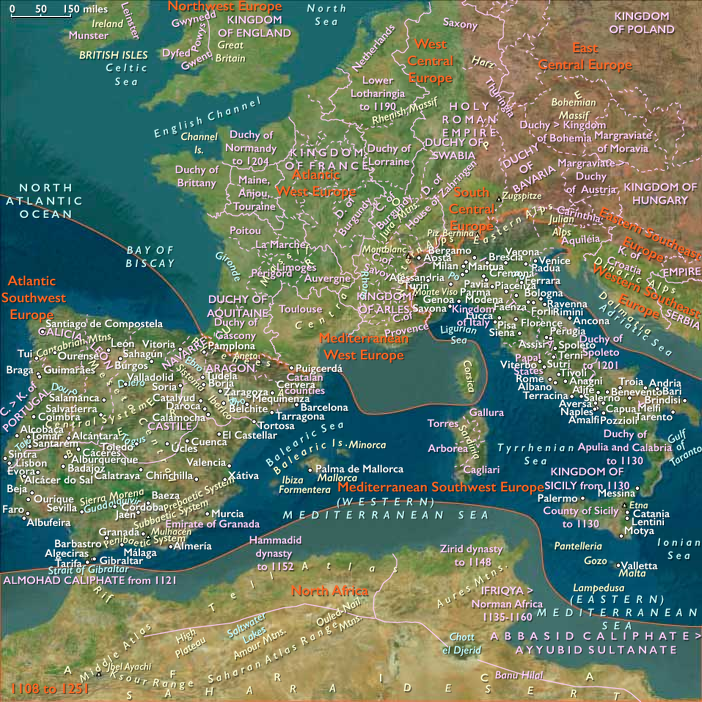
Atlantic Southwest Europe (1108 – 1251 CE): Independent Portugal, Castilian Expansion, and Basque Shipyards
Climate and Environmental Shifts
-
Generally favorable, with localized droughts on the Meseta; Atlantic façade remained cool–wet and fish-rich.
Societies and Political Developments
-
Portugal achieved independence under Afonso I (r. 1139–1185); Coimbra and Lisbon (1147) anchored the realm, while Minho/Trás-os-Montes consolidated.
-
León and Castile alternated union and separation (e.g., Alfonso VII, then Ferdinand II in León, Alfonso VIII in Castile); northern cities (León, Burgos, Salamanca, Valladolid) expanded jurisdiction and markets.
-
Navarre remained an independent Pyrenean crown; Basque valleys deepened self-governance under fueros.
Economy and Trade
-
Cantabrian ports (notably Bilbao’s estuary even before its 1300 charter) exported iron bars, timber, wine, and hides; Lisbon/Porto handled wine, salt fish, and cloth.
-
Basque shipyards innovated ocean-capable hulls and stern rudders; long-range whaling and cod probing began in the 12th–13th centuries.
-
Fair circuits connected León–Burgos–Sahagún to ports; Douro wine and Beira textiles moved coastwise.
Subsistence and Technology
-
Terracing in vine districts; hydraulic mills and riverine warehouses; standardized casks for wine/salt fish; improved compasses and portolans circulated via Italian pilots.
Movement and Interaction Corridors
-
Sea lanes: Lisbon/Porto ⇄ England/Brittany/Flanders; Cantabria ⇄ Bay of Biscay; pilgrim ferries into A Coruña and Santiago.
-
Land: Meseta passes fed Burgos/León; Douro and Minho roads linked to Porto/Viana.
Belief and Symbolism
-
Romanesque–early Gothic churches in León, Burgos, Salamanca; Santiago remained a spiritual magnet; military orders guarded roads and bridges.
Adaptation and Resilience
-
Diversified port system and mixed Atlantic agriculture buffered shocks; royal charters secured municipal autonomy and customs.
Long-Term Significance
By 1251, Portugal was a stable Atlantic kingdom; León–Castile’s northern cities dominated wool and iron corridors; Basque yards readied the technologies that would power 14th–15th-century Atlantic ventures.
The Struggle for Portugal’s Independence (1112–1128 CE)
The death of Alfonso VI of León plunges his kingdom into civil war, with Aragonese, Galician, and Castilian barons vying for control. During this period of instability, Count Henry of Portugal wisely remains neutral and gradually withdraws from his feudal obligations to León.
Teresa’s Rule and Conflict with Alfonso VII (1112–1127)
Upon Henry’s death in 1112, his widow, Teresa, inherits the County of Portugal. Initially, she follows her late husband's policy of nonalignment.
However, once Alfonso VII emerges victorious in the struggle for the Leonese crown, he seeks to assert his suzerainty over Teresa, his aunt, and her Galician consort, Fernando Pérez de Traba.
Teresa refuses to do homage to Alfonso VII, leading to a six-week war in 1127, after which she is forced into submission.
Afonso Henriques Rebels Against Teresa (1128)
As Teresa’s fortunes decline, many of her Portuguese barons, who fear the loss of their power and independence, turn against her. They align themselves with her son, Afonso Henriques, who has recently armed himself as a knight.
On July 24, 1128, at the Battle of São Mamede near Guimarães, Afonso Henriques defeats his mother’s forces and expels her to Galicia, where she later dies in exile.
This victory grants Afonso Henriques full control over Portucalense, known in the vernacular as Portugal, paving the way for his later declaration of independence from León and the establishment of Portugal as a sovereign kingdom.
Afonso Henriques' Early Ambitions and the Battle of Cerneja (1137 CE)
Having seized control of Portugal as a young and ambitious leader, Afonso Henriques is determined to break free from León and establish an independent kingdom.
The Invasion of Galicia and the Battle of Cerneja
To assert his power, Afonso Henriques invades Galicia, confronting the forces of Fernando Pérez de Traba and the Galician barons. He achieves a decisive victory at the Battle of Cerneja, further strengthening his position.
Conflict with Alfonso VII and the Treaty of Tuy (1137 CE)
In response to Afonso’s growing defiance, Alfonso VII of León, who has recently proclaimed himself Emperor of Spain, orders his Galician vassals to launch an offensive against Portugal.
At the same time, Muslim forces in the south, recently reinforced by the Almohads from Morocco, pose a serious threat to Portuguese territories.
Faced with pressure on two fronts, Afonso Henriques chooses to negotiate peace. In 1137, he meets with Alfonso VII at Tuy, where they agree to a truce, allowing Afonso to secure his rule over Portugal while preparing for future challenges to his sovereignty.
Afonso Henriques' Path to Kingship (1139–1143 CE)
Following the Peace of Tuy (1137) with Alfonso VII of León, Afonso Henriques redirects his attention southward to confront the Muslim threat.
The Battle of Ourique (1139) and the Assumption of Kingship
- In 1139, Afonso Henriques leads a deep raid into Al-Andalus, engaging and defeating a Muslim army at Ourique, in the Alentejo.
- Following this decisive victory, he begins to be referred to in official documents as King of Portugal, marking his first assertion of independence from León.
Conflict with Alfonso VII and the Joust at Arcos de Valdevez (1140 CE)
- In 1140, Afonso renews his claim to southern Galicia and invades the region, prompting a military response from Alfonso VII, who marches his army into Portugal.
- The two forces meet at Arcos de Valdevez, where they engage in a tournament-style joust—a contest ultimately won by the Portuguese knights.
- This symbolic Portuguese victory reinforces Afonso’s claim to political and military legitimacy.
Recognition of Portugal at the Conference of Zamora (1143 CE)
- In 1143, Afonso Henriques' self-proclaimed title of king is formally recognized at the Conference of Zamora.
- Alfonso VII, who has declared himself Emperor of Spain, acknowledges Afonso as King of Portugal, though still considering him a vassal of the empire.
This event marks the first diplomatic recognition of Portugal as an independent kingdom, paving the way for its full sovereignty, which will be confirmed by papal recognition in 1179.
The Repopulation of Portugal Under Afonso Henriques and Sancho I
The rapid military expansion of Afonso Henriques, from Coimbra to Lisbon, creates a vast and relatively uninhabited frontier between the north and south of Portugal. To secure these lands and reinforce Christian rule, an immediate repopulation effort begins.
Repopulating the Land with Crusaders and Foreign Settlers
- After the siege of Lisbon in 1147, Afonso Henriques invites many Crusaders to stay in Portugal as settlers. As payment for their military service, they receive land grants, particularly in Atouguia and Lourinhã.
- His successor, Sancho I ("O Povoador"—The Populator), dedicates much of his reign to settling the newly expanded kingdom.
- He actively recruits foreign settlers, especially from Burgundy, his ancestral homeland, sending agents to attract colonists to resettle in Portugal.
Strategic Settlements and Their Impact
- One of the most notable settlements is Vila dos Francos (modern-day Azambuja), which becomes a key hub for Burgundian colonists.
- These new Christian communities spread rapidly, benefiting from royal protection.
- Sancho I sees these settlements not only as a means to populate the kingdom but also as a strategy to reduce the power of the nobility, strengthening royal authority over the realm.
Through these efforts, Portugal transitions from a militarized frontier into a stable, growing monarchy, paving the way for its continued expansion and consolidation.
The Role of Military Orders in Securing the Portuguese Frontier
During the early years of Portuguese expansion, the Tagus Valley and the Alentejo remain too dangerous for the settlement of unarmed colonists due to frequent Muslim counterattacks. To secure these contested regions, the early Portuguese kings rely on religious-military orders, granting them large tracts of land in return for fortification, cultivation, and defense.
The Arrival of the Military Orders
Originally founded in the early 12th century to wage war against infidels and protect Christian pilgrims, these knight-monks have become powerful in both the Holy Land and Europe. In Portugal, their role is crucial, as the king lacks a standing army and must outsource military defense to these warrior-monks.
The Templars and the Fortification of Tomar
Among these military orders, the most successful is the Order of the Templars, which is granted territory along the Rio Zêzere, a tributary of the Tagus. Here, they construct a fortified monastery in Templar fashion at Tomar, establishing a stronghold that becomes a key military and administrative center.
The Expansion of the Templar Domain
Over time, the Templar-controlled lands grow to encompass a vast strategic region, stretching:
- North to Tomar,
- South to Santarém, and
- West to the Benedictine lands of Alcobaça.
The presence of these knightly orders plays a vital role in the stabilization and defense of Portuguese territory, ensuring that the Christian frontier remains secure as the kingdom expands southward.
Afonso Henriques: The Founder of Portugal and the Greatest Christian Conqueror of His Time
A brilliant military commander, Afonso Henriques reconquers more Muslim territory than any other Christian king in Iberia during his reign. His campaigns push the Christian frontier southward, shaping the future Kingdom of Portugal.
Early Expansion and the Establishment of Coimbra as the Capital
- By 1135, Afonso begins securing his newly independent territory, constructing a castle at Leiria as part of his strategy to defend against Muslim incursions.
- He establishes Coimbra as his capital, reinforcing its importance as a political and military stronghold.
The Siege and Conquest of Lisbon (1147 CE)
In 1147, Afonso Henriques capitalizes on internal religious rebellions among the Muslims. With the assistance of a passing fleet of English, Flemish, and German Crusaders, en route to Palestine, he launches a seventeen-week siege of Lisbon, which culminates in the city’s capture.
Expansion into the Alentejo and Papal Recognition
- Taking advantage of continued Muslim infighting and Lisbon’s strategic location, Afonso secures large portions of the Alentejo, advancing south of the Tagus River.
- His relentless military successes lead to official papal recognition in 1179, when Pope Alexander IIIacknowledges Afonso Henriques as King of Portugal. The pope grants him all conquered lands that neighboring kings cannot prove rights over, securing Portugal’s sovereignty.
Legacy: The Birth of a Kingdom
By the time of his death in 1185, Afonso Henriques has carved out an officially recognized Christian kingdom, extending well into Muslim Iberia. His military genius and strategic alliances establish Portugal as a lasting independent monarchy, laying the foundation for its future role in the Age of Exploration.
The Order of the Knights of Saint James and Their Establishment at Palmela
As part of the Christian efforts to secure and settle Portugal's frontier, the Order of the Knights of Saint James (Ordem de Santiago) is granted lands at Palmela, a strategically located town south of the Tagus River.
Role of the Order in the Reconquista
- The Order of Santiago was founded to protect Christian pilgrims and fight against the Moors.
- Their presence at Palmela strengthens Christian control over the Setúbal Peninsula, securing the approaches to Lisbon from the south.
- The knights fortify Palmela, transforming it into a military and religious stronghold that plays a crucial role in the defense of newly conquered lands.
Over time, Palmela becomes one of the key commanderies of the Order of Santiago in Portugal, contributing to the military, agricultural, and administrative consolidation of the kingdom.
Monastic Orders and the Settlement of Central Portugal
As the Christian reconquest of Portugal progresses, the vacant territory between the north and south is gradually settled, not only by nobles and warriors but also by various monastic orders, including the Franciscans, Dominicans, and Benedictines.
The Roman Catholic Church plays a crucial role in this process, granting charters to religious orders to build monasteries and cultivate surrounding lands, contributing to both spiritual and agricultural development.
The Benedictines and the Alcobaça Monastery
Among these monastic communities, the Benedictines are the most successful:
- They establish the Monastery of Alcobaça, one of the most important and enduring monasteries in Portugal.
- They cultivate the surrounding land, planting orchards that continue to thrive to this day.
Expansion and Influence of Alcobaça
The monastic domain of Alcobaça grows to include:
- A community of over 5,000 monks, making it one of the largest monastic institutions in Iberia.
- A vast territory stretching from Leiria in the north to Óbidos in the south.
- Control over the port town of Pederneira (modern-day Nazaré), reinforcing its economic and maritime influence.
The monasteries not only serve religious purposes but also contribute to the economic, cultural, and agricultural development of the newly reconquered lands, helping shape Portugal’s medieval landscape.